
Six Nations
Eight-try France run riot over sorry Wales in Cardiff

Published
7 days agoon
France cemented their status as the northern hemisphere’s most clinical force on Sunday, dismantling a struggling Wales 54-12 at the Principality Stadium in front of the lowest Six Nations crowd in Cardiff history. On a grim afternoon for Welsh rugby, Fabien Galthié’s side delivered an eight-try masterclass, securing their largest-ever victory in the Welsh capital and leaving Steve Tandy’s rebuilding project with plenty of work still to do.
Key moments:
2′ – TRY FRANCE: Émilien Gailleton opens the scoring after just 88 seconds — the fastest try in the Six Nations since Antoine Dupont’s score against Ireland in 2022. The captain’s delicious pass out of the back of the hand sends Théo Attissogbe charging through, and the wing finds Charles Ollivon on his inside shoulder. French players are queuing up to score and it is Gailleton who takes the final pass to canter over untouched. Thomas Ramos converts from in front of the posts (Wales 0-7 France)
11′ – TRY FRANCE: Louis Bielle-Biarrey extends his remarkable try-scoring record with his 23rd score in just 24 Tests. From a lineout on the Welsh 22, Matthieu Jalibert has all the time in the world to execute a pinpoint cross-kick to the left wing, where Bielle-Biarrey finds himself in acres of space. The Bordeaux-Bègles flyer gathers cleanly and touches down without a Welsh defender within ten metres. Thomas Ramos pushes his conversion wide of the left upright (Wales 0-12 France)
14′ – TRY FRANCE: Fabien Brau-Boirie announces himself on the international stage with a debut try of the highest quality. Bielle-Biarrey steps Dewi Lake with embarrassing ease down the left before the ball is worked right through multiple pairs of hands. Jalibert spots the overlap developing, fixes the defence with a shimmy, and sends the 20-year-old Pau centre racing through a gap. The finish is clinical as Brau-Boirie glides past the cover defence to score. Thomas Ramos converts from wide on the right (Wales 0-19 France)
18′ – TRY WALES: The hosts finally register on the scoreboard after Ellis Mee’s catch from the restart allows Wales to escape their own half for the first time. The wing gallops into the French 22 and when a penalty comes near the line, Dewi Lake opts for a quick tap. The ball is recycled through several pairs of hands before loosehead prop Rhys Carre barges over from close range, using every ounce of his considerable frame. Dan Edwards converts from in front of the posts (Wales 7-19 France)
31′ – TRY DISALLOWED FRANCE: Théo Attissogbe appears to have scored France’s fourth try after gathering Antoine Dupont’s clever chip kick over the Welsh defence. The celebrations are cut short, however, as TMO Richard Kelly correctly identifies that Attissogbe was standing in front of Dupont when the scrum-half kicked. The try is chalked off for offside — a reprieve for the hosts (Wales 7-19 France)
37′ – BRAU-BOIRIE DENIED: The debutant centre looks certain to claim his second try after more brilliant work from Dupont, who glides through the Welsh defence before offloading. Brau-Boirie has the line at his mercy but fumbles with the whitewash beckoning — a rare French error on an otherwise flawless afternoon (Wales 7-19 France)
39′ – TRY FRANCE: The bonus point arrives in farcical circumstances that leave Wales head coach Steve Tandy fuming in the coaching box. After Olly Cracknell wins a thundering turnover and Dafydd Jenkins secures the ball, it finds Adam Beard as first receiver on the narrow side. For reasons only he will understand, the Montpellier lock attempts a clearance kick that lacks both accuracy and space. The ball ricochets directly off Attissogbe and into the arms of a grateful Matthieu Jalibert, who canters away unopposed to score under the posts. Thomas Ramos converts to extend the lead to 19 points at the interval (Wales 7-26 France)
Half-time: Wales 7-26 France
Wales statistics: 35% possession, 32% territory. France: 19 clean breaks, 4 tries, bonus point secured. Wales: 30% tackle success in opening quarter, 1 try from 2 entries to French 22.
44′ – TRY FRANCE: France’s power game proves irresistible as they extend their lead within minutes of the restart. From a lineout deep in Welsh territory, the visitors establish a textbook driving maul that the home pack simply cannot repel. The blue-shirted bodies surge forward and hooker Julien Marchand — celebrating his 50th cap — emerges from the back to touch down. Thomas Ramos converts from near the touchline (Wales 7-33 France)
49′ – TRY FRANCE: The try of the match showcases everything magnificent about this French side. Bielle-Biarrey collects a clearance kick near his own 22 and immediately counter-attacks. He exchanges passes with Thomas Ramos — the full-back’s overhead return pass a moment of pure genius — before speeding away down the left touchline on a 50-metre burst. With defenders scrambling, Bielle-Biarrey looks inside to find Théo Attissogbe, who has tracked across from his opposite wing to take the scoring pass and sprint clear. Thomas Ramos converts to take France past 40 points (Wales 7-40 France)
57′ – TRY FRANCE: Attissogbe completes his brace after another moment of magic from Jalibert. France win a lineout inside the Welsh half and work the ball through multiple phases before the fly-half spots the mismatch wide on the right. His cross-kick is weighted to perfection, bouncing kindly for Attissogbe, who finds himself in splendid — and frankly ridiculous — isolation. The wing gathers and touches down without a Welsh defender within 15 metres. Where was the home defence? Thomas Ramos converts from wide on the right (Wales 7-47 France)
61′ – TRY FRANCE: Charles Ollivon caps a magnificent 50th appearance with France’s eighth try. The visitors’ forwards establish close-quarter dominance near the Welsh line, with replacement Rodrigue Neti going agonisingly close near the posts. Baptiste Serin — on for Dupont — shifts the ball right and Ollivon is on hand to crash over from close range. The captain’s try takes France past their half-century. Thomas Ramos converts to complete a flawless afternoon from the tee (Wales 7-54 France)
64′ – ADAMS DENIED: Wales threaten briefly as Eddie James carves through the French midfield and releases Josh Adams with a try beckoning. The veteran wing attempts to ground the ball but fumbles as he stretches for the line — the ball bobbling forward from his grasp. France survive and will have a scrum on their own five-metre line (Wales 7-54 France)
78′ – TRY WALES: A late consolation for the home supporters who have stayed until the end. Wales work through multiple phases near the French line, with Taine Plumtree held up over the whitewash. The referee was playing advantage for offside, and from the subsequent tap penalty, the ball is worked wide right. Louis Rees-Zammit produces a sharp left-foot step to beat one defender before firing a pass to an unmarked Mason Grady, who crosses in the corner. Jarrod Evans pushes his conversion attempt wide of the right upright (Wales 12-54 France)
Full-time: Wales 12-54 France
The 54 points represented France’s highest ever score against Wales, surpassing the 51 they managed at Wembley in 1998. For Wales, whose near three-year wait for a Six Nations victory continues, it was another chastening experience that extended their Championship losing streak to 13 matches — a run now stretching back 1,072 days to when they beat Italy in Rome in March 2023.
The official attendance of 57,744 was the lowest for a Six Nations fixture in Cardiff, falling below the previous record of 58,349 against Italy in 2002. Swathes of empty seats told the sorry story of Welsh rugby’s malaise, with the public losing interest amid turbulent times on and off the field. More than 50% of the Welsh Rugby Union’s turnover comes from money made from men’s home internationals, making the apathy all the more concerning.
Lightning start stuns Cardiff into silence
The contest was effectively over as a spectacle within the opening quarter. France’s speed of foot and thought was simply too much for Wales, whose defence could not reset against the visitors’ relentless offloading game.
It took just 88 seconds for Les Bleus to breach the Welsh line. Antoine Dupont engineered space on the right for Attissogbe with a pass out of the back of his hand that epitomised French flair at its finest. The wing found Ollivon on his inside shoulder, and with French players queuing up to finish, it was Gailleton who accepted the final pass to canter over untouched. Ramos converted and the rout was underway.
Wales were unable to catch their breath before the visitors struck again. From a lineout in the Welsh 22, Jalibert executed a cross-kick of pinpoint accuracy to the left wing, where Bielle-Biarrey had somehow found himself in acres of space. The 22-year-old’s try was his 23rd in just 24 Tests — a quite remarkable conversion rate that underlines why he is considered the most dangerous finisher in world rugby.
The gulf in class was personified by France’s third try, as debutant Brau-Boirie showcased the talent that had seen him likened to former Les Bleus great Yannick Jauzion. Bielle-Biarrey stepped Lake with such ease it looked like choreographed performance rather than competitive sport, before the ball was worked right through multiple pairs of hands. Jalibert spotted the overlap, fixed the defence, and sent the 20-year-old racing through. The finish was clinical, the statement emphatic: France had arrived with serious intent.
“It was a dream day in this great stadium,” Brau-Boirie said afterwards. “This week, I couldn’t stop thinking about it and I prepared well. When you enter the stadium and sing your first Marseillaise, it’s quite special. With my parents in the stands and all those people, this score — for a first cap, it’s crazy.”
Wales offer brief resistance
To their credit, the hosts managed to stem the tide momentarily. Ellis Mee’s strong take from the restart allowed Wales to escape their own half for the first time, and the Scarlets wing galloped into the French 22 with real purpose. When a penalty came near the line, Lake opted for a quick tap, and after sustained pressure near the whitewash, Carre powered over from close range. Edwards converted to reduce the deficit to 12 points.
For a period, Wales competed with greater intensity than they had managed in their 48-7 capitulation against England the previous weekend. Their set-piece showed marked improvement, with the scrum rock solid and the lineout functioning well. The discipline, too, was better — no yellow cards this time after collecting four at Twickenham. Eddie James regularly got his side on the front foot with powerful carries in the midfield, while Aaron Wainwright had another fine match in the back row.
France thought they had scored their fourth try on the half-hour when Attissogbe gathered Dupont’s clever chip kick, but the TMO correctly identified that the wing had been standing in front of the scrum-half when he kicked. The reprieve was brief, however, and moments later Brau-Boirie was denied what seemed a certain second try when he fumbled with the line at his mercy after more brilliant work from Dupont.
Beard’s blunder gifts bonus point
Any hope of a Welsh comeback was extinguished by a moment of madness just before the interval that left head coach Tandy visibly furious in the coaching box. After winning a hard-earned turnover through Cracknell’s thundering tackle and Jenkins’s quick hands, the ball found Beard as first receiver on the narrow side.
For reasons that defied explanation, the Montpellier lock attempted a clearance kick that lacked both accuracy and space. The ball ricocheted directly off Attissogbe and into the arms of a grateful c, who cantered away unopposed to score under the posts. Television cameras caught Tandy appearing to shout angrily in response — his frustration entirely understandable given his side had worked their way back into the contest.
“You probably saw my reaction and that’s why you’re asking,” Tandy admitted afterwards. “It’s disappointing. That’s not aimed at anyone. But we worked our way back in and had some moments. That’s the thing we worked on all week — if we have a transition, we want to move it. To concede off it as well, those are the moments in Test rugby where teams punish you.”
The bonus-point try, scored in such farcical circumstances, gave France a 26-7 lead at the interval and removed any lingering hope of a Welsh revival. The visitors had made 19 clean breaks in the opening 40 minutes; Wales had managed just two entries to the French 22, scoring once.
Second-half showcase
There was no let-up after the break as France turned to their power game. Within minutes of the restart, Marchand was celebrating his 50th cap with a try from a textbook driving maul that the Welsh pack simply could not repel. The hooker emerged from the back of the blue-shirted bodies to touch down, and Ramos converted from near the touchline to extend the lead to 26 points.
Then came the try of the match — a moment that showcased everything magnificent about this French side. Bielle-Biarrey collected a clearance kick near his own 22 and immediately looked to counter-attack. He exchanged passes with Ramos, the full-back’s overhead return pass a moment of pure genius that allowed the wing to burst clear down the left touchline.
With defenders scrambling to cover, Bielle-Biarrey had the awareness to look inside, where Attissogbe had tracked across from his opposite wing to take the scoring pass. The Pau flyer sprinted clear to score, and at 40-7, France had matched their highest total against Wales with half an hour still to play.
Attissogbe soon had his second after collecting another Jalibert cross-kick. The fly-half’s vision had been a feature of France’s attack all afternoon, and this time his execution was again perfect, the ball bouncing kindly for Attissogbe, who found himself in splendid isolation wide on the right. Where was the Welsh defence? The question went unanswered as the wing touched down unopposed.
Ollivon completed France’s blitz with the eighth try on the hour, crashing over from close range after sustained forward pressure. The captain, also celebrating his 50th cap alongside Marchand, now boasts eleven tries in the Six Nations — extending his record as the leading French forward try-scorer in the Championship. Ramos converted to take the visitors past their half-century with still a quarter of the match remaining.
Late consolation for loyal supporters
Wales at least managed to find the line once more in the closing stages, providing some cheer for the supporters who had stayed until the end. After James was held up on the line following a surging break through the French midfield, the hosts maintained their pressure.
Plumtree was held up over the whitewash, but the referee was playing advantage for offside, and from the subsequent tap penalty, the ball was worked wide right. Rees-Zammit, who had been one of the few bright spots for the hosts throughout, produced a sharp left-foot step to beat one defender before firing a pass to an unmarked Grady. The replacement wing crossed in the corner to secure a consolation try that the long-suffering home supporters gratefully acknowledged.
Evans missed the conversion from the touchline, but the final score of 54-12 scarcely did justice to France’s dominance. The statistics painted a brutal picture: France made 28 line breaks to Wales’s seven, beat 47 defenders compared to just 14 by the home side, and missed only 15 tackles to Wales’s 30. With 45 minutes of ball-in-play time, this was rugby played at a pace with which Wales simply could not cope.
Jalibert orchestrates masterclass
Player of the match Jalibert was the outstanding performer for Les Bleus, laying on a pair of tries with his pinpoint cross-kicks while also scoring himself. His partnership with Dupont, who created havoc throughout before making way for Baptiste Serin in the 58th minute, allowed France to slice into space on numerous occasions.
“We find each other well on the field,” Dupont said afterwards. “Our forwards are taking on more and more importance in this system — they play well and are useful to the system through their good running lines. Our defence also allows us to get turnovers that we exploit, so far, in the best possible way.”
The scrum-half paid tribute to the travelling supporters who made the Principality Stadium feel like home. “At the end, when we heard them singing the Marseillaise, we felt like we were at the Stade de France. It’s an immense honour for us to represent all these supporters on the field.”
Attissogbe, who finished with a brace of tries, reflected on an afternoon of free-flowing rugby. “There was a lot of rhythm, it was tiring! But with the big work from the forwards, it was easier with players like that around us to play our rugby. We try to be threatening everywhere. That’s what we want to work on — this ability to be dangerous everywhere, to be as unpredictable as possible.”
Brau-Boirie and Gailleton thrived in their first Test start together, the Pau centre pairing showing the cohesion that attack coach Patrick Arlettaz had predicted earlier in the week. Bielle-Biarrey, meanwhile, continued his remarkable form, proving strong in the aerial battle and devastating on the ground as he cut the Welsh defence to shreds with his speed and sharp footwork.
Tandy remains optimistic despite record defeat
For Wales, this was another humbling experience that extended their losing streak under Tandy to six matches, during which they have conceded 302 points and 42 tries. The head coach attempted to find positives despite the scoreline, pointing to improvements in discipline and set-piece work.
“Obviously disappointed with the scoreline. You’ve got to tip your hat to France and what they brought,” Tandy said. “There was more in us today. Parts of the game, I know you’re all looking at me like I’m stupid, with the path we’re on, I thought there were glimpses. With the set-piece and the intent of how we wanted to go after the game. We’ve come up against a class team.
“There was enough today where we can go back on Tuesday and work on things. It’s not the scoreline we want but it’s part of the journey we’re on. Every nation is at different stages. We’ve got to focus on the things we did better today. Discipline and set-piece was better. Obviously there’s still areas we need to grow.”
When asked about the lowest Six Nations crowd in Cardiff history, Tandy acknowledged the wider malaise affecting Welsh rugby. “The only bit I can control is the team. I understand there’s lots going on and has been in Wales for a really long time. We’re a small nation, we need everything to be flowing in the right direction. We all need to play our part in how we get there.”
Captain Lake echoed his coach’s sentiments while acknowledging the supporters’ frustration. “I guess it’s a step forward, we were a lot better than last week, but there’s still lots to work on. France are a team at the very top of the world. They can create things out of absolutely nothing. They scored some world-class tries today.
“It’s our job to make people want to come and watch games, and at the minute we’re not getting results. All I can ask is that they come along on the journey with us and support us — we want to get better.”
Championship implications
France now sit top of the Six Nations standings with ten points from two matches, their bonus-point victories over Ireland and Wales marking them out as clear favourites to claim their first Grand Slam since 2022. They are the only team for whom the clean sweep remains possible. With 90 points scored after two rounds, Les Bleus have registered their highest total at this stage of the competition since the Six Nations began in 2000.
“Arriving and winning all the matches in this competition is what we’re preparing for,” Dupont said when asked about Grand Slam aspirations. “But until the last round, the Championship won’t be won. We see the intensity and difficulty of the matches every weekend. We have to take these matches one by one — there’s no other way forward.”
For Wales, the search for a first Championship victory since March 2023 continues. They remain in Cardiff for a Round 3 clash against Scotland next Saturday, a fixture that represents perhaps their best chance of ending their drought. But the Scots arrive rejuvenated after their stunning 31-20 victory over England, and on this evidence, even that task appears daunting.
The record books will show that France recorded their highest ever score against Wales, that the Cardiff crowd was the smallest in Six Nations history, and that the gap between these two nations has never appeared wider. Wales have now shipped 50 points at home for the fifth time in just under a year. A third successive wooden spoon surely awaits.
France, by contrast, continue their march towards potential glory. With Dupont orchestrating, Jalibert creating, and Bielle-Biarrey finishing, they possess a potency that no side in this Championship can currently match. These truly are desperate times for Welsh rugby; for France, they could scarcely be brighter.
Wales (7) 12
Tries: Carre, Grady. Con: Edwards.
France (26) 54
Tries: Gailleton, Bielle-Biarrey, Brau-Boirie, Jalibert, Marchand, Attissogbe 2, Ollivon. Cons: Ramos 7.
Wales: L Rees-Zammit; E Mee, E James, J Hawkins, J Adams; D Edwards, T Williams; R Carre, D Lake (capt), T Francis, D Jenkins, A Beard, A Wainwright, A Mann, O Cracknell.
Replacements: R Elias, N Smith, A Griffin, B Carter, T Plumtree, K Hardy, J Evans, M Grady.
France: T Ramos; T Attissogbe, E Gailleton, F Brau-Boirie, L Bielle-Biarrey; M Jalibert, A Dupont (capt); J-B Gros, J Marchand, D Aldegheri, C Ollivon, M Guillard, F Cros, O Jegou, A Jelonch.
Replacements: M Lamothe, R Neti, R Montagne, T Flament, E Meafou, L Nouchi, B Serin, N Nene.
Referee: James Doleman (New Zealand)
Wales host Scotland next Saturday at the Principality Stadium (kick-off 2.15pm GMT). France welcome Italy to Lille on Sunday (kick-off 3.00pm GMT).
Share this:

You may like
-


Russell inspires dramatic Scotland comeback to break Welsh hearts
-


Ireland reborn as ruthless display blows away rudderless England
-


2026 Guinness Six Nations preview: England v Ireland
-


2026 Guinness Six Nations preview: Wales v Scotland
-


Crowley recalled as Ireland axe Prendergast for England showdown
-


Scotland recall Lions duo among five changes for Wales clash
Six Nations
Russell inspires dramatic Scotland comeback to break Welsh hearts
Published
23 hours agoon
21st February 2026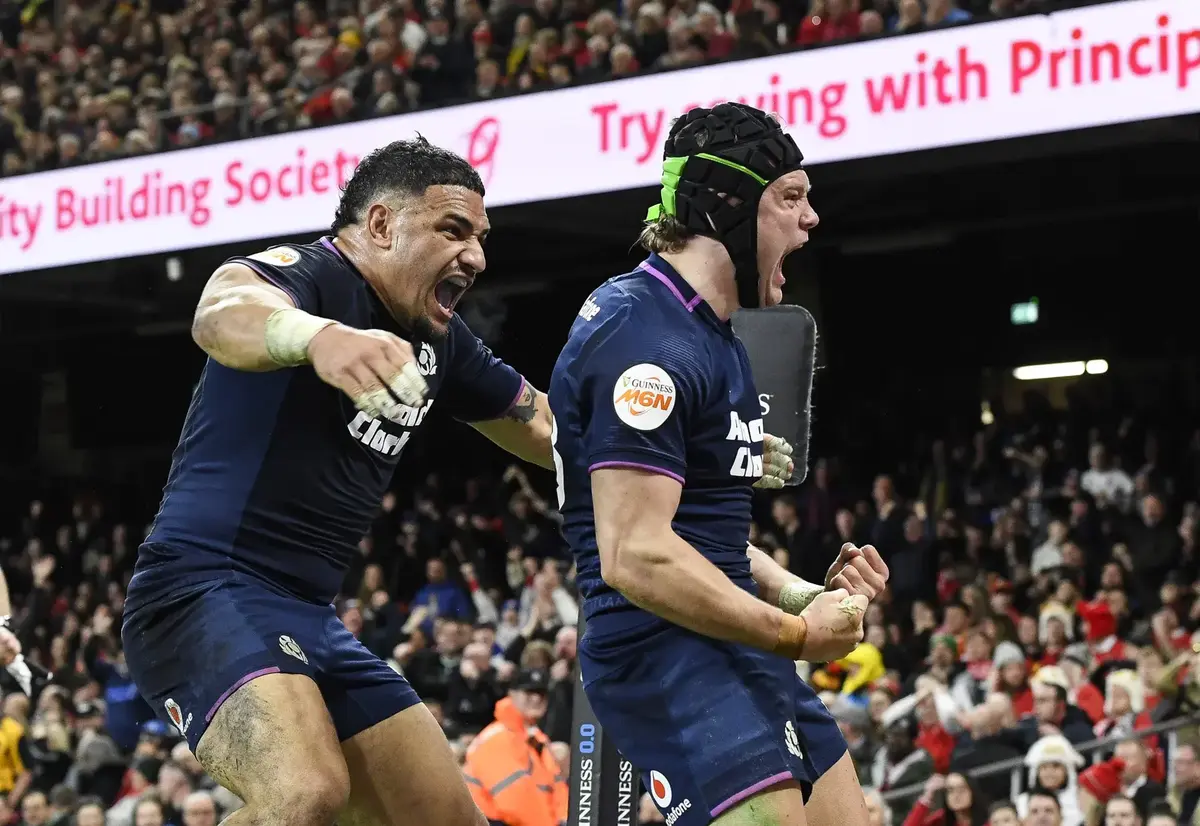
Scotland produced a devastating late comeback to snatch a 26-23 bonus-point victory over Wales at the Principality Stadium, overturning an 11-point deficit in the final quarter to leave Steve Tandy’s side utterly heartbroken in Cardiff. Trailing 23-12 with 22 minutes remaining, Gregor Townsend’s men scored 14 unanswered points — including tries from Darcy Graham and George Turner — to keep their Six Nations title challenge alive, condemn Wales to a 14th consecutive Six Nations defeat, and retain the Doddie Weir Cup.
Key moments:
5′ – YELLOW CARD WALES: Joe Hawkins is sin-binned for a high tackle on Gregor Brown, his shoulder connecting with the Scottish flanker’s head. The contact is sent to the bunker but remains yellow, with Hawkins deemed to have been stationary rather than moving into the collision. Scotland kick for the corner but cannot convert the numerical advantage (Wales 0-0 Scotland)
9′ – TRY WALES: After winning a penalty from a series of wayward Dave Cherry lineout throws, Dewi Lake opts for the tap-and-go. The captain leads the charge before the ball is worked to Rhys Carre, who muscles over from close range for his second try in consecutive matches. Sam Costelow converts (Wales 7-0 Scotland)
14′ – TRY SCOTLAND: From a lineout on the left, Sione Tuipulotu holds his pass before feeding Finn Russell on the loop, who straightens and finds Blair Kinghorn joining the line at pace. With Wales a man down, the overlap is on and Kinghorn’s pass leaves Kyle Steyn with the simplest of walk-in tries in the right corner for his 16th international score. Russell’s conversion from wide on the touchline slides left (Wales 7-5 Scotland)
19′ – TRY WALES: Sustained forward pressure from Dewi Lake, Rhys Carre and Alex Mann creates the platform before Sam Costelow calls for it on the left and flings a flat miss-pass to Josh Adams on the wing. The veteran finishes in the corner for his 24th Wales try. Costelow adds a superb touchline conversion (Wales 14-5 Scotland)
31′ – PENALTY WALES: Sam Costelow extends the Welsh lead after Alex Mann wins a crucial turnover following a storming Kyle Steyn break into the Welsh 22 (Wales 17-5 Scotland)
Half-time: Wales 17-5 Scotland
Wales’ first half-time lead at home under Steve Tandy — and only their third in their last 18 attempts at the Principality Stadium. Carry count: Wales 80-59 Scotland. Turnovers won: Wales 4-2 Scotland.
49′ – PENALTY WALES: Sam Costelow slots his second penalty after Scotland infringe at the breakdown, pushing the Welsh lead to 15 points. Scotland had earlier contrived to drop a certain try, Huw Jones fumbling Duhan van der Merwe’s offload with the line beckoning (Wales 20-5 Scotland)
55′ – TRY SCOTLAND: After 27 phases of sustained pressure on the Welsh line, Finn Russell spots that Louis Rees-Zammit has rushed out of his defensive line, steps past the fullback and burrows over to the right of the posts. Russell converts his own try to cut the deficit to eight points (Wales 20-12 Scotland)
55′ – COSTELOW INJURY: Sam Costelow is carried off unable to bear weight on his leg, visibly distraught. Jarrod Evans replaces the Scarlets fly-half (Wales 20-12 Scotland)
58′ – PENALTY WALES: Jarrod Evans’ first involvement is to slot a penalty that restores an 11-point cushion for the hosts (Wales 23-12 Scotland)
58′ – TRY SCOTLAND: The game’s seminal moment. From the restart, Russell launches the kick-off long and to the left, deep into the Welsh 22. The ball bounces over the head of James Botham, who has turned his back on it, and Darcy Graham — on the field barely four minutes — gathers and sprints past Gabriel Hamer-Webb to score in the left corner untouched, equalling Duhan van der Merwe’s Scotland try-scoring record. Russell’s exquisite touchline conversion cuts the gap to just four points (Wales 23-19 Scotland)
67′ – PENALTY REVERSED: Referee Matthew Carley initially awards Wales a penalty, only for the TMO to identify a croc roll by Tomos Williams on Rory Darge. The decision is reversed, denying Wales the chance to extend their lead and handing Scotland the exit (Wales 23-19 Scotland)
75′ – TRY SCOTLAND: After Louis Rees-Zammit’s knock-on gifts Scotland a penalty, Russell kicks to the corner. George Turner’s lineout finds its mark and Scotland’s pack form a devastating rolling maul. Turner holds on at the back before crashing over for the bonus-point try that puts Scotland ahead for the first time. Russell converts from just right of the posts (Wales 23-26 Scotland)
Full-time: Wales 23-26 Scotland
It was a result that encapsulated everything maddening and magnificent about this Scotland generation — their capacity for both infuriating sloppiness and breathtaking resilience laid bare across 80 extraordinary minutes beneath the Principality Stadium’s closed roof. For Wales, who had led from the ninth minute until five minutes from time, the cruel manner of defeat may prove more painful than any of the heavier losses they have absorbed during their wretched losing run.
“Really proud,” said Scotland captain Sione Tuipulotu afterwards. “I said to the boys at half-time that we’d have to find more of ourselves. The problem-solving in that second half, we found a way to win ugly today. We were playing in an away stadium against a very desperate team. They made things difficult for us.”
The afternoon had begun with an emotional rendition of Mae Hen Wlad Fy Nhadau that brought captain Dewi Lake to tears, the a cappella anthem reverberating beneath the closed roof and setting the tone for what was to come. A crowd of 70,649 — a vast improvement on the 57,744 who had turned up for the France match a week earlier — had heeded Lake’s pre-match plea to make the stadium “the heartbeat of the nation,” and the response was emphatic.
Wales were reduced to 14 players inside five minutes when Joe Hawkins was sin-binned for a high tackle on Gregor Brown, his shoulder connecting with the Scottish flanker’s head. The contact was reviewed by the bunker but remained yellow, with Hawkins deemed to have been stationary rather than moving into the collision.
Scotland kicked for the corner and went through multiple phases inside the Welsh 22, with Steyn looking certain to score after a delayed Russell pass only for the winger’s desire to finish himself — rather than pass to unmarked teammates outside — proving costly. The hosts then scrambled to thwart the attack, before Josh Adams produced a magnificent intercept near his own try line, snaffling Ben White’s pass intended for Duhan van der Merwe and allowing Tomos Williams to clear.
What followed was the most complete passage of Welsh rugby seen this championship. After winning a penalty following a series of Dave Cherry lineout misfires, Wales opted for the tap-and-go — the same move that had yielded a try against France the previous weekend. Captain Lake led the charge, battering into the Scottish defence before the ball was worked to Rhys Carre, who muscled over from close range for his second try in consecutive matches. Costelow’s conversion gave the 14 men a 7-0 lead that silenced the visiting contingent and sent the Principality Stadium into raptures.
Scotland, who had dominated territory in the opening exchanges without reward, responded five minutes later through the clinical finishing of Steyn. From a lineout on the left, Tuipulotu held his pass before feeding Russell on the loop, who straightened and found Kinghorn joining the line at pace. With Wales a man down, the overlap was on and Kinghorn’s pass left Steyn with the simplest of walk-in tries in the right corner for his 16th international score. Russell’s conversion attempt from wide on the touchline slid left — a miss that would prove significant by the final whistle.
The early departure of debutant Gabriel Hamer-Webb, forced off with a bloodied nose after just two minutes on the field following an accidental clash, and the loss of Taine Plumtree to a shoulder injury that brought James Botham into the fray, might have further destabilised Wales. Instead, Tandy’s side played with an intensity and accuracy that defied their recent form. The breakdown work of Alex Mann was exceptional throughout the first half, while Eddie James carried with genuine venom from midfield, his powerful running consistently getting Wales over the gainline and providing the platform from which the hosts could build.
Wales’ second try, arriving on 19 minutes, was the product of sustained forward pressure and smart execution. After Lake burrowed over the gainline through the tight channel, the ball was recycled through multiple phases with Carre and Mann playing instrumental roles in the build-up. Costelow then called for it on the left and flung a flat miss-pass that bisected the Scottish defence to find Adams on the wing. The veteran winger finished with aplomb in the corner for his 24th Wales try, and Costelow’s superb touchline conversion — his third successful kick from three — extended the lead to 14-5. It had been as open a first 20 minutes as you could hope to see in international rugby.
Gregor Townsend, visibly concerned in the coaches’ box, made a bold early intervention, replacing Nathan McBeth and Max Williamson with Pierre Schoeman and Josh Bayliss before the half-hour mark, with Brown reverting from blindside flanker to lock. McBeth had been overpowered at the scrum and Williamson had lost the ball in the build-up to Adams’ try, and the twin change represented a statement of intent from the Scotland head coach.
“I felt we needed to change something,” Townsend explained afterwards. “Wales had a lot of momentum and we know the quality of the guys on our bench. We were looking around half-time anyway and we felt the game had really opened up early, and someone like Josh can make an impact there. It’s such a 23-man game now.”
Yet the substitutions had minimal immediate impact as Wales continued to dominate the physical exchanges. After another storming Steyn break, a vital Mann turnover forced a penalty, and Costelow’s kick on 31 minutes stretched the Welsh advantage to 17-5. At half-time, Wales led by 12 points, having won the carry count 80-59 and secured four turnovers to Scotland’s two. It was Wales’ first half-time lead at home under Tandy — and only their third in their last 18 attempts at the Principality Stadium.
The second half began as the first had ended, with Wales firmly in control. Costelow’s penalty on 49 minutes, following another Scottish infringement at the breakdown, pushed the lead to 20-5. Scotland had earlier contrived to drop a certain try — Huw Jones fumbling Duhan van der Merwe’s offload with the line beckoning after the wing had powered past Hamer-Webb from the restart — in a moment that encapsulated the visitors’ frustrating afternoon. Van der Merwe’s incredulous expression told the story; on another day, that was a try that would have transformed the contest.
Scotland finally found a way through in the 55th minute, though it required 27 phases of sustained pressure on the Welsh line to achieve. Schoeman carried repeatedly, Bayliss battered at the fringes, and the entire Welsh pack threw themselves into a series of desperate tackles. When the ball eventually reached Russell, the fly-half spotted that Rees-Zammit had rushed out of his defensive line, stepped past the fullback and burrowed over to the right of the posts. His conversion cut the deficit to eight points and, for the first time, a hint of anxiety flickered through the stadium.
“It’s something we’ve worked a lot on in this campaign — having composure and being calm in the 22,” Russell said afterwards. “Now it’s only going to the backs when it’s on.”
What happened next will haunt Wales for years to come.
The introduction of Jarrod Evans for the injured Sam Costelow — the Scarlets fly-half was carried off unable to bear weight on his leg, a sight that left him visibly distraught — temporarily steadied Welsh nerves as Evans’ first act was to slot a penalty that restored an 11-point cushion at 23-12. But from the restart, disaster struck. Russell launched the kick-off long and to the left, deep into the Welsh 22. The ball bounced once over the head of James Botham, who had turned his back on it, and Darcy Graham — who had entered the fray as a replacement barely four minutes earlier — could scarcely believe his fortune as he gathered and sprinted past Hamer-Webb into the left corner untouched. In doing so, Graham equalled Van der Merwe’s Scotland try-scoring record.
Russell’s conversion from wide on the left touchline was exquisite, a strike of such precision and nerve that it seemed to transfer the momentum physically from one side to the other. At 23-19, a four-point game, the Principality Stadium fell eerily quiet.
“A lucky bounce I’d say, and they weren’t expecting it,” Russell would later reflect with characteristic understatement, before delivering the game’s most devastating soundbite. “He [Tandy] knows that’s something I look for and Darcy scoring is a coach killer.”
Tandy, who had raised his arms in dismay in the coaches’ box as the try was scored, was characteristically forthright about the moment that cost his side. “It’s huge,” he said. “You need to make people work for their opportunities. We feel we didn’t do that. It gave Scotland energy. It’s another harsh lesson. In high-class games, you can’t knock off. We backed up moments in the game, handled the yellow card well. The intent and physicality was there, but that moment cost us.”
The final quarter became an exercise in Scottish siege warfare. Townsend’s replacements — Turner, Millar Mills, Horne, and Graham among them — injected fresh energy and intensity, with George Horne in particular adding zip and direction to a side that had regained belief. Wales’ legs visibly tired after a first half spent making far more tackles than their bodies could sustain.
A series of penalties deep in Welsh territory provided the platform, though Scotland first botched a lineout maul, the ball hitting the ground and allowing Williams to clear. Tuipulotu was then penalised for a neck roll, offering Wales a brief reprieve. Yet in a game of swinging fortunes, a critical moment arrived in the 67th minute when referee Matthew Carley initially awarded Wales a penalty — only for the TMO to intervene, identifying a croc roll by Tomos Williams on Rory Darge that reversed the decision. Rather than Wales kicking to extend their lead, Scotland had the exit. “It was a fair call,” Tandy conceded afterwards. “We’ve got to be better. You can focus on one or two moments, but we’ve got to be a better team.”
The decisive moment arrived with five minutes remaining. After Rees-Zammit held onto the ball too long and then compounded the error with a knock-on on the ground, Scotland were awarded a penalty just outside the Welsh 22. Russell kicked to the corner without hesitation, and this time Turner’s lineout found its mark. Scotland’s pack, bolstered by the fresh legs of their replacements, formed a devastating rolling maul that trundled inexorably towards the Welsh line. Turner held on for dear life at the back before crashing over to complete an extraordinary turnaround and secure the bonus point.
Russell’s conversion from just right of the posts sealed a 26-23 lead and sent the Scottish contingent into delirium. Wales had one final chance when Matt Fagerson spilled the restart uncontested, gifting the hosts an attacking scrum just beyond the 22. But their scrum was wheeled around and penalised — Ryan Elias ruled to have stood up too early — and Scotland were able to wind down the clock with a penalty advantage, the forwards’ jubilation an apt expression of the occasion. Russell’s final penalty attempt from distance slid wide of the left post, but it mattered not. The whistle sounded and Scotland had escaped with the spoils.
“Bitterly disappointed not to win the game,” said Tandy, who was visibly emotional in his post-match press conference. “Massive pride in the group. That was a step in the right direction, but we’ve got to be better next time. There was a lot to like in the first half, with how we attacked the game. I’m devastated for them. The support today was incredible. There are lots of questions asked about the crowds, but they were unbelievable. Everyone felt it. The players gave them something to cheer about, but ultimately they got behind the team. It’s a snapshot of where we want to be.”
Tandy confirmed that the injuries to Costelow and Plumtree “don’t look great,” with Costelow unable to bear weight and Plumtree sustaining damage to his AC joint. The Wales head coach was particularly sympathetic about his fly-half. “Sam’s been through a lot in his Wales career with not being involved in the autumn, but we backed him to come back in and he really took that opportunity. He was fantastic with the way he drove the team forward in that first half. It’s such a shame for him that it ended with injury.”
Wales captain Lake, who had been immense before being replaced by Ryan Elias, summed up the mood of his dressing room: “It’s gut-wrenching. It’s tough because you know the performance was there. First half, we were dominant. We applied pressure and attacked them. We spoke about staying in moments, we probably didn’t do that for the full 80. But we probably did enough to win the game, which makes it so tough.”
For Scotland, this was the kind of ugly, character-defining victory that championship contenders must find a way to grind out. Their first-half performance had been alarmingly poor — the lineout malfunctioned repeatedly, Cherry’s throwing was wayward, and their discipline at the breakdown gifted Wales a stream of penalties. Russell finished with 11 points — a try and three conversions — but it was the ingenuity of his restart and the composure of his goal-kicking at the death that proved decisive.
“That was some game,” Townsend reflected. “We left it late but I’m really proud of the effort in the second half. It’s not just a physical effort, it’s a mental effort too — finding solutions, staying together and riding momentum waves. Wales started really well, played with real energy. Tactically they were outstanding. They moved the ball quickly, played around the ruck which was tough to defend. They targeted our breakdown and kept their width. They deserved to be ahead and it took a huge effort to get back in the game.”
Townsend singled out the impact of his bench in turning the tide. “The scrum penalty near the end was a huge moment too. It’s a 23-man game and we backed our bench. I thought Josh Bayliss was outstanding. We’re still in the championship. That’s all that counts. Today showed — not just in our game — that anything can happen in the championship.”
Player of the match Rory Darge, who was tireless at the breakdown, captured the significance of the result: “What a massive win for us. Any time you go on the road in the Six Nations you have your work cut out for you. Just delighted with the character we showed. Credit to Wales. We knew they’d come out swinging. It was a tough, tough fixture. It’s hard to wrestle back from 17-5 down and we did that. Massively proud of everyone.”
Russell, reflecting on the decisive comeback, offered a candid assessment: “It’s obviously good having 11 points on the board. There was pressure this week, but it was more expectation. We got the win even though it maybe wasn’t our best performance. Lee Radford and Gregor had a go at us at half-time to hit them and stop absorbing contact. It’s nice to have the break now and get ready for France.”
The result moves Scotland to 11 points at the top of the Six Nations table after three rounds, though France — who play Italy in Lille on Sunday — can overtake them with a bonus-point victory. This was Scotland’s fourth consecutive victory over Wales, their best run since winning five in a row between 1923 and 1927, and their first back-to-back away success in Cardiff since 1984. It was also just the third time Scotland have won the match directly after a Calcutta Cup victory in the Six Nations era. Scotland have risen to seventh in the world rankings.
Townsend’s side face a daunting challenge in round four when they host France at Murrayfield on 7th March, a match that could define their championship. “We’ll be underdogs against France and we know we’ll have to play our best rugby,” said the Scotland head coach. A win there would set up a trip to Dublin on the final day with a first Triple Crown since 1990 on the line — and, potentially, a tilt at a first championship since the Five Nations era in 1999.
For Wales, a 14th consecutive Six Nations defeat extends their record losing run in the championship, with the hosts having now dropped to 12th in the world rankings. They have lost 24 of their last 26 Tests since October 2023, won just once in 15 matches at the Principality Stadium, and have not won a home Six Nations match since beating Scotland in February 2022. Yet this performance represented something altogether different from the capitulations against England and France.
For long stretches, Tandy’s side were the better team: more physical, more disciplined, more dangerous. Mann’s breakdown work was outstanding, Adams was electric on the wing, Botham was superb after his early introduction, and the all-Scarlets midfield of Costelow, Hawkins and James showed genuine cohesion for the first time this campaign. The anguish on the faces of the Welsh players at the final whistle spoke to how close they had come — and how much this defeat will sting.
There is a fallow week before Wales head to Dublin to face Ireland at the Aviva Stadium on 6th March, with Scotland hosting France the following day. On the evidence of this remarkable afternoon in Cardiff, both sides have plenty to reflect upon — but only one can look forward with genuine hope of silverware.
Teams
Wales: 15 Louis Rees-Zammit; 14 Gabriel Hamer-Webb, 13 Eddie James, 12 Joe Hawkins, 11 Josh Adams; 10 Sam Costelow, 9 Tomos Williams; 1 Rhys Carre, 2 Dewi Lake (capt), 3 Tomas Francis, 4 Dafydd Jenkins, 5 Ben Carter, 6 Taine Plumtree, 7 Alex Mann, 8 Aaron Wainwright.
Replacements: 16 Ryan Elias (for Lake, 55), 17 Nicky Smith (for Carre, 43), 18 Archie Griffin (for Francis, 50), 19 Freddie Thomas (for Jenkins, 76), 20 James Botham (for Plumtree, 9), 21 Kieran Hardy, 22 Jarrod Evans (for Costelow, 55), 23 Blair Murray (for Hamer-Webb, 2, blood; for Hamer-Webb, 61).
Sin-bin: Hawkins (5)
Scotland: 15 Blair Kinghorn; 14 Kyle Steyn, 13 Huw Jones, 12 Sione Tuipulotu (capt), 11 Duhan van der Merwe; 10 Finn Russell, 9 Ben White; 1 Nathan McBeth, 2 Dave Cherry, 3 Zander Fagerson, 4 Max Williamson, 5 Scott Cummings, 6 Gregor Brown, 7 Rory Darge, 8 Matt Fagerson.
Replacements: 16 George Turner (for Cherry, 54), 17 Pierre Schoeman (for McBeth, 34), 18 Elliot Millar Mills (for Z. Fagerson, 54), 19 Grant Gilchrist (for Cummings, 66), 20 Josh Bayliss (for Williamson, 34), 21 George Horne (for White, 54), 22 Tom Jordan (for Jones, 66), 23 Darcy Graham (for van der Merwe, 54).
Referee: Matthew Carley (RFU)
Assistant Referees: Karl Dickson (RFU), Adam Leal (RFU)
TMO: Ian Tempest (RFU)
FPRO: Eric Gauzins (FFR)
Attendance: 70,649
Guinness Player of the Match: Rory Darge (Scotland)
Share this:
Six Nations
Ireland reborn as ruthless display blows away rudderless England
Published
1 day agoon
21st February 2026
Ireland produced a record-breaking performance to demolish England 42-21 at Allianz Stadium, scoring five tries in a devastating display that ended the hosts’ nine-match home winning run and reignited Andy Farrell’s side’s Six Nations campaign. What was supposed to be a celebration of Maro Itoje’s 100th cap became a nightmarish afternoon for Steve Borthwick, whose side have now lost back-to-back matches to leave their championship hopes in tatters with away trips to Rome and Paris still to come.
Key moments:
8′ – PENALTY IRELAND: Jack Crowley opens the scoring after Joe McCarthy produces a superb turnover at an England maul, ripping the ball from the drive. Jamison Gibson-Park’s snipe up the middle draws an offside penalty and Crowley slots a composed kick from directly in front of the posts (England 0-3 Ireland)
18′ – LOWE INJURY: James Lowe pulls up clutching his knee while chasing a loose English pass and is unable to continue. Tommy O’Brien replaces the Leinster wing and makes an immediate impact, running a brilliant support line within moments of entering the fray (England 0-3 Ireland)
19′ – TRY IRELAND: Jamison Gibson-Park catches England napping with a moment of pure opportunism. Robert Baloucoune finds space on the right wing and offloads inside to the arriving Tommy O’Brien, before Tom Curry is penalised for coming in from the side. Gibson-Park taps the penalty quickly and sprints past Joe Heyes into the left corner, exploiting every white shirt standing offside. Jack Crowley lands an excellent touchline conversion (England 0-10 Ireland)
23′ – MITCHELL INJURY: England lose scrum-half Alex Mitchell to what Steve Borthwick later confirms as a soft-tissue injury. Jack van Poortvliet replaces him, though the substitute’s afternoon is later marred by a needless backchat penalty that concedes 10 metres (England 0-10 Ireland)
27′ – TRY IRELAND: Stuart McCloskey produces the break of the match, picking a devastating crash-ball line through the English 12-13 channel and bursting through Ollie Lawrence’s attempted tackle for a full 20 metres before Freddie Steward hauls him down. Gibson-Park scoops the ball and moves it swiftly wide for Robert Baloucoune to canter into the right corner. Crowley’s conversion drifts wide of the right post (England 0-15 Ireland)
27′ – YELLOW CARD ENGLAND: Freddie Steward is sin-binned for cynically playing Jamison Gibson-Park at the back of the ruck in the build-up to Baloucoune’s try. The fullback’s card deepens England’s crisis with Ireland already 15 points ahead (England 0-15 Ireland)
29′ – REFEREE INJURY: An extraordinary moment as referee Andrea Piardi collapses clutching his leg while sprinting to keep up with a Josh van der Flier break. “I’m done. My quad is gone. Best of luck for the rest of the game, guys,” the Italian tells both captains before being clapped off by the capacity crowd. Pierre Brousset takes charge, with Craig Maxwell-Keys called to run the line. Jamie George simultaneously replaces Luke Cowan-Dickie at hooker (England 0-15 Ireland)
30′ – TRY IRELAND: Ireland strike again barely a minute after the referee change. Robert Baloucoune comes off his wing to create an extra man near halfway and skips out of Ollie Lawrence’s tackle before popping an offload to Tommy O’Brien, who has the gas to beat Tommy Freeman and stroll in under minimal resistance. Jack Crowley converts and “Fields of Athenry” rings around Twickenham (England 0-22 Ireland)
39′ – TACTICAL SUBSTITUTION: Steve Borthwick throws on Marcus Smith for Freddie Steward in a desperate gamble to inject creativity, having already made three changes with the score at 22-0. England’s attack immediately looks sharper (England 0-22 Ireland)
40′ – TRY ENGLAND: England finally breach the Irish defence on the stroke of half-time. Playing through a penalty advantage after James Ryan uses his hands illegally in a ruck, Marcus Smith delays his pass to create the space for Fraser Dingwall to power between Josh van der Flier and Baloucoune. George Ford converts to give the hosts a sliver of hope heading into the interval (England 7-22 Ireland)
Half-time: England 7-22 Ireland
England statistics: 57% possession, 70% territory. Ireland: 43% possession, 30% territory, 3 handling errors to England’s 11, 4 turnovers conceded to England’s 15. Ireland’s three first-half tries all originated from their own half.
42′ – YELLOW CARD ENGLAND: Henry Pollock is sin-binned within two minutes of the restart after failing to release near his own line. Caelan Doris had burst through a gap in midfield and powered into the 22 before Ireland’s momentum was halted just short. The number eight’s cynical play on his first international start draws a stern rebuke from Pierre Brousset (England 7-22 Ireland)
43′ – TRY IRELAND: Ireland capitalise immediately on Pollock’s yellow card to secure the bonus point. Dan Sheehan taps the penalty and Ireland go through the phases close to the line, with Stuart McCloskey and Caelan Doris battering the gainline. Sheehan spots space, darts left and burrows over from close range. Jack Crowley’s conversion stretches the lead to 22 points as a strange hush descends across the stadium (England 7-29 Ireland)
53′ – TRY ENGLAND: Henry Pollock makes amends on his return from the sin bin, immediately handing off defenders and flicking a pass out the back of the hand to Tommy Freeman, who drives to within metres of the line. The ball is recycled quickly and Ollie Lawrence bursts through a gap to score under the posts. George Ford converts, but any hope of a comeback is tempered by the 15-point deficit (England 14-29 Ireland)
54′ – YELLOW CARD IRELAND: Jamie Osborne is sin-binned for playing the ball on the ground in the aftermath of Lawrence’s try. A debatable call — Bevan Rodd appeared to be over the tryline when Irish players failed to release — but Pierre Brousset is consistent with his earlier decision on Pollock (England 14-29 Ireland)
58′ – PENALTY IRELAND: Jack Crowley extends Ireland’s lead despite playing with 14 men. Bevan Rodd shoves early at the scrum to concede a free kick that quickly leads to a penalty. Crowley dispatches it with no fuss, his composure in stark contrast to England’s growing desperation (England 14-32 Ireland)
65′ – PENALTY IRELAND: Crowley makes history, taking Ireland past their previous highest points tally at Twickenham. The Munster fly-half slots another composed penalty after Guy Pepper is penalised for going off his feet at the breakdown. The lead is 21 points and England fans begin heading for the exits (England 14-35 Ireland)
69′ – TRY IRELAND: Jamie Osborne caps a remarkable return from the sin bin by powering over for Ireland’s fifth try. Gibson-Park’s relentless kick-chase forces a penalty and Ireland secure the lineout before going through the phases. Osborne spots a gap, glides through and powers over Guy Pepper to stretch out and ground the ball. Jack Crowley adds the conversion to take Ireland to 42 points (England 14-42 Ireland)
73′ – McCLOSKEY CHASE-DOWN: The moment that defines Ireland’s ferocity. Marcus Smith intercepts a Jack Crowley pass on his own 22 and hares away down the left wing, apparently clear for a certain try. Stuart McCloskey, the 33-year-old Ulster centre, somehow chases Smith down from behind with astonishing pace and clatters him into touch. The Twickenham crowd falls silent (England 14-42 Ireland)
75′ – TRY ENGLAND: Sam Underhill barrels his way over from close range off a pop pass from Jack van Poortvliet, spinning through one defender and backing through Robert Baloucoune for a consolation score. George Ford adds the conversion but, in truth, it means little (England 21-42 Ireland)
Full-time: England 21-42 Ireland
For a second successive weekend, England were blown away in the first half, conceding 22 unanswered points before Fraser Dingwall crossed on the stroke of half-time to offer the faintest flicker of hope. But where Scotland had at least allowed England back into the contest seven days earlier, Ireland showed no such mercy, extending their lead remorselessly after the break to secure their biggest ever away win over England, surpassing the 32-15 victory here in 2022. Not since they dismantled France in Marseille at the start of the 2024 championship had Ireland hit these heights.
The occasion had promised so much for the 81,953 inside Allianz Stadium on an overcast but still afternoon in south-west London. Itoje walked out alone to a thunderous reception to mark his century of caps, just the ninth Englishman to reach the milestone, a look to the heavens perhaps in memory of his late mother. The Princess of Wales was in attendance. Yet the emotion appeared to weigh on England rather than inspire them, as a series of basic errors in the opening quarter gifted Ireland the platform for a devastating counter-punch.
Farrell had warned his players about the dangers of a wounded England. “We got told we needed to dampen them down and rightly so because we were here two years ago when England lost to Scotland and they played outstandingly well,” the Ireland head coach explained afterwards. His squad heeded the message with a performance built on ferocious defensive intensity, clinical counter-attacking and an unerring willingness to hunt in packs.
England’s struggles were evident from the very first set-piece. An early lineout was overthrown by Luke Cowan-Dickie, with none of the jumpers even leaving the ground. A scrum collapsed. George Ford, usually so reliable with the boot, kicked dead from a penalty — then did so again minutes later, drawing ironic cheers from the crowd. The nervousness was palpable, and Ireland — sharper, hungrier and more composed — were quick to capitalise.
Jack Crowley, restored to the starting fly-half berth with Sam Prendergast dropped from the matchday squad entirely, settled Irish nerves with an early penalty after Joe McCarthy had produced a superb turnover at an England maul. The young Munster man’s selection was handsomely vindicated as he orchestrated Ireland’s attack with a tempo and precision that had been sorely missing in their opening two fixtures, finishing with 17 points from the boot.
Ireland suffered an early setback when James Lowe appeared to damage his knee while chasing a loose English pass in the 18th minute. “It didn’t look too good,” Farrell would later concede. His replacement, the Leinster wing Tommy O’Brien, wasted no time making an impact, running a brilliant support line within moments of entering the fray.
The game’s first try was a masterclass in opportunism from Jamison Gibson-Park. After Baloucoune had found space on Ireland’s right wing and O’Brien ran inside him, Ireland won a penalty when Tom Curry came in from the side. While England’s defenders stood flat-footed, Gibson-Park tapped quickly and sprinted past Joe Heyes to the corner from 15 metres, exploiting the fact that every white shirt was standing offside and unable to legally make a tackle. Crowley’s excellent conversion from wide on the left made it 10-0 and the visiting contingent — an estimated 15,000 of the capacity crowd — erupted.
England were further disrupted when scrum-half Alex Mitchell limped off with what Borthwick later described as a soft-tissue injury, bringing on Jack van Poortvliet. The replacement’s afternoon would be marked by a needless backchat penalty that conceded 10 metres, symptomatic of England’s collective loss of composure.
If the first try was born of instinct, Ireland’s second was pure destruction through the midfield. Stuart McCloskey, who had been a revelation throughout the 2026 championship, picked a devastating crash-ball line through the English 12-13 channel and burst through Ollie Lawrence’s attempted tackle for a full 20 metres before Steward hauled him down. Gibson-Park scooped up the ball and moved it swiftly to Baloucoune, who cantered into the right corner with consummate ease. Steward’s afternoon deteriorated further when he was yellow-carded for cynically playing Gibson-Park at the back of the preceding ruck, a decision that drew groans from a Twickenham crowd already stunned into near-silence.
The match was briefly interrupted by an extraordinary incident in the 29th minute when referee Andrea Piardi collapsed clutching his leg while sprinting to keep up with a Josh van der Flier break. “I’m done. My quad is gone. Best of luck for the rest of the game, guys,” the Italian told both captains before being clapped off by the capacity crowd. Pierre Brousset jogged on from the touchline to take charge, with Craig Maxwell-Keys called to run the line. It was only the sixth time in history that a referee had been replaced during an England match due to injury.
The disruption did nothing to halt Ireland’s momentum. With England now down to 14 men, Baloucoune came off his wing to create an extra man near halfway and skipped out of Lawrence’s tackle before popping an offload to O’Brien, who had the gas to beat Tommy Freeman and stroll in for Ireland’s third try. Crowley’s conversion made it 22-0 and “Fields of Athenry” was ringing around Twickenham before the half-hour mark.
Borthwick, who had already been forced into changes when Mitchell departed and Cowan-Dickie was replaced by Jamie George, threw Marcus Smith on for the returning Steward with half-time approaching. Explaining his tactical substitutions afterwards, the head coach cited George’s experience and leadership qualities alongside Smith’s explosive ability to chase the game. “When you are points down on the scoreboard, you need to score,” Borthwick said. “That’s where someone like Marcus Smith can add a different element.”
The move paid an immediate dividend. England’s most sustained pressure of the half finally yielded a try on the stroke of half-time when Smith delayed his pass to create the space for Dingwall to power between Josh van der Flier and Baloucoune. Ford’s conversion trimmed the deficit to 15 points, though even this required playing through a penalty advantage after James Ryan had used his hands illegally in a ruck.
Whatever optimism that try generated evaporated within three minutes of the restart. Caelan Doris burst through a gap in midfield and powered into the 22, before Ireland’s momentum was halted just short of the line. Henry Pollock, making his first international start and struggling to contain the occasion, failed to release quickly enough and was dispatched to the sin bin for cynical play. Ireland tapped the resulting penalty and, after McCloskey and Doris had battered the gainline, Sheehan spotted space, darted left and burrowed over for the bonus-point try. Crowley’s conversion stretched the lead to 22 points. A strange hush descended across the stadium.
To their credit, England responded with their best passage of the match. Pollock, returning from the sin bin, was immediately involved, handing off defenders and flicking a pass out the back of the hand to Freeman, who drove to within metres of the line. The ball was recycled quickly and Lawrence burst through a gap to score under the posts. Ford’s conversion made it 29-14 with 24 minutes remaining, while Osborne was sin-binned for playing the ball on the ground in the build-up.
But Ireland’s defensive resolve during the Osborne sin-bin period was extraordinary, conceding just six points despite being reduced to 14 men. Tadhg Beirne was immense throughout, producing a choke tackle on Ford that forced a turnover, while his earlier lineout steal and jackal penalties had been pivotal in disrupting England’s set-piece platform. Gibson-Park’s relentless kick-chasing kept England pinned in their own half. Two Crowley penalties — one after Bevan Rodd shoved early at the scrum, the other when Guy Pepper was penalised at the breakdown — extended Ireland’s advantage to 21 points and snuffed out any lingering English hope.
The most remarkable individual moment came in the 73rd minute when Smith intercepted a Crowley pass on his own 22 and hared away down the left wing, apparently clear for a certain try. McCloskey, the 33-year-old Ulster centre who had already dominated the midfield collisions, somehow chased Smith down from behind and clattered him into touch — an astonishing piece of athleticism that encapsulated Ireland’s collective ferocity on the day.
Indeed, minutes earlier Baloucoune had produced a similarly superb covering tackle to deny Freeman what appeared a certain try in the corner, bundling the Northampton wing into touch with a last-ditch effort. These moments drew particular praise from Farrell. “The telling parts of Stu McCloskey chasing back Marcus and being able to put him in touch just shows the fight,” the head coach said. “And also the Rob Baloucoune one on the far side shows the fight and the spirit that these lads have got for one another. It looked like we were hunting people down throughout the game.”
Osborne’s return from the sin bin was marked by Ireland’s fifth score, the fullback powering over Guy Pepper after sustained phase play to cap a remarkable turnaround from his own card. Crowley’s conversion took Ireland to 42 points — their highest ever tally at Twickenham. Sam Underhill burrowed over for a late consolation with five minutes remaining, but the final whistle could not come soon enough for a shell-shocked England, with supporters streaming for the exits long before the end.
Gibson-Park, named player of the match after a performance of the highest calibre, reflected on a display that harked back to Ireland’s golden era: “I think it was a bit of the Ireland of old. We’re brave, and we love to put the ball in space and let the guys on the edge do special things. I count myself very lucky to be part of this team, and it was unbelievable to be out there today with the lads.”
Ireland captain Doris spoke of the belief that had been building beneath the surface: “It’s a special feeling. I’ve been saying to you that there’s been belief at the core of what we’ve been doing. We’ve seen some of it in training, but it hasn’t fully come through for the games. We saw more of that today. Paris was a reference point from where we needed to see a steep incline in performances, and hopefully this will be a reference point we look back on.”
A beaming Farrell, whose squad welcomed Taoiseach Micheál Martin into the dressing room after the match, refused to rank the victory but left no doubt about what it meant. “It’s a special day, 100 per cent, to come here and perform like that,” he said. “I said it to the lads, I didn’t care whether we won or lost, just whether we grew as a group because we know where we want to go to. It just so happens that to the people of Ireland winning does matter and it brings a bit of joy on everyone’s face.”
Borthwick, by contrast, cut a forlorn figure. “It was bitterly disappointing,” the England head coach conceded. “This team has been very, very good for quite a long time in games that are tight, even if we go a score or two down, being very strong in the second half and always finding a way to win. Unfortunately for two weeks now we have given ourselves a mountain to climb, given the opposition too many points and we have not got scoreboard presence. We will be looking closely at that and how I set the team up to make sure it doesn’t happen again.”
The statistics laid bare England’s failings: 15 turnovers conceded to Ireland’s four, and 11 handling errors compared to just three from the visitors. Ireland achieved their dominance with only 43 per cent possession and 30 per cent territory, a testament to their devastating efficiency when presented with opportunities. England’s sole area of superiority was the scrum, where Ellis Genge was dominant against his opposite number, but even that advantage was rendered meaningless by their inability to capitalise on the set-piece platform it provided.
For Borthwick, the questions are now pressing. Back-to-back defeats, both characterised by catastrophic first-half performances, have removed England from title contention as early as the third round. The decision to start Pollock, whose sin-bin proved costly on his maiden start, will be scrutinised, while Ford’s uncharacteristic struggles with the boot compounded the sense that England’s senior players were overwhelmed. Mitchell’s injury is a further concern, with Borthwick confirming a soft-tissue problem that may sideline the scrum-half for the trip to Rome.
Ireland, by contrast, look a team transformed. The half-back partnership of Gibson-Park and Crowley provided the tempo and direction that had been missing against France and Italy, while McCloskey’s thunderous presence in midfield gave the backline a focal point around which everything else clicked. Baloucoune and O’Brien were devastating on the wings, while Beirne’s mischief at the breakdown and McCarthy’s physical dominance in the tight five provided the platform from which Ireland’s backs could operate. Crowley’s performance should put the number 10 debate to bed for the foreseeable future.
The result moves Ireland from fifth to second in the Six Nations table, temporarily drawing within a point of leaders France, and lifts them above both England and France to third in the world rankings. They end the championship with back-to-back home fixtures against Wales and Scotland at the Aviva Stadium, and while their title hopes may ultimately depend on France slipping up, this performance has ensured they will be there to capitalise if the opportunity arises.
For England, whose 12-match winning run now feels like a distant memory, the priority is salvaging pride and momentum from a campaign unravelling at alarming speed. With Italy smelling blood in Rome and a daunting trip to Paris to close the championship, Borthwick faces the biggest test of his coaching tenure.
Teams
England: Freddie Steward; Tommy Freeman, Ollie Lawrence, Fraser Dingwall, Henry Arundell; George Ford, Alex Mitchell; Ellis Genge, Luke Cowan-Dickie, Joe Heyes; Maro Itoje (capt), Ollie Chessum; Tom Curry, Ben Earl, Henry Pollock.
Replacements: Jamie George (for Cowan-Dickie, 29), Bevan Rodd (for Genge, 52), Trevor Davison (for Heyes, 72), Alex Coles (for Itoje, 55), Guy Pepper (for Curry, 52), Sam Underhill (for Earl, 70), Jack van Poortvliet (for Mitchell, 23), Marcus Smith (for Steward, 39).
Ireland: Jamie Osborne; Robert Baloucoune, Garry Ringrose, Stuart McCloskey, James Lowe; Jack Crowley, Jamison Gibson-Park; Jeremy Loughman, Dan Sheehan, Tadhg Furlong; Joe McCarthy, James Ryan; Tadhg Beirne, Josh van der Flier, Caelan Doris (capt).
Replacements: Rónan Kelleher (for Sheehan, 56), Tom O’Toole (for Loughman, 47), Finlay Bealham (for Furlong, 47), Nick Timoney (for van der Flier, 50), Cian Prendergast (for McCarthy, 63), Craig Casey (for Gibson-Park, 71), Ciarán Frawley (for Ringrose, 55), Tommy O’Brien (for Lowe, 18).
Referee: Andrea Piardi (FIR) — replaced by Pierre Brousset (FFR, 29 mins)
Assistant Referees: Pierre Brousset (FFR) / Gianluca Gnecchi (FIR); Craig Maxwell-Keys (RFU, from 29 mins)
TMO: Matteo Liperini (FIR)
Attendance: 81,953
Share this:
Six Nations
2026 Guinness Six Nations preview: England v Ireland
Published
2 days agoon
20th February 2026
There are Six Nations weekends where the stakes feel manageable, where a loss can be absorbed and repackaged as a learning experience. This is emphatically not one of them. When England and Ireland meet at Allianz Stadium on Saturday afternoon, both teams will know that defeat all but extinguishes their championship hopes for another year, leaving France — imperious and ten points clear at the summit — to stroll towards their title defence with barely a backward glance.
Key talking points at a glance:
- Henry Pollock handed first England start at No.8 as Borthwick reshapes back row
- Jack Crowley recalled at fly-half; Sam Prendergast dropped from Ireland’s matchday 23 entirely
- Maro Itoje set to win his 100th cap for England in an emotional afternoon following the death of his mother
- Both sides have one win and one loss after two rounds — the loser is effectively out of the title race
- England seek to extend a nine-match home winning run; Ireland have won four of their last five meetings between the sides
- Millennium Trophy and championship survival on the line
Both sides arrive in southwest London nursing wounds. England’s 12-match winning streak was emphatically ended by Scotland at Murrayfield last weekend, a 31-20 defeat that exposed alarming vulnerabilities in their kicking game and aerial contest. Ireland, meanwhile, have been in a slow bleed since their chastening 36-14 dismantling by France on the tournament’s historic Thursday night opener in Paris, and were unconvincing in squeezing past Italy 20-13 in Dublin a week later.
It all makes for a fixture crackling with tension, desperation, and no small amount of intrigue.
A rivalry renewed
One of the oldest and most storied rivalries in international rugby, England and Ireland first met at The Oval in 1875. Since then, 143 Test matches have been contested, with England winning 81, Ireland 54, and eight ending in draws. The Millennium Trophy — a Viking helmet-shaped award introduced during Dublin’s millennial celebrations in 1988 — currently resides in Irish hands after last year’s 27-22 victory in Dublin.
Yet the modern balance of power in this fixture has shifted perceptibly. Ireland have won four of the last five Six Nations meetings, a run that includes comprehensive victories in Dublin in 2022, 2023 and 2025. The sole English triumph in that sequence came on this ground two years ago, when Marcus Smith’s nerveless drop goal in the dying moments snatched a 23-22 victory that ended Ireland’s pursuit of back-to-back Grand Slams.
That 2024 encounter remains instructive. England, stung by a defeat to Scotland the previous weekend, produced a furious defensive display fuelled by perceived slights from Irish pundits. The parallels with this weekend are unmistakable — Borthwick’s side again arrive wounded by Scotland, again facing an Ireland team expected to prevail. England’s players will need no reminding of how that narrative ended.
Since rugby turned professional in 1995, the rivalry has tightened considerably. In 35 meetings, England have won 19, Ireland 16 — a near-even split that reflects the competitive parity of the modern era. At Twickenham, however, England’s record is formidable: 48 wins from 71 matches on home soil, a statistic that provides cold comfort to visiting sides however favourable their recent head-to-head record may be.
Borthwick’s gamble: unleashing Pollock
Steve Borthwick’s response to the Edinburgh debacle has been characteristically measured yet pointed. Three changes to the starting XV — the promotion of Henry Pollock to his first Test start, the return of Tom Curry at blindside flanker, and Ollie Lawrence’s reinstatement at outside centre — are designed to inject dynamism and physicality into a side that looked sluggish and directionless against Scotland.
Pollock’s selection is the headline act. The 21-year-old Northampton Saints back-rower has earned all seven of his previous caps from the bench, deployed as an impact weapon in the final quarter. Now Borthwick is betting that the young man’s extraordinary energy, pace, and try-scoring instinct can be harnessed from the opening whistle rather than reserved for the closing salvos.
“He’s larger than life,” Borthwick said of England’s most talked-about player. “Each new level you challenge him with, he seems to thrive. He gets people excited, he gets people jumping up and down with joy. He can bring a euphoria to people that not many players can.”
It is not hyperbole. Children at grassroots rugby clubs across England already run around wearing black head tape in imitation of Pollock’s distinctive look, performing his “pulse check” try celebration. Former Ireland captain Brian O’Driscoll came home from covering last weekend’s game to find his son dressed as the man. Bordeaux players targeted him relentlessly in last season’s Champions Cup campaigns — and Pollock responded by scoring wonder tries and stealing the ball from Damian Penaud’s hands.
His deployment at No.8 pushes Ben Earl — arguably England’s most consistent performer this championship with a tournament-leading 39 carries after two rounds — to openside flanker, creating an all-Lions back row alongside Tom Curry. The trio brings searing pace and breakdown menace, though questions remain about their collective lineout contribution against Ireland’s formidable set-piece operators.
The other significant tactical shift sees Tommy Freeman moved back to the right wing, his primary position, after the experiment of deploying him at outside centre. Freeman’s aerial prowess was sorely missed against Scotland, where England lost the kicking battle comprehensively. With Lawrence providing the midfield muscle that Freeman could not, and Freeman’s leap and pace unleashed out wide, England’s attacking shape should look more balanced.
Henry Arundell retains his place on the left wing after escaping further sanction for his two yellow cards — and subsequent red — at Murrayfield. The Bath wing remains the tournament’s top try-scorer with four from two rounds, including a hat-trick against Wales, and Borthwick’s faith in his match-winning ability is unwavering. “I want the ball in his hands,” the coach insisted. “Every England supporter will want the ball in his hands in a bit of space.”
Then there is the emotional dimension. Maro Itoje will lead England out for his 100th cap, becoming only the ninth man to reach the milestone for his country. The occasion is tinged with profound sadness — Itoje recently attended his mother Florence’s funeral in Nigeria, and her absence from the stands will weigh heavily. “I know she would have loved the occasion,” the 31-year-old said quietly this week. “She’s not physically there but I know she will be spiritually there, cheering on from heaven.”
Itoje’s consistency has been remarkable: 95 of his 99 previous caps have been starts, and he has won more than twice as many turnovers as any England player since 2023. His side will need every ounce of that towering presence on Saturday.
Farrell rolls out the old guard
If Borthwick’s selection reflects a desire to energise, Andy Farrell’s five changes to the Ireland starting XV speak to a different impulse: a retreat to the familiar, a reliance on the battle-hardened veterans who have delivered in these cauldrons before.
The starting XV features eight thirtysomethings — Jeremy Loughman, Tadhg Furlong, Tadhg Beirne, Josh van der Flier, Jamison Gibson-Park, James Lowe, Stuart McCloskey and Garry Ringrose. Three more — Finlay Bealham, Nick Timoney and Jack Conan — wait on the bench. Farrell has essentially reassembled Ireland’s greatest hits compilation and challenged them to produce one more classic performance.
“It’s similar to a couple of years ago,” Farrell reasoned. “This game coming on the back of Scotland beating England, and England being told they had to have a reaction. Having lads in the group that have been there and felt that — and how they can convey that feeling to lads like Robert Baloucoune — is pretty important.”
The most significant selection call is at fly-half, where Jack Crowley replaces Sam Prendergast — who has been dropped not merely to the bench but from the matchday 23 entirely. Prendergast’s struggles against both France and Italy, including missed conversions and a failure to find his flow, prompted Farrell to act decisively. Ciaran Frawley, versatile enough to cover fly-half, centre and full-back, provides bench cover in a 5-3 split that signals Ireland’s intention to stretch England in the second half with fresh legs in the backline.
Crowley’s recall represents a chance to remind everyone why he was anointed as Johnny Sexton’s successor after steering Ireland to the 2024 title. Defensively more assured than Prendergast and with a kicking game that can engage the aerial contest, the 26-year-old Munster man injected visible tempo and accuracy when introduced against Italy last weekend.
The return of Lions trio Furlong, Beirne and van der Flier hardens the pack considerably. Furlong’s recall is particularly pointed: Ireland’s scrum has been under siege this championship, with the veteran tighthead enduring the indignity of being lifted off his feet by Italy’s Mirco Spagnolo in Dublin. England will target the Irish scrum mercilessly — they are one of only three teams yet to lose a scrum on their own feed in this year’s championship — and Furlong’s experience from the first whistle is essential.
Van der Flier’s omission from last week’s matchday squad raised eyebrows; now the 2022 World Rugby Player of the Year returns with a point to prove against a back row containing several of the Lions teammates who were preferred to him on last summer’s tour of Australia.
Key players to watch
England: Henry Pollock
England’s Henry Pollock dejected after the 2026 Guinness Six Nations Championship Round 2 game between Scotland and England in Scottish Gas Murrayfield, Edinburgh, Scotland, Saturday, February 14, 2026 (Photo by James Crombie / Inpho)
The man of the moment. In his last five starts for Northampton Saints at No.8, Pollock has scored six tries — a ratio that speaks to his extraordinary finishing instinct for a forward. His searing pace in the wide channels, where he operates more like a winger than a traditional back-rower, could prove devastating if England can get him into space on Freeman’s shoulder. Ireland’s back row must find ways to cut off his supply lines and limit his time on the ball. As Doris acknowledged: “He’s got the ability to make something happen from not a whole lot.”
Ireland: Stuart McCloskey
The Ulster centre’s late-career renaissance has been one of the feel-good stories of this championship. At 33, McCloskey tops Ireland’s statistics for try assists (three), offloads (four) and turnovers won (four) after two rounds. His basketball-style passing created Baloucoune’s try against Italy, and his ability to punch holes in the gainline and offload in contact gives Ireland a point of difference in midfield that they desperately need against England’s physical defensive line. He faces a stern examination from Lawrence, but McCloskey’s form suggests he is ready for it.
Where the battle will be won
The contest will likely be decided in three key areas.
The aerial battle: Scotland exposed England’s vulnerability under the high ball last weekend, running back kicks with devastating effect. Ireland will have studied that blueprint closely, particularly with Baloucoune — whose footwork and speed on his Six Nations debut against Italy caught the eye — and Lowe capable of causing chaos from deep. Conversely, Freeman’s return to the wing should significantly improve England’s contestable kick game, with George Ford’s tactical kicking and Alex Mitchell’s precise box-kicks designed to put Ireland’s back three under constant examination. Mitchell is often England’s last defender on the left edge — Scotland targeted him brilliantly through Finn Russell last weekend, and Ireland will look to exploit the same channel.
The scrum: Ireland’s creaking set-piece has been a recurring theme this championship. England, whose scrum has been effective and aggressive — one of only three teams yet to lose a scrum on their own feed — will smell blood. As former Ireland international Lindsay Peat noted this week, the Irish front row’s inconsistent body heights and alignment have been “a horrific sight” at times. Furlong’s recall from the start is designed to shore up this area, but if England’s pack can generate a penalty stream from the scrum, it will fuel their territorial game and starve Ireland of possession. Farrell has switched to a 5-3 bench partly to accommodate Finlay Bealham as tighthead cover — a measure of how seriously Ireland are taking this threat.
The breakdown: All six back-row forwards were Lions last summer, and the battle for supremacy over the ball on the ground will be ferocious. Ireland lead the championship with 13 turnovers from two rounds, including seven jackals — the best rate of any team. Van der Flier and Beirne are elite operators in this area. But England’s trio of Curry, Earl and Pollock bring relentless energy, and Pollock in particular has a poacher’s instinct that makes him dangerous whenever the ball is loose. Whoever wins this private war will dictate the tempo of the match.
The wider picture
The championship standings tell the story of why this fixture carries such weight. France sit imperiously atop the table on ten points after bonus-point victories over Ireland and Wales. Scotland are second on six, with England third on five, Italy fourth on five, and Ireland fifth on four. Wales prop up the table without a point.
For the loser on Saturday, the mathematics become brutal. Even with three rounds remaining, falling further behind France — who face Italy in Paris on Sunday — would leave the vanquished side relying on an improbable sequence of results to have any hope of the title.
England have the comfort of home advantage and a nine-match winning run at Allianz Stadium stretching back to November 2024. Ireland, however, have won four of the last five Six Nations meetings between the sides, the exception being Marcus Smith’s dramatic late drop goal that sealed a 23-22 victory for England on this ground two years ago. Smith, intriguingly, is named on the bench and could yet have a decisive late cameo again.
What they said
Maro Itoje (England captain): “My message to my team-mates is to seize the opportunity against Ireland. We have to learn our lesson following our disappointing defeat to Scotland at Murrayfield and move forward. We need to address what went wrong and get off to a strong start.”
Caelan Doris (Ireland captain): “There’s always enough motivation playing against England. There’s an eagerness to hunt them down, to get after them, to show what we’re about. Over here as well is an added element. As a young fella watching the Six Nations, it was always the key game that you get excited for. You look at some of the events like 2009 playing in Croke Park, and some of the moments from that game that become kind of iconic in Irish history.”
Steve Borthwick (England head coach): “They have most of the Lions coaching team, half of the Lions Test team. They play together so often with so many players at Leinster. This squad has been together for a long period of time. It’s an exciting Test match.”
Andy Farrell (Ireland head coach): “Games between the two sides have been nip and tuck over recent times and there’s great familiarity and respect across both camps. We know their strengths and our aim is to deliver the best version of ourselves.”
Team news
England: 15 Freddie Steward; 14 Tommy Freeman, 13 Ollie Lawrence, 12 Fraser Dingwall, 11 Henry Arundell; 10 George Ford (vc), 9 Alex Mitchell; 1 Ellis Genge (vc), 2 Luke Cowan-Dickie, 3 Joe Heyes, 4 Maro Itoje (c), 5 Ollie Chessum, 6 Tom Curry, 7 Ben Earl, 8 Henry Pollock.
Replacements: 16 Jamie George (vc), 17 Bevan Rodd, 18 Trevor Davison, 19 Alex Coles, 20 Guy Pepper, 21 Sam Underhill, 22 Jack van Poortvliet, 23 Marcus Smith.
Ireland: 15 Jamie Osborne; 14 Robert Baloucoune, 13 Garry Ringrose, 12 Stuart McCloskey, 11 James Lowe; 10 Jack Crowley, 9 Jamison Gibson-Park; 1 Jeremy Loughman, 2 Dan Sheehan, 3 Tadhg Furlong, 4 Joe McCarthy, 5 James Ryan, 6 Tadhg Beirne, 7 Josh van der Flier, 8 Caelan Doris (c).
Replacements: 16 Rónan Kelleher, 17 Tom O’Toole, 18 Finlay Bealham, 19 Nick Timoney, 20 Jack Conan, 21 Craig Casey, 22 Ciaran Frawley, 23 Tommy O’Brien.
Did you know?
- Ireland have won four of their last five Six Nations meetings with England, their best run in the fixture since a five-match streak between 2015 and 2019
- England have won their last nine home matches, their longest such run since winning 15 in a row between 2015 and 2018 — a sequence that was ended by Ireland
- Maro Itoje will become the ninth England man to win 100 caps, joining Jason Leonard, Lawrence Dallaglio, Ben Youngs, Joe Marler, Jamie George, George Ford, Dan Cole and Jonny Wilkinson
- Henry Pollock’s seven caps from the bench before his first start is the most by any England back-rower since the professional era began
- Stuart McCloskey has assisted 60 per cent of Ireland’s tries in this year’s Six Nations (three of five)
- Gibson-Park was named player of the match in Ireland’s 2022 and 2025 victories over England
- Marcus Smith’s drop goal secured a 23-22 win for England on this ground in 2024 — his last appearance in this fixture
The verdict
Home advantage, the emotional fuel of Itoje’s milestone, and the injection of Pollock’s electricity should give England the edge in what promises to be a fiercely contested arm-wrestle. But Ireland’s experienced campaigners have been in these positions before — written off, underestimated, and dangerous.
This is a fixture that neither side can afford to lose. For England, a second consecutive defeat would shatter the momentum painstakingly built over a 12-match winning run and leave their championship aspirations in ruins before the halfway point. For Ireland, the arithmetic is even starker: fifth in the table and already 36-14 down to France on points difference, another setback would confirm the darkest fears of those who believe this squad has peaked and is now in irreversible decline.
If Crowley can control the tempo, Gibson-Park can provide the quick ball that was absent in Paris, and Ireland’s pack can hold firm at scrum time, the visitors are more than capable of springing a surprise. McCloskey’s midfield dynamism and Baloucoune’s raw pace offer genuine attacking threats, while the return of Beirne, van der Flier and Furlong hardens the Irish pack considerably.
Yet England’s home record, the energy of a reshuffled back row, and the potency of their wide attackers in Arundell, Freeman and Pollock suggest they have more ways to hurt Ireland than vice versa. Borthwick’s men were poor at Murrayfield, but the core of this squad has proven itself capable of responding to adversity. The Twickenham crowd, fired up by Itoje’s centurion moment and Pollock’s box-office appeal, will be a ferocious 16th man.
Expect a tight, tense, territorial affair decided by fine margins — and possibly by a late moment of individual brilliance.
Match Officials
Referee: Andrea Piardi (FIR)
Assistant Referees: Pierre Brousset (FFR), Gianluca Gnecchi (FIR)
TMO: Matteo Liperini (FIR)
FPRO: Mike Adamson (SRU)
Kick-off: Saturday, 21st February 2026, 2.10pm GMT | Allianz Stadium, Twickenham
Share this:


Trending
-

 Men's Rugby World Cup 20273 weeks ago
Men’s Rugby World Cup 2027 fixture details confirmed
-

 Six Nations3 weeks ago
Prendergast brothers to start for Ireland against France
-

 Six Nations2 weeks ago
2026 Guinness Six Nations preview: England v Wales
-

 Six Nations2 weeks ago
Six things we learned from round 1 of 2026 Guinness Six Nations
-

 Six Nations1 week ago
Andy Farrell makes six changes as Ireland seek Italian response
-
Six Nations3 days ago
Crowley recalled as Ireland axe Prendergast for England showdown
-

 Six Nations1 week ago
Ireland survive Italian scare to claim unconvincing victory
-

 Super Rugby Pacific1 week ago
Super Rugby Pacific 2026: Round one preview