Connect with us

United Rugby Championship

Sharks complete historic derby double over Stormers

Published

on

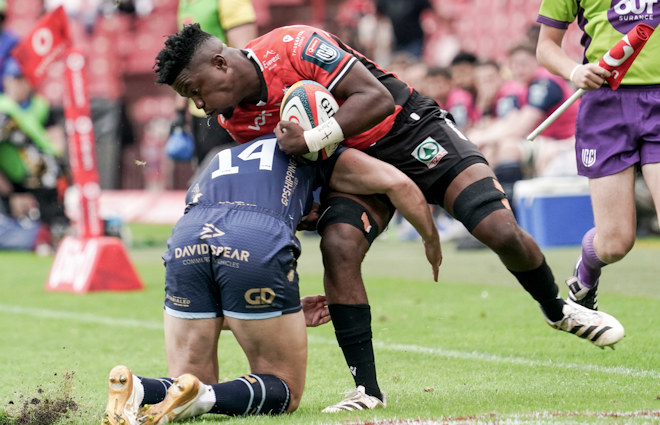
January 24, 2026, Cape Town, Western Cape, South Africa: Sharks ANDRE ESTERHUIZEN during the United Rugby Championship match between the Stormers and the Sharks at the Cape Town Stadium in Cape Town, South Africa. (IMAGO / ZUMA Press Wire)

The Sharks completed a remarkable derby double over the Stormers with a commanding 36-24 victory at Kings Park, their first back-to-back wins against the Cape side in a single season since 2012 Super Rugby.

Just seven days after stunning the Stormers 30-19 in Cape Town to end an eight-match unbeaten run, JP Pietersen’s resurgent side delivered an even more emphatic statement in the return fixture. Five tries to two told the story of a contest in which the Sharks were superior in almost every facet, dominating the aerial battle, winning the collision count and punishing the Stormers’ chronic ill-discipline.

The result was sealed by one of the most bizarre moments of the URC season. With 10 minutes remaining and the Sharks leading 31-24, replacement full-back Warrick Gelant dropped back behind his own line to field a probing kick. Taking his time to dot down, Gelant was oblivious to the danger as Jaco Williams raced in to touch the ball down under his nose – a howler that will haunt the Springbok for some time.

For the Stormers, it was a second consecutive defeat that exposed the same failings that had undermined them in Cape Town. Seventeen penalties conceded, two yellow cards, a malfunctioning lineout and an inability to win the aerial contest – the issues John Dobson had identified seven days earlier remained stubbornly unresolved.

Captain Sacha Feinberg-Mngomezulu was left to reflect on what might have been after his side had led 24-14 early in the second half. “The lack of discipline cost us,” he admitted. “When we played our game, we were on top of them. We were being reckless, careless and irresponsible.”

Key moments

1′ – TRY STORMERS: A sensational start for the visitors. The Stormers win a turnover penalty near the Sharks line from the kick-off, pressuring captain André Esterhuizen. Scrum-half Cobus Reinach takes a quick tap and crashes over within 35 seconds of the opening whistle. Feinberg-Mngomezulu hooks the conversion wide, but the Stormers have caught the hosts completely cold (Sharks 0-5 Stormers)

4′ – SHARKS RESPOND: Jordan Hendrikse catches an up-and-under from Feinberg-Mngomezulu and the Sharks immediately look more composed. A strong run by Ethan Hooker gets them over the advantage line and into the Stormers’ 22. The aerial battle that will define this contest is already taking shape

8′ – YELLOW CARD STORMERS: Paul de Villiers is shown a yellow card for collapsing a maul after repeated Stormers infringements. The visitors have conceded penalty after penalty as the Sharks camp in their 22, and referee Christopher Allison’s patience finally snaps

12′ – TRY SHARKS: The hosts capitalise immediately on their numerical advantage. After sustained pressure and two lineouts, scrum-half Grant Williams spots his opportunity and snipes over from the base of a ruck. Jordan Hendrikse converts to put the Sharks in front for the first time (Sharks 7-5 Stormers)

15′ – PENALTY STORMERS: Feinberg-Mngomezulu slots a penalty in front of goal after the Stormers apply some rare pressure, edging the visitors back ahead despite being a man down (Sharks 7-8 Stormers)

17′ – SHARKS ERROR: Jordan Hendrikse overcooks his restart kick and it goes out on the full, giving the Stormers the feed to a scrum on halfway. A let-off for the visitors

19′ – PENALTY STORMERS: Siya Kolisi is penalised for playing the scrum-half illegally and Feinberg-Mngomezulu extends the Stormers’ lead with another successful kick before a quick water break (Sharks 7-11 Stormers)

24′ – TRY SHARKS: The Sharks’ forwards do all the hard work, powering through the Stormers’ defence with an impressive maul drive before the ball is worked around the corner. Centre Ethan Hooker dives over a ruck to score from close range, showing excellent anticipation to be in the right place. Hendrikse converts to put the hosts back in front (Sharks 14-11 Stormers)

31′ – DISALLOWED TRY STORMERS: Lock Adré Smith appears to score from close range after the Stormers camp on the Sharks’ line, but referee Allison calls an obstruction by prop Neethling Fouché in the build-up. The Sharks are awarded a penalty on their own try-line. A crucial let-off for the hosts

34′ – SMITH REPLACED: Stormers coach John Dobson makes an early change, replacing Smith with JD Schickerling in an attempt to stabilise the stuttering lineout

38′ – PENALTY STORMERS: Feinberg-Mngomezulu lines up a monster 53-metre penalty after the Stormers win one at the scrum. The captain shows ice-cold composure to slot it and level the scores at 14-14

40′ – PENALTY STORMERS: Ben-Jason Dixon puts in a textbook tackle on Aphelele Fassi and wins a penalty on the ground. Feinberg-Mngomezulu steps up again and slots another long-range effort to send the Stormers into half-time with an unlikely 17-14 lead

Half-time: Sharks 14-17 Stormers

43′ – TRY STORMERS: The visitors make the perfect start to the second half. Feinberg-Mngomezulu puts up a well-weighted up-and-under and Paul de Villiers, back from his yellow card, gathers in space. The flanker runs a superb angle, shows outstanding footwork to beat several defenders, and crashes over for a brilliant individual try. Feinberg-Mngomezulu converts and suddenly the Stormers lead by 10 points (Sharks 14-24 Stormers)

47′ – YELLOW CARD STORMERS: The crucial turning point. Lock Ruben van Heerden is shown a yellow card for repeated team infringements at a defensive lineout. The Stormers have given away 11 penalties in just 47 minutes – their ill-discipline has reached critical levels

48′ – TRY SHARKS: The hosts punish the numerical advantage immediately. Grant Williams makes a devastating break through the middle before the ball is worked to captain André Esterhuizen, who strolls over untouched from close range. Hendrikse converts to cut the deficit to three points (Sharks 21-24 Stormers)

52′ – TRY SHARKS: The momentum has swung decisively. After continued pressure with the Stormers still down to 14 men, Jaco Williams receives the ball from his namesake Grant Williams running a channel close to the forwards. The winger shows electric pace to race over out wide for his second try in as many weeks. Hendrikse converts magnificently from the touchline and the Sharks lead for the first time since the 24th minute (Sharks 28-24 Stormers)

57′ – LINEOUT STOLEN: The Sharks win a penalty on the Stormers’ 22 and Hendrikse finds touch five metres out. However, the Stormers produce a crucial steal at the lineout and clear their lines. A brief reprieve for the visitors

68′ – PENALTY SHARKS: The Stormers’ front row buckles at the scrum and concedes a penalty. Hendrikse lines up from 40 metres and slots it to extend the Sharks’ lead to seven points with 12 minutes remaining (Sharks 31-24 Stormers)

71′ – TRY SHARKS: The moment that will haunt Warrick Gelant. Feinberg-Mngomezulu’s clearance kick is poor and the ball bounces into the Stormers’ in-goal area. Gelant drops back to dot it down but is far too casual, taking his time with the ball at his feet. He does not see Jaco Williams racing in at full pace. The winger touches down under Gelant’s nose for one of the most bizarre tries of the season – reminiscent of the infamous Robbie Fleck/Deon Kayser incident from 2000. Hendrikse’s conversion drifts wide but the damage is done (Sharks 36-24 Stormers)

73′ – SHARKS CHANGES: Jurenzo Julius replaces Williams, who departs to a standing ovation after his match-winning double

76′ – STORMERS PUSH: The visitors win back-to-back scrum penalties and kick to touch on both occasions, desperately searching for a losing bonus point. They edge closer but Feinberg-Mngomezulu’s kick goes behind the try-line and a scrum is awarded to the Sharks

79′ – HELD UP: Marcel Theunissen is held up over the try-line as the Stormers throw everything at the Sharks’ defence. The hosts survive and are awarded a goal-line drop-out

80′ – FULL-TIME: The Stormers have one final chance from the restart but knock on in contact. The final whistle blows and the Sharks have completed a famous double

Full-time: Sharks 36-24 Stormers

Match report

When the Stormers scored within 35 seconds of the opening whistle, the Kings Park crowd must have feared the worst. From the kick-off, the visitors swarmed all over captain Esterhuizen, forcing a turnover penalty near the Sharks line. Reinach sized up the situation in an instant – the Sharks defence was scrambled, bodies out of position – and took a quick tap before crashing over untouched. Feinberg-Mngomezulu hooked the conversion wide, but the message was clear: the Stormers had arrived in Durban determined to make amends for the previous week’s defeat.

It proved to be a false dawn. What followed was 79 minutes of Sharks dominance, punctuated only by Feinberg-Mngomezulu’s prodigious boot keeping the Stormers in a contest they had no business being in.

The warning signs were there from the start. Even as Reinach was celebrating, the Stormers’ discipline was already fraying. Jordan Hendrikse caught an up-and-under from Feinberg-Mngomezulu and the Sharks immediately looked more composed, a strong run by Hooker getting them over the advantage line and into the Stormers’ 22. Penalty after penalty allowed the hosts to camp in the visitors’ territory, and when De Villiers was shown a yellow card for collapsing a maul after just eight minutes – the culmination of repeated infringements that had tested referee Allison’s patience to breaking point – it felt almost inevitable that the Sharks would capitalise.

Grant Williams duly obliged, showing the predatory instincts that have made him one of the most dangerous scrum-halves in South African rugby. After two lineouts had been set up without reward, Williams spotted the gap at the base of the ruck. His dart was perfectly timed, finding the soft shoulder of the Stormers’ defence, and he was over before anyone could lay a hand on him. Hendrikse’s conversion put the Sharks 7-5 ahead despite that disastrous start.

The pattern of the contest was established. The Sharks dominated territory and possession, winning the aerial battle hands down with Fassi so much sounder under the high ball than his opposite number Willemse. Wings Edwill van der Merwe and Jaco Williams were brilliant on the chase, repeatedly forcing the Stormers back into their own half with their willingness to compete for every contestable kick.

“If you can’t get out of your half, you can’t play rugby,” Esterhuizen noted afterwards. “You will be trapped the whole time. It fits conditions like this.”

The humidity in Durban made handling treacherous and kicking paramount. The Sharks understood this better than their opponents, playing with a clear plan that targeted the Stormers’ vulnerabilities in the air. Time and again, contestable kicks from the Hendrikse brothers – Grant in the first half, Jaden after the break – caused chaos in the Stormers’ back three.

Feinberg-Mngomezulu’s penalties kept the visitors in touch, restoring their lead at 8-7 and then extending it to 11-7 after Kolisi was penalised for playing the scrum-half illegally. But the Sharks’ second try, on 24 minutes, demonstrated their superiority in the tight exchanges. The forwards did all the hard work first, powering through the Stormers’ defence with an impressive maul drive that sucked in defenders. When the ball was worked around the corner, Hooker showed excellent anticipation to be in the right place, diving over a ruck to dot down from close range. Hendrikse’s conversion made it 14-11 to the hosts.

The Stormers should have struck back moments later. After camping on the Sharks’ line through multiple phases, lock Adré Smith appeared to have scored from close range. The celebrations were already beginning when referee Allison called for a TMO review – and the try was chalked off for an obstruction by prop Neethling Fouché in the build-up. It was a cruel blow, and Smith’s day got worse when Dobson replaced him with JD Schickerling shortly afterwards in an attempt to stabilise the stuttering lineout.

Yet somehow, the visitors led 17-14 at half-time. Feinberg-Mngomezulu’s boot was the difference – two monster penalties from beyond 50 metres in the final minutes of the half keeping the Stormers’ hopes alive despite being comprehensively outplayed in most other facets. The first came after a scrum penalty, 53 metres out, and the captain showed ice-cold composure to slot it and level the scores. Then, with the clock in red, Ben-Jason Dixon put in a textbook tackle on Fassi and won a penalty on the ground. Feinberg-Mngomezulu stepped up again from long range and made no mistake. His accuracy was exceptional, but it was masking deeper problems that would eventually prove fatal.

When De Villiers scored his brilliant individual try three minutes into the second half, it seemed the Stormers might escape with a victory their overall performance did not merit. Feinberg-Mngomezulu’s up-and-under was perfectly weighted, hanging in the humid Durban air. De Villiers, back from his first-half yellow card, gathered in space with no Sharks defender within five metres. What followed was outstanding – the flanker ran a superb angle towards the posts, showed devastating footwork to step inside one defender, then outside another, before powering through a third tackle attempt to crash over. Feinberg-Mngomezulu’s conversion stretched the lead to 10 points at 24-14. For a brief, tantalising moment, the Stormers were in control.

Then Van Heerden was yellow-carded for repeated infringements at a defensive lineout, and the game changed irrevocably. The Stormers had conceded 11 penalties in just 47 minutes – their ill-discipline had reached critical levels, and now they would pay the ultimate price.

The Sharks scored twice in four minutes to turn a 24-14 deficit into a 28-24 lead. The first try was a thing of beauty. Grant Williams received the ball 30 metres out and spotted a mismatch in the Stormers’ depleted defence. He accelerated through the gap, his footwork leaving two defenders grasping at thin air, before drawing the last man and feeding Esterhuizen on his shoulder. The captain had the simplest of tasks, strolling over untouched to cap a magnificent afternoon’s work. Hendrikse converted to cut the deficit to three.

Four minutes later, the bonus point was secured in clinical fashion. From a scrum, Grant Williams again provided the spark, finding his namesake Jaco running a channel close to the forwards. The winger took the pass at pace, showed electric acceleration to beat the covering defender, and raced over out wide for his second try in as many weeks against the Stormers. Hendrikse’s conversion from the touchline was magnificent, curling between the posts to put the Sharks 28-24 ahead. The momentum had swung decisively.

“We talked about it this week to start the halves well,” Dobson admitted. “We probably got both right, but the rest wasn’t a behaviour change from last week. I think the two games were very similar.”

Similar – and similarly frustrating for Stormers supporters. The same ill-discipline that had cost them in Cape Town resurfaced in Durban. The same lineout malfunctions. The same inability to win the aerial contest. The same failure to convert promising positions into points.

Hendrikse’s 68th-minute penalty, slotted from 40 metres after the Stormers’ front row buckled at the scrum, extended the lead to seven points. The visitors were running out of time and ideas.

Then came the moment that will define this match – and haunt Warrick Gelant for years to come. Feinberg-Mngomezulu’s clearance kick was poor, lacking both distance and direction. The ball bounced into the Stormers’ in-goal area, and Gelant dropped back to deal with what should have been a routine situation.

What happened next was inexplicable. The full-back took his time, far too casual with the ball at his feet, seemingly unaware of the danger racing towards him. Jaco Williams, who had been chasing kicks all afternoon, was not about to stop now. He sprinted 40 metres at full pace while Gelant dawdled, arriving just as the full-back finally bent down to dot the ball dead. Williams got there first, touching down under Gelant’s nose for one of the most bizarre tries in URC history.

It was reminiscent of the infamous Robbie Fleck/Deon Kayser incident from a Super Rugby clash between these same teams in 2000, when Stormers centre Fleck thought he was through for the try only to be hit from behind by the flying Kayser. Twenty-six years later, the Stormers had found another way to gift the Sharks a try through a moment of inexcusable casualness.

Hendrikse’s conversion drifted wide, but the damage was done. At 36-24 with nine minutes remaining, the Stormers were now playing for a losing bonus point rather than victory.

They threw everything at the Sharks in the closing stages, winning back-to-back scrum penalties and kicking to touch on both occasions. Marcel Theunissen was held up over the try-line as the visitors launched wave after wave of attacks. But the Sharks’ defence, which had been outstanding all afternoon, held firm. When the Stormers knocked on in contact from the final restart, the whistle blew on a famous double.

“Five-metre lineouts not converted, giving penalties away at mauls which led to some of the discipline stuff,” Dobson lamented. “So to fix the stuff, there needs to be a behaviour change. It was really poor from us and I feel bad for our supporters.”

For the Sharks, this was vindication of the work Pietersen has done since taking over as interim coach six weeks ago. In that period, his side has won four from five matches, beating Saracens in the Champions Cup, hammering Clermont and completing this remarkable double over the previously unbeaten Stormers.

“Give JP Pietersen the Sharks job and let him get on with it,” wrote one analyst. “He is not an interim measure.”

The appointment of Esterhuizen as captain has proved inspired. The powerful centre led from the front throughout both derbies, his physicality in the collisions setting the tone for his team-mates. Around him, players who had looked subdued earlier in the season – Kolisi, Fassi, the Hendrikse brothers – performed with the intensity and authority expected of Springboks.

The Sharks head into a three-week break with their confidence sky-high, having climbed from 14th to eighth in the standings. The Stormers, by contrast, have four weeks to address the problems that have now cost them three of their last four matches.

“There has to be a behaviour change,” Dobson insisted. “It is really poor from us.”

What they said

John Dobson (Stormers head coach): “Credit to the Sharks, they beat us properly over the past two weeks. Our discipline was poor and our set-piece definitely let us down. I thought their aerial game was really good and they played with a really clear plan that worked for them. The most frustrating thing about tonight is that everything that went wrong last week went wrong this week. There has to be a behaviour change – it is really poor from us and bad for our supporters.”

Sacha Feinberg-Mngomezulu (Stormers captain): “The lack of discipline cost us. When we played our game, we were on top of them. Going into halftime, we were up 24-14, and we just let it slip. Within ten minutes, we went from an upbeat team scoring tries. That’s just the reality. We were being reckless, careless and irresponsible. Our discipline is costing us.”

André Esterhuizen (Sharks captain): “Jaden came on and did very well. Grant as well in the first half. We just got a bit of wind behind us in the second half, which helped us a bit. The contesting from our wings, they were superb in the air. We put them under so much pressure, and we won a lot of scraps. That’s what we worked on the whole week. It’s one of the most important parts of the game – if you can’t get out of your half, you can’t play rugby.”

JP Pietersen (Sharks interim head coach): Speaking before the match, Pietersen had predicted: “With the humidity, there will be some errors with the slippery ball, so it’ll be a scrum battle, lineouts, mauling, and high-ball contesting.” His side delivered on all fronts.

Player of the match

Jaco Williams’ opportunistic double earned him the man of the match award, but this was a collective effort from a Sharks side transformed under Pietersen’s guidance. Captain André Esterhuizen was immense throughout – leading from the front in the collisions, providing go-forward ball and capping his performance with a well-taken try. Grant Williams controlled proceedings superbly from scrum-half, his tempo and decision-making perfect for the conditions, while Edwill van der Merwe was a menace in the aerial contest.

For the Stormers, Feinberg-Mngomezulu’s four penalties – including two from beyond 50 metres – kept his side in a contest they otherwise had no right to be in. But even his prodigious boot could not compensate for the failings elsewhere.

Teams

Sharks: Aphelele Fassi; Edwill van der Merwe, Ethan Hooker, André Esterhuizen (captain), Jaco Williams; Jordan Hendrikse, Grant Williams; Phepsi Buthelezi, Vincent Tshituka, Siya Kolisi; Emile van Heerden, Corne Rahl; Hanro Jacobs, Fez Mbatha, Ox Nche
Replacements: Eduan Swart, Phatu Ganyane, Vincent Koch, Jason Jenkins, Nick Hatton, Jaden Hendrikse, Siya Masuku, Jurenzo Julius

Stormers: Damian Willemse; Dylan Maart, Wandisile Simelane, Jonathan Roche, Leolin Zas; Sacha Feinberg-Mngomezulu (captain), Cobus Reinach; Evan Roos, Ben-Jason Dixon, Paul de Villiers; Ruben van Heerden, Adré Smith; Neethling Fouché, André-Hugo Venter, Oli Kebble
Replacements: JJ Kotzé, Ntuthuko Mchunu, Zachary Porthen, JD Schickerling, Marcel Theunissen, Stefan Ungerer, Jurie Matthee, Warrick Gelant

Referee: Christopher Allison (SARU)

Yellow cards: Paul de Villiers (Stormers, 8′ – collapsing maul); Ruben van Heerden (Stormers, 47′ – repeated infringements)

Continue Reading
Click to comment

Leave a Reply

United Rugby Championship

WRU confirms Ospreys or Scarlets will be cut by 2028

Published

on

WRU confirms Ospreys or Scarlets will be cut by 2028
BKT United Rugby Championship, Parc y Scarlets, Llanelli, Wales 26/12/2025 Scarlets vs Ospreys Scarlets' Ryan Elias walks out ahead of the match Mandatory Credit ©INPHO/Andrew Dowling

The Welsh Rugby Union has confirmed its plans to reduce the number of men’s professional teams from four to three from the 2028–29 season, with either the Ospreys or Scarlets set to lose their professional status.

The governing body announced on Wednesday that it will establish three licence areas — one in the capital, one in east Wales and one in west Wales — with Cardiff Rugby and Dragons RFC set to be offered the capital and east licences respectively. That leaves the Swansea-based Ospreys and the Llanelli-based Scarlets in direct competition for the remaining western licence, with a merger between the two also a possibility.

Licensing process and timeline

The WRU Board confirmed that only incumbent teams will be eligible for a licence, ruling out the prospect of any new entities entering the professional game. The licensing process is scheduled to begin in December 2026 and conclude by the end of the 2026–27 season at the latest.

Following the autumn Nations Championship matches in November, the WRU will bring together the leadership of all four professional teams and other stakeholders to co-create what it has called the “future operating model for the men’s game.” That collaborative process will run through the first quarter of 2027, at which point all current professional clubs will be given the opportunity to confirm whether they wish to participate in the new structure.

WRU Vice Chair John Manders said: “We have affirmed that the future operating model will involve three professional teams from start of the 2028/29 season and now have a firm timeline for our next steps. We have already begun to put the support structures in place to develop the related player pathways, to create the best environments for our senior players, to provide the right financial support and to develop the facilities around them. We are making important progress which will safeguard the future of our game, concentrate resources and give our teams the best chance of achieving success at all levels.”

Cardiff and Dragons offered certainty

The announcement provides clarity for Cardiff Rugby, which has been under WRU ownership since being rescued from financial collapse in 2025, and for the independently backed Dragons RFC. Both are set to receive licences provided they agree to the final terms.

Marianne Økland, Chair of the Professional Rugby Board, said: “The aim is to finalise the new licensing model as quickly as possible and then move quickly to confirm future licence arrangements and transition plans. This will allow an orderly implementation and avoid prolonged uncertainty for clubs, players, supporters, investors and sponsors.

“Assuming that Cardiff Rugby and Dragons RFC want to sign up to the proposed licensing terms, there is now certainty that they will be offered the capital and east licences respectively.”

Uncertainty in the west

The decision leaves Ospreys and Scarlets facing an anxious wait. Between them, the two western regions have won the competition now known as the United Rugby Championship six times — the Ospreys lifting the trophy four times, most recently in 2012, and the Scarlets twice, most recently in 2017.

Both clubs only recently signed the Professional Rugby Agreement 2025 (PRA25) following more than a year of wrangling with the WRU. Ospreys signed in June and Scarlets followed in July, securing increased funding of £6.5 million over two years compared to the previous £4.5 million per year. The Scarlets’ agreement came in the same month the club announced a £2.1 million loss for the latest financial year.

A merger between the two was close to happening in 2019 but ultimately fell through, and it remains a practical if deeply controversial possibility.

Økland acknowledged the difficulty of the situation for both clubs: “We understand that there will be ongoing uncertainty until a final decision on the west licence is made. That is why we are committed to progressing in a collaborative way, whilst not underestimating the considerable challenges ahead, and providing stability for all at the earliest opportunity.”

A game in crisis

The restructuring comes against the backdrop of a deep crisis in Welsh rugby. More than 50 per cent of the WRU’s turnover comes from international matches, and the national team’s results have been dire since the 2023 Rugby World Cup in France. Despite briefly topping the world rankings in 2019 and winning the Six Nations title in 2021, Wales have since suffered an unprecedented 18-match Test losing sequence and record home defeats to England, Argentina and South Africa, slumping to 11th in the World Rugby rankings.

The decision to reduce the professional game to three teams has been heavily criticised by players, fans and politicians, sparking protests and even legal action. Whether the restructuring will reverse Welsh rugby’s fortunes or simply deepen the sense of crisis remains to be seen — but the clock is now ticking for Ospreys and Scarlets as they prepare to fight for their survival.

Continue Reading

United Rugby Championship

Schmidt returns to Irish rugby with consultancy role at Ulster

Published

on

Schmidt returns to Irish rugby with consultancy role at Ulster
Australia's Head Coach Joe Schmidt during the warm up ahead of the 2025 Quilter Nations Series game between France and Australia in Stade de France, Paris, France, Saturday, November 22, 2025 (Photo by Dave Winter / Inpho)

Former Ireland and Australia head coach Joe Schmidt has returned to Irish rugby after being appointed Ulster Rugby’s Coach Development Advisor, a newly created consultancy role focused on strengthening the coaching pathway across the province.

Schmidt, 60, will work with coaching staff at all levels over the next 12 months through a combination of in-person visits and remote interactions. The role spans the Academy, age-grade programmes, schools, clubs and the professional game, with the aim of creating a more connected and consistent coaching environment throughout Ulster.

The appointment marks a return to Ireland for the New Zealander, who spent nine years coaching in the country. Schmidt guided Leinster to two Heineken Cups before leading Ireland to three Six Nations Championships, including a Grand Slam in 2018, earning him the World Rugby Coach of the Year award. He subsequently assisted the All Blacks to the 2023 Rugby World Cup final before spending the past two years as Wallabies head coach, stepping down earlier this month after the conclusion of the first phase of the Nations Championship.

Schmidt eager to develop Ulster’s coaching pathway

Speaking on his appointment, Schmidt said: “Ulster has a proud rugby tradition and further developing the coaching pathway in the region is something that we believe can add value. We’ve had initial discussions about where to get started, and I’ve already had the opportunity to work with some of the school coaches, alongside Dan Soper.”

Ulster head coach Richie Murphy, who previously worked alongside Schmidt at both Leinster and Ireland, welcomed the move: “I’ve worked with Joe on a number of occasions throughout my coaching career and know first-hand the value he brings to an organisation.

“We’re delighted to have someone of Joe’s calibre involved with Ulster Rugby. His experience will be hugely beneficial in the development of coaches throughout the entire pathway. The impact of that support will be felt right across the province for years to come.”

Part of Ulster’s long-term strategy

The appointment forms part of Ulster’s wider investment in the future of rugby across the province. Ulster Rugby CEO Hugh McCaughey emphasised the importance of developing coaches alongside players: “As we continue to invest in the future of rugby across Ulster, it is important that we invest not only in our players, but also in the people responsible for developing them.

“Joe’s experience and expertise are recognised throughout the world game. His support will help us develop coaches at every level of the pathway and ultimately strengthen rugby across the province.”

Ulster general manager Rory Best, who served as Ireland captain under Schmidt, described the move as part of a long-term strategy. “Last season we introduced a dedicated focus on player development within our performance pathway. It is equally important that we prioritise the long-term development of our coaches,” Best said.

“Strengthening our coaching pathway is a key part of our long-term strategy. Joe’s involvement will help us support coaches at every stage of their journey, from emerging coaches in schools and clubs through to those operating across our pathway programmes. His experience will help create a more connected and consistent coaching environment across the province.”

What this means for Ulster

Ulster are coming off a season of mixed fortunes. Richie Murphy’s side reached the Challenge Cup final, where they fell to Montpellier in Bilbao, but finished ninth in the United Rugby Championship, missing out on both the play-offs and Champions Cup qualification for the coming campaign.

The province continue to field one of the youngest squads in the URC following a significant overhaul to their playing roster in recent seasons, having missed the play-offs in consecutive years. Schmidt’s involvement, albeit in a consultancy capacity rather than a direct coaching role with the senior squad, adds considerable pedigree to a province still navigating a rebuild.

Schmidt has also been linked with a potential future role at Leinster, where head coach Leo Cullen is set to depart at the end of the 2026–27 season after more than a decade in charge. For now, however, his focus will be on developing the next generation of coaches across Ulster’s pathway.

Continue Reading

United Rugby Championship

Leinster crush abject Bulls to retain URC title at Croke Park

Published

on

Leinster crush abject Bulls to retain URC title at Croke Park
BKT United Rugby Championship Grand Final, Croke Park, Dublin 19/6/2026 Leinster vs Vodacom Bulls Leinster’s Caelan Doris and James Lowe lift the URC trophy Mandatory Credit ©INPHO/Ben Brady

Leinster saved their best for last, producing a devastating display to demolish the Vodacom Bulls 36–7 at Croke Park and become the first side to win back-to-back BKT United Rugby Championship titles. In front of 39,184 supporters on a balmy but wet Friday night in Dublin, Leo Cullen’s side delivered a performance eerily similar to last year’s Grand Final at the same venue, tearing apart a Springbok-laden Bulls outfit that imploded through ill-discipline and errors to suffer a fourth defeat in five URC finals.


Key moments

2 mins – YELLOW CARD BULLS: Canan Moodie shown yellow for a deliberate knock-on, intercepting a Prendergast pass intended for McCarthy. Bulls down to 14.

5 mins – TRY LEINSTER: Tommy O’Brien pounces on a loose Pollard pass, grubbers ahead and gathers to score from 60 metres. Prendergast converts. (Leinster 7–0 Bulls)

6 mins: Caelan Doris goes off with a foot injury. Jack Conan replaces the Leinster captain.

16 mins – TRY LEINSTER: Gibson-Park takes a quick lineout and fires to Prendergast, who feeds Keenan. The full-back breaks through and sends Ioane over in the corner. Prendergast’s conversion misses. (Leinster 12–0 Bulls)

25 mins – YELLOW CARD BULLS: Willie le Roux sin-binned for a deliberate knock-on, cutting out Keenan’s pass to O’Brien.

27 mins – TRY LEINSTER: Jack Conan drives over from close range after sustained forward pressure from the lineout. Prendergast converts. (Leinster 19–0 Bulls)

31 mins – PENALTY LEINSTER: Prendergast slots from in front after a scrum free-kick and penalty for not releasing. (Leinster 22–0 Bulls)

39 mins: Tommy O’Brien limps off with a leg injury. Garry Ringrose on, Ioane moves to the wing.

Half-time: Leinster 22–0 Bulls. A carbon copy of last year’s final, with Leinster in total control. Two Bulls yellow cards for deliberate knock-ons proved devastating, O’Brien, Ioane and Conan all crossing while Prendergast ran the show. Pollard’s error-strewn half summed up the Bulls’ performance, ending with a penalty kicked dead on the stroke of half-time.

46 mins – TRY LEINSTER: Prendergast scores from close range after a clever no-look pass to Osborne opens space. Converts his own try. (Leinster 29–0 Bulls)

55 mins: Harold Vorster held up over the line after a TMO check. Controversial call, with the Bulls adamant he grounded the ball.

58 mins – YELLOW CARD LEINSTER: James Lowe sin-binned for a deliberate knock-on on his farewell appearance.

62 mins – TRY BULLS: Canan Moodie scores off Papier’s pass after a lineout maul. Pollard converts. (Leinster 29–7 Bulls)

67 mins: Ruan Nortjé try disallowed. TMO rules Moodie’s offload in the build-up went forward.

73 mins: Luke McGrath enters for his 257th and final Leinster appearance, replacing Gibson-Park to a standing ovation.

77 mins – TRY LEINSTER: Harry Byrne drives over from close range after sustained pressure. Converts his own try. (Leinster 36–7 Bulls)

Full-time: Leinster 36–7 Bulls

Player of the Match: Sam Prendergast (Leinster)


The victory secured Leinster’s 10th league championship across all formats, 25 years after they won the first Celtic League title in 2001, and went a considerable way towards healing the wounds of their 41–19 Champions Cup final defeat to Bordeaux Bègles in Bilbao just four weeks earlier. It was also a fitting farewell for James Lowe, Luke McGrath, Rieko Ioane and Jerry Cahir, all playing their final matches in blue.

Sam Prendergast, outstanding throughout, was named Player of the Match after contributing a try, three conversions and a penalty for a 13-point haul. The 23-year-old Kildare man controlled proceedings with a composure and authority that will have delighted Ireland head coach Andy Farrell ahead of next month’s Nations Championship opener against Australia in Sydney.

The only cloud over the evening was the first-half departures of captain Caelan Doris and try scorer Tommy O’Brien, both limping off with injuries that will be assessed before Ireland’s squad assembles. Doris, however, offered reassurance afterwards. “My knee was fine, it was actually something else,” the captain said. “We’ll get it checked later. But I’m looking forward to a few beers with the lads. From a big disappointment a few weeks ago, I’m very proud we have been able to turn the page. It’s been a massive motivation for us to get it right, it was great to watch.”

The Bulls had spoken all week about starting fast and maintaining their discipline. They failed on both counts inside 82 seconds. Lowe burst into the clear on the left and Prendergast’s searching pass intended for Joe McCarthy was slapped down by Canan Moodie, who was promptly shown a yellow card for a deliberate knock-on. The visitors initially defended heroically with 14 men, Cameron Hanekom producing a crucial turnover penalty on his own try line to repel Leinster’s opening siege. But they came unstuck on their first meaningful attack when Handré Pollard took his eye off a head-high pass that slipped through his fingers. O’Brien pounced on the loose ball in midfield, grubbed ahead, gathered a kind bounce and sprinted 60 metres to score unopposed. Prendergast converted from in front and Leinster led 7–0 after just five minutes.

Doris’s withdrawal with a foot injury in the sixth minute could have derailed the home side, but Jack Conan slipped seamlessly into the back row and soon made his presence felt. On 16 minutes, Leinster produced the try of the match. Jamison Gibson-Park took a quick lineout and fired a 35-metre pass to Prendergast, who fed Hugo Keenan. The full-back’s spin and acceleration opened up the Bulls defence before he sent it wide left to Ioane, who stepped inside Kurt-Lee Arendse and powered over in the corner. Prendergast’s conversion from the touchline curled wide, but at 12–0, Leinster were already in command.

The province’s defensive line speed was suffocating. When the Bulls briefly flickered into life through Stravino Jacobs, Prendergast accelerated back to make a brave sliding gather that prevented a certain try — a moment of defensive brilliance that encapsulated his influence on the evening. At the other end, Gibson-Park’s grubber forced Willie le Roux to concede a five-metre scrum, and although Rónán Kelleher was held up over the line, Leinster’s relentless pressure soon produced a third score. Keenan magnificently claimed a Prendergast bomb inside the Bulls 22 and le Roux, attempting to intercept Keenan’s pass to O’Brien, became the second Bull to be sin-binned for a deliberate knock-on in the 25th minute. From the resulting lineout, Conan drove low and reached out to ground the ball from close range. Prendergast converted and, at 19–0 after 27 minutes, the contest was effectively over.

Prendergast’s penalty after a scrum free-kick extended the lead to 22–0 in the 31st minute and the Bulls could not find an answer before the break. Their lineout, targeted superbly by Max Deegan and Josh van der Flier throughout, lost four first-half throws, while Pollard’s nightmare continued when he kicked a penalty dead on the stroke of half-time, denying his side any late momentum.

The second half brought no reprieve. Prendergast struck again within six minutes of the restart, reacting smartly to lazy defence on the edge of a ruck to snipe and dive over from close range after his elegant no-look pass to Jamie Osborne had opened the space. He converted his own try to make it 29–0 and the rout was on.

The Bulls showed more fight after introducing their bench, with the Springbok bomb squad of Marco van Staden, Jan-Hendrik Wessels, Wilco Louw, Cobus Wiese and Jeandré Rudolph all arriving in the 53rd minute. Harold Vorster appeared to have crossed for the visitors’ first try, but a TMO review upheld the on-field decision of held up, a call that drew fierce protests from the South Africans and was widely regarded as harsh. Minutes later, Lowe became the third player to be sin-binned for a deliberate knock-on — an unfortunate moment on his farewell appearance — and the Bulls finally breached the Leinster defence when Moodie shot through a gap off Embrose Papier’s pass to score. Pollard converted to make it 29–7 in the 62nd minute.

Any faint hopes of a miracle were extinguished almost immediately. Ruan Nortjé crossed for what appeared to be the Bulls’ second try, but the TMO ruled that Moodie’s offload in the build-up had gone forward — another contentious call that left the visitors fuming. The Bulls’ frustrations should, however, have been directed internally. Their senior players failed to deliver when it mattered most: le Roux and Moodie’s yellow cards were self-inflicted, Pollard’s error led directly to the opening try, and their lineout never functioned.

Leinster, by contrast, were clinical to the end. McGrath’s arrival for his 257th and final appearance in the 73rd minute was greeted with an enormous ovation, and the departing scrum-half helped set up the final try, conducting the forwards’ carries before Harry Byrne drove over from five metres and converted his own score to seal it at 36–7.

Doris, grimacing but on his feet, led the squad up to the trophy podium alongside Lowe, whose two children joined him on stage for an emotional lift of the trophy. “That’s pretty special,” said Prendergast. “We have unbelievable characters leaving the group, it’s nice to have a happy memory to end it on and we can celebrate that in the next few days. Since Europe, all our group has been focused on has been winning this back-to-back. Nobody had done it before.”

Ioane, visibly moved, was succinct. “We saved our best performance until last. I’ve loved my time in Dublin.”

And Lowe, the province’s all-time leading try scorer, offered a promise: “We will go enjoy Japan for a few years, then we will be back in a few years.”

For the Bulls, the questions that have lingered through four finals in five seasons now echo louder than ever. They came to Dublin with 11 Springboks in their starting XV and the momentum of eight consecutive wins, but produced a performance that head coach Johan Ackermann will find difficult to defend. The same mistakes, the same venue, the same outcome — and a record that now reads four defeats from five URC Grand Finals.

Leinster, meanwhile, can bask in the glow of a perfect end to a frustrating season. The URC may not be the trophy they covet most, but it is one worth celebrating — and the sight of Lowe, McGrath and their teammates completing a lap of honour in the Dublin rain, trophy aloft, was the farewell this group deserved.

Teams

Leinster: 15 Hugo Keenan, 14 Tommy O’Brien (Garry Ringrose 40+2), 13 Rieko Ioane, 12 Jamie Osborne, 11 James Lowe, 10 Sam Prendergast (Harry Byrne 68), 9 Jamison Gibson-Park (Luke McGrath 73); 1 Jerry Cahir (Alex Usanov 49), 2 Rónán Kelleher (Dan Sheehan 47), 3 Tadhg Furlong (Thomas Clarkson 47), 4 Joe McCarthy (Diarmuid Mangan 70), 5 James Ryan, 6 Max Deegan, 7 Josh van der Flier, 8 Caelan Doris (captain) (Jack Conan 6).

Vodacom Bulls: 15 Willie le Roux, 14 Kurt-Lee Arendse, 13 Canan Moodie, 12 Harold Vorster, 11 Stravino Jacobs (Stedman Gans 56), 10 Handré Pollard, 9 Embrose Papier (Zak Burger 67); 1 Gerhard Steenekamp (Jan-Hendrik Wessels 53), 2 Johan Grobbelaar (Nizaam Carr 72), 3 Francois Klopper (Wilco Louw 53), 4 Ruan Vermaak (Cobus Wiese 53), 5 Ruan Nortjé, 6 Marcell Coetzee (captain), 7 Elrigh Louw (Marco van Staden 53), 8 Cameron Hanekom (Jeandré Rudolph 53).

Match details

Leinster 36 (Tries: O’Brien, Ioane, Conan, Prendergast, H. Byrne; Conversions: Prendergast 3/4, H. Byrne 1/1; Penalties: Prendergast 1/1)
Vodacom Bulls 7 (Tries: Moodie; Conversions: Pollard 1/1)
Half-time: 22–0

Venue: Croke Park, Dublin
Attendance: 39,184
Referee: Andrea Piardi (Italy)
Assistant Referees: Adam Jones (Wales), Ben Breakspear (Wales)
TMO: Matteo Liperini (Italy)

Continue Reading

Trending

Discover more from Rugby News, Results, and Analysis | Rugby is the Game

Subscribe now to keep reading and get access to the full archive.

Continue reading