Connect with us

Six Nations

Eight-try France run riot over sorry Wales in Cardiff

Published

on

France's Theo Attissogbe celebrates with Antoine Dupont after he scores his sides 5th try of the match during the 2026 Guinness Six Nations Championship Round 2 game between Wales and France in Principality Stadium, Cardiff, Wales, Saturday, February 15, 2026 (Photo by Mike Jones / Inpho)

France cemented their status as the northern hemisphere’s most clinical force on Sunday, dismantling a struggling Wales 54-12 at the Principality Stadium in front of the lowest Six Nations crowd in Cardiff history. On a grim afternoon for Welsh rugby, Fabien Galthié’s side delivered an eight-try masterclass, securing their largest-ever victory in the Welsh capital and leaving Steve Tandy’s rebuilding project with plenty of work still to do.

Key moments:

2′ – TRY FRANCE: Émilien Gailleton opens the scoring after just 88 seconds — the fastest try in the Six Nations since Antoine Dupont’s score against Ireland in 2022. The captain’s delicious pass out of the back of the hand sends Théo Attissogbe charging through, and the wing finds Charles Ollivon on his inside shoulder. French players are queuing up to score and it is Gailleton who takes the final pass to canter over untouched. Thomas Ramos converts from in front of the posts (Wales 0-7 France)
11′ – TRY FRANCE: Louis Bielle-Biarrey extends his remarkable try-scoring record with his 23rd score in just 24 Tests. From a lineout on the Welsh 22, Matthieu Jalibert has all the time in the world to execute a pinpoint cross-kick to the left wing, where Bielle-Biarrey finds himself in acres of space. The Bordeaux-Bègles flyer gathers cleanly and touches down without a Welsh defender within ten metres. Thomas Ramos pushes his conversion wide of the left upright (Wales 0-12 France)
14′ – TRY FRANCE: Fabien Brau-Boirie announces himself on the international stage with a debut try of the highest quality. Bielle-Biarrey steps Dewi Lake with embarrassing ease down the left before the ball is worked right through multiple pairs of hands. Jalibert spots the overlap developing, fixes the defence with a shimmy, and sends the 20-year-old Pau centre racing through a gap. The finish is clinical as Brau-Boirie glides past the cover defence to score. Thomas Ramos converts from wide on the right (Wales 0-19 France)
18′ – TRY WALES: The hosts finally register on the scoreboard after Ellis Mee’s catch from the restart allows Wales to escape their own half for the first time. The wing gallops into the French 22 and when a penalty comes near the line, Dewi Lake opts for a quick tap. The ball is recycled through several pairs of hands before loosehead prop Rhys Carre barges over from close range, using every ounce of his considerable frame. Dan Edwards converts from in front of the posts (Wales 7-19 France)
31′ – TRY DISALLOWED FRANCE: Théo Attissogbe appears to have scored France’s fourth try after gathering Antoine Dupont’s clever chip kick over the Welsh defence. The celebrations are cut short, however, as TMO Richard Kelly correctly identifies that Attissogbe was standing in front of Dupont when the scrum-half kicked. The try is chalked off for offside — a reprieve for the hosts (Wales 7-19 France)
37′ – BRAU-BOIRIE DENIED: The debutant centre looks certain to claim his second try after more brilliant work from Dupont, who glides through the Welsh defence before offloading. Brau-Boirie has the line at his mercy but fumbles with the whitewash beckoning — a rare French error on an otherwise flawless afternoon (Wales 7-19 France)
39′ – TRY FRANCE: The bonus point arrives in farcical circumstances that leave Wales head coach Steve Tandy fuming in the coaching box. After Olly Cracknell wins a thundering turnover and Dafydd Jenkins secures the ball, it finds Adam Beard as first receiver on the narrow side. For reasons only he will understand, the Montpellier lock attempts a clearance kick that lacks both accuracy and space. The ball ricochets directly off Attissogbe and into the arms of a grateful Matthieu Jalibert, who canters away unopposed to score under the posts. Thomas Ramos converts to extend the lead to 19 points at the interval (Wales 7-26 France)
Half-time: Wales 7-26 France
Wales statistics: 35% possession, 32% territory. France: 19 clean breaks, 4 tries, bonus point secured. Wales: 30% tackle success in opening quarter, 1 try from 2 entries to French 22.
44′ – TRY FRANCE: France’s power game proves irresistible as they extend their lead within minutes of the restart. From a lineout deep in Welsh territory, the visitors establish a textbook driving maul that the home pack simply cannot repel. The blue-shirted bodies surge forward and hooker Julien Marchand — celebrating his 50th cap — emerges from the back to touch down. Thomas Ramos converts from near the touchline (Wales 7-33 France)
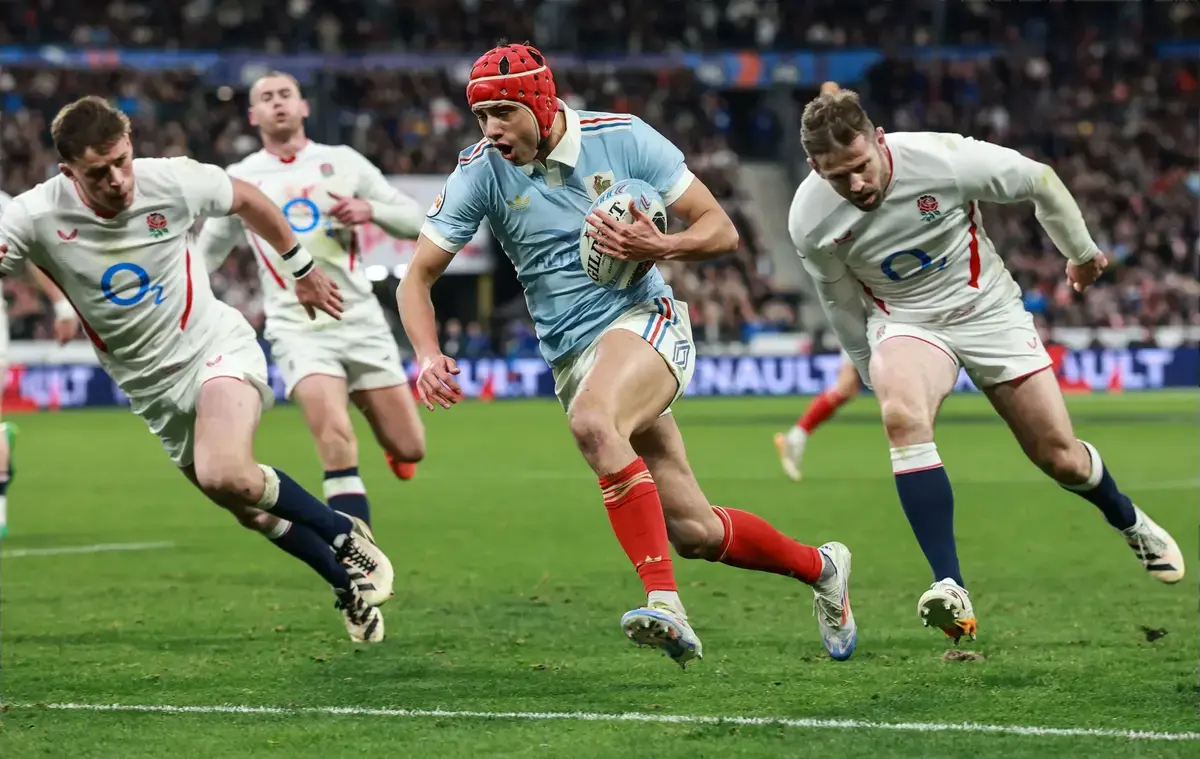
49′ – TRY FRANCE: The try of the match showcases everything magnificent about this French side. Bielle-Biarrey collects a clearance kick near his own 22 and immediately counter-attacks. He exchanges passes with Thomas Ramos — the full-back’s overhead return pass a moment of pure genius — before speeding away down the left touchline on a 50-metre burst. With defenders scrambling, Bielle-Biarrey looks inside to find Théo Attissogbe, who has tracked across from his opposite wing to take the scoring pass and sprint clear. Thomas Ramos converts to take France past 40 points (Wales 7-40 France)
57′ – TRY FRANCE: Attissogbe completes his brace after another moment of magic from Jalibert. France win a lineout inside the Welsh half and work the ball through multiple phases before the fly-half spots the mismatch wide on the right. His cross-kick is weighted to perfection, bouncing kindly for Attissogbe, who finds himself in splendid — and frankly ridiculous — isolation. The wing gathers and touches down without a Welsh defender within 15 metres. Where was the home defence? Thomas Ramos converts from wide on the right (Wales 7-47 France)
61′ – TRY FRANCE: Charles Ollivon caps a magnificent 50th appearance with France’s eighth try. The visitors’ forwards establish close-quarter dominance near the Welsh line, with replacement Rodrigue Neti going agonisingly close near the posts. Baptiste Serin — on for Dupont — shifts the ball right and Ollivon is on hand to crash over from close range. The captain’s try takes France past their half-century. Thomas Ramos converts to complete a flawless afternoon from the tee (Wales 7-54 France)
64′ – ADAMS DENIED: Wales threaten briefly as Eddie James carves through the French midfield and releases Josh Adams with a try beckoning. The veteran wing attempts to ground the ball but fumbles as he stretches for the line — the ball bobbling forward from his grasp. France survive and will have a scrum on their own five-metre line (Wales 7-54 France)
78′ – TRY WALES: A late consolation for the home supporters who have stayed until the end. Wales work through multiple phases near the French line, with Taine Plumtree held up over the whitewash. The referee was playing advantage for offside, and from the subsequent tap penalty, the ball is worked wide right. Louis Rees-Zammit produces a sharp left-foot step to beat one defender before firing a pass to an unmarked Mason Grady, who crosses in the corner. Jarrod Evans pushes his conversion attempt wide of the right upright (Wales 12-54 France)
Full-time: Wales 12-54 France

The 54 points represented France’s highest ever score against Wales, surpassing the 51 they managed at Wembley in 1998. For Wales, whose near three-year wait for a Six Nations victory continues, it was another chastening experience that extended their Championship losing streak to 13 matches — a run now stretching back 1,072 days to when they beat Italy in Rome in March 2023.

The official attendance of 57,744 was the lowest for a Six Nations fixture in Cardiff, falling below the previous record of 58,349 against Italy in 2002. Swathes of empty seats told the sorry story of Welsh rugby’s malaise, with the public losing interest amid turbulent times on and off the field. More than 50% of the Welsh Rugby Union’s turnover comes from money made from men’s home internationals, making the apathy all the more concerning.

Lightning start stuns Cardiff into silence

The contest was effectively over as a spectacle within the opening quarter. France’s speed of foot and thought was simply too much for Wales, whose defence could not reset against the visitors’ relentless offloading game.

It took just 88 seconds for Les Bleus to breach the Welsh line. Antoine Dupont engineered space on the right for Attissogbe with a pass out of the back of his hand that epitomised French flair at its finest. The wing found Ollivon on his inside shoulder, and with French players queuing up to finish, it was Gailleton who accepted the final pass to canter over untouched. Ramos converted and the rout was underway.

Wales were unable to catch their breath before the visitors struck again. From a lineout in the Welsh 22, Jalibert executed a cross-kick of pinpoint accuracy to the left wing, where Bielle-Biarrey had somehow found himself in acres of space. The 22-year-old’s try was his 23rd in just 24 Tests — a quite remarkable conversion rate that underlines why he is considered the most dangerous finisher in world rugby.

The gulf in class was personified by France’s third try, as debutant Brau-Boirie showcased the talent that had seen him likened to former Les Bleus great Yannick Jauzion. Bielle-Biarrey stepped Lake with such ease it looked like choreographed performance rather than competitive sport, before the ball was worked right through multiple pairs of hands. Jalibert spotted the overlap, fixed the defence, and sent the 20-year-old racing through. The finish was clinical, the statement emphatic: France had arrived with serious intent.

“It was a dream day in this great stadium,” Brau-Boirie said afterwards. “This week, I couldn’t stop thinking about it and I prepared well. When you enter the stadium and sing your first Marseillaise, it’s quite special. With my parents in the stands and all those people, this score — for a first cap, it’s crazy.”

Wales offer brief resistance

To their credit, the hosts managed to stem the tide momentarily. Ellis Mee’s strong take from the restart allowed Wales to escape their own half for the first time, and the Scarlets wing galloped into the French 22 with real purpose. When a penalty came near the line, Lake opted for a quick tap, and after sustained pressure near the whitewash, Carre powered over from close range. Edwards converted to reduce the deficit to 12 points.

For a period, Wales competed with greater intensity than they had managed in their 48-7 capitulation against England the previous weekend. Their set-piece showed marked improvement, with the scrum rock solid and the lineout functioning well. The discipline, too, was better — no yellow cards this time after collecting four at Twickenham. Eddie James regularly got his side on the front foot with powerful carries in the midfield, while Aaron Wainwright had another fine match in the back row.

France thought they had scored their fourth try on the half-hour when Attissogbe gathered Dupont’s clever chip kick, but the TMO correctly identified that the wing had been standing in front of the scrum-half when he kicked. The reprieve was brief, however, and moments later Brau-Boirie was denied what seemed a certain second try when he fumbled with the line at his mercy after more brilliant work from Dupont.

Beard’s blunder gifts bonus point

Any hope of a Welsh comeback was extinguished by a moment of madness just before the interval that left head coach Tandy visibly furious in the coaching box. After winning a hard-earned turnover through Cracknell’s thundering tackle and Jenkins’s quick hands, the ball found Beard as first receiver on the narrow side.

For reasons that defied explanation, the Montpellier lock attempted a clearance kick that lacked both accuracy and space. The ball ricocheted directly off Attissogbe and into the arms of a grateful c, who cantered away unopposed to score under the posts. Television cameras caught Tandy appearing to shout angrily in response — his frustration entirely understandable given his side had worked their way back into the contest.

“You probably saw my reaction and that’s why you’re asking,” Tandy admitted afterwards. “It’s disappointing. That’s not aimed at anyone. But we worked our way back in and had some moments. That’s the thing we worked on all week — if we have a transition, we want to move it. To concede off it as well, those are the moments in Test rugby where teams punish you.”

The bonus-point try, scored in such farcical circumstances, gave France a 26-7 lead at the interval and removed any lingering hope of a Welsh revival. The visitors had made 19 clean breaks in the opening 40 minutes; Wales had managed just two entries to the French 22, scoring once.

Second-half showcase

There was no let-up after the break as France turned to their power game. Within minutes of the restart, Marchand was celebrating his 50th cap with a try from a textbook driving maul that the Welsh pack simply could not repel. The hooker emerged from the back of the blue-shirted bodies to touch down, and Ramos converted from near the touchline to extend the lead to 26 points.

Then came the try of the match — a moment that showcased everything magnificent about this French side. Bielle-Biarrey collected a clearance kick near his own 22 and immediately looked to counter-attack. He exchanged passes with Ramos, the full-back’s overhead return pass a moment of pure genius that allowed the wing to burst clear down the left touchline.

With defenders scrambling to cover, Bielle-Biarrey had the awareness to look inside, where Attissogbe had tracked across from his opposite wing to take the scoring pass. The Pau flyer sprinted clear to score, and at 40-7, France had matched their highest total against Wales with half an hour still to play.

Attissogbe soon had his second after collecting another Jalibert cross-kick. The fly-half’s vision had been a feature of France’s attack all afternoon, and this time his execution was again perfect, the ball bouncing kindly for Attissogbe, who found himself in splendid isolation wide on the right. Where was the Welsh defence? The question went unanswered as the wing touched down unopposed.

Ollivon completed France’s blitz with the eighth try on the hour, crashing over from close range after sustained forward pressure. The captain, also celebrating his 50th cap alongside Marchand, now boasts eleven tries in the Six Nations — extending his record as the leading French forward try-scorer in the Championship. Ramos converted to take the visitors past their half-century with still a quarter of the match remaining.

Late consolation for loyal supporters

Wales at least managed to find the line once more in the closing stages, providing some cheer for the supporters who had stayed until the end. After James was held up on the line following a surging break through the French midfield, the hosts maintained their pressure.

Plumtree was held up over the whitewash, but the referee was playing advantage for offside, and from the subsequent tap penalty, the ball was worked wide right. Rees-Zammit, who had been one of the few bright spots for the hosts throughout, produced a sharp left-foot step to beat one defender before firing a pass to an unmarked Grady. The replacement wing crossed in the corner to secure a consolation try that the long-suffering home supporters gratefully acknowledged.

Evans missed the conversion from the touchline, but the final score of 54-12 scarcely did justice to France’s dominance. The statistics painted a brutal picture: France made 28 line breaks to Wales’s seven, beat 47 defenders compared to just 14 by the home side, and missed only 15 tackles to Wales’s 30. With 45 minutes of ball-in-play time, this was rugby played at a pace with which Wales simply could not cope.

Jalibert orchestrates masterclass

Player of the match Jalibert was the outstanding performer for Les Bleus, laying on a pair of tries with his pinpoint cross-kicks while also scoring himself. His partnership with Dupont, who created havoc throughout before making way for Baptiste Serin in the 58th minute, allowed France to slice into space on numerous occasions.

“We find each other well on the field,” Dupont said afterwards. “Our forwards are taking on more and more importance in this system — they play well and are useful to the system through their good running lines. Our defence also allows us to get turnovers that we exploit, so far, in the best possible way.”

The scrum-half paid tribute to the travelling supporters who made the Principality Stadium feel like home. “At the end, when we heard them singing the Marseillaise, we felt like we were at the Stade de France. It’s an immense honour for us to represent all these supporters on the field.”

Attissogbe, who finished with a brace of tries, reflected on an afternoon of free-flowing rugby. “There was a lot of rhythm, it was tiring! But with the big work from the forwards, it was easier with players like that around us to play our rugby. We try to be threatening everywhere. That’s what we want to work on — this ability to be dangerous everywhere, to be as unpredictable as possible.”

Brau-Boirie and Gailleton thrived in their first Test start together, the Pau centre pairing showing the cohesion that attack coach Patrick Arlettaz had predicted earlier in the week. Bielle-Biarrey, meanwhile, continued his remarkable form, proving strong in the aerial battle and devastating on the ground as he cut the Welsh defence to shreds with his speed and sharp footwork.

Tandy remains optimistic despite record defeat

For Wales, this was another humbling experience that extended their losing streak under Tandy to six matches, during which they have conceded 302 points and 42 tries. The head coach attempted to find positives despite the scoreline, pointing to improvements in discipline and set-piece work.

“Obviously disappointed with the scoreline. You’ve got to tip your hat to France and what they brought,” Tandy said. “There was more in us today. Parts of the game, I know you’re all looking at me like I’m stupid, with the path we’re on, I thought there were glimpses. With the set-piece and the intent of how we wanted to go after the game. We’ve come up against a class team.

“There was enough today where we can go back on Tuesday and work on things. It’s not the scoreline we want but it’s part of the journey we’re on. Every nation is at different stages. We’ve got to focus on the things we did better today. Discipline and set-piece was better. Obviously there’s still areas we need to grow.”

When asked about the lowest Six Nations crowd in Cardiff history, Tandy acknowledged the wider malaise affecting Welsh rugby. “The only bit I can control is the team. I understand there’s lots going on and has been in Wales for a really long time. We’re a small nation, we need everything to be flowing in the right direction. We all need to play our part in how we get there.”

Captain Lake echoed his coach’s sentiments while acknowledging the supporters’ frustration. “I guess it’s a step forward, we were a lot better than last week, but there’s still lots to work on. France are a team at the very top of the world. They can create things out of absolutely nothing. They scored some world-class tries today.

“It’s our job to make people want to come and watch games, and at the minute we’re not getting results. All I can ask is that they come along on the journey with us and support us — we want to get better.”

Championship implications

France now sit top of the Six Nations standings with ten points from two matches, their bonus-point victories over Ireland and Wales marking them out as clear favourites to claim their first Grand Slam since 2022. They are the only team for whom the clean sweep remains possible. With 90 points scored after two rounds, Les Bleus have registered their highest total at this stage of the competition since the Six Nations began in 2000.

“Arriving and winning all the matches in this competition is what we’re preparing for,” Dupont said when asked about Grand Slam aspirations. “But until the last round, the Championship won’t be won. We see the intensity and difficulty of the matches every weekend. We have to take these matches one by one — there’s no other way forward.”

For Wales, the search for a first Championship victory since March 2023 continues. They remain in Cardiff for a Round 3 clash against Scotland next Saturday, a fixture that represents perhaps their best chance of ending their drought. But the Scots arrive rejuvenated after their stunning 31-20 victory over England, and on this evidence, even that task appears daunting.

The record books will show that France recorded their highest ever score against Wales, that the Cardiff crowd was the smallest in Six Nations history, and that the gap between these two nations has never appeared wider. Wales have now shipped 50 points at home for the fifth time in just under a year. A third successive wooden spoon surely awaits.

France, by contrast, continue their march towards potential glory. With Dupont orchestrating, Jalibert creating, and Bielle-Biarrey finishing, they possess a potency that no side in this Championship can currently match. These truly are desperate times for Welsh rugby; for France, they could scarcely be brighter.

Wales (7) 12
Tries: Carre, Grady. Con: Edwards.

France (26) 54
Tries: Gailleton, Bielle-Biarrey, Brau-Boirie, Jalibert, Marchand, Attissogbe 2, Ollivon. Cons: Ramos 7.

Wales: L Rees-Zammit; E Mee, E James, J Hawkins, J Adams; D Edwards, T Williams; R Carre, D Lake (capt), T Francis, D Jenkins, A Beard, A Wainwright, A Mann, O Cracknell.
Replacements: R Elias, N Smith, A Griffin, B Carter, T Plumtree, K Hardy, J Evans, M Grady.

France: T Ramos; T Attissogbe, E Gailleton, F Brau-Boirie, L Bielle-Biarrey; M Jalibert, A Dupont (capt); J-B Gros, J Marchand, D Aldegheri, C Ollivon, M Guillard, F Cros, O Jegou, A Jelonch.
Replacements: M Lamothe, R Neti, R Montagne, T Flament, E Meafou, L Nouchi, B Serin, N Nene.

Referee: James Doleman (New Zealand)

Wales host Scotland next Saturday at the Principality Stadium (kick-off 2.15pm GMT). France welcome Italy to Lille on Sunday (kick-off 3.00pm GMT).

Continue Reading
Click to comment

Leave a Reply

Six Nations

Bielle-Biarrey crowned Six Nations Player of the Championship

Published

on

Bielle-Biarrey crowned Six Nations Player of the Championship
France’s Louis Bielle-Biarrey after being Voted 2026 Guinness Men’s Six Nations Player of the Championship in Bordeaux, France, Thursday, April 2, 2026 (Photo by Tom Maher / Inpho)

France’s record-breaking winger Louis Bielle-Biarrey has been named the 2026 Guinness Men’s Six Nations Player of the Championship, becoming only the fourth player in the award’s history to claim the accolade in consecutive years.

The 22-year-old secured 44 per cent of the fan vote in a record ballot that saw 151,525 supporters cast their verdict over a one-week voting period. Ireland centre Stuart McCloskey, Italy’s Tommaso Menoncello and Scotland wing Kyle Steyn were also shortlisted after standout campaigns of their own.

Bielle-Biarrey’s coronation caps a remarkable championship in which he scored nine tries across five matches, breaking his own record of eight set in 2025. That tally included a stunning four-try haul in the decisive final-round victory over England at the Stade de France, a performance that secured back-to-back titles for Fabien Galthié’s side.

“I’m just really happy, honestly,” Bielle-Biarrey said upon receiving his award in Bordeaux. “It’s yet another reward for the team’s hard work throughout the tournament. We were able to defend our title. Winning the tournament two years in a row is no small feat. We’re very happy to have done it.”

Following in Dupont’s footsteps

The Bordeaux Bègles wing joins an elite group of multiple winners that includes Brian O’Driscoll, Stuart Hogg and his France teammate Antoine Dupont, who achieved the same back-to-back feat in 2022 and 2023. Indeed, over the past five Six Nations editions, only Italy’s Menoncello in 2024 has broken French dominance of the individual award.

The symmetry with Dupont is particularly striking. Both players developed through France’s youth pathways before bursting onto the senior stage, and both have now received the ultimate individual recognition in consecutive campaigns. Galthié acknowledged as much after France’s title-clinching victory.

“He is following in Antoine’s footsteps,” the France head coach said. “The players inspire one another. It’s hard to find the right adjectives to talk about him right now, and last year too. He will surely become the top scorer of the tournament, I think.”

Record upon record

The statistics behind Bielle-Biarrey’s championship defy comprehension. His nine tries represent a single-tournament record for the Six Nations era, surpassing the mark of eight he shared with Cyril Lowe (1914) and Ian Smith (1925) after last year’s campaign.

More remarkably, the winger has now scored in ten consecutive Six Nations matches, another record he holds alone. Only Chris Ashton, with his four tries against Italy in 2011, had previously matched the four-try performance Bielle-Biarrey delivered against England.

With 18 tries in just 14 Six Nations appearances, he is already the highest-scoring French player in the championship’s modern era, having overtaken Damian Penaud despite playing in roughly half the number of fixtures. He sits fifth on the all-time scorers list and, at 22, has O’Driscoll’s record of 26 tries firmly in his sights.

Beyond the try-scoring, his attacking numbers were equally impressive: 311 metres gained, 13 defenders beaten, eight clean breaks and four try assists across the championship.

From Grenoble to greatness

Bielle-Biarrey’s trajectory reads like a rugby fairytale. Born in La Tronche in the Isère department with Réunionese heritage through his mother and Toulon roots through his father, he began playing rugby at five years old in Seyssins, a small commune near Grenoble with a population of just 8,000.

His early career saw him deployed at fly-half before coaches identified his devastating pace and moved him to the wing. That speed, clocked at 38 kilometres per hour when he famously beat former European 100m champion Christophe Lemaitre in a sprint earlier this year, has become his calling card.

His first senior start for Bordeaux Bègles in January 2022, at just 18 years old, was immediately marked by a hat-trick against the Scarlets. By August 2023, he had earned his first cap against Scotland, and within weeks he became the youngest French player to score a try at a Rugby World Cup during the tournament on home soil.

The red scrum cap, given to him by his father at age eight, has since become his trademark, instantly recognisable as he accelerates past defenders.

A championship to remember

Bielle-Biarrey’s award arrives after a Six Nations widely heralded as the greatest edition since the championship expanded to six teams in 2000. A record 111 tries were scored across the tournament, with the title ultimately decided by Thomas Ramos’s penalty in the dying seconds of the final match.

The French public certainly responded. Broadcast across France Télévisions and TF1, the 2026 championship attracted over 35.5 million average viewers throughout the five rounds, with 9.5 million tuning in for the title decider against England.

For Bielle-Biarrey, the individual recognition is secondary to collective success. But in a championship of extraordinary moments, his contribution stood apart.

“My parents signed me up for rugby when I was five years old,” he has previously reflected. “Straight away, I really liked it. It is a childhood dream today to be able to live my passion.”

At 22, with two Player of the Championship awards, a cabinet of try-scoring records and the trajectory to become France’s all-time leading scorer, Louis Bielle-Biarrey is living that dream in spectacular fashion.

Continue Reading

Six Nations

Two former winners in shortlist for Player of Six Nations award

Published

on

Two former winners in shortlist for Player of Six Nations award
France's Louis Bielle-Biarrey runs in his side's second try during the 2026 Guinness Six Nations Championship Round 5 game between France and England in Stade de France, Paris, France, Saturday, March 14, 2026 (Photo by Dan Sheridan / Inpho)

The shortlist for the 2026 Guinness Men’s Six Nations Player of the Championship has been announced, with four players recognised for performances that defined what was widely described as one of the most compelling tournaments in recent memory. Louis Bielle-Biarrey (France), Stuart McCloskey (Ireland), Kyle Steyn (Scotland) and Tommaso Menoncello (Italy) make up a quartet selected from those who topped the performance statistics charts and drew the highest share of fan votes in the Team of the Championship poll.

Voting is now open at sixnationsrugby.com and closes on Thursday 26 March at 09:00 GMT.

Key Points

  • Louis Bielle-Biarrey (France) and Tommaso Menoncello (Italy) are the two former winners on the shortlist, having claimed the award in 2025 and 2024 respectively
  • Bielle-Biarrey scored a record nine tries in five matches, breaking his own all-time Championship record set just twelve months earlier
  • Menoncello is nominated for a third successive year, becoming only the third player — alongside Brian O’Driscoll and Antoine Dupont — to achieve three consecutive nominations
  • Ireland’s Stuart McCloskey, 33, leads the tournament’s Oval Insights rankings with a score of 8.6/10, despite not scoring a single try
  • Scotland’s Kyle Steyn equalled the all-time Championship record for defenders beaten, with 26 across the tournament
  • McCloskey would become Ireland’s first winner since Jacob Stockdale in 2018 if he takes the award
  • Steyn’s nomination is the first for a Glasgow Warriors player since 2017
  • The winner is decided entirely by public vote, with fans able to vote at sixnationsrugby.com until 09:00 GMT on Thursday 26 March

Louis Bielle-Biarrey

If there is a frontrunner, it is hard to argue against the 22-year-old Bordeaux-Bègles and France wing. Bielle-Biarrey claimed the Player of the Championship award in 2025 and delivered an encore that left statisticians scrambling for superlatives. His nine tries across five matches broke his own all-time Championship record — he had set the previous mark of eight just twelve months earlier — and makes him the most prolific try-scorer in the history of the competition.

The highlight reel moment of his tournament came against England in a match that immediately entered rugby folklore. Bielle-Biarrey crossed for four tries in the Crunch, becoming only the second player ever to score a quadruple in a single Six Nations match, after Chris Ashton’s effort against Italy in 2011. He also scored in each of France’s five games, an achievement managed by only three other players since the tournament expanded to six nations in 2000.

His numbers elsewhere were just as striking. He led the Championship in clean breaks (19), initial breaks (14) and supported breaks (5), while his 366 metres carried ranked third overall. The Oval Insights algorithm placed him second in its rankings with a score of 8.5 out of 10. His efforts were central to France retaining the Championship title for a second successive year.

Key stats: 9 tries (Championship record), 19 clean breaks (1st), 366 metres carried (3rd), 8.5/10 Oval Insights (2nd)


Stuart McCloskey

At 33, Stuart McCloskey’s 2026 Six Nations campaign reads like a statement of defiance against the passage of time. The Ulster centre was one of only two Irish players — alongside captain Caelan Doris — to play every minute of Ireland’s five matches, and he did so while producing numbers that led not just his team but the entire tournament in several categories.

He did not score a try, yet his fingerprints were on Ireland’s attack at every turn. His six try assists tied for the joint-highest in the Championship, with multiple offloads producing scores for team-mates. He led the tournament in dominant contacts (18, at a remarkable 31% rate), turnovers won among backs (eight, joint-first overall) and tackle attempts among backs (79). His 20 defenders beaten ranked joint-second in the Championship.

The Oval Insights system placed McCloskey first among all players, awarding him 8.6 out of 10. His performances were instrumental in Ireland securing the Triple Crown and finishing as runners-up in the overall standings. Should he win, McCloskey would become Ireland’s first Player of the Championship since Jacob Stockdale in 2018.

Key stats: 6 try assists (joint 1st), 18 dominant contacts (1st), 8 turnovers won (joint 1st), 8.6/10 Oval Insights (1st)


Kyle Steyn

Kyle Steyn’s inclusion in the shortlist may owe more to moments of brilliance than the volume of a Bielle-Biarrey or the relentless consistency of a McCloskey, but few players left as large an impression on individual matches. The 32-year-old Glasgow Warriors winger was awarded Player of the Match twice during the tournament — against England and France — and was at the heart of two results that will be remembered long after the final standings are forgotten.

His 26 defenders beaten across the Championship ranked first in the competition, equalling the all-time record for the category. He scored three tries and covered 316 metres with ball in hand, ranking sixth overall. His Oval Insights score of 8.1 placed him seventh. Scotland’s two standout victories — a thumping win over England and the extraordinary 50-40 defeat of France at Murrayfield — each had Steyn’s footprints running through them.

It would be the first nomination for a Glasgow Warriors player since 2017. Hamish Watson was the last Scotsman to claim the award, in 2021.

Key stats: 26 defenders beaten (1st, joint record), 3 tries, 316 metres (6th), 8.1/10 Oval Insights (7th)


Tommaso Menoncello

At just 23 years old, Tommaso Menoncello is already becoming a fixture on this shortlist. This is his third consecutive nomination, and he arrives having won the award in 2024 before finishing runner-up to Bielle-Biarrey in 2025. His continued presence at the top of the tournament standings speaks to a player who has rapidly established himself as one of the finest centres in world rugby.

This year, Menoncello was central to Italy’s most memorable results — victories over Scotland and England — and was named Player of the Match in the latter. His 14 clean breaks ranked third in the Championship, his 363 metres carried ranked fourth, and his 11 initial breaks placed joint-third. He also matched McCloskey’s joint-second ranking for defenders beaten with 20, and his 36.7% dominant carry rate — 11 dominant carries from 42 attempts — underlined the physical impact he carries into contact.

Only Andrea Masi has previously won the Player of the Championship award as an Italian, making Menoncello’s repeated presence at the summit of the conversation a remarkable achievement for a player still in his early twenties.

Key stats: 14 clean breaks (3rd), 363 metres carried (4th), 20 defenders beaten (joint 2nd), 7.9/10 Oval Insights (8th)


The verdict

On pure statistics, the case for Bielle-Biarrey is compelling — nine tries, a broken record and a Championship winners’ medal make him the obvious choice for many. But with the award decided by public vote, McCloskey’s all-action, selfless game and the passionate Irish fanbase could prove decisive. Steyn’s two Player of the Match awards demonstrate his impact in the biggest moments, while Menoncello’s third successive nomination reinforces just how consistently brilliant he has been.

Fans have until Thursday 26 March at 09:00 GMT to have their say at sixnationsrugby.com.

Continue Reading

Six Nations

Six things we learned from round 5 of the Guinness Six Nations

Published

on

Six things we learned from round 5 of the Guinness Six Nations
France’s Antoine Dupont’s lifts the Men's Six Nations Trophy after the 2026 Guinness Six Nations Championship Round 5 game between France and England in Stade de France, Paris, France, Saturday, March 14, 2026 (Photo by Dan Sheridan / Inpho)

Super Saturday 2026 delivered one of the greatest days in Six Nations history. France retained their championship with a last-gasp 48-46 victory over England in a Paris thriller that will be replayed for generations, as Thomas Ramos held his nerve with the final kick to break Irish and English hearts. Earlier in Dublin, Ireland secured their fourth Triple Crown in five years with a commanding 43-21 win over Scotland, while Wales ended 1,099 days of Six Nations misery by beating Italy 31-17 in Cardiff. Louis Bielle-Biarrey scored four tries to take his tournament tally to nine – a new record – while the championship produced 111 tries, the most since Italy joined the competition. England’s seven tries weren’t enough. Ireland’s six tries secured the Triple Crown but not the title. And Wales finally, mercifully, tasted victory again. Here are six things we learned from a finale that had absolutely everything.

France are deserved champions

Forget the script. Tear up the predictions. This wasn’t supposed to happen. England, who had lost four consecutive matches coming into Paris, weren’t meant to score 46 points and seven tries against the defending champions. France weren’t supposed to concede that many points and still win. And yet here we are, trying to process what might just be the greatest Six Nations match ever played. The 48-46 scoreline tells only part of the story of a game that swung violently from one team to the other across 82 breathless minutes. England led 27-17 at half-time despite Ellis Genge’s yellow card and a penalty try for France. They fell behind 38-27 early in the second half as Louis Bielle-Biarrey completed his hat-trick. They stormed back to lead 46-45 with three minutes remaining after Tommy Freeman’s brilliant finish. And then came the final twist. With the clock in the red, Trevor Davison and Maro Itoje were penalised at a ruck, giving Thomas Ramos a long-range penalty from 47 metres to win the championship. The Stade de France held its breath. Ramos, France’s nerveless full-back who had already become his country’s all-time leading points scorer earlier in the tournament, stepped up and bisected the posts. France were champions. England were heartbroken. Ireland, watching in Dublin, saw their title hopes evaporate with that single kick. “We’re very lucky that we have maybe the best kicker around,” said Fabien Galthié afterwards, and nobody could argue. Bielle-Biarrey’s four tries – taking him to nine for the championship, smashing the previous record – showcased France’s attacking brilliance. The 21-year-old now has 29 tries in just 27 Tests, an astonishing strike rate that surpasses even Damian Penaud. But it was Ramos’s composure under ultimate pressure that won the title. France finished with 30 tries across five matches, equalling their own record from 2025, and scored four-try bonus points in four of their five games. Their only defeat came against England at Twickenham in round two, but they bounced back with three consecutive bonus-point victories. This is back-to-back titles for the first time since 2006-07, and France’s eighth championship triumph since 2000 – more than any other nation in that period. “We’re very proud of our performance today and the spirit we showed,” said François Cros. “We had a tough first half where Scotland put us under pressure, but we came through that and in the second half, we were able to unleash our game.” The attacking rugby France have played throughout this tournament has set new standards. They are deserved champions, winners of the greatest Six Nations finale ever witnessed.

England regain pride but is that enough?

Where has this England been? Steve Borthwick’s side scored seven tries in Paris, ran France ragged for long periods, led at half-time despite playing 10 minutes with 14 men, and came within 90 seconds of one of the great Six Nations upsets. And yet they still lost. They still finish fifth in the table with just one win from five matches. They still have suffered their worst championship campaign in 50 years. The 48-46 defeat completes England’s most disappointing Six Nations since 1976, when they last lost four matches in a single campaign. The performance was everything Borthwick had demanded – attacking ambition, forward dominance, clinical finishing from Tom Roebuck, Cadan Murley, Ollie Chessum (twice), Alex Coles, Marcus Smith and Tommy Freeman. But the result tells the real story. England’s discipline, which has plagued them all championship, cost them again. Genge’s yellow card for collapsing a maul on the stroke of half-time, coupled with a penalty try for France, turned a 27-17 lead into 24-27 at the break. France then scored 14 more points while England were down to 14 men. That’s 21 points conceded in that crucial period. “When we keep 15 men on the field we look a very good team,” admitted Borthwick afterwards, and the statistics bear him out. England have received nine yellow cards across five matches – equalling Italy’s unwanted record from 2002 – and have conceded 63 points while a player off the pitch. Borthwick questioned referee Nika Amashukeli’s communication over the penalty advantage before Bielle-Biarrey’s fourth try, insisting “the players on the pitch were told it was a penalty advantage” when it had been changed to a knock-on advantage by the TMO. But complaints about refereeing cannot mask the bigger picture. England have lost to Scotland, Ireland and Italy in this championship. They beat Wales and pushed France to the wire, but consistency remains their biggest problem. “I believe I’m the right man to lead the team forward,” insisted Borthwick when asked about his future, and this performance in Paris – despite the heartbreaking defeat – might just have earned him more time. England showed character, attacking ambition and forward power that had been missing for much of the season. “I truly believe this team is going places,” insisted captain Itoje. “We showed the spirit of this team. In sport, you don’t want to go through the experiences that we went through over the last four games. But I truly believe this team’s going places.” Pride has been restored. The performance in Paris proved England can compete with the world’s best when they get their game right. But is that enough? Fifth place, four defeats, and another summer of questions about Borthwick’s methods suggest not.

Ireland have found their edge

The Fields of Athenry rang around the Aviva Stadium. Caelan Doris lifted the Triple Crown trophy. Six tries, 43 points, a 12th consecutive victory over Scotland. Everything about Ireland’s final-day performance screamed champions. Everything except the result in Paris that mattered most. Andy Farrell’s side did everything asked of them, delivering their best performance of the championship against a Scotland side who arrived in Dublin dreaming of their own title glory. Jamie Osborne’s fourth-minute try – his fourth of the championship – set the tone for a commanding display built on set-piece dominance and ruthless finishing. Dan Sheehan’s maul try, Robert Baloucoune’s searing pace, Darragh Murray’s bonus-point score on his Six Nations debut, and Tommy O’Brien’s late brace sealed a performance that had Farrell “proud as punch.” The statistics were extraordinary: 42.9 minutes of ball-in-play time in a game for the ages, Ireland’s red zone efficiency at 4.7 points per entry, and Stuart McCloskey delivering a fifth consecutive high-quality display that puts him “in the mix for player of the tournament.” “We had a ruthless edge to us in how we defended and converted in the 22,” said Farrell. “That was the story of the game really.” Ireland finish second, three points behind France, their three-year title reign over. The opening-night defeat in Paris – when Farrell publicly questioned his team’s “intent” – proved decisive. But the response has been remarkable. From the wreckage of that 36-14 hammering, Ireland have rebuilt themselves, winning four consecutive matches with increasing conviction. The 42-21 destruction of England at Twickenham was followed by grittier wins over Italy and Wales, before this commanding display against Scotland. Ireland used 35 players across this championship – more than any previous Farrell campaign – and the depth chart has been tested extensively. Tom O’Toole’s remarkable conversion to loosehead prop, where he delivered 20 tackles in 65 minutes against Scotland, was “amazing” according to Farrell. McCloskey’s consistency has been a revelation. Robert Baloucoune was named the tournament’s Rising Player despite being 28 years old. The Triple Crown – Ireland’s 15th, and ninth of the Six Nations era – represents their fourth in five years, a remarkable achievement. “It’s unique as an Irishman to be cheering them on,” Doris had said of supporting England in Paris, and the strangeness of that moment captured everything about Ireland’s championship. The title may have gone to France, but Ireland have rediscovered the edge, the hunger, and the ruthless efficiency that makes them one of world rugby’s most dangerous sides. The 18-month journey to the 2027 World Cup is officially on track.

Same old story for Scotland

Twelve years. Twelve consecutive defeats to Ireland. Twelve times Scotland have travelled to Dublin dreaming of glory, only to return home empty-handed and heartbroken. The 43-21 defeat wasn’t a hammering – Darcy Graham, Finn Russell and Rory Darge all scored tries – but it was comprehensive enough to end any lingering title hopes and expose the familiar failings that have haunted Gregor Townsend’s tenure. Scotland haven’t won in Dublin since 2010, when Dan Parks nailed a touchline penalty at Croke Park to scuttle Ireland’s Triple Crown voyage. They haven’t beaten Ireland anywhere since 2017. And on this evidence, the wait will continue. Ireland dominated the collisions, winning the breakdown battle and establishing set-piece superiority that Scotland couldn’t match. Jamie Osborne, Dan Sheehan and Robert Baloucoune scored in a devastating first 20 minutes that established a 19-7 half-time lead. Scotland fought back in the third quarter – Russell’s brilliant solo try and Rory Darge’s finish bringing them within five points at 26-21 – but Ireland’s response was ruthless. Darragh Murray’s bonus-point try, created by the bench’s immediate impact after Andy Farrell made six changes simultaneously, restored control before Tommy O’Brien’s late brace sealed the win. “Ireland played well – they always seem to play well against us,” said Townsend afterwards, and that admission tells you everything. The statistics told the story: Ireland made 232 tackles to Scotland’s significantly fewer, controlled territory for long periods, and converted their 22-metre entries with clinical efficiency. “We’d close the gap, and then we’d let them back in through mistackles or mistakes off the kick-off. They’re all our doings,” admitted captain Sione Tuipulotu. Scotland’s attacking rugby was often brilliant – that 19-phase move for Graham’s try showcased their ambition – but they couldn’t sustain it for 80 minutes. They finish third in the table with three wins from five, which represents progress from previous campaigns. But Townsend’s record in Dublin now stands at zero wins from 11 attempts, and Scotland’s inability to beat Ireland home or away remains one of rugby’s great puzzles. “I’m proud of how we stepped up in the second half,” said Tuipulotu. “But I’m gutted. We really set our sights on coming here and getting a result, but Ireland were too good today. Ireland are deserved winners today.” Former Scotland prop Peter Wright touched on deeper issues: “Physically we compete against England and France, but for some reason, we cannot against Ireland.” The same old story continues. Scotland can beat anyone on their day – witness that stunning 50-40 victory over France last week – but they cannot beat Ireland anywhere, anytime. Until that changes, title challenges will remain dreams rather than reality.

Welsh fans can dare to dream

The wait is over. After 1,099 days, 15 consecutive Six Nations defeats, and a three-year journey through rugby’s darkest valleys, Wales finally tasted victory again. The 31-17 triumph over Italy wasn’t just a win – it was a cathartic release of three years’ worth of frustration, disappointment and pain. Aaron Wainwright’s two tries, Dewi Lake’s score from a driving maul, and Dan Edwards’s brilliant 16-point haul (including a try and an audacious drop goal) gave Wales a 31-0 lead that had the Principality Stadium shaking with joy. “It’s everything for us,” said captain Lake afterwards, his voice hoarse with emotion, and you believed every word. This was Wales’s first Six Nations home win since February 2022 – 1,491 days ago – when they beat Scotland. It was their first championship victory of any kind since beating Italy in Rome on 11 March 2023. The relief was palpable. “We hope that we have restored some faith in the jersey and into what this group can do,” added Lake, and the performance suggested genuine progress under Steve Tandy’s guidance. The defensive intensity that had been building through narrow defeats to Scotland and Ireland was maintained throughout. The set-piece dominance – three tries from driving lineouts in the first half – showcased growing power and precision. Edwards, who had been dropped after the France game for Sam Costelow, responded with his finest performance in a Wales shirt, darting through a gaping hole for the bonus-point try before landing that stunning drop goal from 40 metres. “You’re probably thinking ‘what are you doing?’ And then he absolutely buries it,” laughed Tandy afterwards. “I am overwhelmed with pride by what this group delivered,” said Tandy, visibly emotional. “I’ve always said it’s never been a question of desire, physicality or work ethic in this group. It’s just getting them to understand how far they can go with the work ethic and physically they’ve got.” Italy fought back with tries from Tommaso Di Bartolomeo, Tommaso Allan and Paolo Garbisi, but Wales held firm, defending with the hunger and hardness that had been missing in those opening hammerings by England and France. They still finish with the wooden spoon – their third consecutive bottom-placed finish. But unlike the whitewashes of previous years, this campaign ended with a win, with pride restored, and with belief returning. “This group has gone through a lot of emotionally tough things recently, whether that is on the field or off it,” reflected Lake, and that context makes this victory all the more significant. Welsh rugby remains in crisis off the field, with the WRU facing an extraordinary general meeting and existential questions about professional structures. But on the field, Tandy has given Wales something to build on. The foundations are there. The forward pack dominated Italy physically. Young players like Eddie James and Ellis Mee have emerged as genuine Test-quality performers. The 1,099-day nightmare is over. Welsh fans can dare to dream again.

A match too far for Italy

Italy arrived in Cardiff seeking to create history. Victories over Scotland and England had put them on the brink of something never achieved before – three wins in a single Six Nations campaign. But the brave Azzurri, who had given everything to shock England seven days earlier, simply had nothing left in the tank. The 31-17 defeat was comprehensive, painful, and perhaps inevitable after the emotional and physical toll of their historic win in Rome. Gonzalo Quesada’s side looked flat from the opening exchanges, making mistakes in defence they hadn’t made all tournament, losing collisions they’d been winning for weeks, and struggling to find the rhythm that had made them such compelling viewing. Wales raced to a 21-0 half-time lead through Wainwright’s brace and Lake’s try, all from dominant set-piece play. By the time Edwards scored early in the second half to make it 31-0, Italy’s dreams were dust. “Their heart and physicality was bigger than ours in the first half,” admitted Quesada afterwards. “We saw a big improvement from Wales against Ireland and we knew they had the opportunity to put everything out there to get victory. It was a big game from Wales and they never gave up.” Italy did fight back with three second-half tries – and had two more ruled out by the TMO – but the damage had been done. The day of recovery advantage Wales enjoyed proved significant, but there were deeper issues at play. “We used many energies in a long tournament,” reflected captain Michele Lamaro. “The meta that hurts most is the one at the start of the second half because it made our hopes of getting back into the match vacillate.” The defeat means Italy finish fourth in the table with two wins from five, equalling their best-ever championship performance but falling short of the unprecedented third victory that would have represented genuine progress. Still, this was a tournament that exceeded expectations. Victories over Scotland and England – particularly that first-ever triumph against the English in Rome – represented seismic moments for Italian rugby. Tommaso Menoncello, Paolo Garbisi and Ange Capuozzo all showed flashes of world-class ability. But consistency remains the challenge. Italy were brilliant against England, poor against Wales, and somewhere in between against everyone else. “We are a good squad, in a true process of growth,” said Quesada. “We must do attention to what we say, to how we communicate: Wales has a beautiful squad, a quality staff, and all matches in the Six Nations are tough.” For Italy, one match too far. But also, a championship that showed how far they’ve come – and how far they still have to go. Sonnet 4.5Claude is AI and can make mistakes. Please double-check responses.

Continue Reading

Trending

Discover more from Rugby News, Results, and Analysis | Rugby is the Game

Subscribe now to keep reading and get access to the full archive.

Continue reading