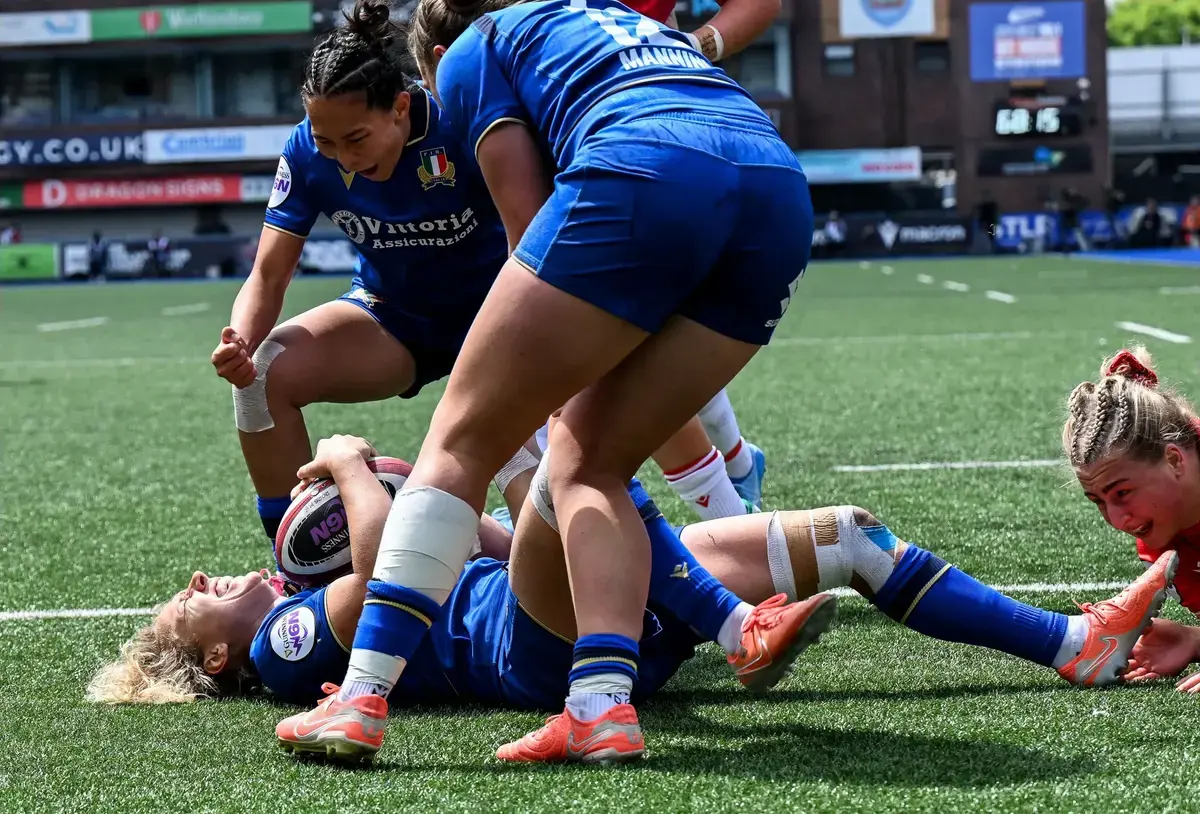
In the sunshine at Rodney Parade, Ireland delivered a commanding performance to cement their third-place position in the Women’s Six Nations with a comprehensive 40-14 victory over Wales. Despite conceding an early try, Scott Bemand’s side responded with six tries of their own to leave the hosts still searching for their first win of the tournament.
Key Moments:
6′ – Carys Cox try after Amee-Leigh Costigan handling error, Keira Bevan conversion (Wales 7-0 Ireland)
20′ – Linda Djougang powers through tackles after Stacey Flood break, Dannah O’Brien conversion (Wales 7-7 Ireland)
30′ – Aoife Wafer crashes over from close range after sustained pressure, Dannah O’Brien conversion (Wales 7-14 Ireland)
40+1′ – Dorothy Wall surges over following Welsh penalties, Enya Breen conversion (Wales 7-21 Ireland)
44′ – Dorothy Wall second try from powerful driving maul, conversion missed (Wales 7-26 Ireland)
54′ – Linda Djougang claims her second try after clever Molly Scuffil-McCabe pass, Dannah O’Brien conversion (Wales 7-33 Ireland)
59′ – Hannah Bluck scores on first involvement with strong line break, Keira Bevan conversion (Wales 14-33 Ireland)
63′ – Aoife Wafer picks from scrum base to power over on blindside, Enya Breen conversion (Wales 14-40 Ireland)
The opening exchanges belonged to Wales, with fly-half Lleucu George, a late replacement for the injured Kayleigh Powell, causing problems with her tactical kicking. It was George’s clever grubber kick that led to the opening score after just six minutes, as Irish winger Amee-Leigh Costigan misjudged the bounce near her own try line. Jasmine Joyce-Butchers applied pressure, forcing a spill that Carys Cox pounced on for the easiest of finishes. Keira Bevan’s conversion gave the hosts a 7-0 lead and sent the 3,568-strong crowd – a record for a women’s international at Rodney Parade – into raptures.
Ireland looked disjointed in the opening quarter, with several promising attacks breaking down through handling errors or Welsh dominance at the breakdown. However, rather than abandoning their attacking ambitions, the visitors continued to show faith in their counter-attacking ability, with full-back Stacey Flood repeatedly punishing loose Welsh kicking.
The breakthrough came after 20 minutes when Flood made significant ground before finding Wafer in support. The number eight was brought down just short, but a series of phases later, prop Linda Djougang powered through two weak Welsh tackles to score. Dannah O’Brien’s conversion levelled the scores, silencing the home crowd and giving Ireland a visible confidence boost.
Ireland’s forwards began to assert their dominance in the collisions, with the Irish pack making metres with every carry. The powerful Aoife Wafer was particularly impressive, consistently breaking the gain line and putting Wales on the back foot.
Ireland took the lead on the half-hour mark after another period of sustained pressure. The formidable Wafer, who would go on to make an astonishing 24 carries for 173 metres throughout the match, crashed over from close range after patient phase play inside the Welsh 22. O’Brien’s conversion extended the lead to 14-7, completing a decisive turnaround after the early setback.
Despite losing O’Brien to a yellow card for a high tackle on Alex Callender in the 37th minute, Ireland finished the half stronger. A series of Welsh penalties provided field position, and second-row Dorothy Wall capitalised with a powerful surge over the line, showing tremendous strength to break through two defenders. Centre Enya Breen, taking over kicking duties, added the extras from a difficult angle to give Ireland a commanding 21-7 half-time advantage.
“We were quite aware of the challenge Wales would present,” said Ireland captain Edel McMahon post-match. “We knew we had to stay patient in our system, in our process. But we were a bit slow to start, probably allowed Wales to come at us as opposed to imposing ourselves.”
If Wales harboured hopes of a second-half comeback, they were swiftly extinguished as Ireland’s forward dominance became overwhelming. Just four minutes after the restart, a perfectly executed driving maul saw Wall crash over for her second try of the afternoon and secure the bonus point. The maul was so dominant that Welsh defenders were powerless to stop it, with Wall dropping at the perfect moment to claim the score. Breen’s conversion attempt drifted wide, but Ireland had stretched their lead to 26-7.
Welsh captain Hannah Jones tried to rally her troops, but Ireland’s pack continued to dominate. Djougang claimed her second try in the 54th minute, receiving a clever pass from scrum-half Molly Scuffil-McCabe and powering over under the posts. O’Brien, back from the sin bin, converted to extend the lead to 33-7.
Wales did manage a moment of joy when replacement Hannah Bluck, who had only been called into the matchday squad after Powell’s late withdrawal, scored with her first touch. Entering the fray in the 58th minute, Bluck immediately showed her pace and power, cutting a superb line through the Irish defence to score under the posts. Bevan’s conversion reduced the deficit to 33-14, giving the home crowd something to cheer about.
Any Welsh momentum was immediately extinguished, however. From a scrum five metres out, Wafer picked up at the base and charged down the blindside, powering through Cox’s attempted tackle to score her second try. Kate Williams was caught slightly slow breaking from the scrum, creating the space for Wafer to exploit. Breen’s conversion from the touchline completed the scoring at 40-14.
“It’s huge,” said player of the match Wafer. “We can take a lot from that but we can also build on it. Our breakdown let us down a lot in the first half, to be honest, and we were frustrated with that going into the sheds at half-time. We speak about being the most connected team in the world. I think that shows on the pitch, but it’s not only the 15 out there or 23, we’ve girls at home who are injured and we’d love them to take to the pitch with us. We play for them as well.”
Ireland’s dominance was reflected in the statistics, with the visitors making 1,019 metres to Wales’ 282 and completing 147 carries to the hosts’ 77. The Irish pack was particularly impressive, with all six tries coming from forwards – Wafer, Wall and Djougang all scoring twice in a display of power that the Welsh simply couldn’t contain.
Wales had to make an astonishing 97 tackles to Ireland’s 47, and the physical toll was evident as the match progressed. The hosts missed 18 tackles compared to Ireland’s six, highlighting the difference in defensive solidity.
Wales prop Sisilia Tuipulotu admitted: “I think we started off strong but we didn’t carry it on for the rest of the game. It’s hard to win a game with 10 plus penalties against us. This is not how we wanted things to go but we’ve only just got a new coach, he’s changing the way we’re going to play and that’s going to take time.”
For Wales head coach Sean Lynn, still seeking his first win since taking over from Ioan Cunningham, it was a sobering afternoon. “I feel really hurt, the players are hurt, the staff are hurt,” he said. “But this is an Ireland side that beat New Zealand. We have got to start turning pressure into points. On that 25-minute mark when we were on their try line, we just didn’t convert, and a side who are at the top of the championship go up the other end to make it 7-7 where it could have been 14-0.”
Despite his side’s dominance, Ireland coach Bemand felt they could have been even more clinical. “I’d hoped to lay down a bit of a statement victory and I think we had probably 16, 18 minutes at the end there where we could have kicked on and that could have been 50, 60 points,” he said. “It’s a bit of a funny one; to come away to a place like Wales and record a win – they haven’t been that plentiful in the near distant past – score tries and pick up a bonus point, it’s really important. So from that perspective, we’re happy. But I’m a little disappointed that we let a statement victory get away from us.”
The victory was particularly significant as it marked Ireland’s second away win of the campaign, following their triumph in Italy. “We’ve had two away games, and we’ve won both,” noted Bemand with satisfaction.
Ireland full-back Stacey Flood was nearly flawless throughout, gaining over 120 metres in the first half alone and consistently putting Ireland on the front foot. Her only blemish came in the 72nd minute when she dropped a pass with the try line at her mercy after a brilliant break from Dorothy Wall.
Ireland captain Edel McMahon reflected: “I was very proud of the girls for sticking at it. We had a slow start ourselves, but we had to grind it out. There were individual moments that gave us the energy to get back into the game, and we stuck with our game plan. The power game up front really showed. Looking back to Italy, our backs were scoring left, right, and centre, but today was more of a forwards’ game.”
The result leaves Wales rooted to the bottom of the table without a win, facing a wooden spoon decider against Italy in Parma on the final weekend. Despite showing early promise under new coach Lynn, who has won three consecutive Premiership Women’s Rugby titles with Gloucester-Hartpury, Wales have struggled to convert pressure into points throughout the campaign.
Ireland, meanwhile, travel to Edinburgh to face Scotland at the Hive Stadium with third place in the championship all but secured. A bonus point of any kind next weekend would mathematically confirm their position as “best of the rest” behind England and France, who will contest the Grand Slam decider at Allianz Stadium.
“We’ll always go after the performance, and we figured if we got our performance right, the scores would come,” Bemand explained post-match. “I think there are bits of the performance where we left points out there, opportunities out there, some clear and obvious, some less so. It was a bit of a frustrating afternoon, Wales were able to get pressure around the breakdown, and some bits of that was on us, so we need to look at that and see what we can do.”
In a tournament where England and France have once again proven to be a class apart, Ireland’s improvement under Bemand continues to show. Their forward power and counter-attacking threat were too much for Wales to handle, suggesting they are gradually closing the gap to the top two as they build towards the World Cup later this year.
“We spoke about closing gaps,” said Bemand. “We don’t want to finish top of the group that can’t close the gap, we want to get closer to France and England. I said after the first game that we were disappointed not to get more out of the France game, and really if we want to get closer to those guys we need elements of the performance out there that we need to keep getting after.”