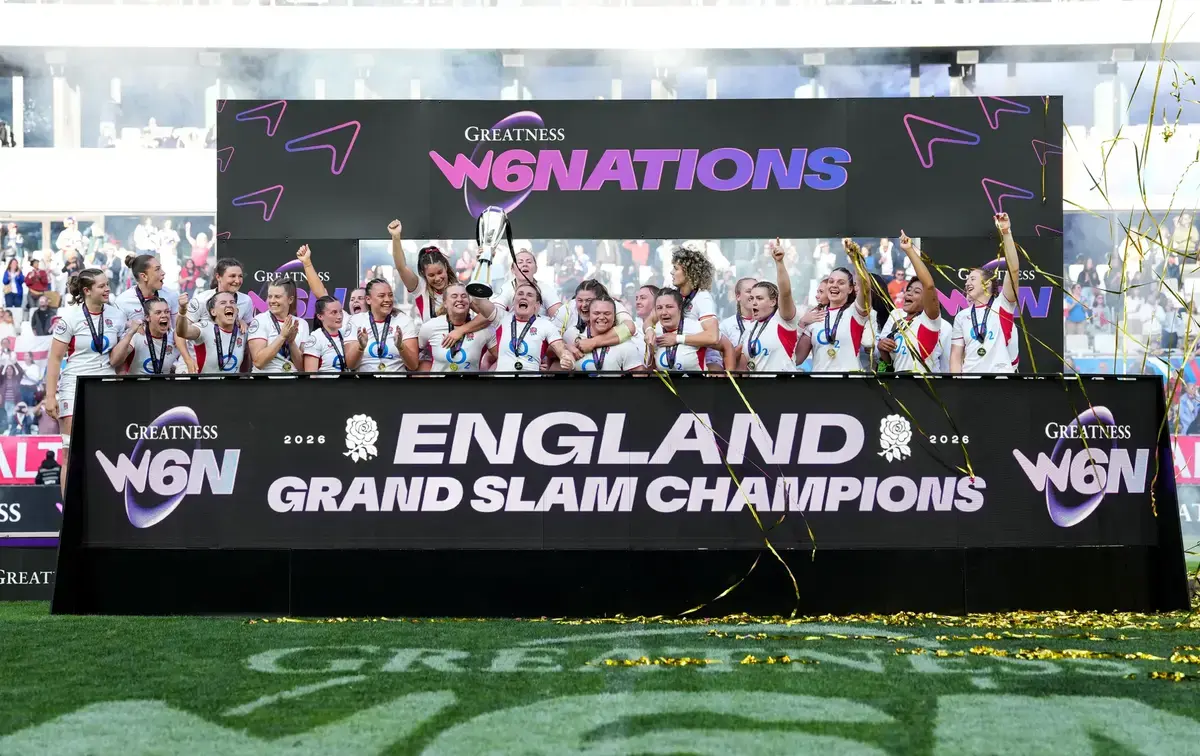
England’s Red Roses produced a devastating display of attacking rugby to thrash Scotland 59-7 at Mattioli Woods Welford Road, setting up a Grand Slam decider against France next Saturday at Twickenham.
Key Moments:
6′ – Kelsey Clifford try from close range, Holly Aitchison conversion (England 7-0 Scotland)
16′ – Marlie Packer try for her 50th England score, Holly Aitchison conversion (England 14-0 Scotland)
20′ – Zoe Aldcroft intercepts Helen Nelson’s pass for 40m try, Holly Aitchison conversion (England 21-0 Scotland)
27′ – Claudia MacDonald try after stepping multiple defenders, Holly Aitchison conversion (England 28-0 Scotland)
34′ – Abbie Ward powers over after Scottish lineout error, Holly Aitchison conversion (England 35-0 Scotland)
40′ – Lark Atkin-Davies try from short range, Holly Aitchison conversion (England 42-0 Scotland)
50′ – Claudia MacDonald scores her second after flowing team move, Holly Aitchison conversion (England 49-0 Scotland)
58′ – Lisa Thomson try from driving maul, Helen Nelson conversion (England 49-7 Scotland)
74′ – Abby Dow solo try with 50m run fending off three defenders, conversion missed (England 54-7 Scotland)
79′ – Abby Dow second try in the corner after quick hands, conversion missed (England 59-7 Scotland)
In front of 15,530 spectators in Leicester, John Mitchell’s side ran in nine tries, including braces for wingers Claudia MacDonald and Abby Dow, as they extended their remarkable winning streak to 24 matches and maintained their perfect record in this year’s championship.
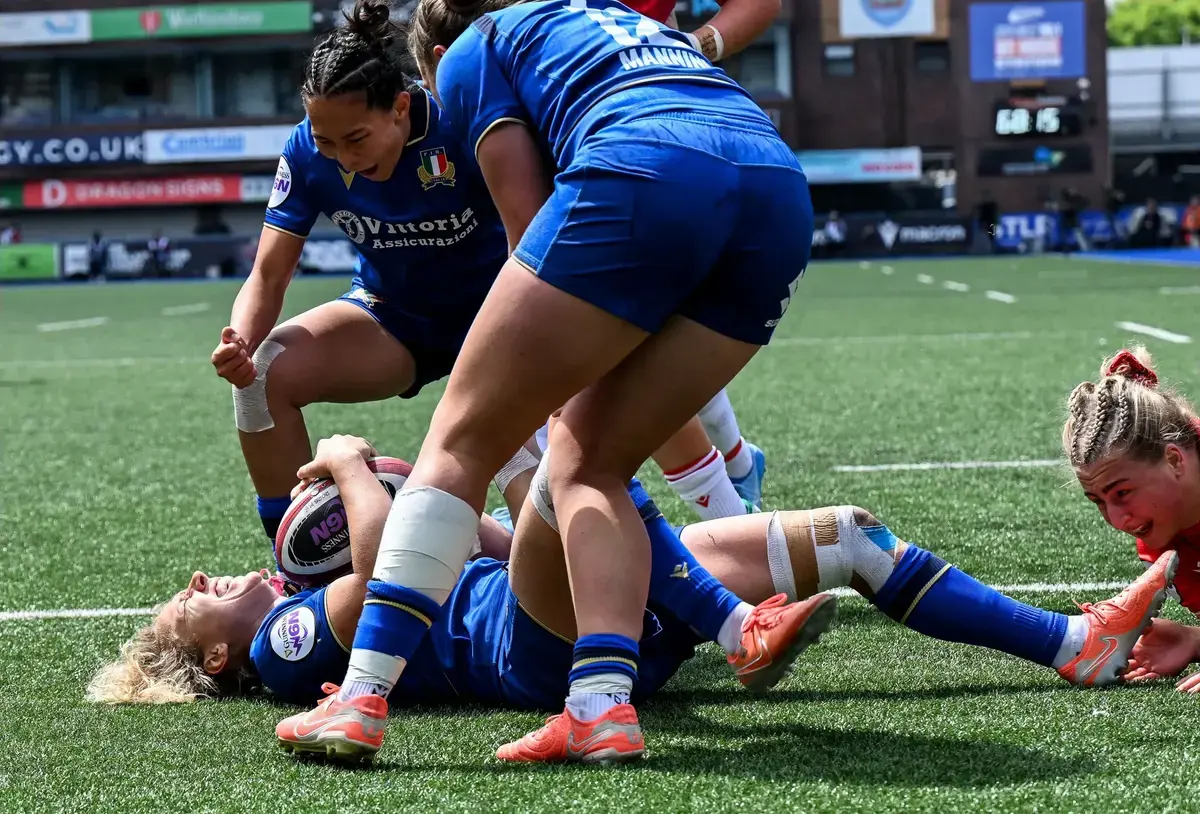
The victory ensures England remain top of the table ahead of next week’s finale against France, who earlier defeated Italy 34-21 despite trailing at half-time in Parma. The two unbeaten sides will now meet at Twickenham with the Six Nations title and Grand Slam at stake.
England had been criticised for slow starts in previous matches but there was no sign of hesitancy this time. They launched into action immediately, with MacDonald making early inroads on the left wing before prop Kelsey Clifford powered over from close range for the opening try after six minutes. The score came after patient build-up play with scrum-half Lucy Packer providing quick service, allowing Clifford to crash over for her second Test try in consecutive matches. Holly Aitchison slotted the first of her seven conversions to establish an early 7-0 lead.
Scotland attempted to respond but found themselves pinned back in their own half, with England’s defensive line speed nullifying any attacking threats. The visitors’ task was made harder by England’s dominance at the scrum, where Sarah Bern, making one of nine changes to Mitchell’s starting lineup, was a destructive presence.
The hosts continued to apply pressure and doubled their advantage in the 16th minute. Following a scrum five metres from the Scottish line, Maddie Feaunati carried powerfully before being brought down just short. Former captain Marlie Packer, reinstated to the starting XV after missing the Wales and Ireland fixtures, spotted a gap around the fringes and burrowed over for her landmark 50th international try. Packer’s achievement moves her above Rory Underwood in England’s all-time try-scoring charts, making her only the second England player to reach the half-century mark. Aitchison’s conversion made it 14-0.
England’s third try in the 20th minute exemplified captain Zoe Aldcroft’s intelligence and athleticism. With Scotland attempting to build an attack near halfway, Aldcroft – the only player to have started all four of England’s matches in this year’s tournament – read Nelson’s pass perfectly, intercepting the ball and accelerating away unchallenged to score under the posts. Aitchison’s straightforward conversion extended the lead to 21-0.
Scotland managed to enter England’s territory briefly through carries from Emma Orr and Fran McGhie, but the hosts’ defence remained resolute, forcing turnovers at crucial moments. England’s counter-attacking threat was evident throughout, with full-back Ellie Kildunne combining effectively with her wingers.
The bonus point was secured in the 27th minute through MacDonald, who had been a livewire all afternoon. After multiple phases in Scotland’s 22, Aitchison found MacDonald with a flat pass, allowing the Exeter Chiefs wing to showcase her footwork by stepping past multiple Scottish defenders before diving over in the corner. It was a timely reminder of her quality after returning from serious neck injuries that had threatened her career. Aitchison maintained her perfect record from the tee with a superb touchline conversion to make it 28-0.
England’s forward dominance was further emphasised in the 34th minute when lock Abbie Ward powered over for the fifth try. The score originated from a Scottish lineout error deep in their own territory, which England capitalised on through quick ball movement. After Jade Shekells made inroads in midfield with a powerful carry, Ward found herself in space five metres out and proved unstoppable from close range. Aitchison’s fifth successful conversion pushed the score to 35-0.
Just before half-time, England demonstrated their ruthless streak with a sixth try. Following sustained pressure in the Scottish 22, hooker Lark Atkin-Davies spotted a gap in the defence and dived over from short range with the clock in the red. Aitchison’s sixth conversion of the half gave England a commanding 42-0 lead at the interval.
The statistics told the story of England’s dominance – they had made 523 attacking metres compared to Scotland’s 128 in the first half, with the visitors struggling to cope with the hosts’ physicality and precision.
Scotland emerged for the second half with renewed determination, showing greater defensive organisation and managing to contain England during the opening exchanges after the restart. The visitors had clearly been galvanised by coach Bryan Easson’s half-time talk, as they began to contest breakdowns more effectively and improved their tackle completion rate.
However, England’s attacking prowess was too much to contain for long, and they struck again ten minutes into the second half with arguably the try of the match. The move began when Abby Dow fielded a clearance kick inside her own half before linking with Jade Shekells, who made ground down the right flank.
England’s rapid ball recycling and slick handling saw the ball transferred from right to left through multiple pairs of hands, with Marlie Packer delivering the final pass to MacDonald, who raced clear down the left wing for her second try. Aitchison maintained her perfect kicking record with another successful conversion, extending England’s lead to 49-0.
Mitchell took the opportunity to refresh his team, introducing his “bomb squad” front row of May Campbell, Hannah Botterman and Maud Muir, emphasising England’s remarkable squad depth. Captain Aldcroft was also withdrawn, with Morwenna Talling taking her place – a sign that England had one eye on next week’s crucial clash with France.
Scotland’s persistence was finally rewarded in the 58th minute when they constructed their most cohesive attack of the match. After winning a penalty, Nelson kicked to the corner, setting up a powerful driving maul that England struggled to contain. Scotland’s forwards, bolstered by several backs joining the drive, pushed over the line with centre Lisa Thomson being credited with the try after a TMO review. Nelson added the conversion to get the visitors on the scoreboard at 49-7.
The try seemed to sting England into action following a brief lull, although Scotland’s improved second-half performance was reflected in the fact that they restricted England to just three tries after the break. The visitors received a boost when Rhea Clarke entered the fray on the hour mark, creating a special moment as she joined sister Elliann Clarke on the pitch – the first time the siblings had played together for Scotland.
As the match entered its final quarter, England’s control was never in doubt, though Scotland continued to show fighting spirit. Elliann Clarke produced a key turnover, while Emma Orr’s tactical kicking pushed England back into their own half at times, giving the Scottish fans something to cheer about.
With ten minutes remaining, England demonstrated why they are ranked number one in the world with a moment of individual brilliance from Abby Dow. The Ealing Trailfinders wing received the ball on the right at the halfway line and set off on a sensational 50-metre run, brushing off three attempted Scottish tackles with powerful fends before accelerating away to score in the corner. It was a breathtaking display of strength and speed that had the Welford Road crowd on their feet. Aitchison’s conversion attempt drifted wide – her first miss after seven successful kicks – leaving the score at 54-7.
Scotland’s afternoon grew more challenging when full-back Chloe Rollie was shown a yellow card for a deliberate knock-on with just two minutes remaining. England took immediate advantage of the extra player, creating space on the right wing for Dow to score her second try. The move began with quick hands in midfield before MacDonald found Dow with a perfectly timed pass, allowing her to sprint over in the corner. Aitchison’s conversion attempt missed again, but by then the damage had been done with England running out emphatic 59-7 winners.
The match highlighted England’s remarkable depth, with Mitchell making nine changes to the side that defeated Ireland last week yet still producing their most dominant performance of the tournament. This selection flexibility has been a hallmark of England’s preparation for the home World Cup later this year.
“There are plenty of headaches for me, it’s a great side to select,” admitted Mitchell. “I have to sit down at home and make a few cups of tea and go through the spreadsheet to pick the side. We have two or three areas of selection I really have to think about.”
For MacDonald, who has battled back from serious neck injuries that threatened her career, the performance was particularly sweet. “Being out of the side for a while, I am loving every second,” she said. “There are so many amazing players in this squad and it’s just a privilege to be playing among them. I’m quite emotional to have won player of the match.”
She added: “The best is yet to come. Look at the skill we have throughout the squad. People say we need to be beaten but we beat each other up in training and push each other so hard.”
Scotland head coach Bryan Easson acknowledged the scale of the challenge his team faced but found positives in their second-half showing. “We didn’t do anything we said we should in the first half. We gave away far too many easy scores, but we showed pride and fight in the second half and can be proud of that.”
He continued: “Bridging the gap is tough because they have 40, 50, 60 players who can play at this level, but we will keep working hard to close the gap.”
Scotland captain Helen Nelson reflected on a tough day at the office: “We were frustrated at half-time. We showed glimpses in the first half but England are so clinical and score quickly. It was a much better second half from us.”
The victory means England remain on course for a seventh consecutive Six Nations title and fourth successive Grand Slam. They have now scored 213 points while conceding just 29 in their four matches, but will face their sternest test against a French side who have also won all their matches, albeit in less convincing fashion.
England have not lost to France since 2018 and will start as favourites, but Mitchell is taking nothing for granted. “Tactically we have to consider playing France. We are in a good place, the medical team have done a great job and we have our best players available.”
Aldcroft was similarly focused on the challenge ahead: “We know France are super, super-physical. We know they love a little offloading game. So hopefully next week will be about stopping them in those areas.”
For Scotland, who last defeated England in 1999, attention now turns to their final match against Ireland in Edinburgh, where they will aim to secure a second victory of the campaign following their opening win against Wales.
The dominating nature of England’s performance reinforced their status as the world’s top-ranked team as they continue their preparation for the home World Cup starting in August. The only question remaining is whether they can cap a perfect Six Nations campaign against their fiercest rivals next Saturday.