Connect with us

Six Nations

2026 Guinness Six Nations preview: Scotland v England

Published

on

Scotland's Ben White congratulates try scorer Huw Jones during the 2025 Six Nations Championship Round 3 between England and Scotland in Allianz Twickenham Stadium, London, England, Saturday, February 22, 2025 (Photo by James Crombie / Inpho)

When Scotland host England at Murrayfield on Saturday afternoon, far more than the Calcutta Cup will be at stake. This Valentine’s Day showdown represents a collision of contrasting narratives: England arrive on a twelve-match winning streak with championship aspirations burning brightly, while Scotland must summon the spirit of recent Calcutta Cup triumphs to salvage a campaign that has lurched into crisis after just one game.

The 144th edition of rugby union’s oldest international fixture promises to be as compelling as any that have preceded it. England, under Steve Borthwick, have developed a ruthless efficiency that yielded a 48-7 demolition of Wales in the opening round. Scotland, meanwhile, are reeling from their shock 18-15 defeat to Italy in Rome — a result that has intensified scrutiny on Gregor Townsend’s position and seen the hosts plummet to tenth in the world rankings.

A rivalry transformed

The historical ledger might favour England — 78 victories to Scotland’s 43, with 17 draws — but recent encounters have told a dramatically different story. Since ending a 38-year winless run at Twickenham in 2021, Scotland have seized the upper hand, winning four of the last five meetings. Townsend has accumulated five Six Nations victories over England, equalling Warren Gatland’s record for any head coach.

Last year’s encounter at Twickenham provided a stark illustration of how fine the margins have become. Scotland outscored England three tries to one, yet three missed conversions from Finn Russell proved costly as Borthwick’s side edged through 16-15. It was England’s first Calcutta Cup success since 2020 — and their first at Murrayfield since that storm-lashed 13-6 victory six years ago.

“It’s our biggest game of the season, it always has been,” acknowledged Townsend, who will take charge of his 100th Test on Saturday. “It’s even more important on the back of a defeat, a disappointing defeat. We know our supporters are behind us as they always are and we’ll need their energy at the weekend.”

England arrive with contrasting emotions. Number eight Ben Earl captured the visitors’ mindset when he revealed the post-match huddle after the Wales victory: “We said: ‘Well done, but we haven’t won at Murrayfield for years.’ We have got to right some wrongs.”

Townsend wields the axe

The Scotland head coach has responded to the Rome debacle with four changes to his starting XV, all in the pack. Most significantly, there will be no Edinburgh players in a Scotland starting line-up for the first time since 1998 — a damning indictment of the capital club’s decline while Glasgow Warriors dominate both the URC and Champions Cup.

British and Irish Lions loosehead Pierre Schoeman and 85-cap lock Grant Gilchrist have been dropped following a poor pack performance in Rome. Nathan McBeth, whose only previous Test start came against Chile on the 2024 summer tour, takes the number one jersey, while Gregor Brown comes into the second row alongside Scott Cummings. Jamie Ritchie returns at blindside flanker, his aerial prowess and breakdown nuisance value preferred to Matt Fagerson, who drops to the bench.

“Obviously it was a big decision not involving Grant,” Townsend conceded. “He has been excellent in this fixture. I can count on one hand the players who have given more in this jersey over the last ten years.”

Perhaps the most striking aspect of the selection is what remains unchanged. Duhan van der Merwe — who has scored seven tries in five Calcutta Cup appearances, including a hat-trick two years ago — remains on the sidelines. Blair Kinghorn, who carried for more metres (857), made more offloads (13), and linebreaks (9) than any other player in last year’s championship, is absent entirely from the matchday 23. Darcy Graham must settle for a place among the replacements.

Borthwick’s measured approach

In contrast to Scotland’s upheaval, England have made minimal changes. Captain Maro Itoje returns to the starting XV after coming off the bench against Wales following the recent death of his mother, while Luke Cowan-Dickie replaces Jamie George at hooker. The backline that dismantled Wales remains intact, with Henry Arundell — scorer of a first-half hat-trick — retaining his place on the left wing.

The only alteration to the matchday squad sees Fin Smith replace Marcus Smith among the replacements as part of a 6-2 bench split. It was Smith whose last-gasp penalty secured victory at Twickenham last year, a moment that will not be lost on the Scottish players.

Borthwick has expressed admiration for Townsend while acknowledging uncertainty about Scotland’s tactical approach. “Are they going to play that wide game, that phase attack, and get the ball in these players’ hands?” he pondered. “Or are they going to bring the kicking blend? Last year they brought a heavy kicking game and it turned into an arm-wrestle. If they bring that phase game, our defence has to be perfect.”

Team news

Scotland: Tom Jordan; Kyle Steyn, Huw Jones, Sione Tuipulotu (capt), Jamie Dobie; Finn Russell, Ben White; Nathan McBeth, George Turner, Zander Fagerson; Gregor Brown, Scott Cummings; Jamie Ritchie, Rory Darge, Jack Dempsey.
Replacements: Dave Cherry, Pierre Schoeman, Elliot Millar Mills, Max Williamson, Matt Fagerson, George Horne, Adam Hastings, Darcy Graham.

England: Freddie Steward; Tom Roebuck, Tommy Freeman, Fraser Dingwall, Henry Arundell; George Ford, Alex Mitchell; Ellis Genge, Luke Cowan-Dickie, Joe Heyes; Maro Itoje (capt), Ollie Chessum; Guy Pepper, Sam Underhill, Ben Earl.
Replacements: Jamie George, Bevan Rodd, Trevor Davison, Alex Coles, Tom Curry, Henry Pollock, Ben Spencer, Fin Smith.

Key players to watch

Scotland: Finn Russell — The mercurial fly-half has been the architect of Scotland’s recent Calcutta Cup successes, his ability to spot space and execute unorthodox passes unlocking even the most organised defences. Russell’s tactical kicking — the cross-field dinks and chips that have created tries — has been a hallmark of Scottish victories. If Scotland are to prevail, Russell must recapture the spark that has deserted him in recent months.

England: George Ford — The veteran fly-half has brought a level of control and order that has transformed England’s attacking threat. His player-of-the-match performance against Wales, in which he assisted two tries, underlined his enduring class. Ford’s battle with Russell will be pivotal; if he can impose his tempo on proceedings and neutralise Scotland’s unpredictability, England will be difficult to stop.

Where the battle will be won

The lineout: Scotland’s set-piece was a calamity in Rome, with throws going astray at the front, middle and back. Ewan Ashman’s injury-enforced absence hands George Turner a recall despite having made only one club start this season. England will target this area relentlessly; if Scotland cannot secure their own ball, they have no platform from which to attack.

The territorial battle: Smart kicking has been a hallmark of Scotland’s Calcutta Cup successes. In 2023 they racked up 1,306 metres with the boot, patiently outlasting England in territorial exchanges. Last year, Ben White’s box-kicking peppered Marcus Smith at full-back. With Freddie Steward now wearing the 15 jersey, Scotland must find new vulnerabilities to exploit.

The first twenty minutes: Scotland’s undoing in Rome came through a passive start that allowed Italy to establish dominance. Townsend has acknowledged that “the start of the game sets the tone of who we are.” England, meanwhile, had the best dominant carry (41%) and gainline success (73%) rates of any team in round one. If Scotland begin sluggishly again, the match could be over as a contest before half-time.

Did you know?

  • The Calcutta Cup is rugby’s oldest international trophy, first played for in 1879 and made from melted Indian rupees when the Calcutta Football Club closed
  • Scotland have won three of their four home games against England under Townsend, including the last two in a row
  • England have now won their last 12 matches in all competitions, their longest winning run since an 18-game streak between 2015 and 2017
  • Duhan van der Merwe has scored seven tries against England in the Six Nations, more than any other player
  • Tommy Freeman has scored in seven consecutive Six Nations matches, the longest such run since Italy joined the championship in 2000
  • This will be Gregor Townsend’s 100th Test match as Scotland head coach

The verdict

This is a fixture that Scotland simply cannot afford to lose. Defeat to England would represent more than merely a second consecutive setback — it would confirm the darkest fears of those who believe Townsend’s reign has run its course. The pressure on the hosts is immense, and the changes to the pack reflect the urgency of the situation.

Yet Scotland have form in this fixture, and that makes them dangerous. Townsend has forged a side that has consistently outwitted and outfought England in recent years, combining tactical discipline with the creative genius of Russell. The Murrayfield crowd will be electrified regardless of the backdrop, and rare is the day that Scotland fail to turn up against the auld enemy.

England’s superior form and confidence should ultimately tell. The return of Itoje adds leadership and ballast to a pack that is developing an increasingly ruthless edge, while the pace of Arundell, Earl and Henry Pollock offers the visitors multiple attacking threats. If England can navigate the early storm, impose their tempo, and avoid the individual errors that have plagued them at Murrayfield in recent years, they possess the class to win comfortably.

The danger, however, is that history repeats itself. Another slow start for Scotland, another period of English dominance that somehow fails to yield a decisive advantage, and Russell produces a moment of magic that turns the contest on its head. Borthwick must find a way to liberate his players from the weight of past failures while simultaneously demanding the accuracy and intensity that has been their trademark.

Recent form favours England, but recent history in this fixture favours the hosts. Scotland sense desperation; England must ensure they do not provide salvation.

Match officials

Referee: Nika Amashukeli (Georgia)
Assistant Referees: Andrea Piardi (Italy), Gianluca Gnecchi (Italy)
TMO: Marius van der Westhuizen (South Africa)

Kick-off: Saturday, 14th February 2026, 4.40pm GMT | Scottish Gas Murrayfield, Edinburgh

Continue Reading
Click to comment

Leave a Reply

Six Nations

Ireland survive Italian scare to claim unconvincing victory

Published

on

Ireland survive Italian scare to claim unconvincing victory
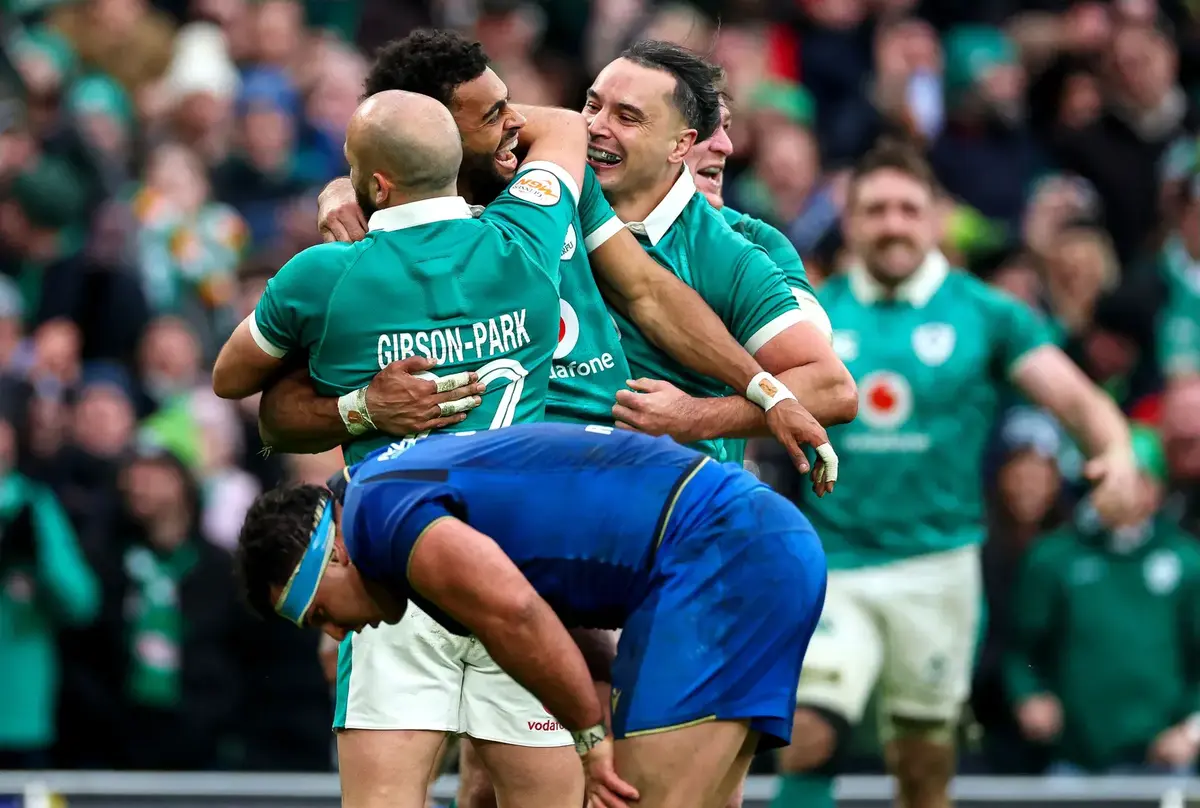
Ireland's Robert Baloucoune celebrates his try with Jamison Gibson-Park and James Lowe during the 2026 Guinness Six Nations Championship Round 2 game between Ireland and Italy in the Aviva Stadium, Dublin, Ireland, Saturday, February 14, 2026 (Photo by Dan Clohessy / Inpho)

Ireland survived an almighty scare to claim a hard-fought 20-13 victory over Italy at the Aviva Stadium, but this unconvincing performance will do little to silence the growing concerns surrounding Andy Farrell’s side ahead of next week’s trip to Twickenham.

Key moments:

11′ – YELLOW CARD ITALY: Louis Lynagh is shown yellow for a deliberate knock-on after flinging out a hopeful arm to intercept Sam Prendergast’s looping pass. James Lowe was unmarked behind him with a clear run to the line, making the decision straightforward for referee Hollie Davidson (Ireland 0-0 Italy)
17′ – TRY IRELAND: Jamie Osborne opens the scoring after patient phase play. Stuart McCloskey spins through contact and produces a sublime offload just before hitting the deck, finding the onrushing full-back who coasts over untouched. Prendergast inexplicably misses the conversion from directly in front of the posts (Ireland 5-0 Italy)
20′ – PENALTY ITALY: Paolo Garbisi gets the Azzurri on the board after Cormac Izuchukwu is penalised for hands in the air at a lineout. A cheap penalty to concede immediately after scoring (Ireland 5-3 Italy)
25′ – ITALY REPRIEVE: Lorenzo Pani demonstrates his attacking threat, chipping over the Irish defence and beating Sam Prendergast’s tackle before racing into the 22. His offload to the unmarked Michele Lamaro is fumbled with the try line begging — a moment that will haunt the Italian captain (Ireland 5-3 Italy)
32′ – YELLOW CARD IRELAND: Craig Casey is sin-binned for an upright tackle that results in head contact with Lorenzo Cannone. The diminutive scrum-half comes off worse in the collision, sporting a bloodied nose, but the letter of the law is applied. The bunker review confirms no upgrade to red (Ireland 5-3 Italy)
33′ – TRY ITALY: The Azzurri capitalise immediately on their numerical advantage. From the resulting lineout, Italy’s forwards establish a rumbling maul that Ireland simply cannot repel. Giacomo Nicotera breaks away from the back to touch down as Italian celebrations erupt. Garbisi converts from the touchline to give the visitors a deserved lead (Ireland 5-10 Italy)
40′ – SCRUM DOMINANCE: Italy win a thunderous scrum penalty on Ireland’s own put-in, the pack marching the hosts backwards with alarming ease. Simone Ferrari and the Italian front row celebrate wildly as tensions flare between the forwards. A statement of intent from Gonzalo Quesada’s men heading into the break
Half-time: Ireland 5-10 Italy
Ireland statistics: 40% possession, 45% territory. Italy: 226 tackles attempted (86% success), 3 scrum penalties won, dominant at set-piece. Ireland: 2 entries to Italian 22 without scoring, 2 missed conversions from Sam Prendergast.
43′ – TRY IRELAND: Ireland respond immediately after the restart. Andy Farrell’s half-time words have the desired effect as Prendergast kicks to the corner from a penalty. Jeremy Loughman is held up twice before Jack Conan spots a gap around the fringes and forces his way over from close range. Prendergast’s conversion drifts wide again — four points left on the tee (Ireland 10-10 Italy)
51′ – TRY DISALLOWED ITALY: Heartbreak for the Azzurri. Tommaso Menoncello produces a moment of magic, bursting through the Irish midfield with devastating footwork before floating a pass to Louis Lynagh on the right wing. The finish is emphatic, but TMO Ian Tempest correctly identifies that Menoncello’s pass drifted forward. The try is chalked off — a pivotal moment that shifts momentum decisively (Ireland 10-10 Italy)
56′ – CROWLEY ON: Jack Crowley replaces Sam Prendergast to the biggest roar of the afternoon. Whether relief at the change or enthusiasm for the Munster fly-half, opinions differ, but Ireland’s attacking tempo transforms almost immediately (Ireland 10-10 Italy)
58′ – TRY IRELAND: Robert Baloucoune marks his Six Nations debut in spectacular fashion. Ireland work overlaps on both flanks with Crowley orchestrating proceedings. Stuart McCloskey produces an outrageous basketball-style pass over the Italian defence, finding Baloucoune in space. The Ulster wing shows devastating acceleration, beating two defenders before stretching over in the corner. Crowley converts to give Ireland breathing room (Ireland 17-10 Italy)
63′ – PENALTY IRELAND: Crowley adds three more after Ireland’s patient phase play earns a penalty in front of the posts. The Munster fly-half is two from two since his introduction as Ireland establish a ten-point cushion (Ireland 20-10 Italy)
66′ – PENALTY ITALY: The Italian scrum continues to dominate as Tadhg Furlong is lifted clean off his feet by replacement loosehead Mirco Spagnolo — a sight rarely witnessed in the veteran prop’s illustrious career. Garbisi makes no mistake with the resulting kick to reduce the deficit to seven (Ireland 20-13 Italy)
70′ – DEBUT FOR EDOGBO: Edwin Edogbo enters the field to warm applause, becoming the first player from Cobh Pirates to represent Ireland. The Munster second row’s remarkable journey — through two ruptured Achilles tendons — reaches its destination with ten minutes remaining
77′ – ITALY AGONISINGLY CLOSE: Paolo Garbisi chips over the rushing Irish defence and Tommaso Menoncello is one bounce of the ball away from scoring under the posts. The ball bobbles agonisingly past his fingertips as Ireland survive another heart-stopping moment (Ireland 20-13 Italy)
83′ – LOWE INTERCEPT SEALS VICTORY: The match-winning moment arrives from Italian error. With the Azzurri camped on the edge of the Irish 22 and desperately seeking an equalising score, Monty Ioane inexplicably throws a pass straight into the arms of James Lowe. The Irish wing sprints 80 metres upfield to earn a penalty that would have set up a bonus-point opportunity (Ireland 20-13 Italy)
83′ – CROWLEY KICKS DEAD: An anticlimactic ending as Crowley, pointing to the corner in pursuit of a fourth try, misjudges his kick and sends the ball dead. The bonus point slips away, but Ireland have the victory. A fitting conclusion to a fitful afternoon (Ireland 20-13 Italy)
Full-time: Ireland 20-13 Italy

The hosts trailed 10-5 at half-time — Italy’s first ever Six Nations lead in Dublin — against opponents brimming with confidence following their opening-round victory over Scotland. It required the introduction of Jack Crowley and Jamison Gibson-Park from the bench to inject the tempo and precision that had been sorely lacking throughout a disjointed first-half display.

Robert Baloucoune marked his Six Nations debut with a try that proved decisive, while James Lowe’s intercept in the dying moments finally allowed Ireland’s supporters to exhale after 83 minutes of anxiety. Yet the manner of victory, achieved against opponents who have never won a championship match in Dublin, raised more questions than it answered about Ireland’s title credentials.

Italy, who made 226 tackles against Scotland last week, were even more ferocious in the Irish capital. Their scrum dominated Ireland’s vaunted pack throughout, with Simone Ferrari and the impressive front row earning three penalties and leaving even the legendary Tadhg Furlong struggling when he entered the fray. The Azzurri will rue the disallowed try for Louis Lynagh, chalked off for Menoncello’s forward pass, and Michele Lamaro’s fumbled offload when a try seemed certain in the first half.

Early exchanges promised much before familiar failings emerged

Ireland began with the intent that Andy Farrell had demanded, Robert Baloucoune claiming an early high ball with authority and James Lowe looking dangerous with ball in hand. The hosts won an early scrum penalty when Danilo Fischetti collapsed, and when Dan Sheehan attempted to power over from close range, it appeared Ireland would make their dominance count.

However, Ferrari’s thunderous hit on the hooker — who illegally leapt into contact — set the tone for Italian resistance that would define the afternoon. It was a portent of things to come; Ireland would repeatedly threaten the Italian 22 only to be repelled by desperate defending or undone by their own profligacy.

Louis Lynagh’s yellow card for a deliberate knock-on in the 11th minute, preventing what would have been a certain try for Lowe, should have opened the floodgates. Instead, Ireland laboured for six more minutes before Jamie Osborne finally crossed, the full-back timing his run perfectly to receive Stuart McCloskey’s offload after the Ulster centre had spun through contact.

Sam Prendergast’s missed conversion from directly in front of the posts proved emblematic of Ireland’s afternoon. The young fly-half, under intense scrutiny following his struggles in Paris, endured another difficult outing — his tactical kicking wayward, his defence exposed — before being replaced by Crowley midway through the second half.

Italy seize control as scrum dominance tells

Paolo Garbisi’s penalty reduced the deficit to two points before Italy truly found their rhythm. Lorenzo Pani, earning his first start in almost two years, demonstrated the kicking range that had earned him selection by threatening repeatedly from deep. His chip and chase in the 25th minute saw him beat Prendergast’s tackle and race into the Irish 22, only for Lamaro to fumble the offload with the try line beckoning.

The reprieve proved temporary. Craig Casey’s yellow card for an upright tackle on Lorenzo Cannone — the scrum-half coming off worse in a collision that left him with a bloodied nose — handed Italy the numerical advantage they craved. Within a minute, Giacomo Nicotera had crashed over from a driving maul that Ireland simply could not repel, Garbisi’s conversion giving the visitors a deserved 10-5 lead at the interval.

The Italian celebrations were raucous, their media contingent in the press box reportedly on their feet when Ferrari won a scrum penalty against Sheehan. They sensed history; they were 40 minutes from becoming the first Italian side to win a Six Nations match at the Aviva Stadium.

Farrell’s bench proves decisive as Ireland rally

Whatever Andy Farrell said at half-time had immediate effect. Tadhg Furlong’s introduction stabilised the scrum sufficiently for Ireland to win a penalty from which they kicked to the corner. c powered over from close range after Jeremy Loughman had been held up twice, though Prendergast’s second missed conversion from a kickable position kept Italy within touching distance.

The game’s pivotal moment arrived in the 51st minute. Menoncello, who had been outstanding throughout, burst through the Irish midfield with devastating footwork before floating a pass to Lynagh on the right wing. The finish was emphatic, but TMO Ian Tempest correctly identified that Menoncello’s pass had drifted forward. The try was disallowed, and the momentum shifted irrevocably.

Crowley’s introduction for Prendergast was greeted with the biggest roar of the afternoon. What proved undeniable was the transformation in Ireland’s attacking tempo. Gibson-Park’s arrival added further urgency, and within three minutes of entering the fray, Crowley had orchestrated the try that would seal victory.

McCloskey’s basketball-style pass over the Italian defence found Baloucoune in space, and the Ulster wing showed devastating acceleration to beat two defenders and stretch over in the corner. Crowley’s conversion and subsequent penalty stretched the lead to ten points, though Garbisi’s three-pointer from another dominant scrum ensured Italy remained within a converted try.

Nerve-shredding finale as Italy throw everything at Ireland

The final quarter was an exercise in anxiety management for Irish supporters. Italy’s scrum continued to dominate, with Furlong lifted clean off his feet by replacement loosehead Mirco Spagnolo — a sight rarely witnessed in the veteran prop’s illustrious career. Garbisi’s resulting penalty reduced the deficit to seven with 14 minutes remaining.

Italy threw everything at Ireland in the closing stages. Menoncello repeatedly found gaps in the Irish midfield, while Garbisi’s tactical kicking pinned the hosts deep in their own territory. In the 77th minute, the Italian fly-half chipped over the rush defence and Menoncello was agonisingly close to gathering a favourable bounce that would have put him clear under the posts.

Edwin Edogbo, the Munster second row, was introduced for his Ireland debut with ten minutes remaining, becoming the first player from Cobh Pirates to represent his country. His remarkable journey — through two ruptured Achilles tendons that sidelined him for two years — reached its destination at a moment when Ireland required fresh legs and renewed energy.

Gibson-Park’s box-kicking proved crucial in the final exchanges, repeatedly finding touch deep in Italian territory. But the decisive moment arrived from Italian error rather than Irish excellence.

With the Azzurri camped on the edge of the Irish 22 and desperately seeking the converted try that would level the scores, the ball was worked wide to Monty Ioane. The experienced wing inexplicably threw a pass straight into the arms of James Lowe, who sprinted 80 metres upfield to earn a penalty.

Ireland sensed an opportunity to claim a bonus point that had seemed unlikely for much of the afternoon. Crowley pointed to the corner, seeking one final assault on the Italian line. But his kick sailed too long, drifting into the in-goal area and out of play. The chance was gone, the bonus point squandered, but the victory secured.

“It’s not my fault it was a bad kick,” referee Hollie Davidson could be heard saying as Ireland players questioned why play wasn’t brought back. An unfortunate ending for Crowley, whose introduction had otherwise transformed Ireland’s fortunes.

Verdict: More questions than answers for Farrell

Captain Caelan Doris acknowledged the scale of Ireland’s struggles: “It was a proper battle the whole way through. That last ten-minute period, we defended quite a bit in our own 22, so I’m happy with some of the character we showed. Italy played some very good stuff and tested us throughout. I feel there’s some stuff we left out there, we weren’t clinical enough, some of our discipline was a little bit off.”

Man of the match Baloucoune reflected on a memorable Six Nations debut: “Even to get a chance to get into the Six Nations camp was unbelievable, but to get to play and score on my Six Nations debut has been unreal. Faz told me to go out there and express myself, and I feel like I’ve done that.”

For Italy, despite extending their winless run in Dublin, this was a performance that confirmed their opening victory over Scotland was no fluke. Gonzalo Quesada’s side were physically dominant for long periods, their scrum a revelation against vaunted opposition, and only a forward pass and a fumbled offload separated them from a historic triumph.

The statistics told a damning story for Ireland: physically dominated at the scrum, second best at the gainline on both sides of the ball, and reliant on their bench to rescue a performance that had drifted alarmingly off course. The return of Crowley and Gibson-Park proved decisive, raising inevitable questions about whether Farrell’s starting selections were correct.

Ireland now travel to Twickenham to face an England side who demolished Wales 48-7 earlier in the afternoon, Henry Arundell claiming a hat-trick as Steve Borthwick’s men ran riot. On this evidence, the visit represents a formidable challenge that will expose any recurring frailties. The scrum, in particular, requires urgent attention if Ireland are to avoid another chastening afternoon.

For Italy, a trip to Paris awaits against the defending champions. While victory seems unlikely, this performance suggests Quesada’s side will provide France with a far sterner examination than many might expect. The days of Italy being Six Nations whipping boys are emphatically over.

Ireland: Jamie Osborne; Robert Baloucoune, Garry Ringrose, Stuart McCloskey, James Lowe; Sam Prendergast (Jack Crowley 56), Craig Casey (Jamison Gibson-Park 53); Jeremy Loughman (Tom O’Toole 66), Dan Sheehan (Rónan Kelleher 53), Thomas Clarkson (Tadhg Furlong 40); Joe McCarthy (Tadhg Beirne 53), James Ryan (Edwin Edogbo 70); Cormac Izuchukwu (Nick Timoney 59), Caelan Doris (capt), Jack Conan.

Italy: Lorenzo Pani; Louis Lynagh, Leonardo Marin, Tommaso Menoncello, Monty Ioane; Paolo Garbisi, Alessandro Fusco (Alessandro Garbisi 70); Danilo Fischetti (Mirco Spagnolo 60), Giacomo Nicotera (Tommaso Di Bartolomeo 60), Simone Ferrari (Muhamed Hasa 60); Niccolò Cannone, Andrea Zambonin (Federico Ruzza 53); Michele Lamaro (capt), Manuel Zuliani (Riccardo Favretto 66), Lorenzo Cannone (David Odiase 70).
Replacements not used: Italy — Paolo Odogwu.

Referee: Hollie Davidson (SRU)

Continue Reading

Six Nations

2026 Guinness Six Nations preview: Ireland v Italy

Published

on

2026 Guinness Six Nations preview: Ireland v Italy
Italy's Tommaso Menoncello is tackled by Caelan Doris of Ireland during the 2025 Guinness Six Nations Championship Round 5 game between Italy and Ireland in the Stadio Olimpico, Rome, Italy, Saturday, March 15, 2025 (Photo by Ben Brady / Inpho)

When Ireland host Italy at the Aviva Stadium on Saturday afternoon, the hosts will be seeking far more than merely their twelfth consecutive victory in this fixture. After the chastening experience of Paris, Andy Farrell’s side must rediscover their identity — and quickly — against opponents who arrive in Dublin with genuine belief that an historic upset is within reach.

The Valentine’s Day kick-off adds a romantic flourish to proceedings, though Ireland supporters will be hoping for considerably more passion from their side than was evident in last week’s 36-14 capitulation to France. Italy, meanwhile, are riding the crest of a wave following their stirring 18-15 victory over Scotland in Rome — their first opening-round triumph since 2013.

A rivalry transformed

The historical ledger makes for predictable reading: Ireland have won 34 of 38 meetings between these nations, including 24 of 25 Six Nations encounters. Yet those bare statistics obscure a more nuanced reality. Italy have emerged from the wilderness, winning three of their last four Tests and demonstrating a tactical sophistication that has confounded even the most established opponents.

Last year’s encounter in Rome provided a stark warning. Ireland scraped home 22-17, requiring Dan Sheehan’s hat-trick of tries to survive a ferocious Italian challenge. The margin flattered the visitors; Gonzalo Quesada’s men had them rattled for long periods, and only desperate defending in the final quarter preserved Ireland’s winning streak.

“We’ve had some great battles against Italy in recent years and Saturday will be no different,” acknowledged Farrell this week. The Ireland head coach knows better than anyone that this fixture no longer represents the comfortable outing it once did. The Azzurri have claimed four victories in their last five meetings with Wales and stunned Scotland at Murrayfield in last year’s championship. They fear no one.

Italy have never beaten Ireland in Dublin in championship rugby — indeed, their sole Six Nations victory came in Rome in 2013 — but this may represent their finest opportunity in years. Ireland arrive wounded, their confidence fragile after France exposed structural weaknesses that had been papered over during the autumn. The Azzurri, conversely, possess momentum, belief, and a tactical clarity that has been years in the making.

Farrell’s selection gamble

The Ireland head coach has responded to the Paris debacle with six changes to his starting XV, the most significant of which comes at openside flanker. Josh van der Flier, the 2022 World Rugby Player of the Year, has been dropped from the matchday 23 entirely — a seismic call that reflects both Ireland’s desperate need for change and the depth of their current malaise.

Captain Caelan Doris shifts to the seven jersey, with Jack Conan promoted to start at number eight and the athletic Cormac Izuchukwu earning his Six Nations debut at blindside. The Ulster back-rower, born in London to an Irish mother and Nigerian father before being raised in Offaly, brings raw physicality and lineout prowess to a pack that was bullied in Paris.

Elsewhere, Robert Baloucoune’s recall on the right wing represents a gamble on explosive potential over proven reliability. The 28-year-old has been in scintillating form for Ulster — six tries in six appearances — but has not worn the green jersey since November 2022. James Lowe returns on the opposite flank after being controversially dropped for the France fixture, while Craig Casey replaces Jamison Gibson-Park at scrum-half.

Perhaps the most intriguing subplot concerns Edwin Edogbo, the Munster second row who is poised to become the first player from Cobh Pirates to represent Ireland. The 23-year-old’s journey to the cusp of international rugby — through a second ruptured Achilles tendon that sidelined him for two years — represents a triumph of perseverance that transcends mere sport.

Quesada’s quiet confidence

While Ireland have torn up their team sheet, Italy have done precisely the opposite. Gonzalo Quesada has made just one enforced change from the side that outmuscled Scotland in Rome’s biblical rain, with Lorenzo Pani replacing Juan Ignacio Brex (absent for family reasons) in a reshuffled backline.

The decision to overlook Ange Capuozzo, despite the Toulouse star returning to fitness this week, speaks volumes about Quesada’s faith in his winning formula. Leonardo Marin shifts from full-back to inside centre, partnering Tommaso Menoncello in a combination that the Argentina-born coach has long earmarked as Italy’s midfield future.

“The human side and family — from my point of view — will always be considered a priority,” Quesada explained of Brex’s absence. “We discussed it with him, and the decision made is for the best.” Such man-management has been a hallmark of Quesada’s tenure, fostering a unity within the Italian camp that has translated into results on the pitch.

The Azzurri’s defensive display against Scotland was nothing short of remarkable: 226 tackles at 86 per cent efficiency, including a 29-phase defensive stand in the dying minutes that preserved their precious lead. Niccolò Cannone made 26 successful tackles — more than any other player in round one — while captain Michele Lamaro pilfered two Scottish lineouts to disrupt their opponents’ primary attacking platform.

Team news

Ireland: Jamie Osborne; Robert Baloucoune, Garry Ringrose, Stuart McCloskey, James Lowe; Sam Prendergast, Craig Casey; Jeremy Loughman, Dan Sheehan, Thomas Clarkson; Joe McCarthy, James Ryan; Cormac Izuchukwu, Caelan Doris (capt), Jack Conan.
Replacements: Rónan Kelleher, Tom O’Toole, Tadhg Furlong, Edwin Edogbo, Tadhg Beirne, Nick Timoney, Jamison Gibson-Park, Jack Crowley.

Italy: Lorenzo Pani; Louis Lynagh, Tommaso Menoncello, Leonardo Marin, Monty Ioane; Paolo Garbisi, Alessandro Fusco; Danilo Fischetti, Giacomo Nicotera, Simone Ferrari; Niccolò Cannone, Andrea Zambonin; Michele Lamaro (capt), Manuel Zuliani, Lorenzo Cannone.
Replacements: Tommaso Di Bartolomeo, Mirco Spagnolo, Muhamed Hasa, Federico Ruzza, Riccardo Favretto, David Odiase, Alessandro Garbisi, Paolo Odogwu.

Key players to watch

Ireland: Dan Sheehan — The Leinster hooker has become Ireland’s most potent weapon against the Azzurri, scoring a hat-trick in the 36-0 victory of 2024 and adding two more in last year’s narrow escape in Rome. The first forward to reach ten Six Nations tries, Sheehan’s ability to finish from close range and his carrying prowess through the middle third could prove decisive. If Ireland establish their driving maul, he will be central to their attacking threat.

Italy: Tommaso Menoncello — The Benetton centre made 103 metres against Scotland on a waterlogged pitch that should have rendered such statistics impossible. At 22, he has already established himself as one of European rugby’s most exciting talents, combining devastating footwork with the physical presence to break the gainline. His partnership with Leonardo Marin, both products of Benetton’s academy, represents Italy’s best hope of breaching Ireland’s defensive line.
Where the battle will be won

The breakdown: France’s aggressive counter-rucking exposed Ireland’s vulnerability over the ball last week, slowing their attacking tempo and forcing errors. Van der Flier’s omission — the player who has defined Ireland’s jackalling threat for the past decade — represents a calculated gamble that Doris, Conan and Izuchukwu can provide equivalent intensity. Italy will target this area relentlessly, with Lamaro and Manuel Zuliani both excellent at slowing opposition ball.

Discipline: Italy conceded 16 penalties against Scotland, a figure that would prove fatal against an Irish side whose driving maul remains one of their most reliable weapons. Every infringement in the opposition 22 provides Farrell’s men with an opportunity to establish their lineout and generate the kind of close-range pressure that produced Sheehan’s tries last year. Quesada has emphasised this concern repeatedly; whether his players can heed the warning remains to be seen.

The aerial battle: Both coaches have selected full-backs with exceptional kicking range. Jamie Osborne was one of Ireland’s better performers in Paris, while Lorenzo Pani’s promotion to the starting XV comes specifically because of his long-range boot. The territorial battle could prove decisive, particularly given the contrasting attacking philosophies: Ireland seeking to establish field position before launching their multi-phase assaults, Italy looking to counter-attack from turnovers and broken play.

Did you know?

  • Ireland have won their last 11 Six Nations matches against Italy, their longest winning streak in the fixture
  • Italy’s sole championship victory over Ireland came in Rome in 2013, a 22-15 triumph
  • Dan Sheehan has scored five tries in his last two appearances against Italy
  • This will be the first men’s Six Nations match refereed by a woman, with Scotland’s Hollie Davidson taking charge
  • Italy have won three of their last four Test matches, their best run since 2013
  • Ireland have never lost to Italy at the Aviva Stadium in championship rugby

The verdict

This is a fixture that Ireland simply cannot afford to lose. Defeat to Italy would represent more than merely a second consecutive setback — it would confirm the darkest fears of those who believe this squad has peaked and is now in decline. The pressure on Farrell’s men is immense, and the wholesale changes to his selection reflect the urgency of the situation.

Yet Italy arrive with genuine belief, and that makes them dangerous. Quesada has forged a side that competes physically, defends with discipline, and possesses the attacking weapons to punish any lapse in concentration. The Marin-Menoncello midfield combination offers creativity, Louis Lynagh provides a threat on the edge, and the Cannone brothers anchor a pack that has proven itself capable of matching anyone at set-piece time.

Ireland’s superior firepower should ultimately tell. The return of Lowe adds a cutting edge that was sorely missed in Paris, while the McCloskey-Ringrose midfield partnership offers experience and nous in the crucial collisions. If Ireland can establish their driving maul, generate quick ball at the breakdown, and avoid the individual errors that plagued them last week, they possess the class to win comfortably.

The danger, however, is that Ireland’s confidence remains fragile. Another slow start, another period of Italian dominance, and the Aviva Stadium could become a cauldron of anxiety rather than a fortress of support. Farrell must find a way to liberate his players from the weight of expectation while simultaneously demanding the accuracy and intensity that has been their trademark.

History favours the hosts, but history has been rewritten before. Italy sense an opportunity; Ireland must ensure they do not provide one.

Match Officials

Referee: Hollie Davidson (SRU)
Assistant Referees: Matthew Carley (RFU), Luc Ramos (FFR)
TMO: Ian Tempest (RFU)
Kick-off: Saturday, 14th February 2026, 2.10pm | Aviva Stadium, Dublin

Continue Reading

Six Nations

Townsend wields axe as Scotland make four changes for England

Published

on

Townsend wields axe as Scotland make four changes for England
Scotland's Pierre Shoeman during the warm up ahead of the 2026 Guinness Six Nations Championship Round 1 game between Italy and Scotland in Stadio Olimpico, Rome, Italy, Thursday, February 7, 2026 (Photo by Bryan Keane / Inpho)

Gregor Townsend has made four changes to his Scotland starting XV for Saturday’s Calcutta Cup clash against England at Murrayfield, with the axe falling heavily on Edinburgh as the capital club finds itself without a single representative in the starting line-up for the first time since 1998.

The selection marks a remarkable nadir for Edinburgh, who have seen their influence on the national team dwindle alarmingly while Glasgow Warriors have surged to dominance in both the United Rugby Championship and Champions Cup. Ten Glasgow players will start on Saturday, a stark illustration of the disparity between Scotland’s two professional clubs.

Schoeman and Gilchrist pay the price

British and Irish Lions loosehead Pierre Schoeman and 85-cap lock Grant Gilchrist have been dropped following a poor pack performance in the shock 18-15 defeat by Italy in Rome. Nathan McBeth, whose only previous Test start came against Chile on the 2024 summer tour, takes the number one jersey, while Gregor Brown comes into the second row alongside Scott Cummings.

The decision to omit Gilchrist was clearly difficult for Townsend. “Obviously it was a big decision not involving Grant,” the head coach said. “He has been excellent in this fixture. I can count on one hand the players who have given more in this jersey over the last ten years. His physicality, his effort. So he’s not got an opportunity to bounce back after the defeat last weekend.”

Ewan Ashman, who endured a torrid afternoon at the lineout in the Stadio Olimpico, has been ruled out with a neck injury. His absence hands Harlequins hooker George Turner, 33, a recall to the starting XV despite having made only one club start this season. “Ewan being injured is a blow for him,” Townsend said. “He’s been one of our best players over the last couple of seasons.”

Ritchie returns to back row

The final change sees Jamie Ritchie return to the back row in place of Matt Fagerson, who drops to the bench. The former captain was not involved in the Rome defeat, and his aerial game and ability as a third lineout jumper have convinced Townsend to restore him to the starting XV. Ritchie packs down alongside Rory Darge and Jack Dempsey in a back row that will need to match England’s formidable trio of Guy Pepper, Sam Underhill and Ben Earl.

Van der Merwe and Kinghorn remain frozen out

Perhaps the most striking aspect of the selection is what remains unchanged. The backline that struggled in the Roman rain stays intact, meaning there is still no place for Duhan van der Merwe, Darcy Graham or Blair Kinghorn. Van der Merwe has been a standout figure in the Calcutta Cup in recent years, scoring crucial tries in Scotland’s victories, yet finds himself surplus to requirements.

The Glasgow duo of Kyle Steyn and Jamie Dobie retain their wing berths, with Tom Jordan at full-back. Finn Russell and Ben White continue at half-back, while Sione Tuipulotu and Huw Jones form the centre partnership.

“It was a difficult decision going into the Italy game and not involving Duhan, Darcy and Blair, three quality players,” Townsend acknowledged. “But those three who got selected ahead were in really good form. What the back three did in the kick battle was excellent. How they’ve been training has been superb, so we’re backing them again this week.”

Controversial bench split retained

Townsend has also opted to retain the 5-3 bench split that drew heavy criticism in Rome, where specialist fly-half Adam Hastings did not see a single minute of action despite being among the replacements. Dave Cherry, the 35-year-old who plays for Vannes in the French second division, continues as replacement hooker, while Graham earns the meagre consolation of a place on the bench.

“The team we’ve selected, we feel, has players who can make a really good impact at the start of the game,” Townsend said. “But also as we go into that final quarter, we understand that Test rugby is a 23-man game and we’ll be using the bench this week because we know England are going to do that.”

Townsend appeals for support

With pressure mounting on his position following the Italy defeat and Scotland’s slide to 10th in the world rankings, Townsend made an impassioned appeal for the Murrayfield crowd to stick with his team. For the first time in living memory, Scotland were booed off the field by their own supporters after throwing away a 21-point lead against Argentina last November.

“It’s our biggest game of the season, it always has been,” he said. “It’s even more important on the back of a defeat, a disappointing defeat. We know our supporters are behind us as they always are and we’ll need their energy at the weekend. The atmosphere at Murrayfield has been very special over the last few years and I’m sure they’re going to the game with huge expectation and hope.”

England’s 16-15 victory at Twickenham last March ended a run of four consecutive Scottish successes in the Calcutta Cup. England last won at Murrayfield six years ago, but arrive on a 12-match winning streak and as heavy favourites to retain the trophy.

Scotland team to face England

Starting XV: 15. Tom Jordan; 14. Kyle Steyn; 13. Huw Jones; 12. Sione Tuipulotu (captain); 11. Jamie Dobie; 10. Finn Russell; 9. Ben White; 1. Nathan McBeth; 2. George Turner; 3. Zander Fagerson; 4. Scott Cummings; 5. Gregor Brown; 6. Jamie Ritchie; 7. Rory Darge; 8. Jack Dempsey.
Replacements: 16. Dave Cherry; 17. Pierre Schoeman; 18. Javan Sebastian; 19. Max Williamson; 20. Matt Fagerson; 21. Ali Price; 22. Adam Hastings; 23. Darcy Graham.

Continue Reading

Trending

Discover more from Rugby News, Results, and Analysis | Rugby is the Game

Subscribe now to keep reading and get access to the full archive.

Continue reading