
Six Nations
Italy survive Scottish siege to claim famous Roman victory

Published
2 weeks agoon
Italy withstood a desperate 29-phase Scottish assault in the dying moments to secure a famous 18-15 victory in torrential rain at the Stadio Olimpico, condemning Gregor Townsend’s side to a damaging Six Nations defeat that intensifies scrutiny on the embattled head coach.
In conditions that deteriorated throughout the afternoon, the Azzurri raced into a 12-0 lead inside 14 minutes through tries from Louis Lynagh and Tommaso Menoncello before Paolo Garbisi’s boot maintained their advantage. Though Jack Dempsey and George Horne crossed for the visitors, Scotland’s malfunctioning set-piece and handling errors proved their undoing as Italy held firm through an extraordinary finale to secure only their third victory over Scotland in 39 meetings.
The result marks Scotland’s first opening-round defeat since 2020 and their second loss to Italy in three years on Roman soil. With England visiting Murrayfield for the Calcutta Cup next weekend, Townsend now faces the most uncomfortable questions of his nine-year tenure as speculation about his future reaches fever pitch.
Key moments
8 mins – TRY ITALY: Louis Lynagh opens the scoring after Juan Ignacio Brex’s perfectly weighted grubber kick finds the Benetton wing in acres of space to gather and aquaplane over. Paolo Garbisi’s conversion hits the post (Italy 5-0 Scotland)
14 mins – TRY ITALY: Tommaso Menoncello scores Italy’s second try with devastating effect. After Louis Lynagh rises to claim Paolo Garbisi’s bomb above Jamie Dobie, Michele Lamaro delivers a looping pass left to Menoncello on the wing who accelerates up the touchline to score. Paolo Garbisi converts (Italy 12-0 Scotland)
24 mins – TRY SCOTLAND: Jack Dempsey provides Scotland’s response with a try from close range. After 14 phases of pressure, Matt Fagerson delivers a delicate offload and Dempsey shows exceptional footwork to step inside Giacomo Nicotera before barging through Paolo Garbisi and Simone Ferrari. Finn Russell converts (Italy 12-7 Scotland)
35 mins – PENALTY ITALY: Paolo Garbisi extends the lead from the tee seconds after missing a drop-goal attempt from directly in front. Award came after Italy win a lineout penalty for Scotland playing the jumper in the air (Italy 15-7 Scotland)
Half-time: Italy 15-7 Scotland.
Italy statistics: 116 tackles made to Scotland’s 25, scrum dominance, 68% territory. Scotland: 5 lineouts lost on own throw, set-piece creaking badly.
47 mins – PENALTY SCOTLAND: Finn Russell cuts the deficit with his first penalty after Italy penalised for offside (Italy 15-10 Scotland)
50 mins – PENALTY ITALY: Paolo Garbisi slots three points after Ewan Ashman penalised for high tackle on Manuel Zuliani. TMO review confirms penalty only with low degree of danger (Italy 18-10 Scotland)
55 mins – YELLOW CARD SCOTLAND: George Turner shown yellow card for dangerous clearout at breakdown, leading with shoulder to back of Manuel Zuliani’s head. Previously awarded penalty to Scotland reversed. Bunker review confirms yellow card only. Ewan Ashman forced to return temporarily as Rory Darge departs to provide front-row cover (Italy 18-10 Scotland)
68 mins – TRY SCOTLAND: George Horne scores crucial try after spotting gap on blind side from driving maul and sliding into the corner through standing water. Finn Russell’s conversion from touchline drifts wide (Italy 18-15 Scotland)
80+ mins – HELD UP: After 29 phases of desperate Scottish pressure in the final play, Max Williamson held up over the line by swarming Italian defence. Ball fails to emerge from ruck and referee Ben O’Keeffe blows for full-time.
Full-time: Italy 18-15 Scotland
Match report
And so they said that Italy could not sustain their upward trajectory in the face of an improving Scotland side boasting Glasgow Warriors’ domestic dominance. Consider that notion most definitively dismissed.
On an afternoon of genuine Roman resilience, Italy laid down a Six Nations marker with a display of tactical nous and defensive heroism to rival any produced during their recent renaissance under Gonzalo Quesada. Led by captain Michele Lamaro on his 50th cap alongside Paolo Garbisi and Juan Ignacio Brex marking the same milestone, the Azzurri looked down on a fancied opponent and perhaps exiled them from title contention for good, leaving Scotland confronting the grim realities of what feels like terminal stagnation under Gregor Townsend.
“Absolutely incredible, I think that shows how much we care for each other, how much we care for this jersey, for this country,” Lamaro said afterwards, barely able to contain his emotion. “This is us. We are here to do these sort of games. That last phase, I couldn’t watch. Well done to the boys, fully deserved. Now we’ve got a dream in our head. We keep going on.”
The hypothesis had been that Scotland’s experience and Glasgow Warriors’ domestic dominance would prove too much for an injury-ravaged Italian side missing star fullback Ange Capuozzo, alongside Tommaso Allan, Sebastian Negri, Gianmarco Lucchesi, Ross Vintcent and both first-choice scrum-halves. It was a theory backed up by the form book: Scotland had won 14 of the last 16 meetings. But this felt like the first time Italy have truly imposed their gameplan on Scotland since their famous 31-29 comeback victory in this fixture two years ago, controlling territory, dominating set-piece and refusing to yield when the pressure mounted.
The 2:10pm GMT kick-off was greeted by a sell-out crowd of 68,245 at the Stadio Olimpico, and the home supporters sensed an opportunity from the moment Lamaro, Brex and Garbisi were given the honour of entering the field before their teammates. The roar threatened to lift the stadium roof. The morning rain and hail had temporarily eased, but darker clouds loomed ominously overhead.
Scotland, reshaped by Townsend with Bristol’s Tom Jordan at fullback and Glasgow wingers Kyle Steyn and Jamie Dobie flanking him — notable omissions being Blair Kinghorn, Darcy Graham and record try-scorer Duhan van der Merwe — knew they needed a fast start. Few predicted the comprehensive nature of their early dismantling.
The visitors actually began with possession, but their first lineout exposed what would become a recurring nightmare. Ewan Ashman’s throw was picked off by Andrea Zambonin, and Italy gratefully accepted the gift. The tone was set for an evening of Scottish frustration. Italy had been warned — and they capitalised ruthlessly.
The opening try arrived after just eight minutes through excellent Italian execution. From an early lineout, Tommaso Menoncello’s powerful carry set up loose ball. Alessandro Fusco, showing clever game management, fooled the Scottish defence into thinking he was moving left before going right. Brex produced a perfectly weighted grubber kick behind the tackle line, threading it between Huw Jones and Jamie Dobie. Lynagh, timing his run superbly, found acres of space to gather and aquaplane over for a wonderfully crafted score. Garbisi’s conversion struck the post, but the Azzurri had drawn first blood in style.
Six minutes later came the defining moment of the first half. Fusco hoisted a high ball that Lynagh rose magnificently to claim, comprehensively beating Dobie in the aerial battle. From quick ball, Lorenzo Cannone fired a glorious miss-one pass wide to Menoncello. The 22-year-old centre, showing the class that earned him 2024 Player of the Championship honours, accelerated up the touchline with sufficient space to beat the cover defence and dive over. Garbisi converted, and at 12-0 after just 14 minutes, Scotland were shell-shocked.
The visitors’ only option was to dig deep and battle for everything. Even that strategy was barely enough as the conditions deteriorated dramatically. The rain, which had been intermittent early on, intensified into a deluge midway through the first half, transforming the pitch into a quagmire. Standing water became visible across the playing surface, and every kick that landed first skidded unpredictably before players aquaplaned through the puddles.
Scotland finally found the tryline through their forwards after extended pressure. Following multiple penalties for Italian offside and obstruction, the visitors worked through 14 phases in the Italian 22. On two occasions Ashman took tap penalties at close quarters, showing Scotland’s determination to cross the line rather than accept three points. From the second, Matt Fagerson delivered a delicate pop pass to Jack Dempsey. The number eight showed exceptional footwork to step inside Nicotera before barging through Garbisi and Ferrari to dive over from two metres. Russell’s conversion made it 12-7 after 24 minutes, and briefly Scotland had hope.
But Garbisi responded immediately with a penalty in the 35th minute. His earlier drop-goal attempt from 15 metres — directly in front and with all the time in the world — had sailed horribly wide in what would have been an astonishing score. But from the tee he made no mistake to extend the lead to 15-7 heading into the break.
At half-time and with Italy having made an extraordinary 116 tackles to Scotland’s 25 in the opening 40 minutes, the interval provided merciful respite for Townsend’s shell-shocked side. The statistics painted a brutal picture: Italy had enjoyed 68% territory, demolished the scrum repeatedly, and Scotland had lost five lineouts on their own throw. It was old-fashioned forward dominance married to clinical finishing, and the visitors had no answer.
The second half began as the first had ended — in torrential rain that made handling treacherous and turned the contest into a test of set-piece strength and tactical kicking. Scotland won an early lineout in the Italian 22 but Ashman’s throw was wayward again, with Menoncello threatening on the break-out before Italy infringed on the deck. Two more lineouts misfired for Scotland before they finally retained ball and Russell cut the deficit with his first penalty in the 47th minute after Italy were caught offside.
Within three minutes, Garbisi had responded. After sustained pressure, he added another penalty in the 50th minute following a high tackle from Ashman on Manuel Zuliani. The TMO bunker review confirmed head contact but deemed it a penalty only with a low degree of danger. That proved to be Ashman’s final contribution — and not before time. His lineout throwing had been wayward throughout, his scrummaging shaky, and his breakdown work ineffective. It had been, by any measure, a torrid afternoon for the Edinburgh hooker.
George Turner entered the fray alongside Darcy Graham for Jamie Dobie, but the replacement hooker’s afternoon would soon take a dramatic turn. With Scotland finally building momentum and attacking in the Italian 22, they won a penalty that Russell was preparing to kick for goal. But the TMO alerted referee Ben O’Keeffe to dangerous play by Turner at the previous breakdown. The Scottish replacement had led with his shoulder into the back of Zuliani’s head in an illegal clearout. Turner was shown a yellow card, the penalty was overturned, and Scotland’s momentum evaporated. The bunker review confirmed the yellow rather than upgrading to a 20-minute red card, but the damage was done.
Rory Darge had to depart to enable Ashman to return temporarily for scrum duty during Turner’s absence, disrupting Scotland’s back row. With 14 men, Scotland’s scrum continued to creak, repeatedly driven backwards by an Italian pack marshalled superbly by props Danilo Fischetti and Simone Ferrari. When the Italian bomb squad arrived — Tommaso Di Bartolomeo, Mirco Spagnolo and Muhamed Hasa replacing the entire front row in the 58th minute — they continued the dominance, earning an immediate scrum penalty accompanied by the roar of an increasingly jubilant Olimpico crowd.
Yet Scotland, to their credit, found a way through Italy’s resolute defence in the 68th minute. From a penalty, Russell kicked to the corner rather than taking three points. The lineout was won through Scott Cummings — a rare success — and the driving maul was set. When it was held on the 5m line, George Horne, who had brought energy since replacing Ben White four minutes earlier, spotted a gap on the blind side and darted for the corner. Using the waterlogged surface to his advantage, he slid in from a few metres out with centimetres to spare for his 12th try for Scotland. Russell’s conversion attempt from the touchline drifted wide, leaving Scotland trailing 18-15 with 12 minutes remaining.
The final quarter became a test of Italian resolve and Scottish desperation. Italy dominated territory as the clock became their best friend, showing game management that would have been unthinkable from them in previous years. After 78 minutes, another Scottish scrum penalty enabled Russell to clear, but Italy’s control of field position kept Scotland pinned back.
With the clock deep into the red, Scotland won a penalty and launched one final assault. What followed was extraordinary. From their own 10-metre line, they went through phase after phase, but the Italian defence held firm with ferocious commitment. One, two, three phases became ten, then twenty, as Scotland desperately searched for a gap.
The ball moved left and right, with Scotland making minimal ground against bodies that refused to break. Tom Jordan slipped on the treacherous surface. Handling errors threatened to end the attack. Players aquaplaned through standing water. Still they came, reaching 27, 28, 29 phases in an extraordinary display of attacking ambition that ultimately came to nothing.
“I could really feel my heart beating,” Quesada revealed afterwards. “I said, ‘What’s going on? I’m breathing. I’m okay. Nothing bad will happen.’ We were not even getting out of the defensive line because the referee was really hard on us… I was really suffering.”
Finally, with the entire stadium holding its breath, Max Williamson attempted to power over from close range. Italian defenders swarmed around the ball carrier in numbers, driving him backwards and holding him up in the tackle. The ball failed to emerge from the ruck, and O’Keeffe had no choice but to blow his whistle for full-time.
The explosion of emotion was instantaneous and immense. Italian players collapsed in tears of joy. Lamaro was engulfed by teammates. The sell-out Roman crowd erupted in celebration of a famous victory earned through tactical nous, set-piece dominance and heroic defensive resolve — holding out for 29 phases and over two minutes of added time without conceding a penalty.
For Scotland, the post-mortem will be painful. Their set-piece statistics made for alarming reading: five lineouts lost on their own throw, multiple scrum penalties conceded, and a complete inability to function in wet conditions. “Very frustrating,” captain Sione Tuipulotu reflected. “We probably let them score too easily in the first 20 minutes. In these conditions, it’s hard to come across points. We were too loose in the carry. They ultimately adjusted better and that’s what won them the game. That’s on us, isn’t it?”
Townsend attempted to focus on the positives while acknowledging the scale of disappointment: “Hugely disappointed to lose your first game in the tournament, makes things tougher. Obviously, the guys are very disappointed. The effort was there. A lot of what we trained was in place. We just gave away too many possessions. We weren’t able to score more points in the first half. It was extremely difficult in the second half but the effort the players put in was tremendous, just not enough to win the game.”
Asked directly if he still had the appetite to turn things around ahead of England’s visit, Townsend said: “Absolutely. We have a game in seven days’ time. We have got a game to review, a selection to be put together. That’s all we’re motivated by. I believe in them, I believe in what we’re doing. Today it didn’t happen and we’re going to make sure it happens next week.”
On the positive side for Scotland, despite trailing for the entire match and playing with 14 men for 10 minutes, they showed character in fighting back to within three points. George Horne’s energy off the bench provided a spark, and Darcy Graham — introduced in the 49th minute — offered glimpses of threat. But despite employing 29 phases in their final attack, this met with no reward against a defence that simply would not break.
Most concerning was the performance at set-piece. Ashman’s lineout throwing was wayward throughout — at least five turnovers on Scotland’s throw — while the scrum was repeatedly driven backwards. Grant Gilchrist put in an atypically poor shift in both set-piece and loose play. When Mirco Spagnolo entered as a replacement loosehead, he “absolutely munched” Zander Fagerson according to The Times’ match report, continuing Italy’s scrum dominance.
For Italy, the future gleams with possibility. Lamaro, inevitably, was magnificent — his breakdown work, his defensive leadership, his carries all functioning at the highest level on his landmark cap. Garbisi showed excellent game management despite those two wayward drop-goal attempts, controlling territory through his tactical kicking while landing three from four off the tee. And the clinical finishing from Lynagh and Menoncello demonstrated that Italy now possess genuine attacking weapons.
Lynagh, speaking afterwards, revealed the try-scoring blueprint: “We talked beforehand. It was the first time those three played together [in Scotland’s back three]. We didn’t necessarily say, ‘Look for the backfield space,’ it just happened to open up. We put the ball there and luckily I scooped up and scored.”
As for the conditions, the Benetton winger admitted: “A few school games back in the UK, but that’s probably the worst conditions I’ve played in – and that’s saying something!”
The depth provided by replacements Federico Ruzza, Riccardo Favretto and the entire new front row suggests Quesada’s squad possesses the resources to target a first top-three finish. Player of the match Simone Ferrari, the Benetton tighthead, epitomised Italy’s forward dominance with his scrum destruction throughout.
Quesada, reflecting on the growth his side has shown, was understandably emotional: “I’m absolutely proud. Especially how much we are growing on the game management. We scored from a couple of set-piece moves we prepared. They respected their roles, the timing, the execution, and we scored. It was a great game and [we showed] a lot of character at the end.”
Looking ahead to the trip to Dublin to face Ireland, who themselves suffered a chastening opening-round defeat to France, Quesada added: “Now we’ve got a complex match against Ireland and we must be ready, continuing to prepare well.”
The Cuttitta Cup, awarded to the winner of this fixture in memory of Italian brothers Massimo and Marcello Cuttitta, now resides in Italian hands for the second time in three years. On this evidence, Italy have well and truly arrived as a force capable of troubling any side in the championship. Their back-to-back home wins over Scotland in Rome represent a seismic shift in this fixture’s dynamics.
For Scotland, what was supposed to be a campaign built on Glasgow Warriors’ unbeaten domestic form has begun in familiar fashion — with defeat, disappointment and difficult questions. With England arriving at Murrayfield next Saturday carrying an 11-match winning streak, the pressure on Townsend has never been more intense in his nine-year tenure.
As Scotland’s supporters trudged away through the Roman rain, the question hanging in the damp air was simple: how much longer can this go on?
Teams
Italy: Leonardo Marin; Louis Lynagh, Juan Ignacio Brex, Tommaso Menoncello, Monty Ioane; Paolo Garbisi, Alessandro Fusco; Danilo Fischetti, Giacomo Nicotera, Simone Ferrari; Niccolò Cannone, Andrea Zambonin; Michele Lamaro (capt), Manuel Zuliani, Lorenzo Cannone.
Replacements: Tommaso Di Bartolomeo (for Nicotera, 58), Mirco Spagnolo (for Fischetti, 58), Muhamed Hasa (for Ferrari, 58), Federico Ruzza (for Zambonin, 68), Riccardo Favretto (for Zuliani, 54-58 temp), Alessandro Garbisi (for Fusco, 61), Giacomo Da Re (not used), Lorenzo Pani (for Marin, 73).
Scotland: Tom Jordan; Kyle Steyn, Huw Jones, Sione Tuipulotu (capt), Jamie Dobie; Finn Russell, Ben White; Pierre Schoeman, Ewan Ashman, Zander Fagerson; Scott Cummings, Grant Gilchrist; Matt Fagerson, Rory Darge, Jack Dempsey.
Replacements: George Turner (for Ashman, 49), Nathan McBeth (for Schoeman, 28-36 blood, then 64), Elliot Millar Mills (for Fagerson, 64), Max Williamson (for Gilchrist, 49), Gregor Brown (for M. Fagerson, 64), George Horne (for White, 64), Adam Hastings (not used), Darcy Graham (for Dobie, 49).
What they said
Michele Lamaro (Italy captain): “Absolutely incredible, I think that shows how much we care for each other, how much we care for this jersey, for this country. This is us. We are here to do these sort of games. That last phase, I couldn’t watch. Well done to the boys, fully deserved. I couldn’t ask more from the boys [on my 50th cap]. It’s been an absolute pleasure for me, an absolute honour to get this big achievement. Now we’ve got a dream in our head. We keep going on. When we play in a conscious way, when we demonstrate who we are, we can put many teams in difficulty, and today you saw that.”
Gonzalo Quesada (Italy head coach): “I’m absolutely proud. Especially how much we are growing on the game management. We scored from a couple of set-piece moves we prepared. They respected their roles, the timing, the execution, and we scored. It was a great game and [we showed] a lot of character at the end. I could really feel my heart beating. I said, ‘What’s going on? I’m breathing. I’m okay. Nothing bad will happen.’ We were not even getting out of the defensive line because the referee was really hard on us. Today we had excellent players both in the starting lineup and on the bench. We have a lot of confidence in all our players and in the work of our group.”
Sione Tuipulotu (Scotland captain): “Very frustrating. We probably let them score too easily in the first 20 minutes. In these conditions, it’s hard to come across points. After when the rain did start coming down after 20 minutes, we struggled to find field position and adjust properly to how the game was going. That’s on us. It’s on us, isn’t it? We were too loose in the carry. They ultimately adjusted better and that’s what won them the game. Ultimately, we’ve still got four more games left in the Six Nations and ones that we need to front up for.”
Gregor Townsend (Scotland head coach): “Hugely disappointed to lose your first game in the tournament, makes things tougher. Obviously, the guys are very disappointed. The effort was there. A lot of what we trained was in place. We just gave away too many possessions. We weren’t able to score more points in the first half. It was extremely difficult in the second half but the effort the players put in was tremendous, just not enough to win the game. I believe in them, I believe in what we’re doing. Today it didn’t happen and we’re going to make sure it happens next week. We saw our supporters on the way to the game today. They mean a huge amount to us and we’re really disappointed for them that we didn’t find a way to win.”
Louis Lynagh (Italy wing): “We talked beforehand. It was the first time those three played together [in Scotland’s back three]. We didn’t necessarily say, ‘Look for the backfield space,’ it just happened to open up. A few school games back in the UK, but that’s probably the worst conditions I’ve played in – and that’s saying something!”
What’s next
Italy travel to Dublin to face Ireland at the Aviva Stadium on Saturday, 14th February (14:10 GMT), looking to build momentum against a side still reeling from their opening-round defeat to France. The teams last met in Dublin with Ireland winning 36-0, but there was just five points between them in Rome last year.
Scotland welcome England to Murrayfield for the Calcutta Cup on Saturday, 14th February (16:40 GMT), with Townsend’s men desperate to respond following this chastening defeat — their first opening-round loss since 2020. England arrive on an 11-match winning streak.
Player of the Match: Simone Ferrari (Italy)
Referee: Ben O’Keeffe (New Zealand)
Assistant Referees: James Doleman (New Zealand), Katsuki Furuse (Japan)
TMO: Richard Kelly (New Zealand)
Attendance: 68,245
Share this:

You may like
-


France grind down spirited Italy to maintain Grand Slam charge
-


Russell inspires dramatic Scotland comeback to break Welsh hearts
-


Ireland reborn as ruthless display blows away rudderless England
-


France reshuffle backline after Jalibert ruled out of Italy clash
-


2026 Guinness Six Nations preview: England v Ireland
-


2026 Guinness Six Nations preview: Wales v Scotland
Six Nations
France grind down spirited Italy to maintain Grand Slam charge
Published
1 day agoon
22nd February 2026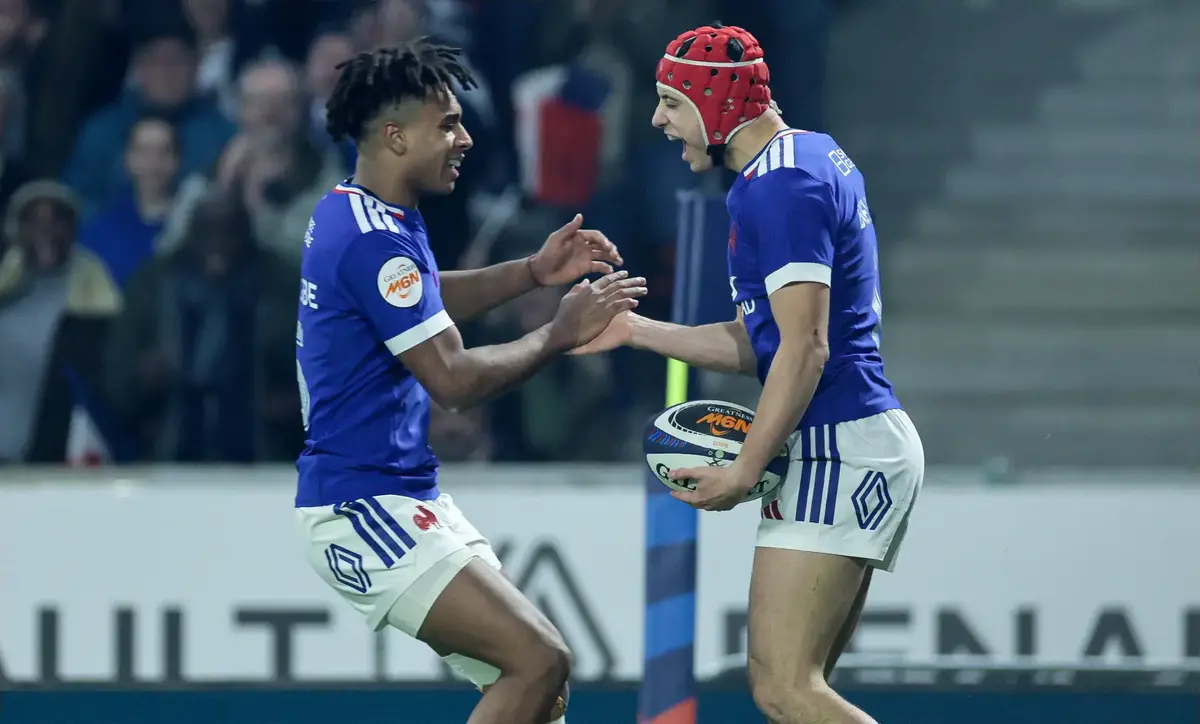
France maintained their relentless march towards a first Grand Slam since 2022 with a bonus-point 33-8 victory over Italy under the closed roof of the Stade Pierre-Mauroy in Lille, though Fabien Galthié’s side were made to work considerably harder than the final scoreline suggests by an Azzurri outfit who refused to buckle for the best part of 70 minutes.
Key moments:
4 mins – TRY FRANCE: Louis Lynagh spills a high ball on halfway and the loose ball falls to Antoine Dupont, who launches a perfectly weighted kick behind the Italian defence. Louis Bielle-Biarrey outpaces Ange Capuozzo in the footrace and grounds the ball deep in the in-goal area, scoring in a record eighth consecutive Six Nations match. Thomas Ramos converts (France 7-0 Italy)
15 mins – TRY FRANCE: Thomas Ramos lands a superb 50:22 to give France an attacking lineout inside the Italian 22. After several phases of close-range battering from the French forwards, Antoine Dupont delivers a flat pass to Emmanuel Meafou, who powers through the tackles of Louis Lynagh and Monty Ioane to crash over for his first international try. Thomas Ramos pushes his conversion wide (France 12-0 Italy)
29 mins – TRY FRANCE: Giacomo Nicotera’s lineout throw sails over the heads of his jumpers and Louis Bielle-Biarrey hacks the loose ball ahead. Émilien Gailleton pounces and explodes into a 60-metre sprint upfield. Hauled down just short of the line, the centre finds Thomas Ramos in support, and the stand-in fly-half beats two defenders before grounding the ball in the left corner. Ramos converts his own try (France 19-0 Italy)
32 mins – TRY ITALY: Tommaso Menoncello’s clever grubber kick behind the French defence forces Thomas Ramos into a panicked pass to Théo Attissogbe. The stand-in fullback opts to run from his own try line rather than kick and is swarmed by Italian chasers. The ball spills loose from the resulting ruck into the in-goal area and Ange Capuozzo, returning from a fractured finger, is the quickest to react, diving on it for Italy’s first try. Paolo Garbisi’s conversion from wide on the right drifts past the post (France 19-5 Italy)
38 mins – INJURY FRANCE: Jean-Baptiste Gros is forced off with a calf complaint. Rodrigue Neti replaces the loosehead prop (France 19-5 Italy)
40 mins – PENALTY ITALY: Danilo Fischetti destroys Dorian Aldegheri at scrum time to win a dominant penalty. Paolo Garbisi slots the kick from 37 metres, just to the left of the posts (France 19-8 Italy)
Half-time: France 19-8 Italy
71 mins – YELLOW CARD ITALY: Louis Lynagh rushes up from the side of a ruck and commits a deliberate knock-down to prevent a French break. Referee Andrew Brace consults with the TMO over a potential penalty try, but the presence of a covering defender behind Lynagh means Italy escape with a yellow card and a penalty. France kick for the corner (France 19-8 Italy)
72 mins – TRY FRANCE: From the resulting lineout, France form a driving maul that surges towards the Italian line, sucking in the depleted defence. Thomas Ramos then executes a sumptuous cross-field kick to the right wing, where debutant Gaël Dréan — called into the starting XV barely 12 hours before kick-off — gathers cleanly in acres of space and touches down for his first international try. Thomas Ramos converts from five metres in from the right touchline (France 26-8 Italy)
77 mins – TRY FRANCE: Louis Bielle-Biarrey zips down the short side before weaving infield. After Lenni Nouchi and Mickaël Guillard take carries inside the 22, Théo Attissogbe is contained near the right corner before France swing it left with two long passes. Émilien Gailleton steps past Paolo Odogwu and slices through the gap to score France’s fifth try. Thomas Ramos converts from 15 metres in from the left touchline (France 33-8 Italy)
Full-time: France 33-8 Italy
Leading 19-8 at half-time after a clinical opening half-hour, the reigning champions were held scoreless for more than 40 minutes of play as Italy’s ferocious defence and dominant scrum kept the contest alive deep into the final quarter. It was only after Louis Lynagh’s yellow card for a deliberate knock-down in the 71st minute that the floodgates finally opened, with tries from debutant Gaël Dréan and Émilien Gailleton in the closing stages turning a hard-fought contest into a deceptively comfortable victory.
The afternoon had begun with unwelcome news for French supporters. Matthieu Jalibert, the in-form fly-half who had scored in each of the opening two rounds, was ruled out on the eve of the match with a calf complaint. The late withdrawal forced a backline reshuffle, with Thomas Ramos shifting to fly-half for his 50th cap, Théo Attissogbe moving to fullback and Toulon’s Dréan parachuted into the starting XV on the wing for what would be a memorable first international appearance. The disruption was significant — France were accustomed to operating with two playmakers at 10 and 15, and instead found themselves with three specialist wingers in their back three — but the depth of Galthié’s squad ensured there was no sense of panic.
Whatever adjustments were required, they did not prevent France from striking with devastating speed. The match was barely four minutes old when Louis Lynagh spilled a high ball on halfway, the loose ball falling into Antoine Dupont’s grateful hands. The captain needed no second invitation, launching a perfectly weighted kick behind the Italian defence for the irrepressible Bielle-Biarrey to outpace Ange Capuozzo in the footrace and ground the ball deep in the in-goal area. It was the Bordeaux-Bègles wing’s try in a record eighth consecutive Six Nations match, and his 24th in just 25 international appearances — numbers that defy belief for a 22-year-old who continues to rewrite the record books with every outing. Ramos added the conversion and France appeared poised to run riot.
A sublime 50:22 from Ramos — who had endured a nervy start, throwing an interception and kicking out on the full — created the platform for France’s second try in the 15th minute. After the lineout, Fabien Brau-Boirie powered into contact and offloaded to Gailleton, who was tackled ten metres out. Ramos and Dréan were both denied from close range on the right as Italy’s defensive wall held firm, but the rampant pressure eventually told. Two phases later, Dupont delivered a flat pass to Emmanuel Meafou on a devastating line and the giant Toulouse lock powered through the tackles of Lynagh and Monty Ioane to crash over for his first international try. Ramos pushed his conversion wide, but at 12-0 after a quarter of an hour, France appeared to be cruising.
Italy, however, were far from cowed. Gonzalo Quesada’s men showed the same combative spirit that had seen them defeat Scotland in round one and push Ireland to the wire in Dublin a week earlier. Leonardo Marin burst through midfield on a searing break that carried Italy deep into the French 22, with Capuozzo and Lynagh in support, but the wing was hauled down just short and the attack faltered at the breakdown. Minutes later, Manuel Zuliani pulled off a brilliant intercept on Thomas Ramos that momentarily had the visitors dreaming of a riposte, but the French scramble defence recovered. Most impressively of all, Italy worked through ten phases inside the French 22 after winning a penalty, with Marin surging powerfully to the five-metre line before Zuliani spilled the ball in contact. The visitors were knocking on the door but could not find the key, and Dupont’s remarkable turnover on Tommaso Menoncello just metres from the try line — snatching the ball from the Italian centre’s hands as he was held up in the air — was a defining moment of the first half.
Their inability to convert pressure into points proved costly, as France struck again on the half-hour with a try born of Italian misfortune and French ruthlessness. Giacomo Nicotera’s lineout throw sailed over the heads of his jumpers and Bielle-Biarrey hacked the loose ball ahead off the side of his boot. Gailleton, alive to the opportunity, sprinted onto it and exploded into a 60-metre run upfield, with Lynagh gaining ground in the chase. When the centre was finally hauled down short of the line, he found Ramos in support, and the stand-in fly-half showed admirable determination to spin past two defenders and ground the ball in the corner. Ramos converted his own try to extend the lead to 19-0, and French supporters could have been forgiven for thinking the floodgates were about to open.
To their immense credit, Italy hit back within three minutes with a try that owed as much to French carelessness as Italian opportunism. Menoncello’s clever grubber kick behind the defence put pressure on Ramos, who tapped it back dangerously infield to Attissogbe. The stand-in fullback, opting to run from his own try line rather than kick to safety, was swarmed by three Italian chasers and tackled just two metres from his own line. The ball then spilled free from the ruck into the in-goal area, and Capuozzo — returning from a fractured finger suffered late last year — swooped through to ground it for a try that underlined Italy’s refusal to submit. Paolo Garbisi’s conversion from wide on the right drifted past the post, but the fly-half did reduce the deficit further on the stroke of half-time. Danilo Fischetti, who had been dominant throughout, destroyed Dorian Aldegheri at scrum time to win a penalty, and Garbisi slotted the kick from 37 metres to make it 19-8.
France had also suffered a blow before the interval when loosehead prop Jean-Baptiste Gros was forced off with a calf complaint, with Rodrigue Neti replacing him — a disruption that would contribute to the scrum difficulties that plagued the hosts in the second period.
The second half descended into an attritional arm-wrestle that bore little resemblance to the free-flowing rugby France had produced in their 36-14 victory over Ireland and 54-12 demolition of Wales. Italy’s scrum continued to provide a steady stream of penalties, with Fischetti and Simone Ferrari winning two more set-piece awards that kept them in French territory, while their breakdown pressure disrupted Dupont’s usually silky service. At one point early in the second half, Italy strung together several phases inside the French 22 as Alessandro Fusco and Capuozzo probed for weaknesses, but Menoncello — who twice interrupted dangerous French attacks with outstanding defensive interventions — epitomised the visitors’ refusal to yield.
The French, for their part, were guilty of uncharacteristic handling errors. Attissogbe fumbled a high ball from the restart, Gailleton overran a short pass from Ramos, and Bielle-Biarrey spilled possession in the aerial contest — errors that stifled momentum and kept the scoreboard frozen. France’s frustration was palpable when, around the hour mark, they pounded away at the Italian line through Meafou, Georges-Henri Colombe and Thibaud Flament, only for Brau-Boirie to knock on under pressure from a swarm of red jerseys just a metre short. Italy’s lineout — their one significant weakness on the afternoon, with several overthrows from Nicotera — continued to malfunction and hand France attacking opportunities, yet the visitors’ tackle count climbed relentlessly as they threw their bodies into every collision.
The decisive turning point arrived in the 71st minute. Dupont passed to the left where Lynagh rushed up from the side of a ruck and knocked down the pass deliberately to prevent the break. Referee Andrew Brace consulted with the TMO over a potential penalty try, but the presence of a covering defender behind Lynagh meant Italy escaped with a yellow card. It was, nonetheless, the moment the match tilted irreversibly in France’s favour. With Italy reduced to 14 men — and effectively 13 after Capuozzo departed with a shoulder injury moments later — France finally found the space they had been craving.
Galthié’s men kicked to the corner from the resulting penalty, and their driving maul surged forward towards the five-metre line, sucking in the depleted Italian defence. Ramos then produced a sumptuous cross-field kick to the right wing, and there was Dréan, in acres of space, to gather cleanly and touch down for his first international try. Called into the starting XV barely 12 hours before kick-off after Jalibert’s withdrawal, the 25-year-old — who has scored 12 tries in 14 club matches this season — had impressed throughout with his physicality in defence, including two thunderous tackles in the opening minutes that announced his arrival on the international stage. Ramos converted to make it 26-8, and France’s long-awaited bonus point was secured.
There was still time for one more score. With three minutes remaining, Bielle-Biarrey zipped down the short side before weaving infield. After carries from replacements Lenni Nouchi and Mickaël Guillard inside the 22, Attissogbe was contained near the right corner before France swung it left with two long passes. Gailleton, who had re-entered the field as a replacement for Brau-Boirie having earlier been used as a temporary substitute for the blood-binned Pierre-Louis Barassi, stepped past Paolo Odogwu and sliced through the gap to score France’s fifth try. Ramos’ fourth conversion from five attempts confirmed a 33-8 victory that, while far from France’s most fluent, demonstrated the grit and defensive resilience that champions require.
Italy had one last chance to respond, winning a penalty and then a lineout ten metres from the French line in the dying seconds. But after 15 phases of battering, the French defence hauled Leonardo Marin into touch to end the contest — a fitting final act that encapsulated both Italy’s admirable persistence and France’s unyielding resolve.
Emmanuel Meafou, named player of the match for his colossal work in both attack and defence, captured the mood in the French camp. “It was a good team performance,” the lock said. “We knew Italy were a strong team. They hung in for 80 minutes, they never cracked and they never let go. We believe in our team. We go again next week. We’re working towards the 2027 World Cup and we’ll keep working.”
Thomas Ramos, whose composed display on his 50th cap helped mask Jalibert’s absence, offered a measured assessment. “It’s a five-point win and, in the title race, that’s what matters. It wasn’t our most complete performance, but Italy brought a lot of intensity. We stayed patient despite errors in the first half. In the second half, we didn’t always convert our chances, but we conceded nothing and made the difference through attrition. Congratulations to the forwards especially, who responded to the challenge.”
France’s defence coach Shaun Edwards acknowledged the difficulty of the contest. “It was a real Test match,” the Englishman said. “The defence at the end was top. Really good and aggressive. You have to dig deep at certain times. If you want to be champions of Europe, you have to dig deep.”
Louis Bielle-Biarrey, asked about his record-breaking streak, was characteristically understated. “I saw it in the dressing room afterwards, on social media,” the wing smiled. “I’m always happy to score, happy that it helps the team. But a winger’s match isn’t just about scoring tries. There’s the dirty work too — the urgent defensive situations inside our 22, racing back to secure rucks. Those are things the general public don’t necessarily see, but the coaches talk about them a lot.”
The wing also reflected on the impact of Jalibert’s late withdrawal on France’s attacking shape. “Just the fact of replacing Matthieu with Théo changed things in our system. We’re used to playing with two fly-halves, and we found ourselves with three wingers. We were in more conventional patterns, like you see at club level. But we got through it pretty well, I think. Gaël had a superb match, Théo responded well at fullback too. Sure, we were sometimes in emergency mode with fewer reference points, but overall, given the result, it’s still satisfying.”
For Italy, there was understandable frustration at a scoreline that did not reflect their contribution. Gonzalo Quesada pointed out that his side were just 11 points behind with ten minutes remaining before the yellow card and Capuozzo’s injury changed the complexion entirely. “The result doesn’t really reflect what we did in the match,” the Argentine coach said. “Even though it was a tight game, we defended very well, especially at the breakdown. I spoke with Galthié and even he was surprised by our attitude. We conceded a try from a cross-field kick while down a man — a shame, because the scoreline doesn’t really capture what we produced.”
Michele Lamaro was characteristically forthright. “The scoreboard is always the truth of the game,” the Italy captain said. “France were unbelievably good at taking their opportunities. Any little error was met with a good reaction from their part. We couldn’t build pressure in the second half and that led to the yellow card. Against teams like this, when you create three or four opportunities you have to convert at least 80 per cent of them. That’s what we were missing, despite raising the bar.”
The worry for the Azzurri extends beyond the result. Capuozzo, whose return from injury had lasted just over an hour, departed with what Quesada hopes is an acromioclavicular joint sprain rather than a dislocation. “I hope it’s just an AC joint injury — that would change a lot of things for us, and for Ugo Mola too,” the coach said, referencing Capuozzo’s Toulouse commitments. Further scans are expected in the coming days.
The victory lifts France to a maximum 15 points from three matches and leaves them in a commanding position at the top of the table, four points clear of second-placed Scotland. A bonus-point victory at Murrayfield in a fortnight would clinch the championship with a round to spare and set up the tantalising prospect of a Grand Slam decider against England at the Stade de France on the final weekend. France barely got out of third gear yet still won by 25 points — a measure of their depth and quality that such performances are sufficient to dispatch a team of Italy’s calibre.
Italy, who remain in fifth place, will lick their wounds before hosting an out-of-sorts England side in Rome on 8 March, a match they will fancy given the struggles of Steve Borthwick’s men this campaign. Quesada’s team have demonstrated throughout this championship that they belong at this level; what they must now learn is how to sustain their intensity for a full 80 minutes against the very best, and how to convert the opportunities they create with greater clinical precision.
As the dust settles on another absorbing afternoon of Six Nations rugby, the championship picture is becoming ever clearer. France, even without Jalibert and operating well within themselves, possess the depth, the ruthlessness and the big-game temperament to go all the way. Bielle-Biarrey’s record-breaking consistency, Dupont’s peerless game management and the emerging quality of players like Dréan, Brau-Boirie and Meafou suggest that Galthié’s squad may yet have their finest hours ahead of them. For the rest of Europe, it is a daunting prospect.
Teams
France: 15 Théo Attissogbe; 14 Gaël Dréan, 13 Émilien Gailleton, 12 Fabien Brau-Boirie, 11 Louis Bielle-Biarrey; 10 Thomas Ramos, 9 Antoine Dupont (capt); 1 Jean-Baptiste Gros, 2 Julien Marchand, 3 Dorian Aldegheri, 4 Thibaud Flament, 5 Emmanuel Meafou, 6 François Cros, 7 Oscar Jegou, 8 Anthony Jelonch.
Replacements: 16 Peato Mauvaka (for Marchand, 58), 17 Rodrigue Neti (for Gros, 38), 18 Georges-Henri Colombe (for Aldegheri, 55), 19 Charles Ollivon (for Jegou, 54), 20 Mickaël Guillard (for Jelonch, 75), 21 Lenni Nouchi (for Cros, 54), 22 Baptiste Serin (for Dupont, 77), 23 Pierre-Louis Barassi (for Gailleton, 58; Gailleton back on for Brau-Boirie, 65).
Italy: 15 Ange Capuozzo; 14 Louis Lynagh, 13 Tommaso Menoncello, 12 Leonardo Marin, 11 Monty Ioane; 10 Paolo Garbisi, 9 Alessandro Fusco; 1 Danilo Fischetti, 2 Giacomo Nicotera, 3 Simone Ferrari, 4 Niccolò Cannone, 5 Andrea Zambonin, 6 Michele Lamaro (capt), 7 Manuel Zuliani, 8 Lorenzo Cannone.
Replacements: 16 Pablo Dimcheff (for Nicotera, 53), 17 Mirco Spagnolo (for Fischetti, 53), 18 Giosuè Zilocchi (for Ferrari, 53), 19 Federico Ruzza (for N. Cannone, 53), 20 Riccardo Favretto (for Zambonin, 53), 21 David Odiase (for Capuozzo, 72), 22 Alessandro Garbisi (for Fusco, 59), 23 Paolo Odogwu (for Ioane, 67).
Sin-bin: Lynagh (71)
Scorers
France: Tries: Bielle-Biarrey (4), Meafou (15), Ramos (29), Dréan (72), Gailleton (77). Conversions: Ramos 4/5.
Italy: Try: Capuozzo (32). Penalty: P. Garbisi (40).
Referee: Andrew Brace (IRFU)
Assistant Referees: Luke Pearce (RFU), Eoghan Cross (IRFU)
TMO: Olly Hodges (IRFU)
FPRO: Richard Kelly (NZRU)
Venue: Stade Pierre-Mauroy, Lille
Guinness Player of the Match: Emmanuel Meafou (France)
Share this:
Six Nations
Russell inspires dramatic Scotland comeback to break Welsh hearts
Published
2 days agoon
21st February 2026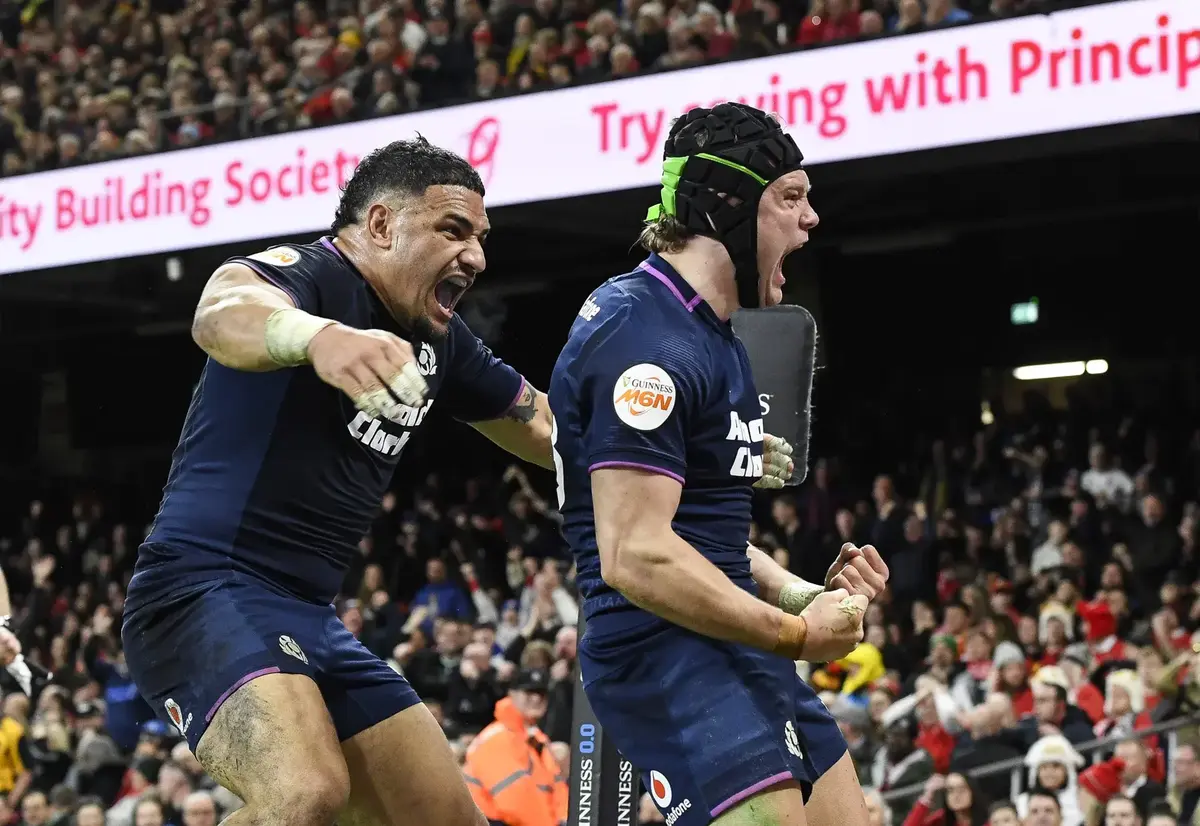
Scotland produced a devastating late comeback to snatch a 26-23 bonus-point victory over Wales at the Principality Stadium, overturning an 11-point deficit in the final quarter to leave Steve Tandy’s side utterly heartbroken in Cardiff. Trailing 23-12 with 22 minutes remaining, Gregor Townsend’s men scored 14 unanswered points — including tries from Darcy Graham and George Turner — to keep their Six Nations title challenge alive, condemn Wales to a 14th consecutive Six Nations defeat, and retain the Doddie Weir Cup.
Key moments:
5′ – YELLOW CARD WALES: Joe Hawkins is sin-binned for a high tackle on Gregor Brown, his shoulder connecting with the Scottish flanker’s head. The contact is sent to the bunker but remains yellow, with Hawkins deemed to have been stationary rather than moving into the collision. Scotland kick for the corner but cannot convert the numerical advantage (Wales 0-0 Scotland)
9′ – TRY WALES: After winning a penalty from a series of wayward Dave Cherry lineout throws, Dewi Lake opts for the tap-and-go. The captain leads the charge before the ball is worked to Rhys Carre, who muscles over from close range for his second try in consecutive matches. Sam Costelow converts (Wales 7-0 Scotland)
14′ – TRY SCOTLAND: From a lineout on the left, Sione Tuipulotu holds his pass before feeding Finn Russell on the loop, who straightens and finds Blair Kinghorn joining the line at pace. With Wales a man down, the overlap is on and Kinghorn’s pass leaves Kyle Steyn with the simplest of walk-in tries in the right corner for his 16th international score. Russell’s conversion from wide on the touchline slides left (Wales 7-5 Scotland)
19′ – TRY WALES: Sustained forward pressure from Dewi Lake, Rhys Carre and Alex Mann creates the platform before Sam Costelow calls for it on the left and flings a flat miss-pass to Josh Adams on the wing. The veteran finishes in the corner for his 24th Wales try. Costelow adds a superb touchline conversion (Wales 14-5 Scotland)
31′ – PENALTY WALES: Sam Costelow extends the Welsh lead after Alex Mann wins a crucial turnover following a storming Kyle Steyn break into the Welsh 22 (Wales 17-5 Scotland)
Half-time: Wales 17-5 Scotland
Wales’ first half-time lead at home under Steve Tandy — and only their third in their last 18 attempts at the Principality Stadium. Carry count: Wales 80-59 Scotland. Turnovers won: Wales 4-2 Scotland.
49′ – PENALTY WALES: Sam Costelow slots his second penalty after Scotland infringe at the breakdown, pushing the Welsh lead to 15 points. Scotland had earlier contrived to drop a certain try, Huw Jones fumbling Duhan van der Merwe’s offload with the line beckoning (Wales 20-5 Scotland)
55′ – TRY SCOTLAND: After 27 phases of sustained pressure on the Welsh line, Finn Russell spots that Louis Rees-Zammit has rushed out of his defensive line, steps past the fullback and burrows over to the right of the posts. Russell converts his own try to cut the deficit to eight points (Wales 20-12 Scotland)
55′ – COSTELOW INJURY: Sam Costelow is carried off unable to bear weight on his leg, visibly distraught. Jarrod Evans replaces the Scarlets fly-half (Wales 20-12 Scotland)
58′ – PENALTY WALES: Jarrod Evans’ first involvement is to slot a penalty that restores an 11-point cushion for the hosts (Wales 23-12 Scotland)
58′ – TRY SCOTLAND: The game’s seminal moment. From the restart, Russell launches the kick-off long and to the left, deep into the Welsh 22. The ball bounces over the head of James Botham, who has turned his back on it, and Darcy Graham — on the field barely four minutes — gathers and sprints past Gabriel Hamer-Webb to score in the left corner untouched, equalling Duhan van der Merwe’s Scotland try-scoring record. Russell’s exquisite touchline conversion cuts the gap to just four points (Wales 23-19 Scotland)
67′ – PENALTY REVERSED: Referee Matthew Carley initially awards Wales a penalty, only for the TMO to identify a croc roll by Tomos Williams on Rory Darge. The decision is reversed, denying Wales the chance to extend their lead and handing Scotland the exit (Wales 23-19 Scotland)
75′ – TRY SCOTLAND: After Louis Rees-Zammit’s knock-on gifts Scotland a penalty, Russell kicks to the corner. George Turner’s lineout finds its mark and Scotland’s pack form a devastating rolling maul. Turner holds on at the back before crashing over for the bonus-point try that puts Scotland ahead for the first time. Russell converts from just right of the posts (Wales 23-26 Scotland)
Full-time: Wales 23-26 Scotland
It was a result that encapsulated everything maddening and magnificent about this Scotland generation — their capacity for both infuriating sloppiness and breathtaking resilience laid bare across 80 extraordinary minutes beneath the Principality Stadium’s closed roof. For Wales, who had led from the ninth minute until five minutes from time, the cruel manner of defeat may prove more painful than any of the heavier losses they have absorbed during their wretched losing run.
“Really proud,” said Scotland captain Sione Tuipulotu afterwards. “I said to the boys at half-time that we’d have to find more of ourselves. The problem-solving in that second half, we found a way to win ugly today. We were playing in an away stadium against a very desperate team. They made things difficult for us.”
The afternoon had begun with an emotional rendition of Mae Hen Wlad Fy Nhadau that brought captain Dewi Lake to tears, the a cappella anthem reverberating beneath the closed roof and setting the tone for what was to come. A crowd of 70,649 — a vast improvement on the 57,744 who had turned up for the France match a week earlier — had heeded Lake’s pre-match plea to make the stadium “the heartbeat of the nation,” and the response was emphatic.
Wales were reduced to 14 players inside five minutes when Joe Hawkins was sin-binned for a high tackle on Gregor Brown, his shoulder connecting with the Scottish flanker’s head. The contact was reviewed by the bunker but remained yellow, with Hawkins deemed to have been stationary rather than moving into the collision.
Scotland kicked for the corner and went through multiple phases inside the Welsh 22, with Steyn looking certain to score after a delayed Russell pass only for the winger’s desire to finish himself — rather than pass to unmarked teammates outside — proving costly. The hosts then scrambled to thwart the attack, before Josh Adams produced a magnificent intercept near his own try line, snaffling Ben White’s pass intended for Duhan van der Merwe and allowing Tomos Williams to clear.
What followed was the most complete passage of Welsh rugby seen this championship. After winning a penalty following a series of Dave Cherry lineout misfires, Wales opted for the tap-and-go — the same move that had yielded a try against France the previous weekend. Captain Lake led the charge, battering into the Scottish defence before the ball was worked to Rhys Carre, who muscled over from close range for his second try in consecutive matches. Costelow’s conversion gave the 14 men a 7-0 lead that silenced the visiting contingent and sent the Principality Stadium into raptures.
Scotland, who had dominated territory in the opening exchanges without reward, responded five minutes later through the clinical finishing of Steyn. From a lineout on the left, Tuipulotu held his pass before feeding Russell on the loop, who straightened and found Kinghorn joining the line at pace. With Wales a man down, the overlap was on and Kinghorn’s pass left Steyn with the simplest of walk-in tries in the right corner for his 16th international score. Russell’s conversion attempt from wide on the touchline slid left — a miss that would prove significant by the final whistle.
The early departure of debutant Gabriel Hamer-Webb, forced off with a bloodied nose after just two minutes on the field following an accidental clash, and the loss of Taine Plumtree to a shoulder injury that brought James Botham into the fray, might have further destabilised Wales. Instead, Tandy’s side played with an intensity and accuracy that defied their recent form. The breakdown work of Alex Mann was exceptional throughout the first half, while Eddie James carried with genuine venom from midfield, his powerful running consistently getting Wales over the gainline and providing the platform from which the hosts could build.
Wales’ second try, arriving on 19 minutes, was the product of sustained forward pressure and smart execution. After Lake burrowed over the gainline through the tight channel, the ball was recycled through multiple phases with Carre and Mann playing instrumental roles in the build-up. Costelow then called for it on the left and flung a flat miss-pass that bisected the Scottish defence to find Adams on the wing. The veteran winger finished with aplomb in the corner for his 24th Wales try, and Costelow’s superb touchline conversion — his third successful kick from three — extended the lead to 14-5. It had been as open a first 20 minutes as you could hope to see in international rugby.
Gregor Townsend, visibly concerned in the coaches’ box, made a bold early intervention, replacing Nathan McBeth and Max Williamson with Pierre Schoeman and Josh Bayliss before the half-hour mark, with Brown reverting from blindside flanker to lock. McBeth had been overpowered at the scrum and Williamson had lost the ball in the build-up to Adams’ try, and the twin change represented a statement of intent from the Scotland head coach.
“I felt we needed to change something,” Townsend explained afterwards. “Wales had a lot of momentum and we know the quality of the guys on our bench. We were looking around half-time anyway and we felt the game had really opened up early, and someone like Josh can make an impact there. It’s such a 23-man game now.”
Yet the substitutions had minimal immediate impact as Wales continued to dominate the physical exchanges. After another storming Steyn break, a vital Mann turnover forced a penalty, and Costelow’s kick on 31 minutes stretched the Welsh advantage to 17-5. At half-time, Wales led by 12 points, having won the carry count 80-59 and secured four turnovers to Scotland’s two. It was Wales’ first half-time lead at home under Tandy — and only their third in their last 18 attempts at the Principality Stadium.
The second half began as the first had ended, with Wales firmly in control. Costelow’s penalty on 49 minutes, following another Scottish infringement at the breakdown, pushed the lead to 20-5. Scotland had earlier contrived to drop a certain try — Huw Jones fumbling Duhan van der Merwe’s offload with the line beckoning after the wing had powered past Hamer-Webb from the restart — in a moment that encapsulated the visitors’ frustrating afternoon. Van der Merwe’s incredulous expression told the story; on another day, that was a try that would have transformed the contest.
Scotland finally found a way through in the 55th minute, though it required 27 phases of sustained pressure on the Welsh line to achieve. Schoeman carried repeatedly, Bayliss battered at the fringes, and the entire Welsh pack threw themselves into a series of desperate tackles. When the ball eventually reached Russell, the fly-half spotted that Rees-Zammit had rushed out of his defensive line, stepped past the fullback and burrowed over to the right of the posts. His conversion cut the deficit to eight points and, for the first time, a hint of anxiety flickered through the stadium.
“It’s something we’ve worked a lot on in this campaign — having composure and being calm in the 22,” Russell said afterwards. “Now it’s only going to the backs when it’s on.”
What happened next will haunt Wales for years to come.
The introduction of Jarrod Evans for the injured Sam Costelow — the Scarlets fly-half was carried off unable to bear weight on his leg, a sight that left him visibly distraught — temporarily steadied Welsh nerves as Evans’ first act was to slot a penalty that restored an 11-point cushion at 23-12. But from the restart, disaster struck. Russell launched the kick-off long and to the left, deep into the Welsh 22. The ball bounced once over the head of James Botham, who had turned his back on it, and Darcy Graham — who had entered the fray as a replacement barely four minutes earlier — could scarcely believe his fortune as he gathered and sprinted past Hamer-Webb into the left corner untouched. In doing so, Graham equalled Van der Merwe’s Scotland try-scoring record.
Russell’s conversion from wide on the left touchline was exquisite, a strike of such precision and nerve that it seemed to transfer the momentum physically from one side to the other. At 23-19, a four-point game, the Principality Stadium fell eerily quiet.
“A lucky bounce I’d say, and they weren’t expecting it,” Russell would later reflect with characteristic understatement, before delivering the game’s most devastating soundbite. “He [Tandy] knows that’s something I look for and Darcy scoring is a coach killer.”
Tandy, who had raised his arms in dismay in the coaches’ box as the try was scored, was characteristically forthright about the moment that cost his side. “It’s huge,” he said. “You need to make people work for their opportunities. We feel we didn’t do that. It gave Scotland energy. It’s another harsh lesson. In high-class games, you can’t knock off. We backed up moments in the game, handled the yellow card well. The intent and physicality was there, but that moment cost us.”
The final quarter became an exercise in Scottish siege warfare. Townsend’s replacements — Turner, Millar Mills, Horne, and Graham among them — injected fresh energy and intensity, with George Horne in particular adding zip and direction to a side that had regained belief. Wales’ legs visibly tired after a first half spent making far more tackles than their bodies could sustain.
A series of penalties deep in Welsh territory provided the platform, though Scotland first botched a lineout maul, the ball hitting the ground and allowing Williams to clear. Tuipulotu was then penalised for a neck roll, offering Wales a brief reprieve. Yet in a game of swinging fortunes, a critical moment arrived in the 67th minute when referee Matthew Carley initially awarded Wales a penalty — only for the TMO to intervene, identifying a croc roll by Tomos Williams on Rory Darge that reversed the decision. Rather than Wales kicking to extend their lead, Scotland had the exit. “It was a fair call,” Tandy conceded afterwards. “We’ve got to be better. You can focus on one or two moments, but we’ve got to be a better team.”
The decisive moment arrived with five minutes remaining. After Rees-Zammit held onto the ball too long and then compounded the error with a knock-on on the ground, Scotland were awarded a penalty just outside the Welsh 22. Russell kicked to the corner without hesitation, and this time Turner’s lineout found its mark. Scotland’s pack, bolstered by the fresh legs of their replacements, formed a devastating rolling maul that trundled inexorably towards the Welsh line. Turner held on for dear life at the back before crashing over to complete an extraordinary turnaround and secure the bonus point.
Russell’s conversion from just right of the posts sealed a 26-23 lead and sent the Scottish contingent into delirium. Wales had one final chance when Matt Fagerson spilled the restart uncontested, gifting the hosts an attacking scrum just beyond the 22. But their scrum was wheeled around and penalised — Ryan Elias ruled to have stood up too early — and Scotland were able to wind down the clock with a penalty advantage, the forwards’ jubilation an apt expression of the occasion. Russell’s final penalty attempt from distance slid wide of the left post, but it mattered not. The whistle sounded and Scotland had escaped with the spoils.
“Bitterly disappointed not to win the game,” said Tandy, who was visibly emotional in his post-match press conference. “Massive pride in the group. That was a step in the right direction, but we’ve got to be better next time. There was a lot to like in the first half, with how we attacked the game. I’m devastated for them. The support today was incredible. There are lots of questions asked about the crowds, but they were unbelievable. Everyone felt it. The players gave them something to cheer about, but ultimately they got behind the team. It’s a snapshot of where we want to be.”
Tandy confirmed that the injuries to Costelow and Plumtree “don’t look great,” with Costelow unable to bear weight and Plumtree sustaining damage to his AC joint. The Wales head coach was particularly sympathetic about his fly-half. “Sam’s been through a lot in his Wales career with not being involved in the autumn, but we backed him to come back in and he really took that opportunity. He was fantastic with the way he drove the team forward in that first half. It’s such a shame for him that it ended with injury.”
Wales captain Lake, who had been immense before being replaced by Ryan Elias, summed up the mood of his dressing room: “It’s gut-wrenching. It’s tough because you know the performance was there. First half, we were dominant. We applied pressure and attacked them. We spoke about staying in moments, we probably didn’t do that for the full 80. But we probably did enough to win the game, which makes it so tough.”
For Scotland, this was the kind of ugly, character-defining victory that championship contenders must find a way to grind out. Their first-half performance had been alarmingly poor — the lineout malfunctioned repeatedly, Cherry’s throwing was wayward, and their discipline at the breakdown gifted Wales a stream of penalties. Russell finished with 11 points — a try and three conversions — but it was the ingenuity of his restart and the composure of his goal-kicking at the death that proved decisive.
“That was some game,” Townsend reflected. “We left it late but I’m really proud of the effort in the second half. It’s not just a physical effort, it’s a mental effort too — finding solutions, staying together and riding momentum waves. Wales started really well, played with real energy. Tactically they were outstanding. They moved the ball quickly, played around the ruck which was tough to defend. They targeted our breakdown and kept their width. They deserved to be ahead and it took a huge effort to get back in the game.”
Townsend singled out the impact of his bench in turning the tide. “The scrum penalty near the end was a huge moment too. It’s a 23-man game and we backed our bench. I thought Josh Bayliss was outstanding. We’re still in the championship. That’s all that counts. Today showed — not just in our game — that anything can happen in the championship.”
Player of the match Rory Darge, who was tireless at the breakdown, captured the significance of the result: “What a massive win for us. Any time you go on the road in the Six Nations you have your work cut out for you. Just delighted with the character we showed. Credit to Wales. We knew they’d come out swinging. It was a tough, tough fixture. It’s hard to wrestle back from 17-5 down and we did that. Massively proud of everyone.”
Russell, reflecting on the decisive comeback, offered a candid assessment: “It’s obviously good having 11 points on the board. There was pressure this week, but it was more expectation. We got the win even though it maybe wasn’t our best performance. Lee Radford and Gregor had a go at us at half-time to hit them and stop absorbing contact. It’s nice to have the break now and get ready for France.”
The result moves Scotland to 11 points at the top of the Six Nations table after three rounds, though France — who play Italy in Lille on Sunday — can overtake them with a bonus-point victory. This was Scotland’s fourth consecutive victory over Wales, their best run since winning five in a row between 1923 and 1927, and their first back-to-back away success in Cardiff since 1984. It was also just the third time Scotland have won the match directly after a Calcutta Cup victory in the Six Nations era. Scotland have risen to seventh in the world rankings.
Townsend’s side face a daunting challenge in round four when they host France at Murrayfield on 7th March, a match that could define their championship. “We’ll be underdogs against France and we know we’ll have to play our best rugby,” said the Scotland head coach. A win there would set up a trip to Dublin on the final day with a first Triple Crown since 1990 on the line — and, potentially, a tilt at a first championship since the Five Nations era in 1999.
For Wales, a 14th consecutive Six Nations defeat extends their record losing run in the championship, with the hosts having now dropped to 12th in the world rankings. They have lost 24 of their last 26 Tests since October 2023, won just once in 15 matches at the Principality Stadium, and have not won a home Six Nations match since beating Scotland in February 2022. Yet this performance represented something altogether different from the capitulations against England and France.
For long stretches, Tandy’s side were the better team: more physical, more disciplined, more dangerous. Mann’s breakdown work was outstanding, Adams was electric on the wing, Botham was superb after his early introduction, and the all-Scarlets midfield of Costelow, Hawkins and James showed genuine cohesion for the first time this campaign. The anguish on the faces of the Welsh players at the final whistle spoke to how close they had come — and how much this defeat will sting.
There is a fallow week before Wales head to Dublin to face Ireland at the Aviva Stadium on 6th March, with Scotland hosting France the following day. On the evidence of this remarkable afternoon in Cardiff, both sides have plenty to reflect upon — but only one can look forward with genuine hope of silverware.
Teams
Wales: 15 Louis Rees-Zammit; 14 Gabriel Hamer-Webb, 13 Eddie James, 12 Joe Hawkins, 11 Josh Adams; 10 Sam Costelow, 9 Tomos Williams; 1 Rhys Carre, 2 Dewi Lake (capt), 3 Tomas Francis, 4 Dafydd Jenkins, 5 Ben Carter, 6 Taine Plumtree, 7 Alex Mann, 8 Aaron Wainwright.
Replacements: 16 Ryan Elias (for Lake, 55), 17 Nicky Smith (for Carre, 43), 18 Archie Griffin (for Francis, 50), 19 Freddie Thomas (for Jenkins, 76), 20 James Botham (for Plumtree, 9), 21 Kieran Hardy, 22 Jarrod Evans (for Costelow, 55), 23 Blair Murray (for Hamer-Webb, 2, blood; for Hamer-Webb, 61).
Sin-bin: Hawkins (5)
Scotland: 15 Blair Kinghorn; 14 Kyle Steyn, 13 Huw Jones, 12 Sione Tuipulotu (capt), 11 Duhan van der Merwe; 10 Finn Russell, 9 Ben White; 1 Nathan McBeth, 2 Dave Cherry, 3 Zander Fagerson, 4 Max Williamson, 5 Scott Cummings, 6 Gregor Brown, 7 Rory Darge, 8 Matt Fagerson.
Replacements: 16 George Turner (for Cherry, 54), 17 Pierre Schoeman (for McBeth, 34), 18 Elliot Millar Mills (for Z. Fagerson, 54), 19 Grant Gilchrist (for Cummings, 66), 20 Josh Bayliss (for Williamson, 34), 21 George Horne (for White, 54), 22 Tom Jordan (for Jones, 66), 23 Darcy Graham (for van der Merwe, 54).
Referee: Matthew Carley (RFU)
Assistant Referees: Karl Dickson (RFU), Adam Leal (RFU)
TMO: Ian Tempest (RFU)
FPRO: Eric Gauzins (FFR)
Attendance: 70,649
Guinness Player of the Match: Rory Darge (Scotland)
Share this:
Six Nations
Ireland reborn as ruthless display blows away rudderless England
Published
3 days agoon
21st February 2026
Ireland produced a record-breaking performance to demolish England 42-21 at Allianz Stadium, scoring five tries in a devastating display that ended the hosts’ nine-match home winning run and reignited Andy Farrell’s side’s Six Nations campaign. What was supposed to be a celebration of Maro Itoje’s 100th cap became a nightmarish afternoon for Steve Borthwick, whose side have now lost back-to-back matches to leave their championship hopes in tatters with away trips to Rome and Paris still to come.
Key moments:
8′ – PENALTY IRELAND: Jack Crowley opens the scoring after Joe McCarthy produces a superb turnover at an England maul, ripping the ball from the drive. Jamison Gibson-Park’s snipe up the middle draws an offside penalty and Crowley slots a composed kick from directly in front of the posts (England 0-3 Ireland)
18′ – LOWE INJURY: James Lowe pulls up clutching his knee while chasing a loose English pass and is unable to continue. Tommy O’Brien replaces the Leinster wing and makes an immediate impact, running a brilliant support line within moments of entering the fray (England 0-3 Ireland)
19′ – TRY IRELAND: Jamison Gibson-Park catches England napping with a moment of pure opportunism. Robert Baloucoune finds space on the right wing and offloads inside to the arriving Tommy O’Brien, before Tom Curry is penalised for coming in from the side. Gibson-Park taps the penalty quickly and sprints past Joe Heyes into the left corner, exploiting every white shirt standing offside. Jack Crowley lands an excellent touchline conversion (England 0-10 Ireland)
23′ – MITCHELL INJURY: England lose scrum-half Alex Mitchell to what Steve Borthwick later confirms as a soft-tissue injury. Jack van Poortvliet replaces him, though the substitute’s afternoon is later marred by a needless backchat penalty that concedes 10 metres (England 0-10 Ireland)
27′ – TRY IRELAND: Stuart McCloskey produces the break of the match, picking a devastating crash-ball line through the English 12-13 channel and bursting through Ollie Lawrence’s attempted tackle for a full 20 metres before Freddie Steward hauls him down. Gibson-Park scoops the ball and moves it swiftly wide for Robert Baloucoune to canter into the right corner. Crowley’s conversion drifts wide of the right post (England 0-15 Ireland)
27′ – YELLOW CARD ENGLAND: Freddie Steward is sin-binned for cynically playing Jamison Gibson-Park at the back of the ruck in the build-up to Baloucoune’s try. The fullback’s card deepens England’s crisis with Ireland already 15 points ahead (England 0-15 Ireland)
29′ – REFEREE INJURY: An extraordinary moment as referee Andrea Piardi collapses clutching his leg while sprinting to keep up with a Josh van der Flier break. “I’m done. My quad is gone. Best of luck for the rest of the game, guys,” the Italian tells both captains before being clapped off by the capacity crowd. Pierre Brousset takes charge, with Craig Maxwell-Keys called to run the line. Jamie George simultaneously replaces Luke Cowan-Dickie at hooker (England 0-15 Ireland)
30′ – TRY IRELAND: Ireland strike again barely a minute after the referee change. Robert Baloucoune comes off his wing to create an extra man near halfway and skips out of Ollie Lawrence’s tackle before popping an offload to Tommy O’Brien, who has the gas to beat Tommy Freeman and stroll in under minimal resistance. Jack Crowley converts and “Fields of Athenry” rings around Twickenham (England 0-22 Ireland)
39′ – TACTICAL SUBSTITUTION: Steve Borthwick throws on Marcus Smith for Freddie Steward in a desperate gamble to inject creativity, having already made three changes with the score at 22-0. England’s attack immediately looks sharper (England 0-22 Ireland)
40′ – TRY ENGLAND: England finally breach the Irish defence on the stroke of half-time. Playing through a penalty advantage after James Ryan uses his hands illegally in a ruck, Marcus Smith delays his pass to create the space for Fraser Dingwall to power between Josh van der Flier and Baloucoune. George Ford converts to give the hosts a sliver of hope heading into the interval (England 7-22 Ireland)
Half-time: England 7-22 Ireland
England statistics: 57% possession, 70% territory. Ireland: 43% possession, 30% territory, 3 handling errors to England’s 11, 4 turnovers conceded to England’s 15. Ireland’s three first-half tries all originated from their own half.
42′ – YELLOW CARD ENGLAND: Henry Pollock is sin-binned within two minutes of the restart after failing to release near his own line. Caelan Doris had burst through a gap in midfield and powered into the 22 before Ireland’s momentum was halted just short. The number eight’s cynical play on his first international start draws a stern rebuke from Pierre Brousset (England 7-22 Ireland)
43′ – TRY IRELAND: Ireland capitalise immediately on Pollock’s yellow card to secure the bonus point. Dan Sheehan taps the penalty and Ireland go through the phases close to the line, with Stuart McCloskey and Caelan Doris battering the gainline. Sheehan spots space, darts left and burrows over from close range. Jack Crowley’s conversion stretches the lead to 22 points as a strange hush descends across the stadium (England 7-29 Ireland)
53′ – TRY ENGLAND: Henry Pollock makes amends on his return from the sin bin, immediately handing off defenders and flicking a pass out the back of the hand to Tommy Freeman, who drives to within metres of the line. The ball is recycled quickly and Ollie Lawrence bursts through a gap to score under the posts. George Ford converts, but any hope of a comeback is tempered by the 15-point deficit (England 14-29 Ireland)
54′ – YELLOW CARD IRELAND: Jamie Osborne is sin-binned for playing the ball on the ground in the aftermath of Lawrence’s try. A debatable call — Bevan Rodd appeared to be over the tryline when Irish players failed to release — but Pierre Brousset is consistent with his earlier decision on Pollock (England 14-29 Ireland)
58′ – PENALTY IRELAND: Jack Crowley extends Ireland’s lead despite playing with 14 men. Bevan Rodd shoves early at the scrum to concede a free kick that quickly leads to a penalty. Crowley dispatches it with no fuss, his composure in stark contrast to England’s growing desperation (England 14-32 Ireland)
65′ – PENALTY IRELAND: Crowley makes history, taking Ireland past their previous highest points tally at Twickenham. The Munster fly-half slots another composed penalty after Guy Pepper is penalised for going off his feet at the breakdown. The lead is 21 points and England fans begin heading for the exits (England 14-35 Ireland)
69′ – TRY IRELAND: Jamie Osborne caps a remarkable return from the sin bin by powering over for Ireland’s fifth try. Gibson-Park’s relentless kick-chase forces a penalty and Ireland secure the lineout before going through the phases. Osborne spots a gap, glides through and powers over Guy Pepper to stretch out and ground the ball. Jack Crowley adds the conversion to take Ireland to 42 points (England 14-42 Ireland)
73′ – McCLOSKEY CHASE-DOWN: The moment that defines Ireland’s ferocity. Marcus Smith intercepts a Jack Crowley pass on his own 22 and hares away down the left wing, apparently clear for a certain try. Stuart McCloskey, the 33-year-old Ulster centre, somehow chases Smith down from behind with astonishing pace and clatters him into touch. The Twickenham crowd falls silent (England 14-42 Ireland)
75′ – TRY ENGLAND: Sam Underhill barrels his way over from close range off a pop pass from Jack van Poortvliet, spinning through one defender and backing through Robert Baloucoune for a consolation score. George Ford adds the conversion but, in truth, it means little (England 21-42 Ireland)
Full-time: England 21-42 Ireland
For a second successive weekend, England were blown away in the first half, conceding 22 unanswered points before Fraser Dingwall crossed on the stroke of half-time to offer the faintest flicker of hope. But where Scotland had at least allowed England back into the contest seven days earlier, Ireland showed no such mercy, extending their lead remorselessly after the break to secure their biggest ever away win over England, surpassing the 32-15 victory here in 2022. Not since they dismantled France in Marseille at the start of the 2024 championship had Ireland hit these heights.
The occasion had promised so much for the 81,953 inside Allianz Stadium on an overcast but still afternoon in south-west London. Itoje walked out alone to a thunderous reception to mark his century of caps, just the ninth Englishman to reach the milestone, a look to the heavens perhaps in memory of his late mother. The Princess of Wales was in attendance. Yet the emotion appeared to weigh on England rather than inspire them, as a series of basic errors in the opening quarter gifted Ireland the platform for a devastating counter-punch.
Farrell had warned his players about the dangers of a wounded England. “We got told we needed to dampen them down and rightly so because we were here two years ago when England lost to Scotland and they played outstandingly well,” the Ireland head coach explained afterwards. His squad heeded the message with a performance built on ferocious defensive intensity, clinical counter-attacking and an unerring willingness to hunt in packs.
England’s struggles were evident from the very first set-piece. An early lineout was overthrown by Luke Cowan-Dickie, with none of the jumpers even leaving the ground. A scrum collapsed. George Ford, usually so reliable with the boot, kicked dead from a penalty — then did so again minutes later, drawing ironic cheers from the crowd. The nervousness was palpable, and Ireland — sharper, hungrier and more composed — were quick to capitalise.
Jack Crowley, restored to the starting fly-half berth with Sam Prendergast dropped from the matchday squad entirely, settled Irish nerves with an early penalty after Joe McCarthy had produced a superb turnover at an England maul. The young Munster man’s selection was handsomely vindicated as he orchestrated Ireland’s attack with a tempo and precision that had been sorely missing in their opening two fixtures, finishing with 17 points from the boot.
Ireland suffered an early setback when James Lowe appeared to damage his knee while chasing a loose English pass in the 18th minute. “It didn’t look too good,” Farrell would later concede. His replacement, the Leinster wing Tommy O’Brien, wasted no time making an impact, running a brilliant support line within moments of entering the fray.
The game’s first try was a masterclass in opportunism from Jamison Gibson-Park. After Baloucoune had found space on Ireland’s right wing and O’Brien ran inside him, Ireland won a penalty when Tom Curry came in from the side. While England’s defenders stood flat-footed, Gibson-Park tapped quickly and sprinted past Joe Heyes to the corner from 15 metres, exploiting the fact that every white shirt was standing offside and unable to legally make a tackle. Crowley’s excellent conversion from wide on the left made it 10-0 and the visiting contingent — an estimated 15,000 of the capacity crowd — erupted.
England were further disrupted when scrum-half Alex Mitchell limped off with what Borthwick later described as a soft-tissue injury, bringing on Jack van Poortvliet. The replacement’s afternoon would be marked by a needless backchat penalty that conceded 10 metres, symptomatic of England’s collective loss of composure.
If the first try was born of instinct, Ireland’s second was pure destruction through the midfield. Stuart McCloskey, who had been a revelation throughout the 2026 championship, picked a devastating crash-ball line through the English 12-13 channel and burst through Ollie Lawrence’s attempted tackle for a full 20 metres before Steward hauled him down. Gibson-Park scooped up the ball and moved it swiftly to Baloucoune, who cantered into the right corner with consummate ease. Steward’s afternoon deteriorated further when he was yellow-carded for cynically playing Gibson-Park at the back of the preceding ruck, a decision that drew groans from a Twickenham crowd already stunned into near-silence.
The match was briefly interrupted by an extraordinary incident in the 29th minute when referee Andrea Piardi collapsed clutching his leg while sprinting to keep up with a Josh van der Flier break. “I’m done. My quad is gone. Best of luck for the rest of the game, guys,” the Italian told both captains before being clapped off by the capacity crowd. Pierre Brousset jogged on from the touchline to take charge, with Craig Maxwell-Keys called to run the line. It was only the sixth time in history that a referee had been replaced during an England match due to injury.
The disruption did nothing to halt Ireland’s momentum. With England now down to 14 men, Baloucoune came off his wing to create an extra man near halfway and skipped out of Lawrence’s tackle before popping an offload to O’Brien, who had the gas to beat Tommy Freeman and stroll in for Ireland’s third try. Crowley’s conversion made it 22-0 and “Fields of Athenry” was ringing around Twickenham before the half-hour mark.
Borthwick, who had already been forced into changes when Mitchell departed and Cowan-Dickie was replaced by Jamie George, threw Marcus Smith on for the returning Steward with half-time approaching. Explaining his tactical substitutions afterwards, the head coach cited George’s experience and leadership qualities alongside Smith’s explosive ability to chase the game. “When you are points down on the scoreboard, you need to score,” Borthwick said. “That’s where someone like Marcus Smith can add a different element.”
The move paid an immediate dividend. England’s most sustained pressure of the half finally yielded a try on the stroke of half-time when Smith delayed his pass to create the space for Dingwall to power between Josh van der Flier and Baloucoune. Ford’s conversion trimmed the deficit to 15 points, though even this required playing through a penalty advantage after James Ryan had used his hands illegally in a ruck.
Whatever optimism that try generated evaporated within three minutes of the restart. Caelan Doris burst through a gap in midfield and powered into the 22, before Ireland’s momentum was halted just short of the line. Henry Pollock, making his first international start and struggling to contain the occasion, failed to release quickly enough and was dispatched to the sin bin for cynical play. Ireland tapped the resulting penalty and, after McCloskey and Doris had battered the gainline, Sheehan spotted space, darted left and burrowed over for the bonus-point try. Crowley’s conversion stretched the lead to 22 points. A strange hush descended across the stadium.
To their credit, England responded with their best passage of the match. Pollock, returning from the sin bin, was immediately involved, handing off defenders and flicking a pass out the back of the hand to Freeman, who drove to within metres of the line. The ball was recycled quickly and Lawrence burst through a gap to score under the posts. Ford’s conversion made it 29-14 with 24 minutes remaining, while Osborne was sin-binned for playing the ball on the ground in the build-up.
But Ireland’s defensive resolve during the Osborne sin-bin period was extraordinary, conceding just six points despite being reduced to 14 men. Tadhg Beirne was immense throughout, producing a choke tackle on Ford that forced a turnover, while his earlier lineout steal and jackal penalties had been pivotal in disrupting England’s set-piece platform. Gibson-Park’s relentless kick-chasing kept England pinned in their own half. Two Crowley penalties — one after Bevan Rodd shoved early at the scrum, the other when Guy Pepper was penalised at the breakdown — extended Ireland’s advantage to 21 points and snuffed out any lingering English hope.
The most remarkable individual moment came in the 73rd minute when Smith intercepted a Crowley pass on his own 22 and hared away down the left wing, apparently clear for a certain try. McCloskey, the 33-year-old Ulster centre who had already dominated the midfield collisions, somehow chased Smith down from behind and clattered him into touch — an astonishing piece of athleticism that encapsulated Ireland’s collective ferocity on the day.
Indeed, minutes earlier Baloucoune had produced a similarly superb covering tackle to deny Freeman what appeared a certain try in the corner, bundling the Northampton wing into touch with a last-ditch effort. These moments drew particular praise from Farrell. “The telling parts of Stu McCloskey chasing back Marcus and being able to put him in touch just shows the fight,” the head coach said. “And also the Rob Baloucoune one on the far side shows the fight and the spirit that these lads have got for one another. It looked like we were hunting people down throughout the game.”
Osborne’s return from the sin bin was marked by Ireland’s fifth score, the fullback powering over Guy Pepper after sustained phase play to cap a remarkable turnaround from his own card. Crowley’s conversion took Ireland to 42 points — their highest ever tally at Twickenham. Sam Underhill burrowed over for a late consolation with five minutes remaining, but the final whistle could not come soon enough for a shell-shocked England, with supporters streaming for the exits long before the end.
Gibson-Park, named player of the match after a performance of the highest calibre, reflected on a display that harked back to Ireland’s golden era: “I think it was a bit of the Ireland of old. We’re brave, and we love to put the ball in space and let the guys on the edge do special things. I count myself very lucky to be part of this team, and it was unbelievable to be out there today with the lads.”
Ireland captain Doris spoke of the belief that had been building beneath the surface: “It’s a special feeling. I’ve been saying to you that there’s been belief at the core of what we’ve been doing. We’ve seen some of it in training, but it hasn’t fully come through for the games. We saw more of that today. Paris was a reference point from where we needed to see a steep incline in performances, and hopefully this will be a reference point we look back on.”
A beaming Farrell, whose squad welcomed Taoiseach Micheál Martin into the dressing room after the match, refused to rank the victory but left no doubt about what it meant. “It’s a special day, 100 per cent, to come here and perform like that,” he said. “I said it to the lads, I didn’t care whether we won or lost, just whether we grew as a group because we know where we want to go to. It just so happens that to the people of Ireland winning does matter and it brings a bit of joy on everyone’s face.”
Borthwick, by contrast, cut a forlorn figure. “It was bitterly disappointing,” the England head coach conceded. “This team has been very, very good for quite a long time in games that are tight, even if we go a score or two down, being very strong in the second half and always finding a way to win. Unfortunately for two weeks now we have given ourselves a mountain to climb, given the opposition too many points and we have not got scoreboard presence. We will be looking closely at that and how I set the team up to make sure it doesn’t happen again.”
The statistics laid bare England’s failings: 15 turnovers conceded to Ireland’s four, and 11 handling errors compared to just three from the visitors. Ireland achieved their dominance with only 43 per cent possession and 30 per cent territory, a testament to their devastating efficiency when presented with opportunities. England’s sole area of superiority was the scrum, where Ellis Genge was dominant against his opposite number, but even that advantage was rendered meaningless by their inability to capitalise on the set-piece platform it provided.
For Borthwick, the questions are now pressing. Back-to-back defeats, both characterised by catastrophic first-half performances, have removed England from title contention as early as the third round. The decision to start Pollock, whose sin-bin proved costly on his maiden start, will be scrutinised, while Ford’s uncharacteristic struggles with the boot compounded the sense that England’s senior players were overwhelmed. Mitchell’s injury is a further concern, with Borthwick confirming a soft-tissue problem that may sideline the scrum-half for the trip to Rome.
Ireland, by contrast, look a team transformed. The half-back partnership of Gibson-Park and Crowley provided the tempo and direction that had been missing against France and Italy, while McCloskey’s thunderous presence in midfield gave the backline a focal point around which everything else clicked. Baloucoune and O’Brien were devastating on the wings, while Beirne’s mischief at the breakdown and McCarthy’s physical dominance in the tight five provided the platform from which Ireland’s backs could operate. Crowley’s performance should put the number 10 debate to bed for the foreseeable future.
The result moves Ireland from fifth to second in the Six Nations table, temporarily drawing within a point of leaders France, and lifts them above both England and France to third in the world rankings. They end the championship with back-to-back home fixtures against Wales and Scotland at the Aviva Stadium, and while their title hopes may ultimately depend on France slipping up, this performance has ensured they will be there to capitalise if the opportunity arises.
For England, whose 12-match winning run now feels like a distant memory, the priority is salvaging pride and momentum from a campaign unravelling at alarming speed. With Italy smelling blood in Rome and a daunting trip to Paris to close the championship, Borthwick faces the biggest test of his coaching tenure.
Teams
England: Freddie Steward; Tommy Freeman, Ollie Lawrence, Fraser Dingwall, Henry Arundell; George Ford, Alex Mitchell; Ellis Genge, Luke Cowan-Dickie, Joe Heyes; Maro Itoje (capt), Ollie Chessum; Tom Curry, Ben Earl, Henry Pollock.
Replacements: Jamie George (for Cowan-Dickie, 29), Bevan Rodd (for Genge, 52), Trevor Davison (for Heyes, 72), Alex Coles (for Itoje, 55), Guy Pepper (for Curry, 52), Sam Underhill (for Earl, 70), Jack van Poortvliet (for Mitchell, 23), Marcus Smith (for Steward, 39).
Ireland: Jamie Osborne; Robert Baloucoune, Garry Ringrose, Stuart McCloskey, James Lowe; Jack Crowley, Jamison Gibson-Park; Jeremy Loughman, Dan Sheehan, Tadhg Furlong; Joe McCarthy, James Ryan; Tadhg Beirne, Josh van der Flier, Caelan Doris (capt).
Replacements: Rónan Kelleher (for Sheehan, 56), Tom O’Toole (for Loughman, 47), Finlay Bealham (for Furlong, 47), Nick Timoney (for van der Flier, 50), Cian Prendergast (for McCarthy, 63), Craig Casey (for Gibson-Park, 71), Ciarán Frawley (for Ringrose, 55), Tommy O’Brien (for Lowe, 18).
Referee: Andrea Piardi (FIR) — replaced by Pierre Brousset (FFR, 29 mins)
Assistant Referees: Pierre Brousset (FFR) / Gianluca Gnecchi (FIR); Craig Maxwell-Keys (RFU, from 29 mins)
TMO: Matteo Liperini (FIR)
Attendance: 81,953
Share this:


Trending
-

 Six Nations2 weeks ago
2026 Guinness Six Nations preview: England v Wales
-

 Six Nations5 days ago
Crowley recalled as Ireland axe Prendergast for England showdown
-

 Six Nations2 weeks ago
Six things we learned from round 1 of 2026 Guinness Six Nations
-

 Six Nations2 weeks ago
Andy Farrell makes six changes as Ireland seek Italian response
-

 Six Nations1 week ago
Ireland survive Italian scare to claim unconvincing victory
-

 Super Rugby Pacific2 weeks ago
Super Rugby Pacific 2026: Round one preview
-

 Six Nations2 weeks ago
2026 Guinness Six Nations preview: Italy v Scotland
-

 Six Nations2 weeks ago
2026 Guinness Six Nations preview: Scotland v England