Connect with us

Super Rugby Pacific

Super Rugby Pacific bosses tell TMOs to stop interfering

Published

on

Referee Angus Gardner during the Crusaders v Chiefs, Super Rugby Pacific Grand Final match, Apollo Projects Stadium, Christchurch, New Zealand. Saturday, 21 June 2025. (Photo by Martin Hunter / action press)

Super Rugby Pacific has confirmed a raft of law modifications for its landmark 30th anniversary season, with officials vowing to keep television match officials on a tight leash as part of a continued push to make rugby more entertaining for fans.

The competition, which kicks off on Friday 13 February when the Highlanders host defending champions the Crusaders at Forsyth Barr Stadium in Dunedin, will introduce five new law innovations alongside a recommitment to limiting TMO interference in matches.

The changes come after All Blacks legend Richie McCaw voiced frustration with the sport’s over-reliance on video officials during a media engagement in Chicago in November. The two-time World Cup-winning captain said rugby had become “stalled” due to the constant interventions.

“We’re our own worst enemies when it comes to picking up mistakes,” McCaw said. “You don’t want to see howlers that cost people the game, but my view is that the game has some grey areas with human input. But we’re so critical of a ref who gets it wrong that everyone’s worried about getting it wrong. So we make sure we get 100 per cent right, which makes the game quite stalled in my opinion.”

Super Rugby Pacific administrators have heeded such concerns, reaffirming their commitment to guidelines first implemented in 2023 that significantly restrict when the TMO can intervene. Under the rules, the video official may only step in unprompted if the referee has overlooked an act of serious foul play at yellow card level or above, or a clear and obvious infringement directly leading to a try.

Any other TMO involvement must be initiated by the on-field referee, a measure designed to empower match officials and improve game flow. The competition claims these measures have already proven effective, with more than four minutes of dead time removed from Super Rugby Pacific matches over the past four seasons.

Five key law changes

The five law innovations approved for 2026, with the backing of clubs, match officials and stakeholders, are as follows:

Penalty try sanctions: It will no longer be mandatory for the referee to issue a yellow or red card to a player on the defending team when awarding a penalty try. Any sanction will be at the discretion of the referee. This change is expected to be particularly well received for incidents involving mauls brought down illegally close to the try line, where the double punishment of a penalty try and a sin-binning was deemed too harsh.

Free kicks over scrums: Accidental offsides and teams delaying playing the ball away from a ruck will now result in free kicks rather than scrums, reducing unnecessary stoppages.

“Use it” enforcement: After the referee has called “use it” at the ruck, no additional players from the team in possession may join the ruck, preventing teams from cynically buying time.

50:22 modification: Teams will be permitted to pass the ball back into their own half before attempting a 50:22 kick, offering greater tactical flexibility.

Quick tap flexibility: Players will be allowed to take quick taps within one metre either side of the mark, or anywhere behind the mark, provided they remain within a two-metre channel running parallel to the touchline.

Super Rugby Pacific chief executive Jack Mesley said the competition was deserving of its reputation for being fan-focused and agile in driving the game forward.
“These innovations for 2026 reflect the ongoing commitment of Super Rugby Pacific to deliver the most entertaining and engaging rugby competition in the world,” Mesley said. “From the members and fans, to the players and coaches, and the referees themselves, we continue to experience resounding support for the measured steps that we’re taking to refine the game.

“We want to be a competition that encourages quick taps and faster restarts, that cuts down on unnecessary stoppages, and that embraces positive, attacking rugby.”
Mesley added that Super Rugby Pacific would continue to work closely with World Rugby to advocate for the successful innovations to be adopted more widely across the global game.

Finals format tweak

The competition has also confirmed a minor adjustment to its finals series format. The six-team playoff structure introduced last season will remain, but the controversial “lucky loser” mechanic has been modified following criticism of the 2025 arrangement.

Last year, the top-seeded Chiefs were upset by the Blues in a Qualifying Final but retained home advantage for the semi-finals, much to the frustration of the Brumbies, who had beaten the Hurricanes in Canberra as the third seed but were forced to travel to Hamilton the following weekend.

Under the revised system for 2026, the highest-ranked losing team from the Qualifying Finals will progress as the fourth seed, ensuring they cannot host a semi-final or grand final should they advance through the knockout stages.

Super Point, the golden point extra time mechanism for matches level at full-time, has also been retained. Teams will contest an additional period of up to ten minutes, with the first team to score declared the winner. If neither side scores, the match is recorded as a draw.

Season outlook

The 2026 season marks three decades since Super Rugby was first contested in 1996. The 11 teams will compete in a round-robin format, playing 14 matches each with two byes, before the top six advance to the Finals Series.

The opening round features a blockbuster New Zealand derby between the Highlanders and Crusaders on Friday night, followed by the NSW Waratahs hosting the Queensland Reds in a traditional Australian rivalry match.

With the law changes designed to produce faster, more free-flowing rugby, administrators will be hopeful the innovations continue to attract fans both to stadiums and television screens. Last season saw improvements across key metrics including broadcast figures and gameday attendances, and officials are banking on the new measures delivering more of the attacking rugby that has been at Super Rugby’s core since its inception.

Whether the international game follows suit remains to be seen, but Super Rugby Pacific is clearly positioning itself as the laboratory for rugby’s evolution, unafraid to experiment in pursuit of a better product for fans.

Continue Reading
Click to comment

Leave a Reply

Super Rugby Pacific

Cotter ruled out of All Blacks bid after signing Reds contract

Published

on

Cotter ruled out of All Blacks bid after signing Reds contract
Blues Coach Vern Cotter before the Crusaders v Blues, Super Rugby Pacific Semi Final match, Apollo Stadium, Christchurch, New Zealand. Friday, 13 June 2025, (Photo by Joseph Johnson / action press)

The Queensland Reds have secured one of world rugby’s most decorated coaches after the Blues’ title-winning mentor Vern Cotter agreed to succeed Les Kiss at Ballymore from 2027.

Cotter, who turned 64 on the day of the announcement, has signed a two-year deal to take charge of the Reds following Kiss’s elevation to the Wallabies post this July. The move represents a significant coup for Queensland Rugby Union, who have landed a coach with proven success in both the northern and southern hemispheres across a 24-year coaching career.

The timing of the announcement proved particularly significant, coming just days after New Zealand Rugby confirmed they were seeking a replacement for the departed Scott Robertson. Cotter would have fitted the criteria perfectly, possessing both New Zealand heritage and international experience, yet revealed negotiations with the Reds had progressed too far for him to entertain the All Blacks vacancy.

“That was a surprise. We were well down conversations with the Reds,” Cotter explained of the All Blacks coaching change. “I was a bit blindsided by the Razor thing. Nobody thought that was coming. There was a review after two years and two years before the World Cup, but we were so far down the track. It would have been hard to say I’m going to make myself available for the All Blacks.

“Everyone would love to coach the All Blacks, but it’s timing and it didn’t work out.”

Cotter’s appointment effectively removes another high-profile candidate from the All Blacks search, joining Joe Schmidt, who remains committed to Rugby Australia through the 2027 World Cup, and Tony Brown, who intends to fulfil his contract with the Springboks. The decision leaves Highlanders and All Blacks XV coach Jamie Joseph and Japan-based former Chiefs boss Dave Rennie as the leading contenders for the national post.

The Kiwi coach has built an impressive record of transforming underperforming teams into winners. His arrival at the Blues in 2024 triggered an immediate revival, guiding the Auckland franchise to their first Super Rugby title in 21 years. Prior to that, he had established a formidable reputation at Clermont-Auvergne, delivering the French club their maiden Top 14 championship in 2009-10 and constructing a remarkable 77-match unbeaten home run that still stands as a professional record.

His international credentials are equally compelling. As Scotland head coach from 2014 to 2017, Cotter posted a 53 per cent winning record—19 victories from 36 Tests—making him the most successful coach of the professional era for the Scottish Rugby Union. He guided the Scots to the 2015 Rugby World Cup quarter-finals, where they suffered an agonising final-minute defeat to Australia, and secured Scotland’s first victory over France in a decade.

Throughout the negotiation process, Cotter sought counsel from an old friend who knew Australian rugby intimately. Schmidt, his former assistant at Clermont and now Wallabies coach, provided invaluable insight into what awaited in Brisbane.

“It was important that I speak to someone who knew the players and who had experience with the environment and rugby in Australia,” Cotter said of Schmidt. “He’s got a glowing report of rugby in Australia. It was a great conversation with Joe and he was very complimentary of the playing roster that’s there, sees some upward growth within that group of internationals, but also players that will potentially become internationals.

“Joe’s a good friend of mine. We’re often in contact and have been quite a lot over the years.”

The connection between the pair stretches back to the early 2000s at Bay of Plenty, where Schmidt served as Cotter’s assistant when the province captured the Ranfurly Shield for the first and only time in their history in 2004. That partnership evidently forged a lasting bond that has transcended continents and decades.
QRU chief executive David Hanham made no attempt to disguise his delight at securing such an accomplished coach. The organisation had set stringent criteria for Kiss’s replacement, demanding a track record of title success and the ability to build upon the high-performance environment already established at the Reds.

“We set a pretty clear criteria, which was we wanted to attract a world-class coach,” Hanham explained. “It was a very specific criteria and one that drove us to speak to a whole range of different coaches around the world. But ultimately, the person we’ve got here today, Vern, has delivered that in spades in northern and southern hemisphere rugby.

“There aren’t many that have done that. Consistent success is a big driver. What stood out immediately to us was Vern’s character and how strongly he aligns with the values that define us as an organisation. His record of sustained success speaks for itself, but just as compelling is the positive impact he has on people, teams and the environments he leads.”

Cotter joins a select group of coaches to have won elite titles in both hemispheres, alongside luminaries such as Michael Cheika, Robbie Deans and Eddie Jones. His challenge in Brisbane will be to break a quarter-final curse that has plagued the Reds since their lone Super Rugby championship in 2011. While Kiss has guided the franchise to playoff appearances in each of the past four seasons, they have been unable to progress beyond the first round of finals.

The veteran coach expressed his enthusiasm for the Australian challenge, citing his longstanding relationship with Reds high performance manager Sam Cordingley, whom he first met during his Clermont days.

“In professional sport, you don’t want to be walking into a vague organisation. The Queensland Rugby Union has already shown it has some really smart people in the business, they are organised and they have a vision,” Cotter said.

“Every time I’ve taken a role in sport, it’s been about the people. When I was contacted about the position, I was chuffed and proud. Australian rugby and Australian sport fascinates me. To work in that culture excites me and when the QRU laid out their plans for the Reds, it was compelling.

“I did my homework. The Queensland mindset is strong. The history of players who have been produced for the Reds and Wallabies, and the junior nurseries behind them, tells me there is scope for the Reds to keep growing. I pride myself on always looking to improve myself as a coach and I certainly feel this can make me a better coach. ‘We train to win’ is always my position.”

Kiss, who will see out one final campaign with the Reds before assuming control of the Wallabies, welcomed the appointment of his successor. The outgoing coach expressed optimism about the transition and pledged to work with his staff to ensure Cotter inherits a squad primed for success.

“I look forward to ensuring the transition to Vern is a good one,” Kiss said. “As part of the coaching group and team management, we are really excited to put everything into a big 2026 season at the Reds with all we have been training and working at.”

New Reds captain Fraser McReight, appointed earlier this month to replace Tate McDermott, offered his endorsement of the incoming coach. The Wallabies flanker emphasised Cotter’s winning pedigree while stressing the squad’s focus remained firmly on the immediate season under Kiss.

“I think it’s a great decision for the club,” McReight said. “Les and all the other coaches here have done a fantastic job as of today and we’ve got one more year, which is kind of where the focus is at. He’s a winner, and he’s done some really great things, so I’m sure he’s just going to continue the tradition of really good coaches here at the Reds and help us to get even better after this season.”

In Auckland, the Blues have moved quickly to provide clarity for their own supporters. Chief executive Karl Budge confirmed the club had been aware of Cotter’s intentions and described the announcement as part of a long-term strategy to ensure seamless succession planning.

“This has been part of a long-term strategy, and both Vern and the club felt it was the right thing to be open and clear before the season begins,” Budge said. “We hugely appreciate everything Vern has done and continues to do for the club. He has delivered exactly what he was brought in to do. The Blues have a strong performance environment, clear DNA of how we want to play and know what it takes to be champions.”

The search for Cotter’s replacement at Eden Park is already underway, with Budge indicating the club is casting its net wide. Unlike New Zealand Rugby’s stipulation for an All Blacks coach, the Blues have not ruled out appointing a foreign coach.

Cotter himself remains fully committed to delivering another successful campaign for the Blues before departing. The franchise opens their 2026 Super Rugby Pacific season against the Chiefs at Eden Park on 14 February, and their coach made clear his focus is entirely on the task at hand.

“I want to go right to the end again,” Cotter declared. “We had a really good pre-season and the whole emphasis has been about learning from last year and becoming better. People should expect my full commitment to the Blues this season. I’m 100 per cent locked in for this season. My focus is on this group, this campaign, and making sure we finish strong. Other clubs should be watching closely.

“I think that’s when the reflecting will happen, if we can get the middle of June and hold it [the trophy] up. And it might be against the Reds in a final. Imagine that?”

When pressed about his All Blacks aspirations, Cotter refused to close the door entirely, acknowledging the dream while accepting the reality of his current commitment.

“Would I love to coach the All Blacks? Yes. I applied in 2011—that’s a long time ago. But once again, I’d given my word, and I don’t like to go back on that. I don’t like to let people down,” he reflected.

“You’d be silly to rule that out. At the moment, there’s two years and that will take us to the World Cup. We’ll see what happens but, hopefully, the All Blacks will be successful and they won’t need another coach for a few more years.”

Continue Reading

Super Rugby Pacific

Blues confirm Lam move to French club Clermont after 2026 season

Published

on

Blues confirm Lam move to French club Clermont after 2026 season
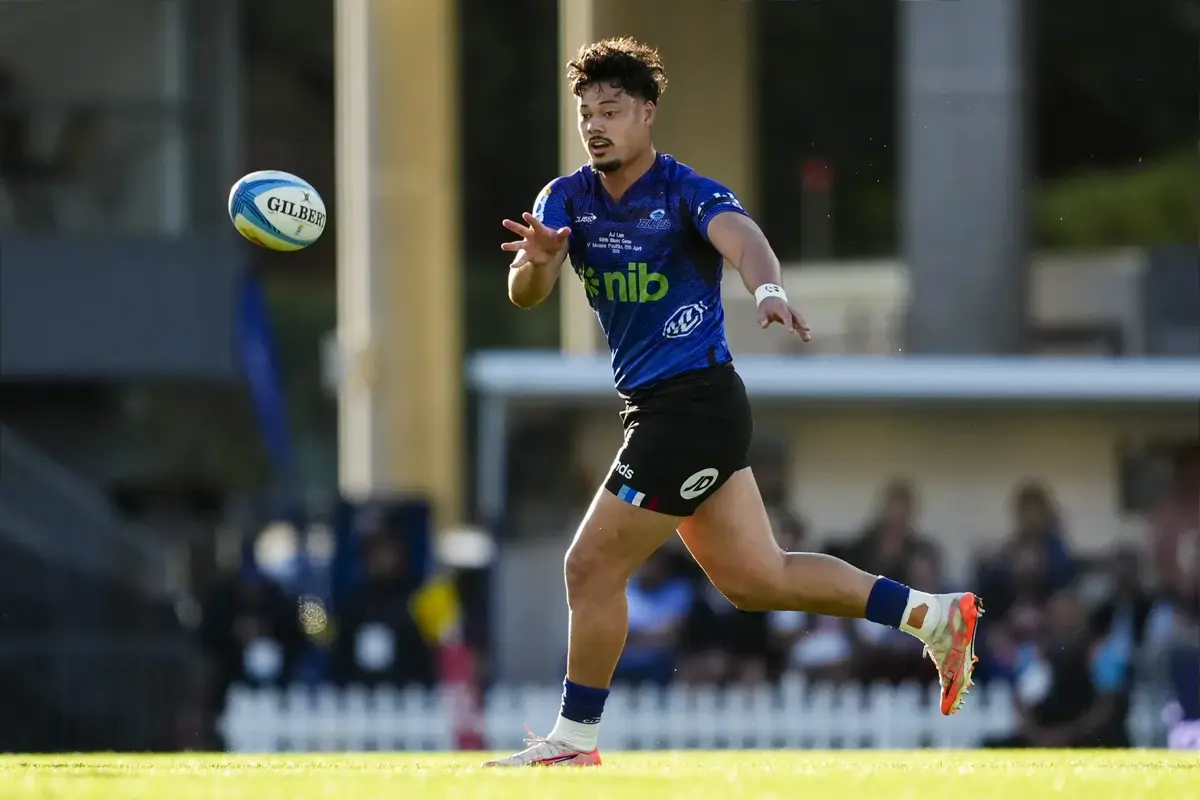
Blues AJ Lam during the Blues v Moana Pasifika, Super Rugby Pacific match, Eden Park, Auckland, New Zealand. Saturday, 12 April 2025, (Photo by Blake Armstrong / action press)

Auckland Blues centre AJ Lam has confirmed his departure to French Top 14 side ASM Clermont Auvergne, signing a three-year contract that will see him leave New Zealand at the conclusion of the 2026 Super Rugby Pacific season.

  • AJ Lam has signed a three-year deal with ASM Clermont Auvergne starting July 2026
  • The 27-year-old centre will complete the 2026 Super Rugby Pacific season with the Blues
  • Lam has made 58 appearances for Auckland since his 2021 debut
  • He will reunite with former Blues teammate Harry Plummer in France

The 27-year-old, who was instrumental in the Blues’ 2024 title triumph, will join former teammate Harry Plummer in the Auvergne region, with Clermont securing one of Super Rugby’s most dynamic midfield threats on a deal running through to 2029.

Lam’s move ends a six-year association with the Blues that began with his Super Rugby debut in 2021. Across 58 appearances, the versatile back has evolved from an outside back into one of the competition’s premier centres, forming a formidable midfield partnership alongside Rieko Ioane and operating outside All Blacks fly-half Beauden Barrett.

“This club has shaped me. The Blues have been my home and I’m proud of what we’ve achieved,” Lam said. “I’m grateful for the support from the coaches, staff, my teammates and our fans. While I’m excited for the opportunity in France, my goal right now is to give everything to the Blues in 2026 and finish my time here in the best possible way.”

The Auckland product’s signature represents a significant coup for Clermont, who have been searching for an experienced, powerful centre capable of complementing their attacking structure. At 1.88m and 100kg, Lam brings the physical presence and technical skill that head coach Christophe Urios has prioritised.

“It’s excellent news for the club,” Urios said. “He’s exactly the profile we were looking for – a player capable of winning collisions, advancing and breaking through defences, but also blessed with very good hands that allow him to bring life and speed to the ball. We’re eager to see how the connections that already exist with Harry will be able to fit into our game system.”

Lam’s departure will coincide with Rieko Ioane’s return from a one-season sabbatical with Leinster, while promising youngsters Xavi Taele and James Cameron will be among those looking to fill the void left by his exit. The timing ensures the Blues retain midfield depth for 2026 whilst planning for the future.

Blues general manager of rugby Murray Williams paid tribute to Lam’s contribution whilst expressing confidence the centre would remain fully committed for his final campaign in Auckland.

“AJ is a Blues man through and through. He’s grown with this club from the moment he arrived,” Williams said. “Clermont are getting a special player, but we’re grateful that we have another full season with him. AJ is locked in for 2026 and we know he’ll give everything for the jersey.”

The move continues a trend of Super Rugby stars securing European opportunities whilst honouring domestic commitments. Lam follows Plummer’s path to Clermont, where the pair will be reunited having combined to devastating effect during the Blues’ 2024 championship run.

Plummer’s recommendation played a significant role in Clermont’s pursuit of Lam, with Urios placing considerable faith in the fly-half’s assessment of his former teammate’s character and motivation.

“He’s both explosive and technical,” Urios added. “With the experience he possesses, he’s capable of giving a new dimension to our attacking line. Moreover, he’s very close to Harry, who strongly recommended him to us. When you know his professionalism and his desire to take the club towards great things, we can only trust him on AJ’s mindset and motivation to join us.”

<script async src=”https://static.smartframe.io/embed.js”></script><smartframe-embed theme=”sp-theme” customer-id=”7c910de5861e399f1115d2a413d299d8″ image-id=”ARCH211561_00199063″ style=”width: 100%; display: inline-flex; aspect-ratio: 4653/3102; max-width: 4653px;”></smartframe-embed><!– https://smartframe.io/embedding-support –>

Lam’s credentials extend beyond club rugby. The centre has been a consistent selection for the All Blacks XV in recent years and earned time with the full All Blacks as injury cover in 2024. However, a surprise omission from the 2025 national development squad fuelled speculation about a potential overseas move that would end his All Blacks eligibility.

At Clermont, Lam will join fellow All Blacks Pita Gus Sowakula and George Moala, adding to the French club’s New Zealand contingent. His arrival follows recent contract extensions for Baptiste Jauneau, Killian Tixeront, Barnabé Massa, Etienne Fourcade, Cristian Ojovan and Giorgi Akhaladze, marking Clermont’s first major signing ahead of the 2026-27 season.

Described by Clermont as a “true first centre” who should be “one of the attractions” of next season’s Top 14, Lam’s combination of creativity, defensive reliability and attacking threat has made him one of Super Rugby’s most complete midfielders. His ability to gain ground through contact whilst possessing the vision and skill to unlock defences has been central to the Blues’ attacking potency.

For now, Lam’s focus remains firmly on delivering another memorable campaign in Blues colours. With the 2026 Super Rugby Pacific season beginning in February, the centre will be determined to bookend his Auckland career with another title challenge, cementing a legacy built on consistency, versatility and an unwavering commitment to the jersey.

The Blues open their 2026 campaign against the Chiefs at Eden Park on 15 February, with Lam certain to be a central figure in their title defence before embarking on his French adventure in July.

Continue Reading

Super Rugby Pacific

Highlanders secure Chiefs No 10 Jacomb in key signing for future

Published

on

Highlanders secure Chiefs No 10 Jacomb in key signing for future
Chiefs Josh Jacomb during the Super Rugby Pacific match, Blues v Chiefs, Eden Park, Auckland, New Zealand. Saturday, 15 February 2025, (Photo by Paul Taylor / action press)

The Highlanders have secured one of New Zealand rugby’s brightest young prospects, with Taranaki first five-eighths Josh Jacomb signing a two-year deal that will see him join the Dunedin-based franchise from the 2027 Super Rugby Pacific season.

The 24-year-old playmaker, who has spent the past two seasons understudying All Black Damian McKenzie at the Chiefs, will remain in Hamilton for the 2026 campaign before heading south to take up what the Highlanders hope will be a pivotal role in their ongoing rebuild under head coach Jamie Joseph.

Jacomb’s signature represents a significant coup for the Highlanders, who have been actively pursuing young talent since Joseph’s return to the coaching helm. The move addresses what has been a problematic position for the franchise, with the first five-eighths duties shared between Cameron Millar and Taine Robinson throughout a challenging 2025 campaign.

“I’ve learned a lot at the Chiefs, especially working alongside someone like D-Mac, but I feel I’m ready to take the next step in my career and hopefully play a more prominent role,” Jacomb said. “I believe a move to the Highlanders is the best place for me to do that. I know that I will have to continue to work hard as they already have some good young talent down there, but I am genuinely excited by the prospect of playing for the Highlanders.”

The signing comes after months of speculation surrounding Jacomb’s future, with the young pivot finding his pathway to regular starting opportunities blocked by McKenzie’s presence. The All Blacks star recently extended his contract with New Zealand Rugby through to 2029, effectively sealing Jacomb’s fate in Hamilton despite the playmaker’s obvious potential.

In his two seasons with the Chiefs, Jacomb has managed just nine starting appearances, a statistic that belies his considerable talent and ambition. His performances for Taranaki in the National Provincial Championship have been nothing short of exceptional, including a remarkable 30-point haul against Auckland at Eden Park that underlined his readiness for a more prominent role in Super Rugby.

Jacomb’s credentials extend beyond domestic competition. He earned a starting berth at first five-eighths for the All Blacks XV against Georgia last November, a selection that affirmed national selectors’ view of him as one of New Zealand’s most promising game drivers. He further enhanced his reputation with another start at No 10 for the Barbarians against the Springboks in June, demonstrating his ability to perform on the international stage.

Joseph, who has been instrumental in reshaping the Highlanders’ roster with an eye towards youth and potential, was effusive in his praise of the new recruit.

“We believe Josh has some untapped potential that we can help him realise,” Joseph said. “He’s hungry, driven, and ready to lead. We’re very excited to see what he can accomplish with us and also what he can contribute to our team performances over the coming seasons. I think this is a strong signing for us and aligns perfectly with our broader club strategy of building depth and competition in all positions – growing individual players and the team as a whole.”

The timing of the move is particularly significant given that Jacomb will remain at the Chiefs for the 2026 season, a year that looms large in the All Blacks calendar with a tour of South Africa scheduled. New Zealand Rugby has earmarked that tour as a development opportunity for the next generation of All Blacks playmakers, making game time in Super Rugby Pacific crucial for those with international ambitions.

It is understood that Jacomb was keen to make the switch immediately, but his existing contract obligations mean he will need to bide his time for another year. The delay may prove fortuitous, however, as it allows him to continue learning from McKenzie whilst maintaining his sharpness in what is likely to be a competitive 2026 campaign.

The Highlanders’ recruitment of Jacomb is made all the more impressive by the fact that he reportedly turned down a substantial offer from a Japanese club to remain in New Zealand. His commitment to staying in Super Rugby and pursuing All Blacks honours speaks to his long-term ambitions and confidence in the Highlanders’ project.

Jacomb will join a youthful Highlanders squad that Joseph has been carefully assembling. The backline already boasts considerable firepower in the form of All Black Timoci Tavatavanawai, former All Blacks Sevens flyer Caleb Tangitau, and fellow Taranaki and Barbarians representative Jacob Ratumaitavuki-Kneepkens.

For the Highlanders faithful, who have endured some of their most challenging results in recent campaigns, the signing represents a tangible sign of progress. The franchise has been engaged in a tug-of-war with the Chiefs for Jacomb’s services, and securing his commitment – albeit with a delayed start date – will be viewed as a victory for Joseph’s vision.

The situation also presents interesting questions for the Chiefs, who will need to carefully manage their resources in 2026. Whilst McKenzie remains their first-choice playmaker, the franchise has the option of deploying him at fullback, though they are already well-stocked in the back three with All Blacks Emoni Narawa and Leroy Carter, as well as Etene Nanai-Seturo and new recruit Kyren Taumoefolau.

For Jacomb, the next two years represent both a challenge and an opportunity. He must first navigate one more season as McKenzie’s deputy, a role that demands patience and professionalism, before taking centre stage in Dunedin. His performances in Taranaki’s successful Ranfurly Shield defence in 2024 and his subsequent international appearances suggest he possesses both the skill and temperament to thrive under pressure.

The Highlanders, meanwhile, must ensure they provide the right environment for Jacomb to flourish once he arrives. Joseph’s track record of developing young talent augurs well, but the franchise will need to demonstrate tangible progress in 2026 to convince their new signing that the move south was the right decision.

Continue Reading

Trending

Discover more from Rugby News, Results, and Analysis | Rugby is the Game

Subscribe now to keep reading and get access to the full archive.

Continue reading