Connect with us

Men's Rugby World Cup 2027

Pools confirmed for Men’s Rugby World Cup 2027 in Australia

Published

on

Pools confirmed for Men’s Rugby World Cup 2027 in Australia

SYDNEY, AUSTRALIA - Michael Atkinson, Dan Carter, Alicia Lucas and Tim Horan pose at the broadcast desk during the Men's Rugby World Cup 2027 Draw at Channel Nine Studios on December 03, 2025 in Sydney, Australia. (Photo by Mark Kolbe - World Rugby/World Rugby via Getty Images)

Preparations for Men’s Rugby World Cup 2027 reached a crucial milestone on Wednesday with confirmation of the six pools that will headline the largest tournament in rugby union’s history, setting up a blockbuster opening match between New Zealand and hosts Australia in Perth.

  • Six pools confirmed for 24-team tournament at Sydney draw ceremony
  • New Zealand face hosts Australia in blockbuster Pool A clash
  • England and Wales drawn together for third time in four tournaments
  • Ireland and Scotland paired for third consecutive World Cup
  • South Africa could face New Zealand in quarter-finals if pools go to form
  • Match schedule to be announced on 3 February 2026
  • Ticket presale window opens 18 February 2026

The draw, conducted at a ceremony in Sydney and broadcast live on Stan Sport, 9Gem and 9Now in Australia, as well as globally via RugbyPass TV and World Rugby’s YouTube channel, revealed the pool compositions for the expanded 24-team tournament that will take place across seven Australian cities from 1 October to 13 November 2027.

For the first time, the Men’s Rugby World Cup features 24 teams competing across six pools of four, an expanded format designed to break down barriers and make the game more accessible to fans around the world. The draw was presented by a star-studded line-up including World Rugby Chair and former Australian international Brett Robinson, All Blacks legend and two-time World Cup winner Dan Carter, former Wallabies captain and Australia’s most-capped player James Slipper, and Olympic gold medallist and former Australian Sevens star Alicia Lucas.

The headline attraction emerged immediately as New Zealand were drawn from the top band into Pool A, where hosts Australia had already been placed as the second band representative. The trans-Tasman rivals, who have never met in the pool stages of a World Cup, are now likely to face each other in the tournament’s opening match at Perth’s Optus Stadium on 1 October. Chile and debutants Hong Kong China complete Pool A, ensuring the Wallabies and All Blacks should progress comfortably to the knockout stages.

However, the winner of that opening encounter will secure a significantly more favourable path through the tournament. Pool A’s winner is set to face a third-placed team in the Round of 16, whilst the runner-up would likely meet France in the last 16 – a daunting prospect for whichever side finishes second.

More significantly, if the pools play out according to form, the winner of Pool A faces a potential quarter-final against reigning world champions South Africa, setting up a mouth-watering clash between rugby’s current powerhouses. The Springboks, pursuing an unprecedented hat-trick of World Cup titles, have been drawn in Pool B alongside Italy, Georgia and Romania – all teams they have faced in previous World Cups.

“We’re obviously stoked to get the All Blacks,” said Wallabies captain Harry Wilson. “We verse quite a lot, so to get them in the showpiece event, our first game, it’d be really exciting. In a World Cup, if you want to win it, you’ve got to beat the best teams, and they’re obviously one of the best teams in the world. If we get the Springboks in a quarter-final it’ll be exciting. It’s a challenge which we’re going to have to be ready for.”

The draw has set up a fascinating dynamic where South Africa and New Zealand, currently ranked first and second in the world respectively, are on a collision course for a quarter-final meeting – provided both top their pools and navigate their Round of 16 fixtures. The winner of that potential blockbuster would likely face France in the semi-finals and possibly England in the final, should the tournament unfold according to current world rankings.

Pool C sees Argentina drawn with Fiji, Spain and Canada in what appears a relatively straightforward group for Los Pumas, who should top the pool and potentially face Ireland in a quarter-final. The Argentinians will be expected to navigate their pool comfortably, though Fiji possess the attacking firepower to cause problems on their day.

Pool D has reunited Ireland and Scotland for the third consecutive World Cup, with Uruguay and Portugal – both of whom impressed as underdogs in France 2023 – completing the group. Ireland won their previous pool encounter 36-14 in France, and Andy Farrell’s side will be favourites to top the group once again. However, finishing second would come at a significant cost, with France the likely opponents in the Round of 16.

Pool E brings together France, Japan, the United States and Samoa in an intriguing group that should see Les Bleus progress as winners. France, runners-up in 2023, will be amongst the favourites for the tournament and have drawn a pool that should allow them to build momentum through the early stages. Japan, hosts of the 2019 tournament, will provide stern opposition, whilst the USA – hosts of the 2031 tournament – will be eager to make an impression.

Perhaps the most compelling pool from a British perspective is Pool F, where England and Wales have been paired together for the third time in four tournaments. The two sides famously met at the same stage in 2015, with Wales’ 28-25 victory at Twickenham contributing significantly to hosts England’s early exit from their own tournament. Tonga and Zimbabwe, making their first World Cup appearance since 1991, complete Pool F.

Despite Wales’ current struggles – with just two wins in 22 Tests over the past two years – they have a strong chance of progressing as Pool F runners-up at the very least, with Tonga the lowest-ranked team in band three of the draw, and Zimbabwe returning to the tournament after a 36-year absence. The runners-up from Pool F will face the runners-up of Pool C in the last 16, most likely Argentina or Fiji.

The expanded format means the top two teams from each pool will progress to the Round of 16, along with the four best third-placed teams. This ensures 16 of the 24 competing nations will reach the knockout stages, creating a more dramatic and competitive pool phase where every match carries significant weight.

The draw methodology, based on the World Rugby Rankings at the end of the November 2025 internationals, was designed to avoid the lopsided pools that characterised the 2023 tournament. The draw for that edition had been held in December 2020, three years before the tournament, and rankings changed dramatically in the intervening period. Powerful teams such as the All Blacks and France were grouped together in 2023, whilst the Springboks and Ireland shared another pool, creating an unbalanced draw.

Under the new system, teams were divided into four bands of six, with each band drawn randomly into Pools A through F. This ensured that teams in the top band would not meet until the Round of 16 at the earliest, whilst also giving all teams a chance to inspect hotels, training venues and gymnasiums well in advance of the tournament.

“It’s really exciting. The Wallabies will play [New Zealand] four times in the lead-up and it gives you a great opportunity to really plot a path to get up and organise for that game,” said Wallabies coach Joe Schmidt, who will hand over to Les Kiss before the tournament. “Chile and Hong Kong China, they’re two newcomers that will challenge you in a different way; challenge you to keep that level of performance to a certain height so that when you hit the round of 16, you hit the ground running.”

With the pools now confirmed, teams and fans can begin planning their Rugby World Cup 2027 journey in earnest. The next major milestone will be the announcement of the match schedule on Tuesday, 3 February 2026, which will reveal the specific fixtures, dates and venues for all 52 matches across the six-week tournament.

Rugby fans will then have an opportunity to secure seats during an exclusive two-week presale window starting on 18 February 2026 at 12:00 AEDT. Fans must create a ticketing account before 12:00 AEDT on Tuesday, 17 February 2026 to be eligible to enter the presale. With 2.5 million tickets available across the tournament, including one million priced under AUD$100, organisers are confident of breaking attendance records.

RWC 2027 – POOLS

Pool A: New Zealand, Australia, Chile, Hong Kong China
Pool B: South Africa, Italy, Georgia, Romania
Pool C: Argentina, Fiji, Spain, Canada
Pool D: Ireland, Scotland, Uruguay, Portugal
Pool E: France, Japan, USA, Samoa
Pool F: England, Wales, Tonga, Zimbabwe

Continue Reading
Click to comment

Leave a Reply

Men's Rugby World Cup 2027

Men’s Rugby World Cup 2027 fixture details confirmed

Published

on

Men’s Rugby World Cup 2027 fixture details confirmed
The 2027 Rugby World Cup schedule has been revealed. Photo: World Rugby

The match schedule and ticket prices for Men’s Rugby World Cup Australia 2027 have been released, confirming dates, venues, and kick-off times for all 52 tournament matches. Tickets go on sale from 18 February for registered fans.

Key points

  • Dates, venues, kick-off times and ticket prices confirmed for all 52 matches across the 24-team tournament
  • Weekend-focused schedule designed to maximise attendance
  • Hosts Australia to face Hong Kong China in Perth for the opening match on 1 October 2027
  • South Africa begin their title defence against Italy in Adelaide
  • Five matches scheduled for 17 October, a first for the tournament
  • Ticket prices start at AUD$40, with one million tickets available at $100 or under

Expanded format brings more matches

World Rugby has released the complete match schedule for Men’s Rugby World Cup Australia 2027. The eleventh edition of the tournament is the first under the expanded 24-team format, featuring 52 matches across seven host cities.

The tournament will begin in Perth on 1 October, with Australia facing Rugby World Cup debutants Hong Kong China in the opening match. Hong Kong China qualified as Asian champions following World Rugby’s 2023 decision to expand the men’s World Cup from 20 to 24 teams.

The Wallabies will then travel to Sydney for their second pool match against New Zealand on 9 October at Stadium Australia. This is the first time the two nations have been drawn in the same pool, with all four previous Rugby World Cup meetings occurring in knockout rounds.

South Africa begin title defence

Reigning champions South Africa will open their campaign in Adelaide on 3 October against Italy at the Adelaide Oval. The Springboks, who defeated New Zealand in the 2023 final, are seeking a third consecutive World Cup title.

The Adelaide Oval will also host Zimbabwe’s return to the Rugby World Cup for the first time since 1991, when they face Wales on 2 October.

Six Nations rivals meet in pool stage

England and Wales have been drawn together in Pool F and will meet at Stadium Australia on 16 October. The match could determine the pool winner, with the victor likely securing a more favourable knockout pathway.

England will begin against Tonga in Brisbane on 2 October, before facing Zimbabwe in Adelaide on 8 October. The Sydney venue is where England won their only World Cup in 2003, defeating Australia in extra time through Jonny Wilkinson’s drop goal.

Ireland and Scotland will meet for a third successive World Cup, playing in Perth on 10 October. Ireland open against Portugal in Sydney on 4 October, while Scotland begin against Uruguay in Melbourne on 3 October.

Weekend-focused schedule

The schedule spans 19 matchdays and clusters fixtures on weekends to maximise attendance. Only two Monday fixtures have been scheduled across the six-week tournament, with one falling on an Australian public holiday.

Each of the seven host cities will stage two matches on the same weekend during the pool phase. The pool stage concludes on 17 October with five matches played in a single day, the first time this has occurred at a Rugby World Cup. The fixtures include Italy v Georgia, Ireland v Uruguay, Scotland v Portugal, France v Samoa, and South Africa v Romania.

New round of 16 format

The expanded tournament introduces a round of 16 knockout stage, with matches hosted in Brisbane, Melbourne, Perth and Sydney. Pool winners and runners-up progress automatically, while the four best third-placed teams also advance.

Brisbane Stadium and Stadium Australia will host quarter-finals on 30 and 31 October. Both semi-finals take place in Sydney on 5 and 6 November, followed by the bronze final on 12 November and the final on 13 November.

Player welfare considerations

The schedule includes a minimum of five rest days between matches for all 24 teams. Kick-off times have been adjusted for local conditions, with later starts in warmer cities such as Townsville and Brisbane.

Official reaction

Photo from World Rugby

World Rugby Chair Brett Robinson said: “The wait is over. This is the moment teams and fans have been waiting for and the start of their Rugby World Cup 2027 journey. We’ve assembled the most compelling match schedule to date, carefully designed to balance player welfare, fan experience and global reach.”

Men’s Rugby World Cup 2027 Managing Director Chris Stanley added: “By clustering matches on weekends, local communities in our seven host cities will enjoy a festival atmosphere, with tickets available to suit all needs and budgets. Fans have a unique opportunity to be part of this edition and are encouraged to register now to access the Presale on 18 February.”

Wallabies captain Harry Wilson said: “It’s obviously great to face Hong Kong in the first match and then have a week to build to what is going to be another massive match against New Zealand. We probably don’t know too much about them yet but over the next 18 months we will be watching the games and getting across them, because during a World Cup they’ll be a threatening team.”

Ticket Information

The Presale begins on 18 February at 12:00 AEDT and closes on 4 March. Tickets will be available on a first-come, first-served basis via tickets.rugbyworldcup.com. Prices start from AUD$40 for adults and AUD$20 for children, with one million tickets priced at AUD$100 or less.

World Rugby CEO Alan Gilpin said the tournament will have 2.5 million tickets available, slightly more than the 2015 edition in England. Purchase limits range from six to ten tickets per match, per customer.

Key Fixtures

Opening match: Australia v Hong Kong China – 1 October, Perth Stadium
Pool A: Australia v New Zealand – 9 October, Stadium Australia, Sydney
Pool D: Ireland v Scotland – 10 October, Perth Stadium
Pool F: England v Wales – 16 October, Stadium Australia, Sydney
Final: 13 November, Stadium Australia, Sydney

Continue Reading

Men's Rugby World Cup 2027

World Cup 2027 to kick off in Perth as tournament format unveiled

Published

on

World Cup 2027 to kick off in Perth as tournament format unveiled
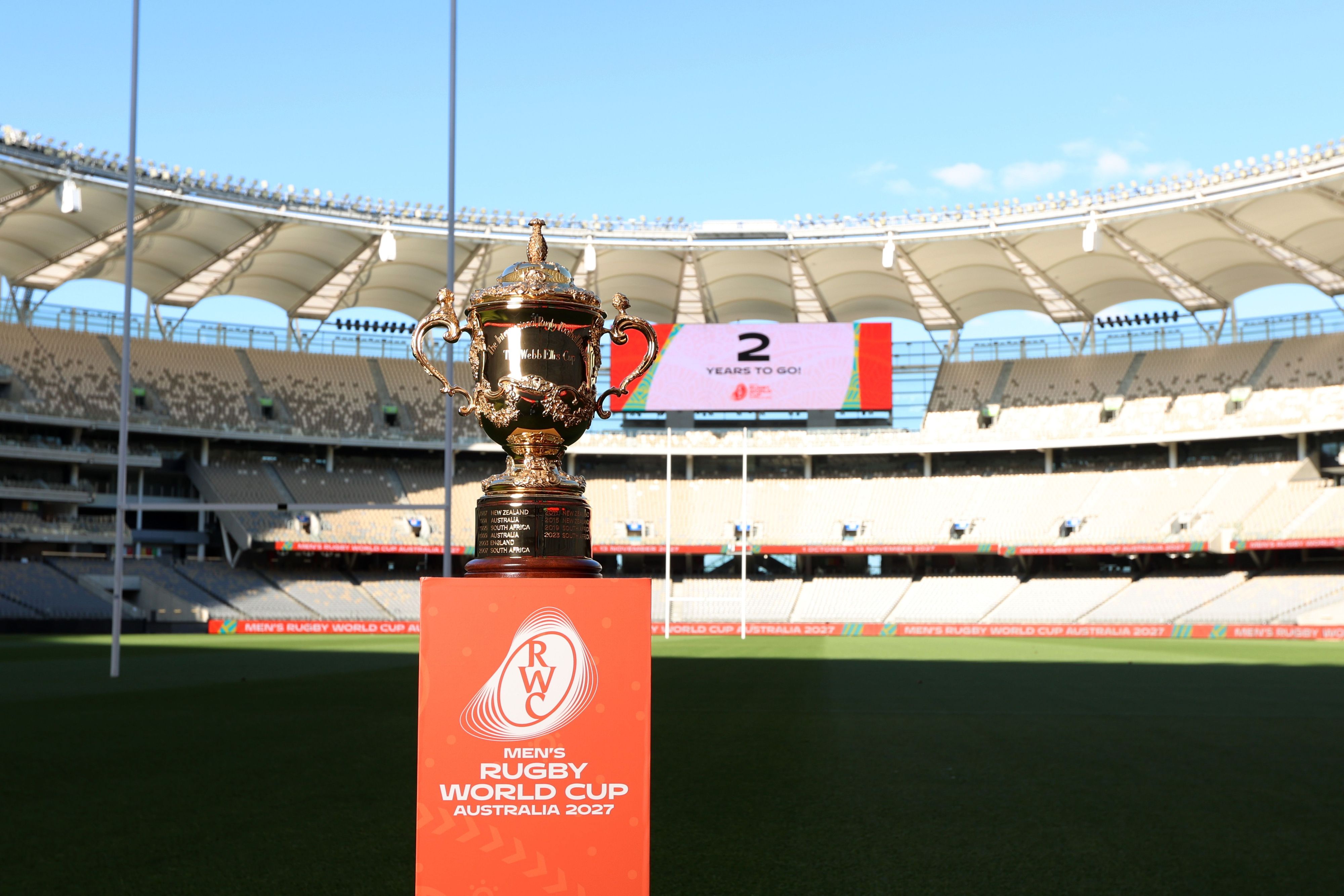
Two years from today, Perth Stadium will host the opening match of the biggest Men’s Rugby World Cup in history, kicking off six weeks of world-class rugby across Australia from 1 October to 13 November, 2027.

Two years from today, Perth Stadium will host the opening match of the biggest Men’s Rugby World Cup in history, launching six weeks of world-class rugby across Australia from 1 October to 13 November 2027.

  • Perth Stadium confirmed as host of opening match on 1 October 2027
  • Tournament draw set for evening of 3 December 2025, broadcast on Channel Nine
  • Expanded 24-team format featuring six pools of four teams
  • First-ever Round of 16 knockout phase in Rugby World Cup history
  • 52 matches across seven Australian cities over six weeks
  • 2.5 million tickets available, one million priced under AUD$100

World Rugby confirmed the landmark details at a celebration in Perth’s Kings Park on Wednesday, announcing 3 December 2025 as the date of the tournament draw and revealing the new competition format that will see 24 nations compete for the Webb Ellis Cup for the first time.

The draw, to be held on the evening of 3 December (AEST), will be broadcast live in Australia on Channel Nine, as well as on international broadcasters and RugbyPass TV. In a historic first, all 24 competing teams will be known at the time of the draw, with the 24th and final qualifier to be determined at November’s Final Qualification Tournament in Dubai (8-18 November).

A new expanded format

The tournament will feature six pools of four teams, with the World Rugby Men’s Rankings at the end of the November internationals used to create four bands of six teams. Each band will be drawn randomly into Pool A, B, C, D, E or F, marking a departure from the traditional five-pool structure that has characterised previous tournaments.

The top two teams from each pool plus the four best third-placed teams will qualify for the knockout phase, ensuring 16 nations progress beyond the pool stages. This expanded qualification pathway promises to make every pool match count whilst bringing greater entertainment and competitive tension to the opening phase.

The introduction of a Round of 16 represents the tournament’s most significant structural innovation. Winners of Pools A, B, C and D will play the four best third-placed teams, whilst winners of Pools E and F will face the runners-up from Pools D and B. The runners-up in Pools A and C will meet the second-placed teams from Pools E and F.

Chris Stanley, Managing Director of Men’s Rugby World Cup Australia 2027, explained the rationale behind the new structure. “24 teams, 52 matches, seven host cities, and six weeks of amazing rugby,” Stanley told media in Perth. “And for the very first time at a Rugby World Cup, a round of 16. With more teams, the biggest tournament ever requires a new and innovative format.”

World Rugby Chair Brett Robinson said the expanded format reflected rugby’s global growth. “With only two years until the biggest Men’s Rugby World Cup ever, I’m thrilled to see the tournament draw date revealed,” Robinson said. “The draw brings the potential match-ups to life, rivalries are set and fans across the globe can envision the unforgettable rugby that awaits.

“Expanding Men’s Rugby World Cup to 24 teams is a landmark moment for our sport. It means more nations, more matches, and more opportunities for fans around the world to connect with rugby. The introduction of a round of 16 will deliver even more knockout rugby, ensuring every match counts and every team has the chance to make history. Importantly, we’ve been able to achieve this within a streamlined tournament window that protects player welfare while enhancing the spectacle. This is a huge step forward for rugby and a reflection of the game’s global growth.”

One last team to qualify

The qualification process is almost complete, with 23 teams now confirmed after Chile defeated Samoa 31-12 in the South America/Pacific play-off on Saturday, 27 September in Viña del Mar. The final remaining spot will be determined at the Final Qualification Tournament from 8-18 November in Dubai, where Belgium, Namibia, and either Brazil or Paraguay will join Samoa in competing for the last place in Australia.

For the current Wallabies squad, their world ranking position adds urgency to the remaining international fixtures. Australia currently sits seventh in the World Rugby Rankings, placing them in a precarious position ahead of the December draw. Climbing into the top six before the November 2025 rankings cut-off would prove crucial in avoiding a heavyweight opponent in the pool phase.

Perth to kick off tournament

The choice of Perth Stadium as the opening venue provides a strategic western gateway for the tournament. The 60,000-capacity venue, which offers direct flight connections from Europe and South Africa, will host the Wallabies in the tournament’s inaugural match. Perth will stage a total of seven matches, including the opening fixture, four additional pool matches and two Round of 16 encounters.

Western Australia Premier Roger Cook welcomed the announcement, declaring it would be “the largest sporting event ever held in Western Australia.” Cook emphasised Perth’s unique positioning for international visitors. “You can imagine Western Australia being the place to be for that opening round, it’s going to unleash an incredible six weeks of tournament and fire the starter’s gun for what will be an amazing event,” he said. “Western Australia will be at the epicentre of that when the tournament kicks off.”

The tournament will span seven host cities across Australia, with 52 matches to be played over the six-week period. Sydney emerges as the biggest winner, hosting a mammoth 13 matches including both semi-finals, the bronze final, two quarter-finals and the tournament decider on 13 November at Accor Stadium – the 82,000-capacity venue that hosted the dramatic 2003 final between Australia and England.

Brisbane will host 10 matches, including two quarter-finals, making it one of the core tournament destinations. Melbourne secured nine matches in a last-minute deal with World Rugby, including seven pool matches and two Round of 16 fixtures. The Victorian capital had initially withdrawn its bid due to financial constraints following the state government’s decision to pull out of hosting the 2026 Commonwealth Games, but returned to the negotiating table in late January.

“You’ve got to say that nine matches in Melbourne is fantastic,” Robinson told reporters. “It wouldn’t be the World Cup without going to the ‘G’, so it’s wonderful that we’ve got there and they’re participating in a significant way in the tournament.”

It is understood the MCG will host most of Melbourne’s fixtures, including the two Round of 16 knockout matches, with nearby AAMI Park also set to secure games. Perth’s Optus Stadium was considered to stage a quarter-final given its 60,000 capacity and friendlier time zone for European and African audiences, but the city will instead host two Round of 16 matches.

Adelaide will host five pool matches, whilst Newcastle and Townsville have been awarded four pool matches each. Canberra, where the ACT Brumbies are based, will not host any matches. “I’ve got a few chips on my shoulders, as a lot of Brumbies do, but we haven’t quite got the stadium to be competitive,” said Robinson, who previously captained the Brumbies. “We’ve got a wonderful rugby community, playing at home in Canberra is a wonderful place to play the game, it’s just we don’t have the facilities to compete for the scale of this tournament.”

New South Wales Premier Chris Minns highlighted his state’s success in the hosting allocations. “It’s great to see New South Wales come out on top – securing hosting rights to Men’s Rugby World Cup 2027. Staging the finals and having more matches than any other state, demonstrates just how attractive NSW is as a destination for global sporting events,” Minns said. “To all those keen rugby fans across the globe – it’s time to lock in your travel plans. Not only will you get to watch some fantastic sport, but you will also get to tour the best state in the world, home to extraordinary national parks and unparalleled Harbour views.”

First tickets on sale in February 2026

Ticketing arrangements promise unprecedented accessibility. Fans will have two initial opportunities to secure their place at the tournament’s 11th edition, with the first tickets going on sale following the release of the match schedule early next year.

In February 2026, a closed presale will open for fans who have registered their interest before the presale begins at rugbyworldcup.com/2027. All matches and all price categories will be available during this presale, and fans are encouraged to register to give themselves the best chance to secure tickets.

Then, in May 2026, a three-week general application phase will open to all supporters worldwide, offering the chance to request tickets for any match with a ballot system implemented for oversubscribed price categories to ensure fairness. With 2.5 million tickets available across the tournament – more than any previous edition – it will be the most accessible Rugby World Cup in history, narrowly surpassing the attendance figures for England 2015.

Significantly, one million tickets will be priced under AUD$100, with entry-level prices starting at AUD$40 for adults and AUD$20 for children. This pricing strategy aims to make the tournament accessible to families and younger fans whilst maximising attendance across all venues.

World Rugby chief executive Alan Gilpin said the expanded format would make it the biggest World Cup ever. “We’ve got 2.5 million tickets to sell across the tournament, so it will just sneak across Rugby World Cup in England in 2015,” Gilpin said. “We’ve got 52 matches now, so we’ve got four more matches. That part’s exciting because there’s more knockout content than ever before, six pools of four, it’ll be electric from the start.”

Impact for Australia and rugby

The economic projections surrounding the tournament remain substantial. With 250,000 international visitors expected over the six-week period, the tournament is projected to generate AUD$1.3 billion in direct visitor expenditure across the country and seven host cities. The broader economic impact is expected to exceed AUD$2 billion, positioning the tournament as the largest sporting event on Australian soil since the Sydney 2000 Olympics.

Rugby Australia Chief Executive Phil Waugh, who played for the Wallabies in the heartbreaking 2003 final, emphasised the transformative potential of the tournament. “Rugby World Cup is among the planet’s biggest sporting events and Australia is incredibly excited to welcome the world to the 2027 edition,” Waugh said. “Australia has a rich history of hosting major tournaments – indeed, we co-hosted the first ever Rugby World Cup almost 40 years ago – and I have no doubt this event will captivate and enthral the hundreds of thousands attending in-stadium and the hundreds of millions viewing around the world.

“A Men’s Rugby World Cup presents a unique opportunity for our country. From the positive economic impacts, to the energising of the fan base, to the inspiration provided to the next generation of players, RWC 2027 will leave a legacy that will be felt in Australia for many years to come.”

Beyond the immediate economic impact, organisers are targeting 200,000 rugby participants by 2029, aiming to convert tournament exposure into sustained grassroots engagement – addressing one of Australian rugby’s persistent challenges following the 2003 tournament.

Stanley said Wednesday’s announcement coincided with the 25th anniversary of the Sydney 2000 Olympics closing ceremony. “Men’s Rugby World Cup 2027 will be the biggest sporting event on Australian soil since Sydney 2000,” Stanley said. “This is a once-in-a-generation opportunity for Australians to be part of a truly international celebration and for the global rugby community to share in an incredible Men’s Rugby World Cup in Australia.”

Golden decade for Australian rugby

The tournament forms the centrepiece of what Rugby Australia has termed a “golden decade” for the sport in the country, encompassing this year’s British and Irish Lions tour, the 2029 Women’s Rugby World Cup, and the 2032 Olympics in Brisbane. Adelaide is also slated to host the Australia/New Zealand invitational match against the British and Irish Lions in July this year.

For the Wallabies, the tournament represents an opportunity to erase the disappointment of the 2023 edition in France, where they failed to progress beyond the pool stages for the first time in their history under then-coach Eddie Jones. The addition of the Round of 16 will likely ensure Australia progresses past the pool stages, having spectacularly bombed out after losing narrowly to Fiji before being hammered by Wales in Lyon.

Incumbent Wallabies captain Harry Wilson spoke of the emotional significance of a home World Cup. “It’s hard to put into words how significant a Rugby World Cup on home soil is, and to have the host cities confirmed brings another level of excitement and anticipation,” Wilson said. “I have vivid memories of being a young boy, living in country New South Wales with my family when Australia last held the tournament in 2003 and what that buzz was like for the local community. As players, Rugby World Cup is certainly in the back of our minds, and we know the whole country will be right behind us in a little over two years’ time.”

Waugh reflected on his own experience playing in the 2003 final. “Taking the field for the final in 2003 was among the greatest honours of my career and I am delighted this generation of Wallabies will have the privilege of experiencing the emotion, excitement and joy of pulling on the gold jersey before our passionate fans at a Men’s Rugby World Cup in own backyard,” he said.

Just who leads the Wallabies at the tournament remains to be seen, with current coach Joe Schmidt unlikely to continue beyond 2025. Les Kiss has already been named as his replacement ahead of the team’s clash with New Zealand this weekend in Perth.

The road ahead

As the countdown begins in earnest, attention now shifts to the Final Qualification Tournament in Dubai and the November internationals that will determine the final rankings and seedings. The draw on 3 December will provide the first tangible glimpse of the tournament’s competitive landscape, setting rivalries in motion and allowing fans worldwide to begin planning their journey to Australia for rugby’s greatest celebration.

“The Draw on 3 December will be the next major milestone — the moment when fans and players alike discover who they’ll be facing in the pool phase,” Stanley said. “From there, anticipation will only grow as we move towards unveiling the match schedule and opening ticket sales in February 2026.”

With defending champions South Africa seeking to become the first nation to win three consecutive World Cups, and powerhouses including New Zealand, Ireland, England, France and Argentina all harbouring ambitions, the stage is set for what promises to be the most competitive and accessible Rugby World Cup in the tournament’s 40-year history.

The tournament that began in 1987 in Australia and New Zealand will return to Australian shores four decades later, expanded, evolved and ambitious – ready to unite a nation for six unforgettable weeks and leave a legacy that will resonate for generations to come.

Continue Reading

Men's Rugby World Cup 2027

Four teams one win away from RWC 2027 qualification this weekend

Published

on

Four teams one win away from RWC 2027 qualification this weekend
Recoletas Burgos Caja Rural during their Men s 2025 European Rugby Championship match Spain vs. Netherlands at Complutense University s Central pitch on February 2, 2025. Madrid, Spain. ( IMAGO / ZUMA Press Wire)

Georgia, Romania, Spain, and Portugal could all secure their places at Rugby World Cup 2027 this weekend as the Rugby Europe Championship reaches a crucial stage in the qualification process.

After impressive opening round victories, these four teams are now just one win away from reaching the semi-finals of the competition – which would automatically guarantee their spot at the tournament in Australia. The qualification structure means the four semi-finalists will claim Europe’s direct qualification spots for the 2027 World Cup.

Georgia, who maintained their near eight-year unbeaten run in the Championship with a record-breaking 110-0 victory over tournament newcomers Switzerland last weekend, will host the Netherlands in Tbilisi on Saturday. A win would secure their place in the semi-finals and extend their remarkable dominance of European rugby outside the Six Nations.

“The fact that this is a World Cup qualifier will increase our motivation to some extent, although we have not reduced our efforts so far,” said Georgia captain Beka Saginadze. “We defeated Switzerland by a record-breaking margin and I am grateful to have been a part of this team last weekend.”

Spain, seeking their first World Cup appearance since 1999, travel to face Switzerland on Sunday after opening their campaign with an impressive 53-24 win over the Netherlands. The match carries extra significance for Los Leones, who were disqualified from both the 2019 and 2023 tournaments due to player eligibility issues.
“Last week was part one of our two part objective,” said Spain captain Jon Zabala. “We know that we need two wins in a row to secure a Rugby World Cup 2027 place and we will be fully focused on a second win this weekend.”

In Pool B, Romania face a tricky trip to Belgium after overcoming Germany 48-10 in their opener. The match presents a potential banana skin for the Oaks, as Belgium demonstrated their upset potential by shocking Portugal 10-6 in Mons last year.

Portugal, who impressed many at the 2023 World Cup in France, could secure back-to-back tournament appearances if they defeat Germany in Lisbon on Sunday. However, head coach Simon Mannix has called for defensive improvements despite their opening 40-30 victory over Belgium.

The stakes remain high for the losing teams as well. The four nations that miss out on the semi-finals will compete for fifth place overall, with that team earning a spot in the Final Qualification Tournament alongside three teams from outside Europe.

Should any upsets occur this weekend, the qualification picture could become significantly more complicated. With first playing third and second facing fourth in both pools, all eight teams could theoretically end the weekend level on five points, with head-to-head results becoming the deciding factor.

Continue Reading

Trending

Discover more from Rugby News, Results, and Analysis | Rugby is the Game

Subscribe now to keep reading and get access to the full archive.

Continue reading