International
Erasmus springs fly-half surprise for Boks against Barbarians
Rassie Erasmus names Quan Horn at fly-half and hands Junior Bok captain Riley Norton a start as Springboks open their 2026 season against the Barbarians in Gqeberha.
Published
5 months agoon
Rassie Erasmus has wasted no time setting the tone for the Springboks’ 2026 campaign, naming Lions fullback Quan Horn as his starting fly-half for Saturday’s season-opening clash against the Barbarians at the Nelson Mandela Bay Stadium in Gqeberha. The selection of the 24-year-old, who has a single cap to his name from the 2024 Test against Portugal, is the headline talking point from a matchday 23 that blends established Test experience with a wave of emerging talent. Siya Kolisi will captain the side, which features 18 capped internationals alongside five uncapped players, as the four-time world champions begin preparations for a demanding season that includes the inaugural Nations Championship and the Greatest Rivalry Series against the All Blacks.
Key team news:
- Quan Horn, primarily a fullback with the Lions, handed a surprise start at fly-half
- Junior Bok captain Riley Norton and Bordeaux-Bègles prop Carlu Sadie are the two uncapped players in the starting XV
- Manie Libbok available but held back to protect him ahead of the Nations Championship
- Sacha Feinberg-Mngomezulu sidelined with an ankle injury; Handré Pollard unavailable due to the URC final
- Faf de Klerk returns to the Springbok setup from the bench after an extended absence
- Three further uncapped players named among the replacements: JJ Kotze, Paul de Villiers and Vusi Moyo
The fly-half gambit is born partly of necessity and partly of curiosity. Sacha Feinberg-Mngomezulu, the Springboks’ first-choice pivot, is sidelined with an ankle injury that is expected to keep him out for several weeks. Handré Pollard is unavailable as his Vodacom Bulls prepare for the URC final against Leinster, while Damian Willemse is absent from both the Springbok and SA ‘A’ squads, understood to have been given a rest period after a gruelling season with the DHL Stormers.
The first teams for 2026 are in! Check out who will run out for the #Springboks and SA 'A' in Gqeberha this weekend – more here: https://t.co/r2CD0pyoAo 💪#ForeverGreenForeverGold pic.twitter.com/mgNCbfWYCn
— Springboks (@Springboks) June 16, 2026
That leaves Manie Libbok as the most experienced fly-half at Erasmus’s disposal, but the head coach has opted to wrap the 28-year-old in cotton wool rather than risk an injury in a non-cap fixture. Erasmus was candid about the reasoning behind the decision, pointing to a painful lesson from last year’s season opener.
“I think Manie has played a lot of rugby in Japan,” Erasmus said. “We must see, does Handré get through the game this weekend without an injury? I think we’ve learned our lessons last year when we played Japan and we got an injury to Ox Nche and we didn’t really have to play Ox in that specific game because he was match fit and everything. Then Jan-Hendrik got suspended and then eventually we had to go with Boan and Gerhard, who did really well. So we’re trying just to avoid that with Manie.”
The move to Horn at fly-half, then, serves a dual purpose. It protects Libbok for the Nations Championship opener against England at Ellis Park on 4 July, while simultaneously exploring whether Horn’s running game and distribution can translate into a genuine option at pivot. Erasmus sees a player whose skill set at first receiver for the Lions already mirrors much of what is required of a fly-half at international level, and the potential to operate across the back three and at number ten could prove invaluable when it comes to bench composition.
“We want to see Quan Horn, can he play 10 and 15? Hopefully, in the future that will help with 6-2 splits, because we know he can play wing, we know he can play 15,” Erasmus explained. “The assistant coaches, all of us, really see something special in him when it comes to 10.”
Horn will be partnered at half-back by Grant Williams, the Sharks scrum-half who is working his way back to full fitness after an injury-disrupted period. Behind the half-backs, the midfield pairing of Andre Esterhuizen and Jesse Kriel brings physicality and experience in equal measure, while the back three of Aphelele Fassi, Cheslin Kolbe and Edwill van der Merwe offers pace and finishing quality across the board. Fassi is another returning from a period on the sidelines, and this match provides a valuable opportunity to sharpen his match fitness before the Tests that matter.
The forward pack carries a familiar look in the loose trio, where Kolisi is flanked by Pieter-Steph du Toit at openside and Jasper Wiese at number eight — a combination that has been at the heart of the Springboks’ recent dominance. The second row, however, provides the most eye-catching selection after the fly-half call. Riley Norton, the 20-year-old who captained the Junior Springboks to World Rugby U20 Championship glory in 2025 and led them to U20 Rugby Championship success last month, will pack down alongside the vastly experienced Franco Mostert. Norton’s inclusion is a significant statement of faith from Erasmus, particularly given that lock depth has been flagged as an area of concern following injury clouds over Salmaan Moerat and others this season.
In the front row, Bordeaux-Bègles tighthead Carlu Sadie joins Norton as the second uncapped player in the run-on side. Sadie, a Champions Cup winner with the French club, will scrummage alongside hooker Andre-Hugo Venter and the returning Ox Nche.
The replacements bench carries a six-two forward-back split, with three uncapped players among the substitutes. Stormers hooker JJ Kotze, Stormers loose forward Paul de Villiers and Sharks fly-half Vusi Moyo — the 19-year-old SA U20 playmaker — will each await their opportunity to make a first impression in Springbok colours. Moyo, in particular, has caught the eye of the coaching staff during the two-week training camp.
“Then Vusi on the bench, I must say he’s one of the guys that really caught the eye in this two weeks,” Erasmus said. “We think the two of them can do the job for us.”
Providing experience from the bench alongside the newcomers are front-rowers Ntuthuko Mchunu and Zachary Porthen, forwards Ben-Jason Dixon and Evan Roos, and the returning Faf de Klerk. The 34-year-old scrum-half, who will join the Cheetahs next season, has not featured in a Springbok matchday squad since the 2025 win over Georgia, and his inclusion adds a welcome dose of streetwise composure to the replacement options.
It is worth noting that this fixture does not carry official Test status, meaning no caps will be awarded. However, players selected do receive their Springbok colours, making it a landmark occasion for the five uncapped men in the squad.
Erasmus struck a positive tone about the balance of his squad, acknowledging that injuries and player management had forced adjustments but expressing satisfaction with how the newer faces had integrated.
“We said from the outset that we wanted to give a few players returning from injury and others who have been playing overseas game time in this match, while at the same time exposing some of the younger players on our radar to top-class international rugby, and we believe this squad reflects those objectives,” Erasmus said.
The Barbarians, for their part, are expected to provide a stern examination. Their squad includes South Africa-born Scotland wing Duhan van der Merwe and former All Blacks scrum-half TJ Perenara among a group assembled from leagues across the globe. The invitational side lost 54-7 to the Springboks in their first-ever fixture on South African soil in Cape Town last year, and they will be determined to produce a more competitive showing this time around.
“They have a group of exciting and experienced players in their squad, and they’ll come out guns blazing and try to produce an entertaining style of rugby, which will serve as a good test for us,” Erasmus warned. “They are always a tough side to analyse because they have players from all around the world, and a quality coaching team, who will set high standards for them.”
With the Nations Championship squad set to be announced the following day, Saturday’s double-header in Gqeberha — which also features an SA ‘A’ match against Zimbabwe in the curtain-raiser — represents a final audition for several players on the fringes of Erasmus’s plans. The stakes may not be reflected in the record books, but for Norton, Sadie, Moyo and their fellow uncapped teammates, the opportunity is anything but a friendly.
Springbok team to face the Barbarians:
15. Aphelele Fassi (Hollywoodbets Sharks)
14. Cheslin Kolbe (Tokyo Sungoliath)
13. Jesse Kriel (Canon Eagles)
12. Andre Esterhuizen (Hollywoodbets Sharks)
11. Edwill van der Merwe (Hollywoodbets Sharks)
10. Quan Horn (Lions)
9. Grant Williams (Hollywoodbets Sharks)
8. Jasper Wiese
7. Pieter-Steph du Toit
6. Siya Kolisi (captain, Hollywoodbets Sharks)
5. Franco Mostert
4. Riley Norton (DHL Stormers) uncapped
3. Carlu Sadie (Bordeaux-Bègles) uncapped
2. Andre-Hugo Venter
1. Ox Nche (Hollywoodbets Sharks)
Replacements:
16. JJ Kotze (DHL Stormers) uncapped
17. Ntuthuko Mchunu (Hollywoodbets Sharks)
18. Zachary Porthen (DHL Stormers)
19. Ben-Jason Dixon (DHL Stormers)
20. Paul de Villiers (DHL Stormers) uncapped
21. Evan Roos (DHL Stormers)
22. Faf de Klerk (Canon Eagles)
23. Vusi Moyo (Hollywoodbets Sharks) uncapped
Match details: South Africa v Barbarians, Nelson Mandela Bay Stadium, Gqeberha. Saturday 20 June, 15:00 (SAST) / 13:00 (GMT). Live on SuperSport. Referee: Morné Ferreira (South Africa).
You may like
-
South African starlet Siba Mahashe enjoys remarkable rise
-
DHL Stormers select star-studded side for revenge mission
-
DHL Stormers savour happy homecoming for Springbok superstars
-
Springboks seal RGR series with Baltimore blitz over All Blacks
-
Mo’unga gets the call in revamped All Blacks for Baltimore finale
-
Springboks make two changes for Baltimore Test against All Blacks
International
Springboks seal RGR series with Baltimore blitz over All Blacks
Published
2 months agoon
13th September 2026
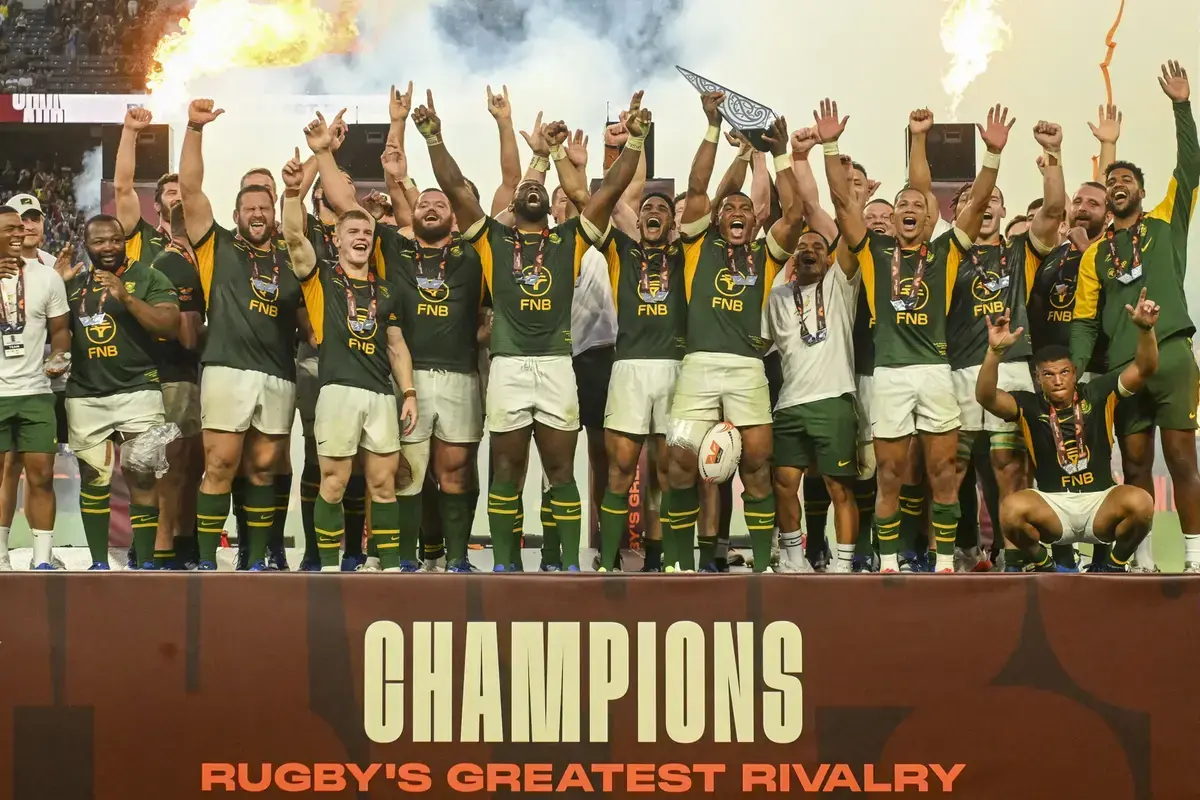
The Springboks clinched Rugby’s Greatest Rivalry series 3-1, overwhelming the All Blacks 43-28 at M&T Bank Stadium in Baltimore in the first meeting between the two rivals on American soil. Six tries to four in front of a record US rugby crowd sealed the most emphatic and expansive victory of the series, confirming the world champions’ supremacy at the end of a tour that captivated the sport.
Key moments
3 mins – PENALTY SOUTH AFRICA: Sacha Feinberg-Mngomezulu kicks an early penalty after the All Blacks are penalised at the breakdown. (South Africa 3–0 All Blacks)
9 mins – TRY ALL BLACKS: Codie Taylor scores after Cam Roigard throws a long pass across the goal-line from a ruck. Taylor’s 24th Test try — an All Blacks hooker record, passing Dane Coles. McKenzie converts. (South Africa 3–7 All Blacks)
14 mins – TRY SOUTH AFRICA: Damian de Allende powers over from close range after a 10-phase surge into the All Blacks’ 22. Feinberg-Mngomezulu converts. (South Africa 10–7 All Blacks)
~18 mins – TMO COMMUNICATION BREAKDOWN. Play is suspended for approximately 10 minutes after the referee loses communication with the Television Match Official. Both captains agree to continue without TMO involvement unless foul play occurs.
22 mins – TRY SOUTH AFRICA: Morne van den Berg sells a dummy and darts over from close range. The scrumhalf converts his own try. (South Africa 17–7 All Blacks)
~38 mins – TRY ALL BLACKS: Will Jordan enters the line from the right wing and races in beside the posts, capping a remarkable 32-phase sequence that sapped the Springbok defence. The move began from a front-of-the-lineout play after South Africa conceded a scrum penalty. McKenzie converts. (South Africa 17–14 All Blacks)
Half-time: South Africa 17–14 All Blacks. The Springboks led through de Allende and van den Berg after a dominant first quarter, but the All Blacks fought back through Taylor’s record try and Jordan’s score from a magnificent 32-phase build-up. A 10-minute TMO breakdown embarrassed the showcase event. The Springboks’ scrum and breakdown superiority was again evident.
48 mins – TRY SOUTH AFRICA: Malcolm Marx scores from a rolling lineout maul after the Springboks win a scrum penalty and kick to the corner. Manie Libbok converts. (South Africa 24–14 All Blacks)
51 mins – TRY SOUTH AFRICA: Pieter-Steph du Toit barges over after Feinberg-Mngomezulu breaks into the All Blacks’ 22 from a scrum and the Springbok forwards batter through. Libbok converts. (South Africa 31–14 All Blacks)
~55 mins – Roigard tackled without the ball. The halfback is taken out after kicking through to the Springbok line. TMO reviews but finds Roigard was offside at the preceding ruck. Penalty reversed. Frustration mounts for the All Blacks.
~63 mins – TRY ALL BLACKS: Ethan Blackadder scores his first Test try after a lineout drive and Roigard’s charge around a ruck creates the opening. McKenzie converts. (South Africa 31–21 All Blacks)
71 mins – TRY SOUTH AFRICA: Kurt-Lee Arendse swoops on a loose ball after a Moorby tackle incident and races more than 50 metres to score. A devastating counterattack. Feinberg-Mngomezulu converts. (South Africa 38–21 All Blacks)
75 mins – TRY SOUTH AFRICA: Cameron Hanekom powers over after taking the ball from Jordan, who had scrambled back in cover. The replacement flanker seals the series. Unconverted. (South Africa 43–21 All Blacks)
80 mins – TRY ALL BLACKS: Beauden Barrett crosses for a consolation score in the final minute. McKenzie converts. (South Africa 43–28 All Blacks)
Full-time: South Africa 43–28 All Blacks. Series: South Africa 3–1.
This wasn’t the suffocating, grinding Springbok rugby that had characterised the second and third Tests. This was champagne stuff — expansive, electric and utterly ruthless. South Africa mixed power with panache, combining their traditional forward dominance with a willingness to give the ball air that had the All Blacks’ defence scrambling and the Baltimore crowd roaring its approval. When Siya Kolisi hoisted the Greatest Rivalry trophy aloft after it was presented by Dan Carter and Schalk Burger, few could argue it had gone to the wrong side.
The All Blacks, true to their free-flowing blueprint, moved the ball with typical slickness and crossed four times themselves, but on this intoxicating Baltimore evening they had no answer to a rampant Springbok side firing on all cylinders. The Springboks made 11 line breaks and played with the freedom of a team given licence to cut loose by a coach who knew his side could not lose the series. Rassie Erasmus had done it again.
“I thought it was epic,” Erasmus said. “The whole series so far has been epic, and they can draw it in Baltimore. But we wanted to finish it properly.”
The All Blacks’ penalty problems surfaced immediately. Feinberg-Mngomezulu kicked a third-minute penalty, and from there the Springboks established the tempo that would define the match. But the tourists struck back in the ninth minute when Cam Roigard, sharp and direct throughout his 80 minutes, threw a long pass across the goal-line from a ruck for captain Codie Taylor to score. In doing so, Taylor claimed his 24th Test try — the most by any All Blacks hooker, overtaking Dane Coles’s long-standing record. McKenzie converted.
The lead was short-lived. The Springboks launched a 10-phase surge into the All Blacks’ 22 and, from a ruck close to the line, Damian de Allende powered over for his fourth try of the series. Feinberg-Mngomezulu converted for 10-7. Then came an extraordinary interruption: the referee lost communication with the Television Match Official, suspending play for approximately ten minutes. Both captains agreed to continue without TMO involvement unless foul play occurred — an embarrassing episode for a match being showcased to a new American audience.
When play resumed, the Springboks pressed their advantage. Josh Moorby was controversially penalised for an offence while attempting to place the ball in a tackle, gifting the hosts field position. From the resulting lineout, man-of-the-match Morne van den Berg cut back against the grain and darted over to score. The scrumhalf then converted his own try — the second time in the series he had done so — for 17-7.
The All Blacks’ response was their finest passage of play in the match. After South Africa conceded a scrum penalty, Taylor found his jumper at the front of the lineout and set in motion a 32-phase movement that sapped the Springboks’ defence. Surge after surge was absorbed before the ball was moved to the backs, and Jordan — entering the line from his right wing — raced in beside the posts. McKenzie converted, and the tourists went to the break trailing by just three at 17-14.
Whatever hope that stirred evaporated within six minutes of the restart. The Springboks scored two tries in three minutes to blow the match apart. First, a scrum penalty gave them the chance to kick to the corner, and from the lineout their maul — that terrifying, irresistible weapon — drove the All Blacks backwards before Marx peeled off to score. Libbok converted for 24-14. From the restart, the Springboks won a scrum and Feinberg-Mngomezulu broke into the All Blacks’ 22 before du Toit drove over from close range. Libbok converted again and at 31-14, the series was over as a contest.
“We were confident that if we got a few things right tonight we’d have a good chance of winning,” Rennie said. “We fell short. It’s disappointing from that perspective.”
The All Blacks’ frustrations multiplied. Roigard kicked through to the Springbok line only to be taken out without the ball — a penalty seemed certain, but the TMO discovered Roigard was offside at the preceding ruck and the decision was reversed. Moorby was then denied a favourable ruling after taking a tackle that wasn’t ruled early. Richie Mo’unga, starting his first Test since the 2023 World Cup final, kicked for the corner and from the lineout Blackadder — busy, abrasive and tireless throughout — scored his first Test try. McKenzie converted for 31-21 and briefly the All Blacks sensed a comeback.
Arendse killed it stone dead. In the 71st minute, the ball bounced loose after the controversial Moorby tackle incident and the Springbok flyer swooped on it, accelerating from inside his own half on a devastating 50-metre run to score under the posts. It was the try of the match and the moment that sealed the series in emphatic fashion. Feinberg-Mngomezulu converted. Replacement flanker Cameron Hanekom added a sixth four minutes later, powering over after taking the ball from Jordan, who had scrambled back in cover.
Beauden Barrett, the 144-cap veteran who had been introduced from the bench, crossed for a consolation in the final minute that McKenzie converted, but the 43-28 scoreline — the largest winning margin of the series — told the story of South African dominance. The try count across four Tests finished 20-18 in the All Blacks’ favour, yet the Springboks won the series 3-1 — a testament to their ability to win the decisive moments through set-piece power, breakdown dominance and the relentless physicality of their bench rotation.
Rennie was honest in defeat. “Yeah, look, the boys put in a massive shift again,” he said. “You look at all the numbers, and everything’s very even, but they were electric, and when they got their opportunities, and we were trying to chase the game late, we put ourselves under a bit more pressure.” On the breakdown discipline that conceded crucial penalties, he was blunt: “Yeah, it’s not good enough. It just does not affect the game either. But it’s dumb.”
The head coach maintained perspective on a tour that had tested his squad to its limits. “We’ve had a captured audience of what turned out to be 49 players,” Rennie said. “I thought the set piece was excellent tonight — scrum and lineout were a real positive. When we get our continuity going, we’re going to score tries. We’re tracking in the right direction, but we’ve got to close the gap and we know that.”
Mo’unga, playing his first Test in three years, labelled the 2026 Springboks a “complete team” and acknowledged the gulf the All Blacks need to bridge before the likely World Cup quarter-final meeting next year. Jordie Barrett was again outstanding at inside centre — arguably the All Blacks’ most consistently excellent player across the entire tour — while Blackadder, Jordan and Peter Lakai all enhanced their reputations in a losing cause.
Taylor, captaining for the final time on tour, hoped the Baltimore crowd took something from the occasion. “I hope American fans left understanding how exciting rugby can be,” the hooker said. Rennie echoed the sentiment: “They obviously love their sports, and they got right behind rugby. I would have liked to see a few more black jerseys, but obviously there’s a lot of South Africans over here.”
The Greatest Rivalry Tour is over. Across eight matches and seven weeks, the All Blacks used 49 players, scored 49 tries, won five of eight fixtures and lost the Test series 3-1 after winning the opener. They return to New Zealand battered, bruised and wiser — with a Bledisloe Cup and a European tour still ahead before the World Cup. The Springboks, meanwhile, have now won everything there is to win. They head to Australia in 2027 as the team to beat, their greatness no longer debatable. As Erasmus said in Cape Town: they are the benchmark. And as Baltimore showed, the gap between benchmark and challenger remains stubbornly difficult to close.
Teams
South Africa: 15 Damian Willemse, 14 Kurt-Lee Arendse, 13 Jesse Kriel, 12 Damian de Allende, 11 Ethan Hooker, 10 Sacha Feinberg-Mngomezulu, 9 Morne van den Berg, 8 Jasper Wiese, 7 Pieter-Steph du Toit, 6 Siya Kolisi (c), 5 Ruan Nortje, 4 Eben Etzebeth, 3 Thomas du Toit, 2 Malcolm Marx, 1 Ox Nche.
Replacements: 16 Deon Fourie, 17 Gerhard Steenekamp, 18 Wilco Louw, 19 Cobus Wiese, 20 Cameron Hanekom, 21 Cobus Reinach, 22 Andre Esterhuizen, 23 Manie Libbok.
All Blacks: 15 Damian McKenzie, 14 Will Jordan, 13 Anton Lienert-Brown, 12 Jordie Barrett, 11 Josh Moorby, 10 Richie Mo’unga, 9 Cam Roigard, 8 Peter Lakai, 7 Ethan Blackadder, 6 Tupou Vaa’i, 5 Sam Darry, 4 Patrick Tuipulotu, 3 Fletcher Newell, 2 Codie Taylor (c), 1 Ethan de Groot.
Replacements: 16 Asafo Aumua, 17 Xavier Numia, 18 Tyrel Lomax, 19 Josh Lord, 20 Wallace Sititi, 21 Kyle Preston, 22 Rieko Ioane, 23 Beauden Barrett.
Match details
South Africa 43 (Tries: de Allende, van den Berg, Marx, du Toit, Arendse, Hanekom; Conversions: Feinberg-Mngomezulu 2/3, van den Berg 1/1, Libbok 2/2; Penalties: Feinberg-Mngomezulu 1/1)
All Blacks 28 (Tries: Taylor, Jordan, Blackadder, Barrett; Conversions: McKenzie 4/4)
Half-time: 17–14 (South Africa)
Venue: M&T Bank Stadium, Baltimore
Attendance: Record US rugby crowd
Referee: Karl Dickson (England)
Man of the match: Morne van den Berg (South Africa)
Series result: South Africa 3–1
Greatest Rivalry series result
First Test, Ellis Park, Johannesburg: South Africa 16–33 All Blacks
Second Test, DHL Stadium, Cape Town: South Africa 33–26 All Blacks
Third Test, FNB Stadium, Johannesburg: South Africa 29–24 All Blacks
Fourth Test, M&T Bank Stadium, Baltimore: South Africa 43–28 All Blacks
Series: South Africa 3–1
International
Mo’unga gets the call in revamped All Blacks for Baltimore finale
Published
2 months agoon
11th September 2026
Dave Rennie has made sweeping changes for the fourth and final Test against the Springboks at M&T Bank Stadium in Baltimore on Saturday, with Richie Mo’unga handed his first Test start since the 2023 Rugby World Cup final and Ethan Blackadder earning his first in more than two years. Codie Taylor captains a revamped side that must win to prevent the Springboks claiming the Greatest Rivalry series outright.
Key squad news:
- Richie Mo’unga earns his first Test start since the 2023 World Cup final; Ruben Love dropped from the 23
- Codie Taylor captains the All Blacks in the absence of the injured Ardie Savea
- Ethan Blackadder makes his first Test start in more than two years at openside flanker
- Ethan de Groot and Josh Lord return after clearing concussion protocols from the first Test
- Five changes to the starting XV; Newell, Tuipulotu, Lienert-Brown also start
- Fabian Holland unavailable due to illness
- All Blacks must win to draw the series 2-2
The changes are driven by necessity and opportunity. Ardie Savea (dislocated shoulder), Luke Jacobson (elbow tendon) and Quinn Tupaea (MCL) were all injured in the third Test defeat in Soweto, while Fabian Holland has been ruled out through illness. Their absence, combined with the return of Ethan de Groot and Josh Lord — who have cleared World Rugby’s concussion protocols after the sickening first Test collision — has prompted a significant reshuffle.
Mo’unga’s selection at first five-eighth is the headline talking point. The 56-cap playmaker replaces Ruben Love, who drops out of the matchday 23 entirely after starting all three Tests in the series. It is Mo’unga’s first Test start since the one-point World Cup final defeat to these same Springboks in Paris three years ago, completing a remarkable journey from three seasons in Japanese club rugby back to the international arena.
“Richie has been patient and professional since arriving on tour,” Rennie said. “He’s earned this opportunity. His vision, his decision-making and his ability to run a game at the highest level are exactly what we need in a match of this magnitude.”
Blackadder’s inclusion at openside is a reward for his extraordinary tour. The Crusaders flanker’s two-try, 16-carry display against the Lions was the standout individual performance of the franchise matches, and he has been unlucky not to feature in a Test matchday squad until now. He forms a new-look loose forward trio with Tupou Vaa’i, who shifts from lock to blindside, and Peter Lakai at number eight.
The front row sees de Groot return at loosehead alongside Taylor and Fletcher Newell, who replaces Tyrel Lomax at tighthead for his first Test start of the series. Lomax provides impact from the bench. Patrick Tuipulotu partners Sam Darry — the only forward to start in the same position as the third Test — in a second-row combination that offers a different profile from the Holland-Vaa’i and Holland-Darry pairings used earlier in the series. Lord’s return from concussion protocols means he can provide lock cover from the reserves.
In the backs, Anton Lienert-Brown replaces the injured Tupaea at outside centre alongside Jordie Barrett, while Josh Moorby comes onto the left wing. Cam Roigard, Will Jordan and Damian McKenzie are retained, with Rieko Ioane and Leroy Carter providing outside back cover on the bench.
Taylor, who captained the All Blacks for the first time against the Bulls earlier on tour, takes the armband for the biggest match of his 111-cap career. “It’s a huge honour to captain the All Blacks in a Test match of this magnitude,” Taylor said. “We’re desperate to get a result. The boys are hurting after last week and we know what’s at stake.”
Barrett dismissed any suggestion the All Blacks might be mentally or physically spent after seven weeks on tour. “We’ve still got a lot to play for,” Barrett said. “We came here to win a series and while that’s no longer possible, sharing it is the next best thing. We owe it to ourselves and everyone back home to finish this tour the right way.”
The match marks the first time the All Blacks and Springboks have met on American soil. M&T Bank Stadium, the 70,257-capacity home of the NFL’s Baltimore Ravens, will host the sixth All Blacks Test played in the United States, following matches in Chicago, Washington DC and San Diego. Baltimore is a candidate city for the 2031 Rugby World Cup.
The series stands at 2-1 in the Springboks’ favour. A New Zealand victory would see each nation retain one half of the Greatest Rivalry trophy in a drawn series. Defeat would confirm the first series loss for an All Blacks touring side in South Africa since 1976 and hand the Springboks both halves of the silverware.
“This is why you play rugby,” Rennie said. “A deciding Test match against the best team in the world in front of 70,000 people. We know the Boks will be desperate to finish it here, but so are we. We’ve shown throughout this tour that we can beat anyone when we’re at our best. Now we need to deliver the performance of the tour.”
All Blacks team for the fourth Test
M&T Bank Stadium, Baltimore. Saturday 12 September, kick-off 5pm local time (Sunday 13 September, 9am NZT).
1. Ethan de Groot (44 caps), 2. Codie Taylor (c) (111), 3. Fletcher Newell (39), 4. Patrick Tuipulotu (58), 5. Sam Darry (11), 6. Tupou Vaa’i (50), 7. Ethan Blackadder (15), 8. Peter Lakai (13), 9. Cam Roigard (23), 10. Richie Mo’unga (56), 11. Josh Moorby (4), 12. Jordie Barrett (84), 13. Anton Lienert-Brown (92), 14. Will Jordan (60), 15. Damian McKenzie (80).
Reserves: 16. Asafo Aumua (25), 17. Xavier Numia (4), 18. Tyrel Lomax (54), 19. Josh Lord (16), 20. Wallace Sititi (22), 21. Kyle Preston (4), 22. Rieko Ioane (89), 23. Leroy Carter (10).
International
Springboks make two changes for Baltimore Test against All Blacks
Published
2 months agoon
9th September 2026
Rassie Erasmus has made just two changes to the Springbok starting XV for the Rugby’s Greatest Rivalry series decider against the All Blacks at M&T Bank Stadium in Baltimore on Saturday, sending the clearest possible signal that he intends to go for the kill and clinch a 3-1 series victory on American soil.
Key team news:
- Damian Willemse returns at fullback in place of the injured Cheslin Kolbe, who broke his jaw in the third Test and has remained in South Africa
- Morne van den Berg earns his first start of the series at scrum-half, with Cobus Reinach dropping to the bench
- The forward pack is unchanged for the third consecutive Test
- A Springbok victory would seal a 3-1 series win; an All Blacks victory would draw the series
- Eben Etzebeth extends his record as the most capped Springbok to 146 Tests
- The loose trio of Kolisi, du Toit and Wiese will start together for a record 19th time
- It is the first Springbok Test in history to be played in Baltimore
- Kick-off is at 23:00 SA time (17:00 EDT)
The decision to retain the same matchday squad with only injury-enforced and form-based adjustments is a statement of intent from Erasmus. Having won the second and third Tests to take a 2-1 lead, the Springbok coach is backing the combinations that turned the series around rather than rotating for the finale.
Only two changes to the #Springboks team for Saturday's RGR decider in Baltimore – more here: https://t.co/ULt9zgTIeY #ForeverGreenForeverGold #RugbysGreatestRivalry pic.twitter.com/6lai1VcHdq
— Springboks (@Springboks) September 7, 2026
“We feel that the team is well settled and all the players delivered in their respective roles in the last two matches, so we believe selecting the same matchday squad, and naming Damian back in his regular position, makes sense for the closing match of the series,” Erasmus said. “These players also know exactly what to expect from a very determined All Blacks team, who will give everything to draw the series this weekend.”
Willemse’s return is straightforward. The fullback started the first two Tests before a hamstring injury ruled him out in Cape Town, with Kolbe deputising superbly at 15 across the second and third matches. Kolbe’s broken jaw, sustained at FNB Stadium, has ended his series and he was among six players who remained in South Africa as the squad flew to the United States.
“Damian started the first two Tests and had it not been for a niggle last week, he would have also started that match, so it’s good to have him back,” Erasmus said. “He is a quality player, and he knows the guys around him very well, so it will simply be a matter of him picking up where he left off before last week.”
The more intriguing selection is van den Berg’s promotion ahead of Reinach. The Lions scrum-half made a telling impact off the bench in the third Test and Erasmus was effusive in his praise. “Morne made a fantastic impact when he took the field last week, and he deserves a chance to start, so Cobus switches to the bench where he will add experience and skill in this vital match,” the Springbok coach said.
He expanded on van den Berg’s journey to this point. “He’s not a youngster. I think he’s 27 or something like that already, so he’s not a youngster to break through. But we’ve always tracked him, and I think he’s just been unfortunate with injuries and also some really good nines that played ahead of him or got opportunities ahead of him,” Erasmus said. “After his last injury, we thought it was going to be a tough year for him to get back into the mix, but he really did his rehab really well, and he’s back to full fitness. I think last week when he got his opportunity, he really did well, and we think he deserves a start.”
The forward pack is unchanged for the third week running. Nche, Marx and Louw continue in the front row, Etzebeth and Nortje in the second row, and captain Kolisi, du Toit and Wiese in a loose trio that will extend its own record to 19 Test starts together. Etzebeth stretches his all-time caps mark to 146, while Wiese needs just one more appearance after this match to reach 50 caps.
In the backline, Feinberg-Mngomezulu starts at fly-half for a fifth consecutive Test, with Arendse and Hooker on the wings and de Allende and Kriel continuing their settled midfield partnership. The bench is also unchanged from the third Test — Fourie, Steenekamp, Thomas du Toit, de Jager, Esterhuizen and Hanekom as the six forward replacements, with Reinach and Libbok the two specialist backs.
Erasmus confirmed that Handre Pollard, who has missed the last three Tests with a calf injury, is fit again and will likely feature against Australia in Perth on 27 September — the one-off Test the squad will travel to directly from Baltimore. Franco Mostert is also expected to return for that fixture.
Saturday’s match will be the first Springbok Test in Baltimore and only the fourth in the United States. South Africa have played three previous Tests on American soil — victories over the USA in 1981 and 2001, and a narrow 22-20 defeat to Wales in Washington DC in 2018, which was Erasmus’s first match in charge as head coach. The 2031 Rugby World Cup will be hosted in the USA, lending additional significance to high-profile fixtures on American soil.
Erasmus was blunt about the stakes. “If we don’t win, then we have achieved nothing,” he said.
He expected the All Blacks, who have lost Ardie Savea, Luke Jacobson and Quinn Tupaea to series-ending injuries from the third Test, to come out swinging regardless. “We have faced the All Blacks three weeks in a row, and just like us, they are a proud team who showed last week that they will never stop fighting until the final whistle, so we are under no illusions about the magnitude of the challenge ahead this weekend,” Erasmus said.
“That said, we are equally determined to finish the series strongly and give everything to lift the trophy, and the players are excited about the match. We have no doubt that it’s going to be another epic encounter that will require a full-blown 80-minute effort on attack and defence.”
Springboks:
15. Damian Willemse (DHL Stormers, 54 caps)
14. Kurt-Lee Arendse (Mitsubishi Dynaboars, 34 caps)
13. Jesse Kriel (Canon Eagles, 93 caps)
12. Damian de Allende (Wild Knights, 102 caps)
11. Ethan Hooker (Hollywoodbets Sharks, 12 caps)
10. Sacha Feinberg-Mngomezulu (DHL Stormers, 23 caps)
9. Morne van den Berg (Lions, 9 caps)
8. Jasper Wiese (Urayasu D-Rocks, 48 caps)
7. Pieter-Steph du Toit (Toyota Verblitz, 101 caps)
6. Siya Kolisi (c) (DHL Stormers, 106 caps)
5. Ruan Nortje (Kubota Spears, 23 caps)
4. Eben Etzebeth (Hollywoodbets Sharks, 145 caps)
3. Wilco Louw (DHL Stormers, 34 caps)
2. Malcolm Marx (Kubota Spears, 92 caps)
1. Ox Nche (Hollywoodbets Sharks, 51 caps)
Replacements:
16. Deon Fourie (DHL Stormers, 15 caps)
17. Gerhard Steenekamp (Vodacom Bulls, 22 caps)
18. Thomas du Toit (Hollywoodbets Sharks, 36 caps)
19. Lood de Jager (Wild Knights, 76 caps)
20. Andre Esterhuizen (Hollywoodbets Sharks, 34 caps)
21. Cameron Hanekom (Vodacom Bulls, 5 caps)
22. Cobus Reinach (DHL Stormers, 56 caps)
23. Manie Libbok (Kintetsu Liners, 33 caps)
Match details: South Africa v New Zealand, M&T Bank Stadium, Baltimore. Saturday 12 September (Saturday 13 September NZT), 17:00 EDT / 23:00 SA time. Live on SuperSport.