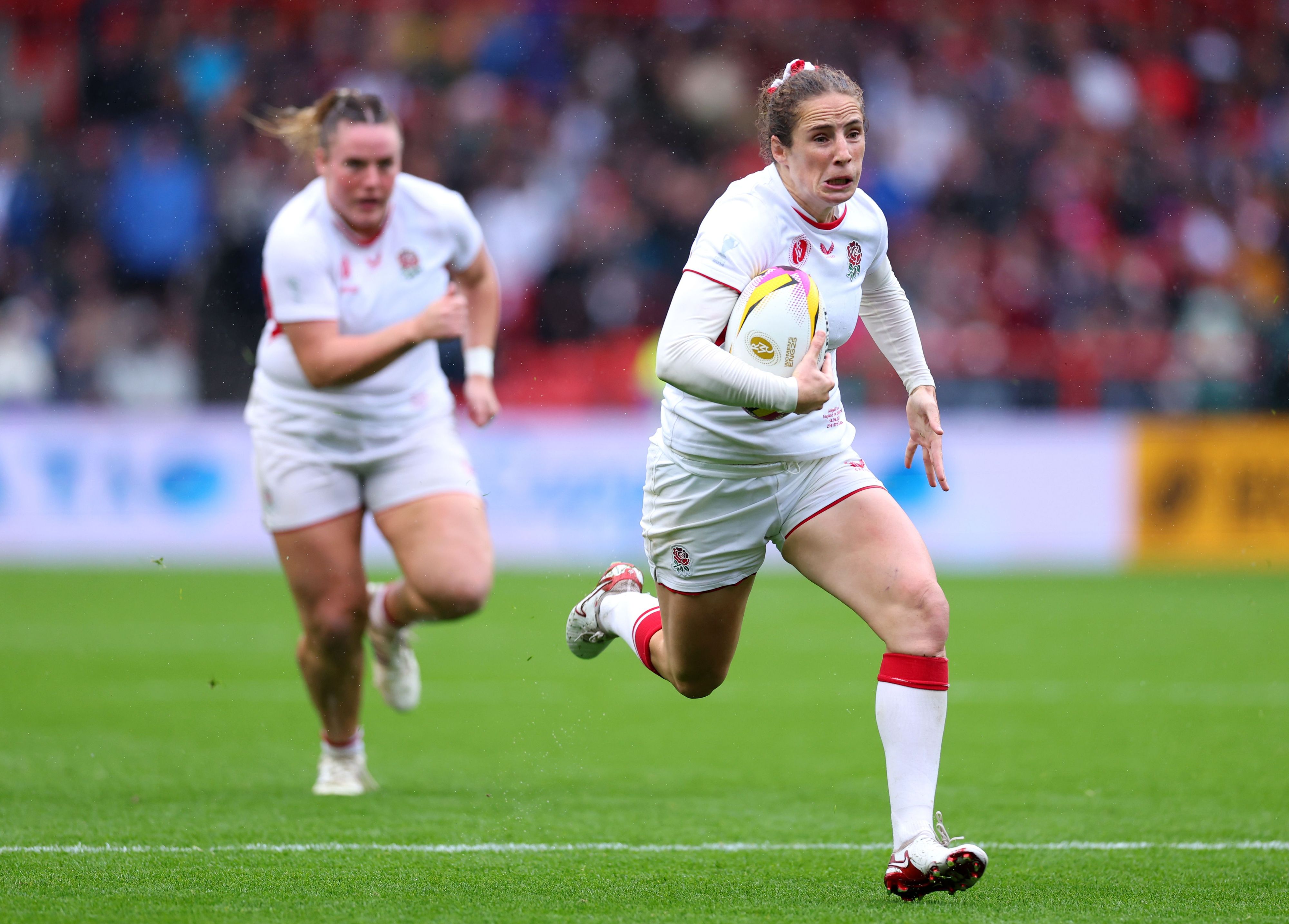
England extended their record-breaking winning streak to 31 matches with a commanding 40-8 victory over Scotland at a rain-soaked Ashton Gate, securing their place in the World Cup semi-finals against France. The victory broke England’s own world record for consecutive international rugby union wins, surpassing their previous mark of 30 straight victories. The Red Roses demonstrated their tournament credentials with a masterclass in game management that showcased their forward power and clinical finishing, whilst Scotland’s brave effort in their first quarter-final since 2002 ultimately succumbed to the hosts’ relentless pressure.
Key moments:
3′ – Helen Nelson slots penalty goal (0-3)
12′ – Kelsey Clifford crashes over for England’s first try, Holly Aitchison converts (7-3)
15′ – Morwenna Talling powers through Scottish defence, Holly Aitchison converts (14-3)
31′ – Abby Dow scores her 50th England try from wide pass, Holly Aitchison misses conversion (19-3)
39′ – Kelsey Clifford’s second try extends England’s dominance, Holly Aitchison converts (26-3)
45′ – Amy Cokayne breaks off driving maul to score, Holly Aitchison converts (33-3)
64′ – Holly Aitchison’s reverse pass try seals victory, Holly Aitchison converts (40-3)
80′ – Rhona Lloyd’s emotional consolation try for Scotland, Helen Nelson misses conversion (40-8)
Despite the challenging conditions in Bristol, with torrential rain and swirling winds creating treacherous underfoot conditions, England recovered from a shaky opening to assert their authority over neighbours they haven’t lost to since 1999. The victory marked their 28th consecutive triumph over Scotland and set up a mouth-watering semi-final clash with France, who had earlier fought back from 13-0 down to defeat Ireland 18-13 in similarly difficult weather in Exeter.
Scotland, appearing in their first quarter-final since 2002, made the brighter start despite the overwhelming pre-match expectations. The visitors had clearly studied England’s recent tendency to start slowly, pressing high and forcing early errors from the tournament favourites. A sustained eight-phase attacking sequence in the opening minutes, with flanker Evie Gallagher and scrum-half Leia Brebner-Holden making crucial yards, demonstrated Scotland’s intent to make this a contest. When England strayed offside, Helen Nelson stepped up to calmly slot over from close range after just four minutes, giving Scotland a deserved 3-0 lead.
However, England’s response demonstrated why they remain the world’s number one ranked team. Their pack began to exert their physical dominance in the set-piece battles, with the conditions favouring their forward-orientated gameplan. Prop Kelsey Clifford, starting in place of the injured Hannah Botterman, showed England’s remarkable depth by leading from the front. After loosehead Maud Muir had bulldozed through a Scottish tackle to set up quick ball, Clifford displayed excellent footwork to spin out of contact and power over for England’s opening try on 12 minutes. Holly Aitchison, making her first start of the tournament at fly-half, added the conversion from in front of the posts to give the hosts a 7-3 advantage.
Scotland’s lineout struggles in the wet conditions proved increasingly costly, with their set-piece misfiring repeatedly as England’s forwards targeted the throw-in. The breakthrough seemed to settle England’s nerves, and their tactical kicking game, expertly orchestrated by Aitchison, began to pin Scotland deep in their own territory. The fly-half’s range of passing and intelligent use of the boot in difficult conditions demonstrated why she had been handed her first World Cup start ahead of Zoe Harrison.
Lock Morwenna Talling, who would later be named player of the match, capitalised on Scotland’s third lineout error in quick succession when she pounced on loose ball. With powerful support from flanker Sadia Kabeya bound onto her back, Talling bullied her way over the line despite three Scottish defenders converging on her. Aitchison’s successful conversion from close to the posts stretched England’s lead to 14-3 after just 15 minutes.
Scotland’s set-piece struggles proved costly throughout the first half, with their lineout misfiring repeatedly in the difficult conditions. England’s tactical kicking game, orchestrated expertly by debutant starter Aitchison, kept the pressure on Scotland’s back three, with the conditions favouring territory over ambition.
The defining moment of the first half arrived on 31 minutes when England’s patience in building phases finally unlocked Scotland’s defence. After sustained pressure in Scotland’s 22-metre area, with the forwards consistently making yards, Aitchison demonstrated her class with a sublime diagonal pass that found Abby Dow in acres of space on the right wing. The winger, making her 57th appearance for England, crossed unopposed for her milestone 50th international try – becoming only the sixth Red Rose to reach that landmark. Aitchison’s conversion attempt drifted wide in the swirling wind, but at 19-3, England’s superiority was becoming undeniable.
Clifford capped a dominant first-half display with her second try three minutes before the interval. England’s forwards had established complete dominance in the tight exchanges, with Natasha Hunt’s distribution keeping Scotland’s defence constantly stretched. When the ball swung left, Jess Breach and Megan Jones combined effectively before England turned infield, allowing Clifford to power through for her second score. Aitchison’s conversion made it 26-3 at the break.
The second half followed a predictable pattern, with England’s bench strength and tactical nous proving decisive. Head coach John Mitchell made strategic changes, introducing fresh legs while Scotland battled valiantly against the inevitable. Amy Cokayne, who had been denied a first-half try for obstruction after the television match official intervened, made no mistake seven minutes after the restart when she broke off from England’s trademark driving maul five metres from the line to score their fifth try.
There was a deeply emotional moment on 46 minutes when Scotland’s Jade Konkel was substituted in what proved to be her 74th and final international appearance. The 31-year-old number eight, who became Scotland’s first professional women’s rugby player in 2016, was seen in floods of tears on the bench as the realisation of her retirement hit home. Scotland legend Donna Kennedy, watching from the stands, went over to comfort the firefighter who had given 12 years of distinguished service to her country across two World Cup cycles.
Scotland’s resistance remained admirable given the circumstances surrounding their squad. The quarter-final appearance represented significant progress for a team that has faced considerable off-field challenges, with approximately half the World Cup squad understood to be without contracts beyond this tournament. The timing of this contract uncertainty, communicated to players during their World Cup preparation, has created additional pressure on a group that has fought hard to reach their first knockout stage in 23 years.
Scotland captain Rachel Malcolm, who confirmed she won’t be retiring, acknowledged the potential impact: “We want to keep players in the game. We have built something special here and we want to keep as many within the game as we can. Those losses are going to be pretty big and they are going to have an impact.”
Despite their circumstances, Scotland continued to compete with pride. Centre Emma Orr produced one of the match’s defensive highlights when she made an outstanding cover tackle to deny Dow a second try after the winger had charged down Lisa Thomson’s clearance kick early in the second half. There was also a moment of individual brilliance from Helen Nelson, whose deft chip over England’s defence bought valuable territory in style.
Holly Aitchison, making her first start of the tournament, capped an impressive individual display with England’s sixth try on 64 minutes. The fly-half, who had controlled the game superbly in challenging conditions, took an inside pass from replacement Zoe Harrison to dive over near the posts, converting her own score to make it 40-3.
The final moments provided the tournament’s most emotional scene when Scotland wing Rhona Lloyd evaded Jess Breach’s tackle to score a consolation try with the clock in the red. The tears flowed immediately for Lloyd and her teammates, knowing this represented the end of an era for several players and the conclusion of Bryan Easson’s tenure as head coach.
The sold-out crowd of 25,295 at Ashton Gate created a magnificent atmosphere despite the torrential conditions, underlining the growing popularity of the women’s game. Notable attendees included USA star Ilona Maher, who delighted fans by appearing on the big screen drinking from two cups simultaneously, and former England goalkeeper Mary Earps, who plays for Paris St-Germain. Even injured England players got involved in the atmosphere, with Ellie Kildunne and Marlie Packer spotted banging drums from the stands to support their teammates.
England captain Zoe Aldcroft, returning from injury for her first start since the tournament opener, was delighted to be back involved: “It is amazing to be back out there with the girls. We’re buzzing to head into next week and turn it up another gear. We had the weather conditions to contend with, but we kept in the fight and kept the pressure on Scotland. Now we’re excited to prepare as well as we can against France.”
Player of the match Talling praised her team’s forward display: “It was really good. Obviously the weather wasn’t great, but we put our best foot forward and I think the pack did a great job getting us going forward. It’s always massive to play your best rugby. That’s what this tournament is about and I think the competition only drives each of us to get better.”
Kelsey Clifford, who excelled in her starting debut following Hannah Botterman’s injury, reflected on the team’s approach: “I think we played the conditions well today, and tightened up where we needed to, but also we backed our skillset and tried to push that to the max. This whole group is special, and we want to do something special. We’re in a semi-final of a World Cup – people dream of this.”
Abby Dow emphasised the team’s unity: “It was 100% a team effort, we were able to perform so well in the forwards to give us a stable platform, and as a backline I thought we done well to identify space and go to it. This team is more than just team mates, it’s a group of friends, and being able to share memories together only strengthens our bonds.”
Scotland captain Rachel Malcolm reflected on her team’s tournament with pride despite the disappointment: “I am disappointed with the outcome but overall when I reflect on the tournament, I’m proud of how we have shown up in attack and defence and where we want to take Scotland women’s rugby. We are going to miss Bryan [Easson] hugely.”
Departing head coach Bryan Easson was philosophical about his final game in charge: “We did what we wanted to do, reaching the knockout stages. This shouldn’t be the end, it should be the start of something. This has to be a stepping stone.”
The Red Roses have now scored 72 points in their last two matches whilst conceding just 11, with their driving maul and scrum dominance providing the platform for their clinical finishing. Their ability to adapt their gameplan to the wet conditions, utilising Aitchison’s tactical kicking and the power of their forward pack, demonstrated the game management that makes them such formidable opponents.
The Red Roses will face a France side that showed tremendous character in their comeback victory over Ireland, having recovered from a 13-0 half-time deficit in similarly treacherous conditions. The teams’ last meeting in the Six Nations produced a thrilling 43-42 victory for England at Twickenham, suggesting next Saturday’s semi-final could provide the spectacle that weather conditions denied on this quarter-final afternoon.
For Scotland, this quarter-final appearance represents significant progress despite the contract uncertainty surrounding the squad. Their first knockout appearance in 23 years has demonstrated the talent within Scottish rugby, but the immediate future remains uncertain with several experienced players likely to retire and others facing an unclear professional pathway.







 Nations Championship1 week ago
 Nations Championship2 weeks ago
 Nations Championship2 weeks ago
 Nations Championship2 weeks ago
 Nations Championship1 week ago
 Junior World Championship2 weeks ago
 Nations Championship1 week ago
 Nations Championship1 week ago