Connect with us

International

Wallabies get out of jail as Wilson scores late try to beat Fiji

Published

on

RUGBY WALLABIES FIJI, Harry Wilson of the Wallabies (red headgear) celebrates with Fraser McReight after scoring the match winning try during the Men s Internationals Test match between the Wallabies and Fiji at McDonald Jones Stadium in Newcastle, Sunday, July 6, 2025. (IMAGO / AAP)

Captain Harry Wilson emerged as the hero in the dying seconds to rescue Australia from a humiliating defeat, spinning over from close range to give the Wallabies a heart-stopping 21-18 victory over Fiji in their first Test of 2025. The skipper’s 79th-minute try capped a dramatic finale at McDonald Jones Stadium that saw the hosts trail for the final quarter before Wilson’s moment of individual brilliance saved Joe Schmidt’s side from what would have been a catastrophic setback ahead of the British & Irish Lions series.

Key moments:

10′ – David Porecki crashes over from driving maul, Noah Lolesio converts (AUS 7-0)
39′ – Fraser McReight finishes brilliant passing move involving Joseph-Aukuso Suaalii, Noah Lolesio converts (AUS 14-0)
40′ – Salesi Rayasi scores on debut after classic Fijian counter-attack, Caleb Muntz misses conversion (AUS 14-5)
51′ – Caleb Muntz penalty reduces deficit (AUS 14-8)
55′ – Lekima Tagitagivalu scores after Jiuta Wainiqolo’s length-of-field break, Caleb Muntz converts (FIJ 15-14)
68′ – Caleb Muntz penalty extends Fiji lead (FIJ 18-14)
79′ – Harry Wilson’s captain’s try seals dramatic victory, Ben Donaldson converts (AUS 21-18)

For much of the second half, it appeared Fiji were destined to repeat their stunning 2023 World Cup triumph over Australia, with the visitors’ trademark broken-field running and clinical finishing threatening to inflict another painful defeat. Lekima Tagitagivalu’s 55th-minute try, brilliantly created by Jiuta Wainiqolo’s mesmerising 60-metre burst, had given Fiji a deserved lead that they held until Wilson’s intervention with the clock in the red.

The Wallabies had dominated the opening exchanges with a forward-focused approach that immediately paid dividends. After Langi Gleeson was held up over the line following some powerful driving play, the ensuing penalty allowed them to kick to the corner. The subsequent lineout was executed to perfection, with the Australian pack forming an unstoppable rolling maul that crashed over with inevitable force. David Porecki emerged from the mass of gold jerseys with the ball, marking his return to Test rugby after 643 days with a try that epitomised the direct approach Schmidt demands. Noah Lolesio’s conversion from close range gave Australia the perfect start.

The hosts should have extended their advantage midway through the first half when Harry Potter appeared to have crossed after a neat backline move created an overlap down the right flank. The Force winger had found space after some crisp passing, but Tom Wright’s final pass drifted forward and the try was correctly disallowed. It was a frustrating pattern that would plague Australia throughout the afternoon.

Joseph-Aukuso Suaalii provided the star quality Australia craved, the former rugby league sensation showcasing his class with an exquisite piece of skill for Fraser McReight’s crucial second try. The build-up began with patient phase play in the Fijian 22, as Australia finally showed the composure that had been lacking. Noah Lolesio demonstrated excellent vision to find Len Ikitau on his left shoulder, with the Brumbies centre showing soft hands to collect the pass. The Wallabies had momentum, the Fijian defence was retreating, and Ikitau delivered a sublime offload to Suaalii. The 21-year-old barely touched the ball in a piece of magical catch-and-pass play that sent McReight clear. The flanker could have made one more pass to guarantee the score, but opted to go himself, straightening up before diving over in the corner. Lolesio’s touchline conversion was inch-perfect, giving Australia what appeared to be a comfortable 14-0 lead.

But Fiji refused to be overawed, and their response came in typically dramatic fashion. Noah Lolesio’s shocking brain fade after the half-time siren proved costly – instead of kicking the ball dead to end the half, he attempted an ambitious chip kick over the defence from inside his own half. Tom Wright failed to regather the bouncing ball, gifting Fiji prime field position as the siren had already sounded. What followed was classic Fijian rugby at its devastating best. The visitors moved the ball through multiple phases with the kind of offloading and support play that has made them famous worldwide. Bodies flew into breakdowns, quick ball was recycled, and suddenly space opened up on the left wing. Salesi Rayasi, making his international debut after switching allegiance from New Zealand, showed remarkable composure to dive over in the corner despite the attention of three gold jerseys. The fullback’s finish was spectacular, reaching out to plant the ball down as he crashed into the advertising boards. Caleb Muntz’s conversion attempt from the touchline struck the upright, but the psychological damage was done.

The second half belonged largely to Fiji, with their unstructured approach causing Australia constant headaches. The visitors struck first through Muntz’s penalty on 51 minutes, capitalising on Australian ill-discipline to reduce the deficit to just six points. But the moment that will live long in Fijian folklore arrived four minutes later when Jiuta Wainiqolo produced one of the tries of the year.

The Toulon winger was presented with an awful pass that bounced on the ground inside his own 22-metre line, but what happened next was pure magic. Wainiqolo scooped up the ball and immediately cut infield, stepping past the lunging James Slipper with embarrassing ease. The former sevens star then broke through not one but two more tacklers in the middle of the field, his acceleration leaving gold jerseys grasping at thin air. With the defence scrambling desperately, Wainiqolo had Tom Wright completely beaten with a devastating side-step that sent the fullback tumbling. But the most remarkable moment was yet to come – with Lekima Tagitagivalu steaming up in support, Wainiqolo delivered an outrageous no-look pass over his right shoulder that found his teammate in stride. Tagitagivalu gathered the ball without breaking pace and crashed over for a try that had the sizeable Fijian contingent in the 28,132 crowd in raptures. Muntz’s conversion from the touchline was perfect, and suddenly Fiji led 15-14 with 25 minutes remaining.

Australia’s response was hampered by a series of forward passes that denied them crucial scores. Max Jorgensen thought he had crossed after Harry Potter’s chip and chase found the winger in space, but the TMO correctly ruled that Wright’s pass to Potter in the build-up had drifted forward. The decision took an eternity to make, adding to the frustration of a home crowd already exasperated by the stop-start nature of the contest.

Fiji appeared to have sealed victory when they crossed again after another Australian turnover, with Sireli Maqala diving over following a scintillating counter-attack. But fortune smiled on the Wallabies when replays showed Potter’s foot had grazed the touchline when fielding the initial clearing kick, nullifying everything that followed. It was a massive reprieve for Australia, though their problems mounted when Noah Lolesio was stretchered off with what appeared to be a serious neck injury.

The Wallabies’ frustration mounted when Muntz slotted another penalty with 12 minutes remaining, extending Fiji’s advantage to 18-14. For long periods, it seemed the visitors might achieve back-to-back victories over their hosts, but Wilson had other ideas. The number eight, who had led from the front all afternoon with his tireless carrying and breakdown work, sensed his moment when Australia finally breached the Fijian 22 in the closing stages.

After a series of penalties had given the Wallabies attacking lineouts, the pressure eventually told. Nic White marshalled his forwards through multiple phases, but the white wall held firm. Pick-and-go after pick-and-go yielded minimal ground as Fiji’s defence remained resolute. But with time running out, Wilson took matters into his own hands. Picking from the base of a ruck just five metres out, he charged at the line with his back to the tacklers. As bodies converged, the captain showed remarkable strength and awareness to spin and somehow ground the ball amid a forest of legs and arms. The touch judge’s flag went up immediately, and McDonald Jones Stadium erupted. Ben Donaldson, who had replaced the injured Lolesio, made no mistake with the conversion to seal a victory that had looked unlikely just minutes earlier.

The victory, Australia’s first in Newcastle since 2012, will provide welcome relief for Schmidt ahead of the Lions series, though the performance raised as many questions as it answered. The Wallabies’ tendency to overplay in contact and their inability to maintain pressure for sustained periods will concern the coaching staff. Pierre Brousset’s pedantic officiating didn’t help the spectacle, with countless scrum resets and lectures disrupting the flow throughout.

Schmidt’s post-match assessment reflected his concerns despite the victory. “Massively relieved, because you want to get a result,” the coach admitted. “But I am disappointed with the performance and I know the players will be looking for more out of themselves, and that has to happen in a very short space of time. Thirteen days’ time, we won’t be afforded the number of errors that Fiji gave us.”

The injury to Noah Lolesio adds another layer of concern for Australia. The fly-half, who had only recently returned from concussion sustained in the Super Rugby semi-finals, was stretchered off after a heavy tackle and must now be considered doubtful for the first Lions Test on 19 July.

For Fiji, this was both heartbreak and validation. Mick Byrne’s side proved they belong at this level, their pace and power causing problems throughout. “Fiji were superb,” Schmidt acknowledged. “Some of the players we knew would be elusive and quick and powerful, and they turned up and were all those things.” The performance confirmed that their 2023 World Cup victory over Australia was no fluke.

The crowd of 28,132 – a record for rugby in Newcastle – witnessed a classic that showcased both the beauty and frustration of the modern game. Wilson’s late heroics salvaged what could have been a disastrous start to Australia’s year, but the Wallabies will need to find significantly more consistency if they’re to trouble Andy Farrell’s Lions when the series begins in Brisbane on 19 July.

International

Springboks seal RGR series with Baltimore blitz over All Blacks

Published

on

Springboks seal RGR series with Baltimore blitz over All Blacks
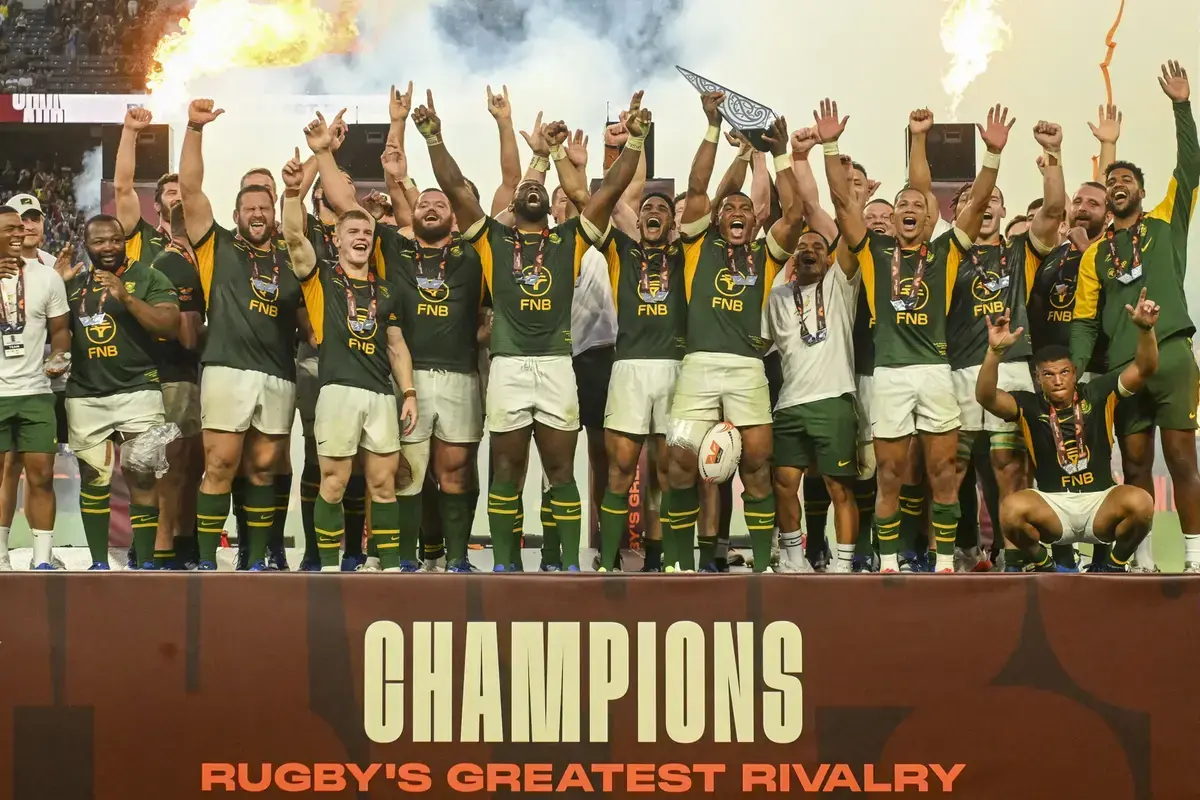
South Africa with the trophy during All Blacks v South Africa, Rugbys Greatest Rivalry Tour, Baltimore, USA, 13 September 2026. (Photo by Jack Megaw / action press)

The Springboks clinched Rugby’s Greatest Rivalry series 3-1, overwhelming the All Blacks 43-28 at M&T Bank Stadium in Baltimore in the first meeting between the two rivals on American soil. Six tries to four in front of a record US rugby crowd sealed the most emphatic and expansive victory of the series, confirming the world champions’ supremacy at the end of a tour that captivated the sport.

Key moments

3 mins – PENALTY SOUTH AFRICA: Sacha Feinberg-Mngomezulu kicks an early penalty after the All Blacks are penalised at the breakdown. (South Africa 3–0 All Blacks)

9 mins – TRY ALL BLACKS: Codie Taylor scores after Cam Roigard throws a long pass across the goal-line from a ruck. Taylor’s 24th Test try — an All Blacks hooker record, passing Dane Coles. McKenzie converts. (South Africa 3–7 All Blacks)

14 mins – TRY SOUTH AFRICA: Damian de Allende powers over from close range after a 10-phase surge into the All Blacks’ 22. Feinberg-Mngomezulu converts. (South Africa 10–7 All Blacks)

~18 mins – TMO COMMUNICATION BREAKDOWN. Play is suspended for approximately 10 minutes after the referee loses communication with the Television Match Official. Both captains agree to continue without TMO involvement unless foul play occurs.

22 mins – TRY SOUTH AFRICA: Morne van den Berg sells a dummy and darts over from close range. The scrumhalf converts his own try. (South Africa 17–7 All Blacks)

~38 mins – TRY ALL BLACKS: Will Jordan enters the line from the right wing and races in beside the posts, capping a remarkable 32-phase sequence that sapped the Springbok defence. The move began from a front-of-the-lineout play after South Africa conceded a scrum penalty. McKenzie converts. (South Africa 17–14 All Blacks)

Half-time: South Africa 17–14 All Blacks. The Springboks led through de Allende and van den Berg after a dominant first quarter, but the All Blacks fought back through Taylor’s record try and Jordan’s score from a magnificent 32-phase build-up. A 10-minute TMO breakdown embarrassed the showcase event. The Springboks’ scrum and breakdown superiority was again evident.

48 mins – TRY SOUTH AFRICA: Malcolm Marx scores from a rolling lineout maul after the Springboks win a scrum penalty and kick to the corner. Manie Libbok converts. (South Africa 24–14 All Blacks)

51 mins – TRY SOUTH AFRICA: Pieter-Steph du Toit barges over after Feinberg-Mngomezulu breaks into the All Blacks’ 22 from a scrum and the Springbok forwards batter through. Libbok converts. (South Africa 31–14 All Blacks)

~55 mins – Roigard tackled without the ball. The halfback is taken out after kicking through to the Springbok line. TMO reviews but finds Roigard was offside at the preceding ruck. Penalty reversed. Frustration mounts for the All Blacks.

~63 mins – TRY ALL BLACKS: Ethan Blackadder scores his first Test try after a lineout drive and Roigard’s charge around a ruck creates the opening. McKenzie converts. (South Africa 31–21 All Blacks)

71 mins – TRY SOUTH AFRICA: Kurt-Lee Arendse swoops on a loose ball after a Moorby tackle incident and races more than 50 metres to score. A devastating counterattack. Feinberg-Mngomezulu converts. (South Africa 38–21 All Blacks)

75 mins – TRY SOUTH AFRICA: Cameron Hanekom powers over after taking the ball from Jordan, who had scrambled back in cover. The replacement flanker seals the series. Unconverted. (South Africa 43–21 All Blacks)

80 mins – TRY ALL BLACKS: Beauden Barrett crosses for a consolation score in the final minute. McKenzie converts. (South Africa 43–28 All Blacks)

Full-time: South Africa 43–28 All Blacks. Series: South Africa 3–1.


This wasn’t the suffocating, grinding Springbok rugby that had characterised the second and third Tests. This was champagne stuff — expansive, electric and utterly ruthless. South Africa mixed power with panache, combining their traditional forward dominance with a willingness to give the ball air that had the All Blacks’ defence scrambling and the Baltimore crowd roaring its approval. When Siya Kolisi hoisted the Greatest Rivalry trophy aloft after it was presented by Dan Carter and Schalk Burger, few could argue it had gone to the wrong side.

The All Blacks, true to their free-flowing blueprint, moved the ball with typical slickness and crossed four times themselves, but on this intoxicating Baltimore evening they had no answer to a rampant Springbok side firing on all cylinders. The Springboks made 11 line breaks and played with the freedom of a team given licence to cut loose by a coach who knew his side could not lose the series. Rassie Erasmus had done it again.

“I thought it was epic,” Erasmus said. “The whole series so far has been epic, and they can draw it in Baltimore. But we wanted to finish it properly.”

The All Blacks’ penalty problems surfaced immediately. Feinberg-Mngomezulu kicked a third-minute penalty, and from there the Springboks established the tempo that would define the match. But the tourists struck back in the ninth minute when Cam Roigard, sharp and direct throughout his 80 minutes, threw a long pass across the goal-line from a ruck for captain Codie Taylor to score. In doing so, Taylor claimed his 24th Test try — the most by any All Blacks hooker, overtaking Dane Coles’s long-standing record. McKenzie converted.

The lead was short-lived. The Springboks launched a 10-phase surge into the All Blacks’ 22 and, from a ruck close to the line, Damian de Allende powered over for his fourth try of the series. Feinberg-Mngomezulu converted for 10-7. Then came an extraordinary interruption: the referee lost communication with the Television Match Official, suspending play for approximately ten minutes. Both captains agreed to continue without TMO involvement unless foul play occurred — an embarrassing episode for a match being showcased to a new American audience.

When play resumed, the Springboks pressed their advantage. Josh Moorby was controversially penalised for an offence while attempting to place the ball in a tackle, gifting the hosts field position. From the resulting lineout, man-of-the-match Morne van den Berg cut back against the grain and darted over to score. The scrumhalf then converted his own try — the second time in the series he had done so — for 17-7.

The All Blacks’ response was their finest passage of play in the match. After South Africa conceded a scrum penalty, Taylor found his jumper at the front of the lineout and set in motion a 32-phase movement that sapped the Springboks’ defence. Surge after surge was absorbed before the ball was moved to the backs, and Jordan — entering the line from his right wing — raced in beside the posts. McKenzie converted, and the tourists went to the break trailing by just three at 17-14.

Whatever hope that stirred evaporated within six minutes of the restart. The Springboks scored two tries in three minutes to blow the match apart. First, a scrum penalty gave them the chance to kick to the corner, and from the lineout their maul — that terrifying, irresistible weapon — drove the All Blacks backwards before Marx peeled off to score. Libbok converted for 24-14. From the restart, the Springboks won a scrum and Feinberg-Mngomezulu broke into the All Blacks’ 22 before du Toit drove over from close range. Libbok converted again and at 31-14, the series was over as a contest.

“We were confident that if we got a few things right tonight we’d have a good chance of winning,” Rennie said. “We fell short. It’s disappointing from that perspective.”

The All Blacks’ frustrations multiplied. Roigard kicked through to the Springbok line only to be taken out without the ball — a penalty seemed certain, but the TMO discovered Roigard was offside at the preceding ruck and the decision was reversed. Moorby was then denied a favourable ruling after taking a tackle that wasn’t ruled early. Richie Mo’unga, starting his first Test since the 2023 World Cup final, kicked for the corner and from the lineout Blackadder — busy, abrasive and tireless throughout — scored his first Test try. McKenzie converted for 31-21 and briefly the All Blacks sensed a comeback.

Arendse killed it stone dead. In the 71st minute, the ball bounced loose after the controversial Moorby tackle incident and the Springbok flyer swooped on it, accelerating from inside his own half on a devastating 50-metre run to score under the posts. It was the try of the match and the moment that sealed the series in emphatic fashion. Feinberg-Mngomezulu converted. Replacement flanker Cameron Hanekom added a sixth four minutes later, powering over after taking the ball from Jordan, who had scrambled back in cover.

Beauden Barrett, the 144-cap veteran who had been introduced from the bench, crossed for a consolation in the final minute that McKenzie converted, but the 43-28 scoreline — the largest winning margin of the series — told the story of South African dominance. The try count across four Tests finished 20-18 in the All Blacks’ favour, yet the Springboks won the series 3-1 — a testament to their ability to win the decisive moments through set-piece power, breakdown dominance and the relentless physicality of their bench rotation.

Rennie was honest in defeat. “Yeah, look, the boys put in a massive shift again,” he said. “You look at all the numbers, and everything’s very even, but they were electric, and when they got their opportunities, and we were trying to chase the game late, we put ourselves under a bit more pressure.” On the breakdown discipline that conceded crucial penalties, he was blunt: “Yeah, it’s not good enough. It just does not affect the game either. But it’s dumb.”

The head coach maintained perspective on a tour that had tested his squad to its limits. “We’ve had a captured audience of what turned out to be 49 players,” Rennie said. “I thought the set piece was excellent tonight — scrum and lineout were a real positive. When we get our continuity going, we’re going to score tries. We’re tracking in the right direction, but we’ve got to close the gap and we know that.”

Mo’unga, playing his first Test in three years, labelled the 2026 Springboks a “complete team” and acknowledged the gulf the All Blacks need to bridge before the likely World Cup quarter-final meeting next year. Jordie Barrett was again outstanding at inside centre — arguably the All Blacks’ most consistently excellent player across the entire tour — while Blackadder, Jordan and Peter Lakai all enhanced their reputations in a losing cause.

Taylor, captaining for the final time on tour, hoped the Baltimore crowd took something from the occasion. “I hope American fans left understanding how exciting rugby can be,” the hooker said. Rennie echoed the sentiment: “They obviously love their sports, and they got right behind rugby. I would have liked to see a few more black jerseys, but obviously there’s a lot of South Africans over here.”

The Greatest Rivalry Tour is over. Across eight matches and seven weeks, the All Blacks used 49 players, scored 49 tries, won five of eight fixtures and lost the Test series 3-1 after winning the opener. They return to New Zealand battered, bruised and wiser — with a Bledisloe Cup and a European tour still ahead before the World Cup. The Springboks, meanwhile, have now won everything there is to win. They head to Australia in 2027 as the team to beat, their greatness no longer debatable. As Erasmus said in Cape Town: they are the benchmark. And as Baltimore showed, the gap between benchmark and challenger remains stubbornly difficult to close.

Teams

South Africa: 15 Damian Willemse, 14 Kurt-Lee Arendse, 13 Jesse Kriel, 12 Damian de Allende, 11 Ethan Hooker, 10 Sacha Feinberg-Mngomezulu, 9 Morne van den Berg, 8 Jasper Wiese, 7 Pieter-Steph du Toit, 6 Siya Kolisi (c), 5 Ruan Nortje, 4 Eben Etzebeth, 3 Thomas du Toit, 2 Malcolm Marx, 1 Ox Nche.
Replacements: 16 Deon Fourie, 17 Gerhard Steenekamp, 18 Wilco Louw, 19 Cobus Wiese, 20 Cameron Hanekom, 21 Cobus Reinach, 22 Andre Esterhuizen, 23 Manie Libbok.

All Blacks: 15 Damian McKenzie, 14 Will Jordan, 13 Anton Lienert-Brown, 12 Jordie Barrett, 11 Josh Moorby, 10 Richie Mo’unga, 9 Cam Roigard, 8 Peter Lakai, 7 Ethan Blackadder, 6 Tupou Vaa’i, 5 Sam Darry, 4 Patrick Tuipulotu, 3 Fletcher Newell, 2 Codie Taylor (c), 1 Ethan de Groot.
Replacements: 16 Asafo Aumua, 17 Xavier Numia, 18 Tyrel Lomax, 19 Josh Lord, 20 Wallace Sititi, 21 Kyle Preston, 22 Rieko Ioane, 23 Beauden Barrett.

Match details

South Africa 43 (Tries: de Allende, van den Berg, Marx, du Toit, Arendse, Hanekom; Conversions: Feinberg-Mngomezulu 2/3, van den Berg 1/1, Libbok 2/2; Penalties: Feinberg-Mngomezulu 1/1)
All Blacks 28 (Tries: Taylor, Jordan, Blackadder, Barrett; Conversions: McKenzie 4/4)
Half-time: 17–14 (South Africa)

Venue: M&T Bank Stadium, Baltimore
Attendance: Record US rugby crowd
Referee: Karl Dickson (England)
Man of the match: Morne van den Berg (South Africa)
Series result: South Africa 3–1

Greatest Rivalry series result

First Test, Ellis Park, Johannesburg: South Africa 16–33 All Blacks
Second Test, DHL Stadium, Cape Town: South Africa 33–26 All Blacks
Third Test, FNB Stadium, Johannesburg: South Africa 29–24 All Blacks
Fourth Test, M&T Bank Stadium, Baltimore: South Africa 43–28 All Blacks
Series: South Africa 3–1

Continue Reading

International

Mo’unga gets the call in revamped All Blacks for Baltimore finale

Published

on

Mo’unga gets the call in revamped All Blacks for Baltimore finale
All Blacks Richie Mo'unga during the All Blacks v Lions match, Rugbys Greatest Rivalry, Ellis Park, Johannesburg, South Africa, Tuesday, 25 August 2026. (Photo by Anton Geyser / action press)

Dave Rennie has made sweeping changes for the fourth and final Test against the Springboks at M&T Bank Stadium in Baltimore on Saturday, with Richie Mo’unga handed his first Test start since the 2023 Rugby World Cup final and Ethan Blackadder earning his first in more than two years. Codie Taylor captains a revamped side that must win to prevent the Springboks claiming the Greatest Rivalry series outright.

Key squad news:

  • Richie Mo’unga earns his first Test start since the 2023 World Cup final; Ruben Love dropped from the 23
  • Codie Taylor captains the All Blacks in the absence of the injured Ardie Savea
  • Ethan Blackadder makes his first Test start in more than two years at openside flanker
  • Ethan de Groot and Josh Lord return after clearing concussion protocols from the first Test
  • Five changes to the starting XV; Newell, Tuipulotu, Lienert-Brown also start
  • Fabian Holland unavailable due to illness
  • All Blacks must win to draw the series 2-2

The changes are driven by necessity and opportunity. Ardie Savea (dislocated shoulder), Luke Jacobson (elbow tendon) and Quinn Tupaea (MCL) were all injured in the third Test defeat in Soweto, while Fabian Holland has been ruled out through illness. Their absence, combined with the return of Ethan de Groot and Josh Lord — who have cleared World Rugby’s concussion protocols after the sickening first Test collision — has prompted a significant reshuffle.

Mo’unga’s selection at first five-eighth is the headline talking point. The 56-cap playmaker replaces Ruben Love, who drops out of the matchday 23 entirely after starting all three Tests in the series. It is Mo’unga’s first Test start since the one-point World Cup final defeat to these same Springboks in Paris three years ago, completing a remarkable journey from three seasons in Japanese club rugby back to the international arena.

“Richie has been patient and professional since arriving on tour,” Rennie said. “He’s earned this opportunity. His vision, his decision-making and his ability to run a game at the highest level are exactly what we need in a match of this magnitude.”

Blackadder’s inclusion at openside is a reward for his extraordinary tour. The Crusaders flanker’s two-try, 16-carry display against the Lions was the standout individual performance of the franchise matches, and he has been unlucky not to feature in a Test matchday squad until now. He forms a new-look loose forward trio with Tupou Vaa’i, who shifts from lock to blindside, and Peter Lakai at number eight.

The front row sees de Groot return at loosehead alongside Taylor and Fletcher Newell, who replaces Tyrel Lomax at tighthead for his first Test start of the series. Lomax provides impact from the bench. Patrick Tuipulotu partners Sam Darry — the only forward to start in the same position as the third Test — in a second-row combination that offers a different profile from the Holland-Vaa’i and Holland-Darry pairings used earlier in the series. Lord’s return from concussion protocols means he can provide lock cover from the reserves.

In the backs, Anton Lienert-Brown replaces the injured Tupaea at outside centre alongside Jordie Barrett, while Josh Moorby comes onto the left wing. Cam Roigard, Will Jordan and Damian McKenzie are retained, with Rieko Ioane and Leroy Carter providing outside back cover on the bench.

Taylor, who captained the All Blacks for the first time against the Bulls earlier on tour, takes the armband for the biggest match of his 111-cap career. “It’s a huge honour to captain the All Blacks in a Test match of this magnitude,” Taylor said. “We’re desperate to get a result. The boys are hurting after last week and we know what’s at stake.”

Barrett dismissed any suggestion the All Blacks might be mentally or physically spent after seven weeks on tour. “We’ve still got a lot to play for,” Barrett said. “We came here to win a series and while that’s no longer possible, sharing it is the next best thing. We owe it to ourselves and everyone back home to finish this tour the right way.”

The match marks the first time the All Blacks and Springboks have met on American soil. M&T Bank Stadium, the 70,257-capacity home of the NFL’s Baltimore Ravens, will host the sixth All Blacks Test played in the United States, following matches in Chicago, Washington DC and San Diego. Baltimore is a candidate city for the 2031 Rugby World Cup.

The series stands at 2-1 in the Springboks’ favour. A New Zealand victory would see each nation retain one half of the Greatest Rivalry trophy in a drawn series. Defeat would confirm the first series loss for an All Blacks touring side in South Africa since 1976 and hand the Springboks both halves of the silverware.

“This is why you play rugby,” Rennie said. “A deciding Test match against the best team in the world in front of 70,000 people. We know the Boks will be desperate to finish it here, but so are we. We’ve shown throughout this tour that we can beat anyone when we’re at our best. Now we need to deliver the performance of the tour.”

All Blacks team for the fourth Test

M&T Bank Stadium, Baltimore. Saturday 12 September, kick-off 5pm local time (Sunday 13 September, 9am NZT).

1. Ethan de Groot (44 caps), 2. Codie Taylor (c) (111), 3. Fletcher Newell (39), 4. Patrick Tuipulotu (58), 5. Sam Darry (11), 6. Tupou Vaa’i (50), 7. Ethan Blackadder (15), 8. Peter Lakai (13), 9. Cam Roigard (23), 10. Richie Mo’unga (56), 11. Josh Moorby (4), 12. Jordie Barrett (84), 13. Anton Lienert-Brown (92), 14. Will Jordan (60), 15. Damian McKenzie (80).

Reserves: 16. Asafo Aumua (25), 17. Xavier Numia (4), 18. Tyrel Lomax (54), 19. Josh Lord (16), 20. Wallace Sititi (22), 21. Kyle Preston (4), 22. Rieko Ioane (89), 23. Leroy Carter (10).

Continue Reading

International

Springboks make two changes for Baltimore Test against All Blacks

Published

on

Springboks make two changes for Baltimore Test against All Blacks
South Africa Damian Willemse is tackled by All Blacks George Bower during the All Blacks v South Africa second test match, Rugbys Greatest Rivalry, DHL Stadium, Cape Town, South Africa, Saturday, 29 August 2026. (Photo by Nic Bothma / action press)

Rassie Erasmus has made just two changes to the Springbok starting XV for the Rugby’s Greatest Rivalry series decider against the All Blacks at M&T Bank Stadium in Baltimore on Saturday, sending the clearest possible signal that he intends to go for the kill and clinch a 3-1 series victory on American soil.

Key team news:

  • Damian Willemse returns at fullback in place of the injured Cheslin Kolbe, who broke his jaw in the third Test and has remained in South Africa
  • Morne van den Berg earns his first start of the series at scrum-half, with Cobus Reinach dropping to the bench
  • The forward pack is unchanged for the third consecutive Test
  • A Springbok victory would seal a 3-1 series win; an All Blacks victory would draw the series
  • Eben Etzebeth extends his record as the most capped Springbok to 146 Tests
  • The loose trio of Kolisi, du Toit and Wiese will start together for a record 19th time
  • It is the first Springbok Test in history to be played in Baltimore
  • Kick-off is at 23:00 SA time (17:00 EDT)

The decision to retain the same matchday squad with only injury-enforced and form-based adjustments is a statement of intent from Erasmus. Having won the second and third Tests to take a 2-1 lead, the Springbok coach is backing the combinations that turned the series around rather than rotating for the finale.

“We feel that the team is well settled and all the players delivered in their respective roles in the last two matches, so we believe selecting the same matchday squad, and naming Damian back in his regular position, makes sense for the closing match of the series,” Erasmus said. “These players also know exactly what to expect from a very determined All Blacks team, who will give everything to draw the series this weekend.”

Willemse’s return is straightforward. The fullback started the first two Tests before a hamstring injury ruled him out in Cape Town, with Kolbe deputising superbly at 15 across the second and third matches. Kolbe’s broken jaw, sustained at FNB Stadium, has ended his series and he was among six players who remained in South Africa as the squad flew to the United States.

“Damian started the first two Tests and had it not been for a niggle last week, he would have also started that match, so it’s good to have him back,” Erasmus said. “He is a quality player, and he knows the guys around him very well, so it will simply be a matter of him picking up where he left off before last week.”

The more intriguing selection is van den Berg’s promotion ahead of Reinach. The Lions scrum-half made a telling impact off the bench in the third Test and Erasmus was effusive in his praise. “Morne made a fantastic impact when he took the field last week, and he deserves a chance to start, so Cobus switches to the bench where he will add experience and skill in this vital match,” the Springbok coach said.

He expanded on van den Berg’s journey to this point. “He’s not a youngster. I think he’s 27 or something like that already, so he’s not a youngster to break through. But we’ve always tracked him, and I think he’s just been unfortunate with injuries and also some really good nines that played ahead of him or got opportunities ahead of him,” Erasmus said. “After his last injury, we thought it was going to be a tough year for him to get back into the mix, but he really did his rehab really well, and he’s back to full fitness. I think last week when he got his opportunity, he really did well, and we think he deserves a start.”

The forward pack is unchanged for the third week running. Nche, Marx and Louw continue in the front row, Etzebeth and Nortje in the second row, and captain Kolisi, du Toit and Wiese in a loose trio that will extend its own record to 19 Test starts together. Etzebeth stretches his all-time caps mark to 146, while Wiese needs just one more appearance after this match to reach 50 caps.

In the backline, Feinberg-Mngomezulu starts at fly-half for a fifth consecutive Test, with Arendse and Hooker on the wings and de Allende and Kriel continuing their settled midfield partnership. The bench is also unchanged from the third Test — Fourie, Steenekamp, Thomas du Toit, de Jager, Esterhuizen and Hanekom as the six forward replacements, with Reinach and Libbok the two specialist backs.

Erasmus confirmed that Handre Pollard, who has missed the last three Tests with a calf injury, is fit again and will likely feature against Australia in Perth on 27 September — the one-off Test the squad will travel to directly from Baltimore. Franco Mostert is also expected to return for that fixture.

Saturday’s match will be the first Springbok Test in Baltimore and only the fourth in the United States. South Africa have played three previous Tests on American soil — victories over the USA in 1981 and 2001, and a narrow 22-20 defeat to Wales in Washington DC in 2018, which was Erasmus’s first match in charge as head coach. The 2031 Rugby World Cup will be hosted in the USA, lending additional significance to high-profile fixtures on American soil.

Erasmus was blunt about the stakes. “If we don’t win, then we have achieved nothing,” he said.

He expected the All Blacks, who have lost Ardie Savea, Luke Jacobson and Quinn Tupaea to series-ending injuries from the third Test, to come out swinging regardless. “We have faced the All Blacks three weeks in a row, and just like us, they are a proud team who showed last week that they will never stop fighting until the final whistle, so we are under no illusions about the magnitude of the challenge ahead this weekend,” Erasmus said.

“That said, we are equally determined to finish the series strongly and give everything to lift the trophy, and the players are excited about the match. We have no doubt that it’s going to be another epic encounter that will require a full-blown 80-minute effort on attack and defence.”

Springboks:
15. Damian Willemse (DHL Stormers, 54 caps)
14. Kurt-Lee Arendse (Mitsubishi Dynaboars, 34 caps)
13. Jesse Kriel (Canon Eagles, 93 caps)
12. Damian de Allende (Wild Knights, 102 caps)
11. Ethan Hooker (Hollywoodbets Sharks, 12 caps)
10. Sacha Feinberg-Mngomezulu (DHL Stormers, 23 caps)
9. Morne van den Berg (Lions, 9 caps)
8. Jasper Wiese (Urayasu D-Rocks, 48 caps)
7. Pieter-Steph du Toit (Toyota Verblitz, 101 caps)
6. Siya Kolisi (c) (DHL Stormers, 106 caps)
5. Ruan Nortje (Kubota Spears, 23 caps)
4. Eben Etzebeth (Hollywoodbets Sharks, 145 caps)
3. Wilco Louw (DHL Stormers, 34 caps)
2. Malcolm Marx (Kubota Spears, 92 caps)
1. Ox Nche (Hollywoodbets Sharks, 51 caps)

Replacements:
16. Deon Fourie (DHL Stormers, 15 caps)
17. Gerhard Steenekamp (Vodacom Bulls, 22 caps)
18. Thomas du Toit (Hollywoodbets Sharks, 36 caps)
19. Lood de Jager (Wild Knights, 76 caps)
20. Andre Esterhuizen (Hollywoodbets Sharks, 34 caps)
21. Cameron Hanekom (Vodacom Bulls, 5 caps)
22. Cobus Reinach (DHL Stormers, 56 caps)
23. Manie Libbok (Kintetsu Liners, 33 caps)

Match details: South Africa v New Zealand, M&T Bank Stadium, Baltimore. Saturday 12 September (Saturday 13 September NZT), 17:00 EDT / 23:00 SA time. Live on SuperSport.

Continue Reading

Trending