Connect with us

Womens Six Nations

Hannah Bluck handed first Six Nations start as Wales make four changes for Italy test

Published

on

Wales Head Coach Ioan Cunningham has made four changes to his starting lineup for the historic Women’s Six Nations Test against Italy at the Principality Stadium in Cardiff on Saturday, April 25th. The marquee selection sees centre Hannah Bluck earn her first start of the 2024 campaign, partnering captain Hannah Jones in midfield.

The other changes see Jenny Hesketh return at fullback, Lisa Neumann brought in on the wing, and Keira Bevan preferred at scrum-half alongside fly-half Lleucu George. The forward pack remains unchanged from the one that took the field against France, with props Gwenllian Pyrs and Sisilia Tuipulotu joined by hooker Carys Phillips in the front row. Locks Natalia John and Abbie Fleming combine with flankers Alisha Butchers, vice-captain Alex Callender, and No. 8 Georgia Evans.

Jasmine Joyce and Kayleigh Powell were released for GB Sevens duty, while injuries ruled out Kerin Lake, Bethan Lewis, and Mollie Wilkinson. Niamh Terry and Nel Metcalfe could make appearances off the bench.

In his comments, Cunningham stressed the occasion’s significance. “Nobody needs to tell us how important this game is…but our focus is totally on what we need to do as a team,” he said. “We’re making history by playing the first stand-alone women’s Test match at the Principality Stadium and it’s a stage this squad…deserves.”

With an eye towards improvement, Cunningham added, “Against France, we created pressure and opportunities, and we just need to be more clinical and finish off those opportunities.”

Wales team to face Italy

15 Jenny Hesketh; 14 Lisa Neumann; 13 Hannah Jones (captain), 12 Hannah Bluck; 11 Carys Cox; 10 Lleucu George, 9 Keira Bevan; 1 Gwenllian Pyrs, 2 Carys Phillips, 3 Sisilia Tuipulotu; 4 Natalia John, 5 Abbie Fleming; 6 Alisha Butchers, 7 Alex Callender (vice-captain), 8 Georgia Evans

Replacements

16 Kelsey Jones, 17 Abbey Constable, 18 Donna Rose, 19 Kate Williams, 20 Gwennan Hopkins, 21 Sian Jones, 22 Niamh Terry, 23 Nel Metcalfe

Continue Reading
Click to comment

Leave a Reply

Womens Six Nations

Red Roses hold off France to retain Grand Slam in Twickenham epic

Published

on

Red Roses hold off France to retain Grand Slam in Twickenham epic
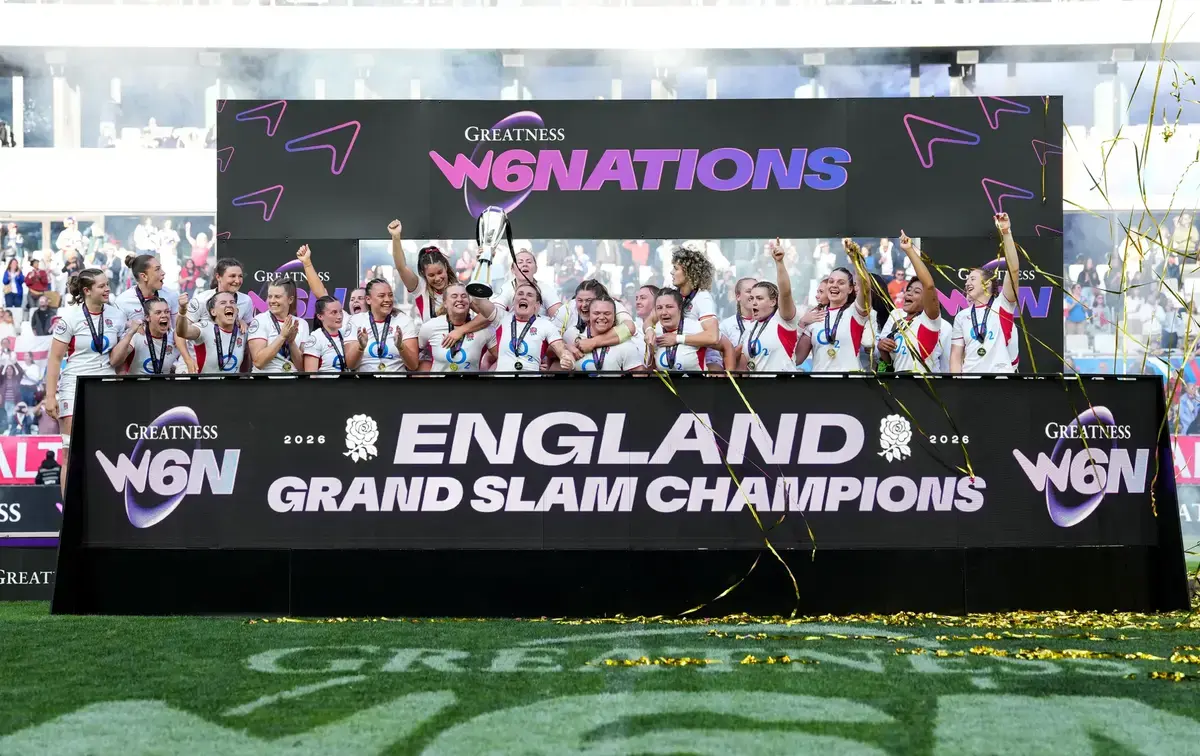
England's Zoe Aldcroft lifts the trophy with teammates after the 2025 Guinness Women's Six Nations Championship Round 5 game between England and France in Allianz Twickenham Stadium, London, England, Saturday, April 26, 2025 (Photo by Tom Maher / Inpho)

England claimed their seventh successive Women’s Six Nations title and a fourth consecutive Grand Slam with a nerve-shredding 43-42 victory over France at Allianz Stadium, Twickenham.

Key Moments:

3′ – Abby Dow try from Zoe Harrison grubber kick, conversion missed (England 5-0 France)
5′ – Carla Arbez try after powerful French forward carries, Morgane Bourgeois conversion (England 5-7 France)
7′ – Emma Sing try following Megan Jones pass, Zoe Harrison conversion (England 12-7 France)
11′ – Lark Atkin-Davies try from rolling maul, conversion missed (England 17-7 France)
17′ – Emma Sing scores second try after England forward dominance, Zoe Harrison conversion (England 24-7 France)
21′ – Assia Khalfaoui yellow card for high tackle on Maud Muir
22′ – Claudia MacDonald try from Megan Jones long pass, Zoe Harrison conversion (England 31-7 France)
29′ – Pauline Bourdon Sansus opportunistic try after Zoe Harrison handling error, Morgane Bourgeois conversion (England 31-14 France)
37′ – Marine Ménager try following 50:22 kick from Morgane Bourgeois, conversion successful (England 31-21 France)
48′ – Zoe Aldcroft try after Zoe Harrison break, conversion successful (England 38-21 France)
50′ – Kelly Arbey solo try, beating multiple defenders, Morgane Bourgeois conversion (England 38-28 France)
57′ – Abby Dow scores second try from Harrison pass, conversion hits post (England 43-28 France)
69′ – Morgane Bourgeois try from Axelle Berthoumieu offload, conversion successful (England 43-35 France)
79′ – Joanna Grisez spectacular solo try from deep, Morgane Bourgeois conversion (England 43-42 France)

In a contest that will go down as one of the greatest in the competition’s history, John Mitchell’s Red Roses were pushed to the limit by a French side that refused to surrender despite trailing 31-7 inside 24 minutes.

The victory, played out before a crowd of 37,573, extended England’s remarkable Six Nations winning streak to 34 matches. But the slender margin – the closest of Mitchell’s tenure – provided a timely test ahead of the home World Cup that begins in August.

England started like a freight train, demonstrating their clinical attacking prowess with Abby Dow crossing after just three minutes. After sustained possession in the French half, Zoe Harrison spotted space behind the defensive line and delivered a perfectly weighted grubber kick into the right corner. The ball bounced kindly for Dow, who gathered at pace and swerved past Morgane Bourgeois to score. Harrison’s conversion attempt from the touchline drifted wide.

France responded immediately with their first meaningful attack. The visitors won possession from the restart and launched a series of powerful carries interspersed with deft offloads that caught the hosts off guard. Marine Ménager made the initial break through the middle before fly-half Carla Arbez received the ball at pace, skipped past two attempted tackles and dived over. Bourgeois added the extras to give France a surprise 7-5 lead.

The Red Roses, unfazed by this early setback, reclaimed the lead within minutes. A kick that went out on the full gave England an attacking lineout, from which they established a powerful rolling maul deep into French territory. When the ball was released to the backs, Megan Jones timed her pass perfectly to send Emma Sing over in the corner for her first try. Harrison’s successful conversion put England 12-7 ahead.

England’s forward dominance continued to tell as Lark Atkin-Davies powered over from another unstoppable rolling maul in the 11th minute. The Red Roses’ hooker controlled the ball expertly at the back of the drive and crashed over the line despite France’s desperate attempts to halt the momentum. Harrison couldn’t add the extras from out wide, but England had established a 17-7 advantage.

Sing claimed her second try of the match just six minutes later, benefiting from England’s relentless pressure. After a French lineout error gifted possession near their own 22, England’s pack drove forward once more before shipping the ball wide. Jones again provided the final pass, drawing in the last defender to give the full-back a simple finish. Harrison converted from in front of the posts, stretching the lead to 24-7.

The contest took another significant turn when French prop Assia Khalfaoui was shown a yellow card for a high tackle on Maud Muir. England immediately capitalised on their numerical advantage, working the ball from a lineout to the backs where Jones delivered a magnificent long looping pass that took out multiple defenders and found Claudia MacDonald in space on the left wing. The Exeter wing showed impressive pace to score in the corner, and Harrison’s conversion from the touchline extended England’s lead to 31-7.

At that stage, with England looking irresistible, the Mexican wave was already circulating around Twickenham. But it proved premature as the momentum shifted dramatically on the half-hour mark.

England attempted to clear their lines from deep, but Natasha Hunt’s pass to Harrison was slightly low. The fly-half fumbled the ball behind her own try line, and Pauline Bourdon Sansus reacted quickest, pouncing on the loose ball to score a gift of an opportunistic try. Bourgeois added the conversion to reduce the deficit to 31-14.

Energised by this unexpected score, France grew in confidence and began to play with greater freedom. Five minutes before half-time, Bourgeois produced a superb 50:22 kick that gave France an attacking lineout deep in English territory. From the set-piece, the French forwards drove with purpose before releasing the ball to the backs. After a series of phases that stretched the English defence, Marine Ménager received the ball at pace and crashed over near the posts despite the attentions of two defenders. Bourgeois’s immaculate conversion reduced the deficit to just ten points as the teams headed to the changing rooms.

Mitchell’s side started the second period with renewed purpose and appeared to have weathered the storm when captain Zoe Aldcroft finished off a brilliant move in the 48th minute. The attack began with Dow making significant ground down the right wing before being tackled. When the ball was recycled, Harrison showed exceptional vision to spot a gap, executing a perfect dummy that took her through the French defensive line. As the cover defence converged, the fly-half timed her pass perfectly to find Aldcroft running a superb support line, and the captain galloped over for a try converted by Harrison to make it 38-21.

But France refused to fold and responded with a try of breathtaking individual brilliance from Kelly Arbey. From a scrum on halfway, the French backs moved the ball wide where the 19-year-old wing found herself confronted by both Sing and Dow. With remarkable strength and balance, Arbey fended off both defenders in quick succession before accelerating away to score in the corner. Bourgeois maintained her perfect kicking record with a superb conversion to bring France back within ten points at 38-28.

England’s attacking threat remained potent, however, and they created breathing space once more in the 57th minute. After sustained pressure in the French 22, with forwards making powerful carries close to the line, Harrison delivered another moment of quality with a long, looping pass that found Dow unmarked on the right wing. The prolific finisher crossed for her second try of the match, though Harrison’s conversion attempt struck the right upright, leaving the score at 43-28.

With the match entering its final quarter, France’s famed offloading game began to cause England serious problems. The visitors’ forwards carried with increasing confidence, consistently breaking the gain line and finding support runners with deft passes out of the tackle. Their persistence was rewarded with 11 minutes remaining when, after multiple phases in the England 22, Axelle Berthoumieu was stopped just short of the line but managed to offload to Bourgeois who dived over in the corner. The full-back then converted her own try with a remarkable kick from the touchline to make it 43-35.

The tension inside Twickenham was palpable as France continued to press forward in search of another score. Emma Sing produced a crucial intervention with five minutes remaining, making a try-saving tackle on Ménager who had broken clear down the right wing. The French centre was forced into touch just metres from the line when she appeared certain to score.

But with the clock in the red, France produced one final moment of magic. Joanna Grisez received the ball deep inside her own half and set off on a spectacular solo run that showcased her sevens background. The wing’s explosive acceleration took her past three England defenders before a final burst of speed carried her around the last covering tackler to score under the posts. Bourgeois’s sixth successful conversion from as many attempts made it a one-point game at 43-42.

With one final restart to navigate, England players walked slowly to halfway, hearts in mouths. When confusion between Lina Queyroi and Taina Maka resulted in a knock-on from the kick-off, the Red Roses could finally celebrate their seventh successive championship by the narrowest of margins.

Despite the triumph, England’s defensive frailties – particularly around the breakdown and in the wider channels – raised questions ahead of the World Cup on home soil. France’s total of 42 points was more than England had conceded in their previous four Six Nations matches combined.

For Mitchell, whose rotation policy throughout the tournament has built impressive squad depth with 34 players used, this nail-biting finale provided invaluable experience under pressure.

“I would rather have this sort of feedback, any day of the week,” said Mitchell afterwards. “We got it done, we completed a goal that hasn’t been done in the modern era – four Grand Slams in a row – and now we can have a celebration and get ready for a World Cup.”

The England coach was particularly impressed with his side’s start but acknowledged defensive improvements would be needed before the World Cup. “Defence wins titles and that wasn’t great from us but our start was pretty good. France made lots of pick and goes and we were poor in edge defence.”

Captain Aldcroft, named player of the match and experiencing her first championship as skipper, almost dropped the trophy during the presentation – but like her team, held on when it mattered most. “I am so proud of all the girls’ effort, we battled it out today,” she said. “France came at us so all credit to us for holding on.”

Continue Reading

Womens Six Nations

Fran McGhie try seals last-gasp win for Scotland over Ireland

Published

on

Fran McGhie try seals last-gasp win for Scotland over Ireland
Scotland's Francesca McGhie celebrates scoring the winning try during the 2025 Guinness Women's Six Nations Championship Round 5 game between Scotland and Ireland in Hive Stadium, Edinburgh, Scotland, Saturday, April 26, 2025 (Photo by Ryan Byrne / Inpho)

Scotland produced a stirring final-day performance to snatch a dramatic 26-19 victory over Ireland in the Women’s Six Nations at Edinburgh’s Hive Stadium, with Francesca McGhie’s try in the dying seconds providing a thrilling climax to their campaign.

Key Moments:

10′ – Amee-Leigh Costigan try after Molly Scuffil-McCabe break, Dannah O’Brien conversion (Scotland 0-7 Ireland)
25′ – Lana Skeldon try from unstoppable rolling maul, conversion missed (Scotland 5-7 Ireland)
42′ – Emma Orr breaks through defensive line after Sarah Bonar interception, Helen Nelson conversion (Scotland 12-7 Ireland)
48′ – Linda Djougang powers over after Ruth Campbell line-break, conversion missed (Scotland 12-12 Ireland)
58′ – Rachel McLachlan scores in corner from Chloe Rollie offload, Helen Nelson conversion (Scotland 19-12 Ireland)
72′ – Emily Lane darts through gap for her first international try, Dannah O’Brien conversion (Scotland 19-19 Ireland)
81′ – Francesca McGhie seals dramatic victory in final play, Helen Nelson conversion (Scotland 26-19 Ireland)

Despite having less possession and territory for much of the contest, Bryan Easson’s side demonstrated remarkable defensive resilience and clinical finishing to overcome an Irish team that had been looking to secure three away wins in the championship for the first time since 2017.

Ireland arrived in Edinburgh with momentum following victories against Italy and Wales, and started the brighter of the two sides. The visitors dominated the early exchanges, controlling possession and territory as they camped in the Scottish 22. Their pressure was rewarded in the 10th minute when scrum-half Molly Scuffil-McCabe exploited a gap in the fringe defence, accelerating through before releasing winger Amee-Leigh Costigan who finished expertly in the left corner. Dannah O’Brien added a superb touchline conversion to give Ireland a 7-0 lead.

The setback galvanised Scotland, who had struggled initially to gain a foothold in the match. Their response came in the 25th minute through a well-executed set-piece move. After winning a penalty, Scotland opted for a lineout five metres from the Irish line, and the resulting maul proved unstoppable as hooker Lana Skeldon emerged with her 19th international try. Helen Nelson’s conversion attempt drifted wide, leaving Ireland with a narrow 7-5 advantage.

Ireland’s afternoon was further complicated when influential back-row Dorothy Wall was forced off with what appeared to be a serious non-contact injury – a potentially significant concern ahead of this summer’s Rugby World Cup.

As half-time approached, Ireland intensified their pressure, with prop Linda Djougang twice being held up over the line in quick succession. The visitors appeared certain to extend their lead, only for the momentum to shift dramatically in first-half stoppage time. Scotland lock Sarah Bonar produced a crucial interception in her own 22 and, spotting space ahead, kicked downfield to relieve pressure. When Ireland failed to find touch with the clearing kick, Scotland capitalised ruthlessly as centre Emma Orr scythed through the defensive line to score under the posts. Nelson’s conversion gave the hosts an unexpected 12-7 half-time lead despite Ireland having dominated possession statistics with over 70% of the ball.

Ireland regrouped after the interval and levelled the match in the 48th minute. After Ruth Campbell’s impressive line break created forward momentum, Djougang – having been denied twice earlier – finally forced her way over the line for a try confirmed after TMO review. The score came with an additional advantage for Ireland as Scottish winger Rhona Lloyd was shown a yellow card for a head-on-head tackle on Costigan during the build-up. O’Brien’s conversion attempt missed, leaving the scores tied at 12-12.

Despite being reduced to 14 players, Scotland produced arguably their most impressive passage of play just before the hour mark. After sustained pressure, full-back Chloe Rollie created space with a brilliant offload out of contact to flanker Rachel McLachlan, who crossed in the left corner. Nelson landed a magnificent conversion from the touchline to restore Scotland’s seven-point advantage at 19-12.

The contest continued to ebb and flow as Ireland threw everything at Scotland in search of an equaliser. The pressure eventually told as Scottish fly-half Nelson was sin-binned for killing the ball close to her own line. Ireland immediately capitalised on their numerical advantage, with replacement scrum-half Emily Lane darting through a gap to score her first international try. O’Brien’s conversion levelled the scores at 19-19 with just seven minutes remaining.

With momentum seemingly shifting towards the visitors, many expected Ireland to complete their comeback in the closing stages. However, it was Scotland who summoned one final effort as the clock ticked into the red. After securing an attacking lineout five metres out, they executed a perfect switch of play to the left wing where McGhie displayed remarkable composure to dive over in the corner and spark wild celebrations. Nelson, back from her yellow card, added the extras to seal a memorable 26-19 victory.

Scotland’s defensive effort was epitomised by flanker Rachel McLachlan, who was deservedly named player of the match after an all-action display that included 62 metres carried and a crucial try. Number eight Evie Gallagher was equally impressive, securing several vital turnovers at critical moments.

For Ireland, Amee-Leigh Costigan continued her fine tournament form with another try, while Molly Scuffil-McCabe provided spark from scrum-half. Prop Linda Djougang showed remarkable persistence to finally score after being held up twice earlier in the match.

Scotland head coach Bryan Easson was emotional after the final whistle: “It was extremely emotional. I don’t know what the possession stats were, but we had to fight for everything we got. Defensively, we were absolutely outstanding, some of the turnovers… Then to have the skill to score. We deserved everything we got today because of the fight and heart in that team performance.”

McLachlan echoed her coach’s sentiments: “Proud, so proud. There’s been some down bits in this campaign for us. We wanted to come out and show heart and pride in the jersey at home, and I think we did exactly that. We came into this game with belief and we continued to believe throughout. We picked ourselves up and just kept going. We knew we had it in us.”

The statistics highlighted Scotland’s efficiency, with the hosts winning despite having just 38% possession compared to Ireland’s 62%. Ireland’s territorial dominance was even more pronounced, yet Scotland’s clinical attack and resolute defence proved decisive.

The victory secured a fourth-place finish for Scotland in the final Six Nations standings, having also defeated Wales in their opening fixture. Ireland’s losing bonus point was enough to secure third place behind champions England and runners-up France, but they will rue missing the opportunity to record three away wins in a single championship for the first time in eight years.

Both teams will now turn their attention to preparation for the Rugby World Cup, which begins in August. Ireland’s campaign starts against Japan in Northampton on August 24th, while Scotland will hope to build on this performance as they finalise their tournament preparations.

The dramatic nature of Scotland’s victory, snatching success with the final play after defending heroically for long periods, will provide a significant psychological boost ahead of the World Cup. For Ireland, the disappointment of this defeat will be compounded by injury concerns surrounding Dorothy Wall, though their overall Six Nations campaign still represents progress under head coach Scott Bemand.

Continue Reading

Womens Six Nations

Ireland overcome slow start to blow away winless Wales in Newport

Published

on

Ireland overcome slow start to blow away winless Wales in Newport
Ireland’s Aoife Wafer celebrates a try with teammates during the 2025 Guinness Women's Six Nations Championship Round 4 game between Wales and Ireland in Rodney Parade, Newport, Wales, Sunday, April 20, 2025 (Photo by Laszlo Geczo / Inpho)

In the sunshine at Rodney Parade, Ireland delivered a commanding performance to cement their third-place position in the Women’s Six Nations with a comprehensive 40-14 victory over Wales. Despite conceding an early try, Scott Bemand’s side responded with six tries of their own to leave the hosts still searching for their first win of the tournament.

Key Moments:

6′ – Carys Cox try after Amee-Leigh Costigan handling error, Keira Bevan conversion (Wales 7-0 Ireland)
20′ – Linda Djougang powers through tackles after Stacey Flood break, Dannah O’Brien conversion (Wales 7-7 Ireland)
30′ – Aoife Wafer crashes over from close range after sustained pressure, Dannah O’Brien conversion (Wales 7-14 Ireland)
40+1′ – Dorothy Wall surges over following Welsh penalties, Enya Breen conversion (Wales 7-21 Ireland)
44′ – Dorothy Wall second try from powerful driving maul, conversion missed (Wales 7-26 Ireland)
54′ – Linda Djougang claims her second try after clever Molly Scuffil-McCabe pass, Dannah O’Brien conversion (Wales 7-33 Ireland)
59′ – Hannah Bluck scores on first involvement with strong line break, Keira Bevan conversion (Wales 14-33 Ireland)
63′ – Aoife Wafer picks from scrum base to power over on blindside, Enya Breen conversion (Wales 14-40 Ireland)

The opening exchanges belonged to Wales, with fly-half Lleucu George, a late replacement for the injured Kayleigh Powell, causing problems with her tactical kicking. It was George’s clever grubber kick that led to the opening score after just six minutes, as Irish winger Amee-Leigh Costigan misjudged the bounce near her own try line. Jasmine Joyce-Butchers applied pressure, forcing a spill that Carys Cox pounced on for the easiest of finishes. Keira Bevan’s conversion gave the hosts a 7-0 lead and sent the 3,568-strong crowd – a record for a women’s international at Rodney Parade – into raptures.

Ireland looked disjointed in the opening quarter, with several promising attacks breaking down through handling errors or Welsh dominance at the breakdown. However, rather than abandoning their attacking ambitions, the visitors continued to show faith in their counter-attacking ability, with full-back Stacey Flood repeatedly punishing loose Welsh kicking.

The breakthrough came after 20 minutes when Flood made significant ground before finding Wafer in support. The number eight was brought down just short, but a series of phases later, prop Linda Djougang powered through two weak Welsh tackles to score. Dannah O’Brien’s conversion levelled the scores, silencing the home crowd and giving Ireland a visible confidence boost.

Ireland’s forwards began to assert their dominance in the collisions, with the Irish pack making metres with every carry. The powerful Aoife Wafer was particularly impressive, consistently breaking the gain line and putting Wales on the back foot.

Ireland took the lead on the half-hour mark after another period of sustained pressure. The formidable Wafer, who would go on to make an astonishing 24 carries for 173 metres throughout the match, crashed over from close range after patient phase play inside the Welsh 22. O’Brien’s conversion extended the lead to 14-7, completing a decisive turnaround after the early setback.

Despite losing O’Brien to a yellow card for a high tackle on Alex Callender in the 37th minute, Ireland finished the half stronger. A series of Welsh penalties provided field position, and second-row Dorothy Wall capitalised with a powerful surge over the line, showing tremendous strength to break through two defenders. Centre Enya Breen, taking over kicking duties, added the extras from a difficult angle to give Ireland a commanding 21-7 half-time advantage.

“We were quite aware of the challenge Wales would present,” said Ireland captain Edel McMahon post-match. “We knew we had to stay patient in our system, in our process. But we were a bit slow to start, probably allowed Wales to come at us as opposed to imposing ourselves.”

If Wales harboured hopes of a second-half comeback, they were swiftly extinguished as Ireland’s forward dominance became overwhelming. Just four minutes after the restart, a perfectly executed driving maul saw Wall crash over for her second try of the afternoon and secure the bonus point. The maul was so dominant that Welsh defenders were powerless to stop it, with Wall dropping at the perfect moment to claim the score. Breen’s conversion attempt drifted wide, but Ireland had stretched their lead to 26-7.

Welsh captain Hannah Jones tried to rally her troops, but Ireland’s pack continued to dominate. Djougang claimed her second try in the 54th minute, receiving a clever pass from scrum-half Molly Scuffil-McCabe and powering over under the posts. O’Brien, back from the sin bin, converted to extend the lead to 33-7.

Wales did manage a moment of joy when replacement Hannah Bluck, who had only been called into the matchday squad after Powell’s late withdrawal, scored with her first touch. Entering the fray in the 58th minute, Bluck immediately showed her pace and power, cutting a superb line through the Irish defence to score under the posts. Bevan’s conversion reduced the deficit to 33-14, giving the home crowd something to cheer about.

Any Welsh momentum was immediately extinguished, however. From a scrum five metres out, Wafer picked up at the base and charged down the blindside, powering through Cox’s attempted tackle to score her second try. Kate Williams was caught slightly slow breaking from the scrum, creating the space for Wafer to exploit. Breen’s conversion from the touchline completed the scoring at 40-14.

“It’s huge,” said player of the match Wafer. “We can take a lot from that but we can also build on it. Our breakdown let us down a lot in the first half, to be honest, and we were frustrated with that going into the sheds at half-time. We speak about being the most connected team in the world. I think that shows on the pitch, but it’s not only the 15 out there or 23, we’ve girls at home who are injured and we’d love them to take to the pitch with us. We play for them as well.”

Ireland’s dominance was reflected in the statistics, with the visitors making 1,019 metres to Wales’ 282 and completing 147 carries to the hosts’ 77. The Irish pack was particularly impressive, with all six tries coming from forwards – Wafer, Wall and Djougang all scoring twice in a display of power that the Welsh simply couldn’t contain.

Wales had to make an astonishing 97 tackles to Ireland’s 47, and the physical toll was evident as the match progressed. The hosts missed 18 tackles compared to Ireland’s six, highlighting the difference in defensive solidity.

Wales prop Sisilia Tuipulotu admitted: “I think we started off strong but we didn’t carry it on for the rest of the game. It’s hard to win a game with 10 plus penalties against us. This is not how we wanted things to go but we’ve only just got a new coach, he’s changing the way we’re going to play and that’s going to take time.”

For Wales head coach Sean Lynn, still seeking his first win since taking over from Ioan Cunningham, it was a sobering afternoon. “I feel really hurt, the players are hurt, the staff are hurt,” he said. “But this is an Ireland side that beat New Zealand. We have got to start turning pressure into points. On that 25-minute mark when we were on their try line, we just didn’t convert, and a side who are at the top of the championship go up the other end to make it 7-7 where it could have been 14-0.”

Despite his side’s dominance, Ireland coach Bemand felt they could have been even more clinical. “I’d hoped to lay down a bit of a statement victory and I think we had probably 16, 18 minutes at the end there where we could have kicked on and that could have been 50, 60 points,” he said. “It’s a bit of a funny one; to come away to a place like Wales and record a win – they haven’t been that plentiful in the near distant past – score tries and pick up a bonus point, it’s really important. So from that perspective, we’re happy. But I’m a little disappointed that we let a statement victory get away from us.”

The victory was particularly significant as it marked Ireland’s second away win of the campaign, following their triumph in Italy. “We’ve had two away games, and we’ve won both,” noted Bemand with satisfaction.
Ireland full-back Stacey Flood was nearly flawless throughout, gaining over 120 metres in the first half alone and consistently putting Ireland on the front foot. Her only blemish came in the 72nd minute when she dropped a pass with the try line at her mercy after a brilliant break from Dorothy Wall.

Ireland captain Edel McMahon reflected: “I was very proud of the girls for sticking at it. We had a slow start ourselves, but we had to grind it out. There were individual moments that gave us the energy to get back into the game, and we stuck with our game plan. The power game up front really showed. Looking back to Italy, our backs were scoring left, right, and centre, but today was more of a forwards’ game.”

The result leaves Wales rooted to the bottom of the table without a win, facing a wooden spoon decider against Italy in Parma on the final weekend. Despite showing early promise under new coach Lynn, who has won three consecutive Premiership Women’s Rugby titles with Gloucester-Hartpury, Wales have struggled to convert pressure into points throughout the campaign.

Ireland, meanwhile, travel to Edinburgh to face Scotland at the Hive Stadium with third place in the championship all but secured. A bonus point of any kind next weekend would mathematically confirm their position as “best of the rest” behind England and France, who will contest the Grand Slam decider at Allianz Stadium.

“We’ll always go after the performance, and we figured if we got our performance right, the scores would come,” Bemand explained post-match. “I think there are bits of the performance where we left points out there, opportunities out there, some clear and obvious, some less so. It was a bit of a frustrating afternoon, Wales were able to get pressure around the breakdown, and some bits of that was on us, so we need to look at that and see what we can do.”

In a tournament where England and France have once again proven to be a class apart, Ireland’s improvement under Bemand continues to show. Their forward power and counter-attacking threat were too much for Wales to handle, suggesting they are gradually closing the gap to the top two as they build towards the World Cup later this year.

“We spoke about closing gaps,” said Bemand. “We don’t want to finish top of the group that can’t close the gap, we want to get closer to France and England. I said after the first game that we were disappointed not to get more out of the France game, and really if we want to get closer to those guys we need elements of the performance out there that we need to keep getting after.”

Continue Reading

Trending

Discover more from Rugby News, Results, and Analysis | Rugby is the Game

Subscribe now to keep reading and get access to the full archive.

Continue reading