
Autumn Nations Series
George Ford gets the nod for England Test opener with Wallabies

Published
4 weeks agoon
England head coach Steve Borthwick has rewarded the architects of July’s successful Argentina tour by selecting George Ford at fly-half and Guy Pepper in the back row for Saturday’s autumn opener against Australia at Twickenham.
- George Ford selected at fly-half ahead of Fin Smith with Marcus Smith omitted entirely
- Tommy Freeman shifts to outside centre in all-Northampton midfield with Fraser Dingwall
- Guy Pepper earns fourth cap in back row ahead of British & Irish Lions tourist Tom Curry
- Luke Cowan-Dickie set for 50th cap milestone from the bench
- Six-two split on replacements bench shows Borthwick’s emphasis on strong finish
Ford has edged out Fin Smith in the battle for the number 10 jersey, continuing in the role he filled with distinction during the summer when England secured an impressive series win in Argentina. Marcus Smith, who was England’s first-choice fly-half during the Six Nations before joining the British & Irish Lions tour to Australia, has been omitted from the matchday 23 entirely.
Team news is in 📋
Steve Borthwick has named his 23-player squad for Saturday’s @QuilterNations opener against the @wallabies.@O2 | #WearTheRose
— England Rugby (@EnglandRugby) October 28, 2025
Perhaps the most intriguing selection sees Tommy Freeman deployed at outside centre, forming an all-Northampton Saints midfield partnership with Fraser Dingwall. The experiment with Freeman at 13 began during England’s emphatic 68-14 victory over Wales in the final match of this year’s Six Nations, and Borthwick is clearly keen to develop this option further despite the 24-year-old’s outstanding club form on the wing, including four tries against Saracens last weekend.
“Tommy has consistently played really well for England. He went very well at centre at the end of the Six Nations,” Borthwick said. “He’s gone on record as wanting to play at 13 for his club — he hasn’t had too many opportunities to do that. But certainly here, we’ve been training him at 13 for a long period of time now.”
Freeman’s positional switch means Exeter’s Immanuel Feyi-Waboso and Sale’s Tom Roebuck are selected on the wings, with Leicester’s Freddie Steward completing the back three at full-back. Feyi-Waboso has been in exceptional try-scoring form this season, leading the Premiership charts with seven in five matches.
In the forwards, Bath’s Guy Pepper has been chosen ahead of Tom Curry at blindside flanker after impressing during the summer tour, where he made his debut and won two further caps. The 22-year-old will form a mobile back row alongside Sam Underhill and Ben Earl, with Curry named among the replacements.
“That combination in the back row with Sam and Guy, who did so well in Argentina, gives us a strength in that area,” explained Borthwick. “Tom Curry has done really well to come back. He looks in fantastic shape but clearly hasn’t played minutes. I thought the right thing to do for him was to be on the bench.”
Up front, the head coach has opted for the less experienced Fin Baxter and Joe Heyes as his starting props, with British & Irish Lions duo Ellis Genge and Will Stuart given replacement roles. Saracens’ Jamie George starts at hooker, while Sale’s Luke Cowan-Dickie is set to win his 50th cap from the bench, having made his England debut against France in 2015.
“Luke is a fierce competitor who gives absolutely everything every time he pulls on an England shirt,” said Borthwick. “Reaching 50 caps is a reflection of his consistency, resilience and commitment to the team over many years. We couldn’t be prouder of his achievement.”
Captain Maro Itoje will be joined in the second row by Leicester’s Ollie Chessum, with vice-captains Ellis Genge, George Ford and Jamie George providing additional leadership throughout the team.
In a significant tactical decision, Borthwick has opted for a six-two split of forwards and backs on the bench, suggesting England will look to overpower Australia in the latter stages of the match. Northampton’s Henry Pollock and Bath’s Ben Spencer provide the backline cover, with Fin Smith the sole specialist back replacement.
This selection strategy reflects Borthwick’s focus on addressing England’s recent habit of losing tight games. “We had a period where we lost a series of games late,” Borthwick said. “If you look at that — the age profile and number of caps on the bench — in Q4 [fourth quarter of the match] we weren’t quite getting over the line.”
The head coach has hinted at even more positional experimentation in future, revealing: “We’ve been investing for a long period with Ben Earl in the centres. I think there will be a time where I’ll consider starting Ben Earl at centre, especially with all the quality back-row forwards we’ve got. Guy Pepper has been training in the back line and we’ve been looking at Henry Pollock on the wing.”
England face an Australia side that defeated Japan 19-15 in Tokyo last weekend, but the Wallabies will be without several key players, including Len Ikitau, Tom Hooper and Will Skelton, as Saturday’s fixture falls outside World Rugby’s international window.
“We’re excited to begin our Quilter Nations Series campaign against Australia and to test ourselves against a strong, in-form side,” said Borthwick. “Australia have had four months together, so it’ll be a great challenge for us first up. We’ve worked hard with the time we’ve had, and the players can’t wait to play in front of a passionate home crowd.”
After Saturday’s match against Australia, England will host Fiji, New Zealand and Argentina on successive weekends at Twickenham.
England team to face Australia:
Starting XV:
15. Freddie Steward (Leicester Tigers)
14. Tom Roebuck (Sale Sharks)
13. Tommy Freeman (Northampton Saints)
12. Fraser Dingwall (Northampton Saints)
11. Immanuel Feyi-Waboso (Exeter Chiefs)
10. George Ford (Sale Sharks)
9. Alex Mitchell (Northampton Saints)
1. Fin Baxter (Harlequins)
2. Jamie George (Saracens)
3. Joe Heyes (Leicester Tigers)
4. Maro Itoje (Saracens, captain)
5. Ollie Chessum (Leicester Tigers)
6. Guy Pepper (Bath Rugby)
7. Sam Underhill (Bath Rugby)
8. Ben Earl (Saracens)
Replacements:
16. Luke Cowan-Dickie (Sale Sharks)
17. Ellis Genge (Bristol Bears)
18. Will Stuart (Bath Rugby)
19. Alex Coles (Northampton Saints)
20. Tom Curry (Sale Sharks)
21. Henry Pollock (Northampton Saints)
22. Ben Spencer (Bath Rugby)
23. Fin Smith (Northampton Saints)
Share this:

You may like
-


All Blacks wrap up season with resounding victory over Wales
-


Springboks overpower indisciplined Ireland to end Dublin hoodoo
-


Hansen hat-trick inspires Ireland to record rout of Wallabies
-


George Ford guides England past All Blacks to claim historic win
-


Springboks survive another red card to hold off Italy in Turin
-


Barrett returns as All Blacks name new midfield for England Test
Autumn Nations Series
All Blacks wrap up season with resounding victory over Wales
Published
4 days agoon
23rd November 2025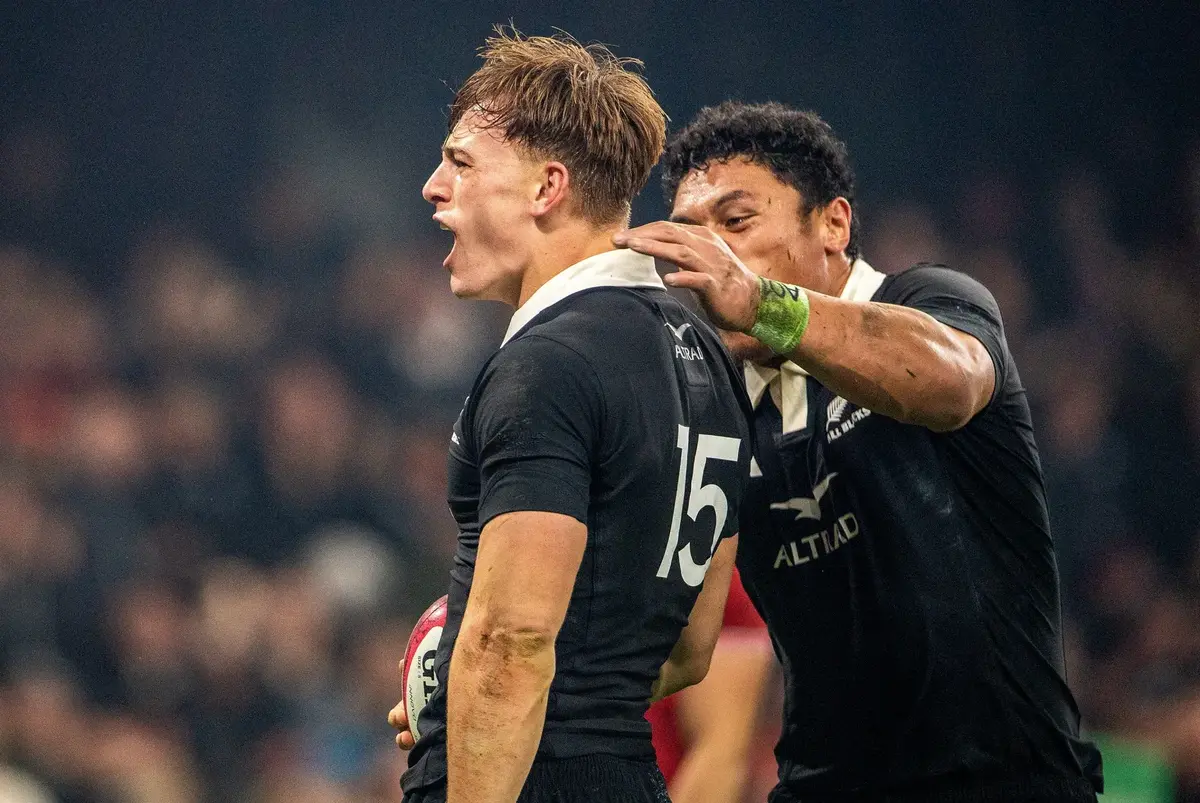
New Zealand signed off their 2025 season with a dominant 52-26 victory over Wales at Principality Stadium, though not before Tom Rogers etched his name into history by becoming the first Welshman to score a hat-trick against the All Blacks.
Key moments
4′ – TRY NEW ZEALAND: Caleb Clarke finishes slick backline movement in left corner after Ruben Love’s flat pass, Damian McKenzie converts (Wales 0-7 New Zealand)
9′ – TRY WALES: Tom Rogers scores in corner after Louis Rees-Zammit wins aerial battle and Dan Edwards produces backhanded offload, Dan Edwards converts (Wales 7-7 New Zealand)
13′ – PENALTY NEW ZEALAND: Damian McKenzie kicks penalty after Taine Plumtree penalised for not releasing (Wales 7-10 New Zealand)
29′ – TRY NEW ZEALAND: Ruben Love produces brilliant solo try with step and acceleration from 20 metres after Wallace Sititi’s powerful carry, Damian McKenzie converts (Wales 7-17 New Zealand)
33′ – TRY WALES: Tom Rogers gets second try after Tomos Williams grubber kick, Blair Murray regathers and excellent hands from Dan Edwards and Max Llewellyn create space, Dan Edwards converts (Wales 14-17 New Zealand)
38′ – TRY NEW ZEALAND: Tamaiti Williams powers through three defenders from close-range lineout, spinning out of multiple tackles, Damian McKenzie converts (Wales 14-24 New Zealand)
Half-time: Wales 14-24 New Zealand
43′ – TRY WALES: Tom Rogers completes historic hat-trick after Dafydd Jenkins charges down kick and Joe Hawkins and Max Llewellyn create space with excellent distribution, Dan Edwards converts (Wales 21-24 New Zealand)
46′ – NO TRY NEW ZEALAND: Caleb Clarke denied after Du’Plessis Kirifi knock-on in buildup spotted by TMO
48′ – NO TRY NEW ZEALAND: Will Jordan held up over line after referee Hollie Davidson reverses on-field decision following TMO review showing Welsh defender got arm under ball
51′ – TRY NEW ZEALAND: Rieko Ioane scores in corner from Damian McKenzie cross-field kick, twisting through Dan Edwards’ tackle, Damian McKenzie converts (Wales 21-31 New Zealand)
58′ – YELLOW CARD WALES: Gareth Thomas sent to sin-bin for no-arms tackle on final team warning
59′ – TRY NEW ZEALAND: Sevu Reece finishes patient 14-phase buildup in right corner after space created by numerical advantage, Damian McKenzie converts (Wales 21-38 New Zealand)
68′ – YELLOW CARD WALES: Taine Plumtree sent to sin-bin for high tackle on Will Jordan with shoulder to head contact
70′ – TRY NEW ZEALAND: Sevu Reece gets second try with brilliant sidestep and footwork to beat Jarrod Evans after regathering awkward bounce, Damian McKenzie converts (Wales 21-45 New Zealand)
76′ – TRY WALES: Louis Rees-Zammit scores acrobatic flying finish in corner, diving parallel to ground after 11-phase buildup, Jarrod Evans misses conversion (Wales 26-45 New Zealand)
79′ – TRY NEW ZEALAND: Caleb Clarke scores second try after Leicester Fainga’anuku line break and one-handed offload to Rieko Ioane, Damian McKenzie converts (Wales 26-52 New Zealand)
Full-time: Wales 26-52 New Zealand
The victory, coming just seven days after their disappointing loss to England at Twickenham that denied them a Grand Slam, provided some consolation for Scott Robertson’s side as they finished the year with a 10-3 record. For Wales, the wait for a first victory over New Zealand since 1953 continues, extending the All Blacks’ winning streak to 34 matches in this fixture.
That's our 2025 season wrapped up. 🫡 pic.twitter.com/WaOqlVGf4m
— All Blacks (@AllBlacks) November 22, 2025
Robertson made 13 changes to his starting lineup, handing valuable test exposure to fringe players in the final match of the year. Only captain Scott Barrett, flanker Simon Parker and Will Jordan retained their places from the England defeat, with Jordan switching from fullback to the right wing. The gamble nearly backfired as Wales, despite holding just 33 percent possession, stayed within touching distance for 50 minutes before New Zealand’s class and superior fitness told in the final quarter.
Before kickoff, the Principality Stadium was transformed into a spectacular theatre. The roof was closed and the lights dimmed as fireworks burst around the players, who were illuminated by a single spotlight. The crowd of over 70,000 delivered an a cappella rendition of the Welsh national anthem, marking 120 years since it was first sung before a rugby match, coincidentally also against New Zealand in 1905. The haka followed under the dramatic lighting, with Rieko Ioane leading Kapa o Pango as the crowd tried to drown it out. Scottish referee Hollie Davidson made history as the first woman to take charge of an All Blacks test match.
The match exploded into life from the opening whistle, with New Zealand striking first through Caleb Clarke after just four minutes. The forwards laid the platform with powerful carries from Simon Parker and Samisoni Taukei’aho down the blindside, before the All Blacks swung the ball left through the hands. Ruben Love’s flat pass created the overlap, and Clarke, showing his devastating pace, streaked away to score in the left corner, brushing off a tackle attempt from Rees-Zammit. Damian McKenzie converted from the touchline to begin what would be a perfect day with the boot, never missing a single kick at goal throughout the match.
Wales’ response was immediate and spectacular. Louis Rees-Zammit soared above McKenzie to claim a high ball from a Tomos Williams box kick on the edge of the 22-metre area, beating the All Blacks fullback in the aerial contest and giving Wales crucial front-foot possession. They recycled quickly and spread the ball left, where first five-eighths Dan Edwards produced a brilliant backhanded offload that may have gone to ground but was scooped up brilliantly by Rogers, who dived over in the corner. Edwards’ conversion from wide out levelled the scores at 7-7 after just nine minutes, setting the tone for a thrilling first half and giving the home crowd hope.
McKenzie restored New Zealand’s lead with a penalty in the 13th minute after Taine Plumtree was penalised for going off his feet at the breakdown, unable to release the tackled player. Wales nearly struck back moments later when prop Rhys Carre powered through a gap and charged towards the line from 10 metres out. It looked certain he would score, but Pasilio Tosi produced a crucial defensive play, first stopping Carre in the tackle and then springing to his feet with lightning speed to win a turnover penalty just two metres from the line. It was a try-saving moment that kept New Zealand ahead.
The All Blacks extended their advantage in the 29th minute when Love produced the try of the half. Following a goal-line dropout after McKenzie’s kick had gone too deep, Wallace Sititi took the restart and came flying like he’d been shot out of a cannon, charging back at the Welsh defensive line with devastating effect. After several phases built momentum, the ball reached Love flat-footed on Wales’ 22-metre line. The fullback unleashed a devastating right-foot step that sent him between Carre and Deaves, then showed blistering acceleration to sprint 20 metres under the posts, fending off a despairing tackle attempt. McKenzie’s simple conversion made it 17-7, and New Zealand appeared to be taking control.
Wales refused to buckle, with Rogers claiming his second try in the 33rd minute to keep the contest alive. The try started with brilliant work by Dafydd Jenkins, who drove deep into New Zealand territory. With penalty advantage after the All Blacks strayed offside, Tomos Williams spotted space behind the defensive line and dropped a clever grubber kick through. Blair Murray, the fullback playing against his country of birth, showed excellent awareness to run onto the ball and regather. Wales recycled quickly, and after Edwards drew defenders, Max Llewellyn received the ball and slipped a pass to Rogers on the left wing. The Scarlets flyer had too much pace for the covering defence and crossed in the same corner as his first try. Edwards’ conversion from wide out cut the deficit to just three points at 17-14, and the atmosphere inside the stadium became electric.
Prop Tamaiti Williams had the final word of the half, powering through three defenders from close range after a five-metre lineout. Holland won the lineout ball at the front, and when it emerged from the drive, it went to Williams. The big prop showed incredible strength, refusing to go down as he was hit by two Welsh forwards. He took on two more defenders and cork-screwed his way through multiple tackles, spinning out of their grip to force the ball down. It was a display of raw power that gave the All Blacks a 24-14 advantage at the break despite Wales’ spirited resistance and their 108 first-half tackles compared to just 38 by New Zealand.
The second half began dramatically as Rogers completed his historic hat-trick just two minutes after the restart. Dafydd Jenkins charged down a McKenzie kick to win possession, breathing life into the Welsh attack. The big lock then won a crucial ball in the air to give his team front-foot momentum. From there it was slick hands, with Joe Hawkins at inside centre producing a wonderful long pass that took out two New Zealand defenders. The ball found Llewellyn, who had space on the left edge and immediately released Rogers. The winger showed a nice side-step off his left foot to beat Love as the last defender and crossed for his third try. Edwards’ conversion made it 21-24, Rogers had made history, and the Principality Stadium erupted in anticipation of a potential upset. He became only the fourth player ever to score a hat-trick against the All Blacks, joining Greg Cornelsen, Ray Mordt and Andre Joubert in that exclusive club.
What followed was a period of chaos and TMO interventions that nearly saw New Zealand score twice in quick succession. Clarke appeared to cross in the 46th minute after the All Blacks built through more than a dozen phases. From a midfield position, McKenzie released Love, who tipped it onto Clarke. The powerful winger burst through tackles from Llewellyn and Murray and brought it around to score next to the posts. McKenzie’s conversion was successful, but television match official Ian Tempest intervened, having spotted that Kirifi had knocked the ball forward on the ground at an earlier breakdown. The try was scrubbed out, though New Zealand retained possession through a penalty for Wales not rolling away.
From the resulting five-metre lineout, more drama unfolded. Holland’s throw was scrappy and went backwards, evading Kirifi before Jordan scooped it up. The fullback showed incredible strength, willing his way through multiple Welsh defenders towards the goal line. Referee Hollie Davidson was right on the spot and initially awarded the try, saying she had seen a grounding on the line. However, she then double-checked with the TMO. After reviewing multiple angles, it was deemed inconclusive whether Jordan had grounded the ball, and Davidson took another look before ruling Jordan had been held up, with a Welsh arm getting under the ball. It was a let-off for Wales, who had absorbed wave after wave of All Blacks pressure.
The pressure finally told in the 51st minute when McKenzie delivered a pinpoint cross-field kick from left to right. The kick was intended for Jordan on the wing, but the ball bounced awkwardly and sailed over both Jordan and Rogers in the aerial contest. Ioane was backing up perfectly and gathered the loose ball. Despite the best efforts of Edwards, who tackled him, Ioane showed great strength to twist his back towards the tackler and force his way over the line, stretching to place the ball in the corner. McKenzie’s superb conversion from the right touchline extended the lead to 31-21, finally giving New Zealand breathing room after their two disallowed tries.
Wales’ discipline then deteriorated dramatically as fatigue set in from making tackles constantly without the ball. Gareth Thomas was sin-binned in the 58th minute for a no-arms tackle after persistent team infringements at the breakdown. Captain Dewi Lake had already received a warning from Davidson that the next infringement would result in a yellow card, and when Thomas’ high tackle came without wrapping his arms, he was given his marching orders.
The numerical advantage proved immediate. From the resulting lineout just five metres out, the All Blacks mounted several sorties. Taukei’aho was stopped near the posts, then Newell hammered away at the line. After 14 phases, the All Blacks had stretched the Welsh defence to breaking point. They snaked left with Taukei’aho coming close again before Christie and McKenzie shifted the ball back down the right. Keeping the ball alive through multiple phases, they created space on the right edge for replacement wing Sevu Reece. The ball went through Jordan’s hands to Lienert-Brown, who fired it onto an unmarked Reece. The Wellington flyer had a simple run-in, diving over in the right corner. McKenzie’s perfect conversion from wide out made it 38-21.
As Thomas returned in the 68th minute, Plumtree joined him in the sin-bin for a high tackle on Jordan. The TMO review showed Plumtree’s shoulder had made direct contact with Jordan’s head, with his body height slightly too high. It met the threshold for a yellow card, and Wales were reduced to 13 men for a period, facing the onslaught with just 14 for much of the final 20 minutes. The floodgates opened under the relentless pressure.
Reece claimed his second try in the 70th minute with a moment of individual brilliance that showcased his world-class footwork. After New Zealand built through multiple phases from the penalty, McKenzie spotted space and flung a pass out right. The ball found open ground, meaning Reece had to turn and regather the awkward bounce before facing the right way again. By the time he did, Jarrod Evans was chasing him down as the final defender. It didn’t matter. With a shimmy, a wriggle and a devastating sidestep, Reece left Evans grasping at air as if he were a training mannequin. He strolled over in the corner for what was probably the try of the match. McKenzie’s seventh consecutive successful conversion stretched the lead to 45-21, and what had once been a close contest was now becoming a rout.
Rees-Zammit provided Wales with a moment of brilliance in the 76th minute, producing a trademark flying finish in the corner that gave the home crowd something to celebrate. After Wales went through more than 11 phases, showing great patience with the ball, they worked their way to within five metres of the line. Jenkins and Lake made strong carries before Wales shifted it right. Rees-Zammit received the ball on the right wing with Clarke defending. The former NFL rookie showed his exceptional athleticism, taking off from several metres out and flying through the air. He stretched parallel to the ground, reaching out superman style with one arm extended, and managed to plant the ball in the corner under pressure from Clarke before landing. It was an acrobatic finish that demonstrated why he’s regarded as one of the most exciting finishers in world rugby. Evans’ conversion attempt from the right touchline drifted wide, but Wales had scored more than 25 points against the All Blacks for the first time in their history.
Clarke had the final say, scoring his second try in the 79th minute after Leicester Fainga’anuku’s powerful run created the opportunity. Wales attempted to shift the ball but Llewellyn missed his tackle in the midfield channel. Fainga’anuku exploded through the gap on halfway, breaking the line with devastating effect. The powerful centre then delivered a brilliant one-handed offload as he was being tackled, finding Ioane in support. The All Blacks centre unselfishly drew the final defender before passing wide to Clarke, who had an easy run-in on the left wing, strolling over unopposed. McKenzie’s conversion brought up 50 points and completed his perfect eight-from-eight kicking performance, accumulating 17 points from seven conversions and a penalty. Reece then tapped the final penalty quickly and kicked the ball directly into the stands to bring the curtain down on a solid 26-point victory.
Wallace Sititi was named player of the match, with his thundering carries throughout proving crucial. The number eight made 11 carries and consistently won collisions, dominating the gainline battle and laying the platform for New Zealand’s dominance. Taukei’aho roamed wide on numerous occasions, making crucial metres with his strong running, while Holland proved a reliable target in the lineout, winning crucial ball throughout. McKenzie’s flawless kicking display yielded 17 points and never looked in doubt, while Jordan impressed under the high ball despite being denied a try, winning multiple aerial contests that prevented Wales from building pressure.
The statistics told the story of New Zealand’s dominance. The All Blacks held 67 percent possession, ran 1,313 metres compared to Wales’ 540, and conceded just three penalties to Wales’ 11. Wales made 228 tackles to New Zealand’s 85, evidence of the relentless pressure they faced throughout. The All Blacks also had nine line breaks compared to Wales’ eight, despite having far more of the ball, showing that Wales were dangerous when they had possession but simply didn’t see enough of it.
The result gives New Zealand something to build on heading into 2026, though questions remain about their consistency after three losses this season, including defeats to South Africa, France and England. Robertson will be pleased with the exposure given to fringe players, but the defensive vulnerabilities exposed at times will be a concern.
For Wales, despite conceding 50 points at home for the third time in 2025, there were glimpses of attacking quality and resilience that suggest better days may lie ahead under new head coach Steve Tandy, particularly ahead of their final autumn international against world champions South Africa next weekend. The hosts will be without 13 players who play club rugby in England and France because the game has been organised outside World Rugby’s international window, presenting another significant challenge.
Share this:
Autumn Nations Series
Springboks overpower indisciplined Ireland to end Dublin hoodoo
Published
4 days agoon
22nd November 2025
South Africa ended their 13-year wait for victory in Dublin with a 24-13 triumph over Ireland at the Aviva Stadium on Saturday evening, though the world champions were forced to withstand a determined rearguard action from opponents who equalled the record for most cards received in a single Test match.
Key moments:
4′ – TRY SOUTH AFRICA: Damian Willemse finishes brilliantly in corner, Sacha Feinberg-Mngomezulu misses conversion (Ireland 0-5 South Africa)
19′ – RED CARD IRELAND: James Ryan shown 20-minute red card for illegal clear-out on Malcolm Marx
34′ – YELLOW CARD IRELAND: Sam Prendergast sent to sin bin for repeated infringements
34′ – TRY SOUTH AFRICA: Cobus Reinach snipes over from close range, Sacha Feinberg-Mngomezulu converts (Ireland 0-12 South Africa)
37′ – TRY IRELAND: Dan Sheehan crashes over from close range, Jack Crowley converts (Ireland 7-12 South Africa)
40′ – YELLOW CARD IRELAND: Jack Crowley sent to sin bin for hand in ruck
40+2′ – YELLOW CARD IRELAND: Andrew Porter sent to sin bin for scrum infringement
40+3′ – PENALTY TRY SOUTH AFRICA: Matthew Carley awards penalty try after Irish scrum collapses (Ireland 7-19 South Africa)
Half-time: Ireland 7-19 South Africa
44′ – PENALTY IRELAND: Sam Prendergast kicks penalty (Ireland 10-19 South Africa)
47′ – TRY SOUTH AFRICA: Sacha Feinberg-Mngomezulu bursts through to score, conversion missed (Ireland 10-24 South Africa)
56′ – PENALTY IRELAND: Sam Prendergast kicks penalty (Ireland 13-24 South Africa)
62′ – YELLOW CARD IRELAND: Paddy McCarthy sent to sin bin for repeated scrum penalties
79′ – YELLOW CARD SOUTH AFRICA: Grant Williams sent to sin bin for not rolling away
Full-time: Ireland 13-24 South Africa
In an extraordinary contest that descended into chaos at times, Ireland were shown five yellow cards and one 20-minute red card in a catastrophic disciplinary breakdown that saw them reduced to 12 players before half-time. Yet despite the numerical disadvantages and South Africa’s overwhelming scrum dominance, Andy Farrell’s side demonstrated such ferocious resistance that Rassie Erasmus will acknowledge his team should have won far more convincingly given their possession and territory.
First victory in Dublin since 2012 💥#Springboks #ForeverGreenForeverGold #IREvRSA pic.twitter.com/JW9CR4bkBg
— Springboks (@Springboks) November 22, 2025
The atmosphere inside the Aviva Stadium was electric as both sides entered their final autumn international of 2025. Ireland, buoyed by convincing victories over Japan and Australia, sensed an opportunity to claim a statement scalp. South Africa, unbeaten on their European tour with wins over Japan, France and Italy, arrived determined to conquer the one venue that had eluded Erasmus throughout his all-conquering coaching tenure.
The match exploded into life immediately, with Ireland striking purposefully through early attacks down the left flank. Twice in the opening exchanges James Lowe found space on the wing through clever skip passes from Sam Prendergast and Garry Ringrose, suggesting the hosts had arrived with genuine ambition to topple the world’s number one side. The crowd roared its approval as Ireland established early territorial dominance.
But South Africa demonstrated within four minutes precisely why they are the sport’s pre-eminent force. From a lineout on Ireland’s 10-metre line, the Springboks launched an attack that showcased their evolved attacking philosophy. Pieter-Steph du Toit gathered at the tail and powered forward through initial contact, making crucial metres before presenting quick ball. When the recycled possession emerged, Caelan Doris jumped aggressively out of the defensive line, attempting to shut down the threat at source. His gamble backfired spectacularly as it created a dog-leg in Ireland’s defensive structure.
Damian de Allende identified the space instantly, timing his run perfectly before exploiting the gap with a powerful surge that left Irish defenders scrambling. The inside centre’s delayed pass then released the attack into wider channels where Cheslin Kolbe, with his trademark footwork and acceleration, sniped through another narrow opening. The diminutive wing drew the final defender before delivering a perfectly weighted pass to Damian Willemse on the left touchline.
With Mack Hansen and Tommy O’Brien converging on him and minimal space to work with, Willemse produced a moment of supreme athleticism. The full-back launched himself towards the corner flag in a superman dive, stretching his right arm fully extended to plant the ball millimetres inside the touchline before momentum carried him into touch. Feinberg-Mngomezulu pushed the conversion attempt across the face of the posts, but the Springboks had drawn first blood with a try that perfectly encapsulated their transformation from one-dimensional power rugby to a team capable of striking from anywhere.
Ireland responded positively, with Lowe skinning Kolbe brilliantly on the left touchline through superb footwork and a powerful fend that sent the Springbok wing tumbling. The crowd erupted as Ireland worked the ball through multiple phases, building momentum and creating space out wide. The subsequent attack saw Tommy O’Brien receive possession on the right wing with space to exploit, only for Pieter-Steph du Toit to arrive with a thunderous initial hit that stopped the young Leinster wing in his tracks.
As O’Brien was held upright in the tackle, Feinberg-Mngomezulu arrived at pace from his fly-half position. What happened next sparked the match’s first major controversy. The South African appeared to lead with his shoulder, making no discernible attempt to wrap his arms as he collided with O’Brien. The contact appeared high, causing O’Brien’s head to whiplash violently backwards. The crowd bayed for a card as Matthew Carley consulted his TMO.
After lengthy deliberation with multiple replays scrutinised, Carley controversially awarded only a penalty. The decision stunned observers throughout the stadium and watching around the world, particularly given South Africa’s recent disciplinary issues with high tackles that had seen Lood de Jager and Franco Mostert sent off in consecutive matches against France and Italy. Irish supporters vented their fury, whilst South African players escaped with relief palpable on their faces.
Ireland kicked to the corner and established good lineout possession, but their promising position met a devastating end in the 19th minute through an act of shocking recklessness. Prendergast struck a penalty attempt cleanly from 22 metres and slightly left of centre, but watched helplessly as the ball cannoned back off the left upright with perfect trajectory for the posts. Lowe reacted quickest to the fortuitous rebound, gathering the ball before it bounced and setting Ireland on the attack once more.
The hosts flooded forward with renewed purpose. Multiple phases of aggressive carrying brought them to within metres of South Africa’s line, with the crowd sensing their first try. Tadhg Beirne received possession from short range and powered through initial contact before appearing to reach out and plant the ball over the line. The Aviva Stadium exploded in celebration.
But TMO intervention revealed a darker picture in the build-up. As Ireland had surged towards the line, James Ryan had launched himself into a ruck with complete disregard for safety protocols. The Leinster lock flew off his feet, leading with his shoulder as he cleared out the ruck. His shoulder made direct and forceful contact with Malcolm Marx’s head, the Springbok hooker’s neck snapping backwards from the impact. There was no mitigation, no attempt to use his arms, and clear recklessness in the execution.
The try was immediately disallowed and Ryan shown a yellow card. As he trudged towards the sideline, the TMO’s voice crackled through the stadium speakers, confirming what everyone feared: the yellow would be reviewed by the foul play review officer for a potential upgrade to a 20-minute red card. Within minutes, the confirmation came through. Ryan’s evening was over, his first red card at any level a bitter personal milestone, and Ireland would spend the next 12 minutes with just 14 players before being allowed to replace him with Cian Prendergast.
Down to 14 men and having had a likely try disallowed, Ireland absorbed pressure impressively for a period, completing tackles at over 90 per cent whilst maintaining defensive shape through sheer bloody-minded determination. Their best moment of reprieve came around the 26th minute when South Africa appeared to have breached the line again. Following sustained pressure and multiple carries from their powerful pack, loosehead prop Boan Venter crashed over from close range, burrowing through bodies to ground the ball.
However, the TMO once again intervened, this time in Ireland’s favour. Replays showed that in the build-up, Jasper Wiese had delivered an off-load to Eben Etzebeth that had drifted forward. The pass was subtle in its illegality, floating perhaps a metre ahead of its intended target, but it was clear enough for the officials to disallow the score. South Africa’s frustration was evident, though they could have no complaints with the accuracy of the decision.
South Africa’s scrum began asserting devastating dominance approaching the half-hour mark, revealing what would become the defining narrative of the contest. The Springbok front row, marshalled superbly by player of the match Malcolm Marx, with Thomas du Toit and Boan Venter providing formidable support, repeatedly folded back Andrew Porter and Tadhg Furlong. Each scrum became an ordeal for Ireland, their pack driven backwards with alarming regularity, conceding a succession of penalties that created sustained attacking platforms for the visitors.
The pressure proved relentless. Tommy O’Brien departed for a head injury assessment after making a high tackle on Canan Moodie—somehow avoiding sanction himself when his shoulder made contact with the South African wing’s head, perhaps Carley finally achieving some semblance of consistency in his officiating. Jack Crowley entered as replacement fly-half, with Mack Hansen shuffling to full-back as Ireland’s defensive structure creaked under the onslaught.
The breakthrough arrived in the 34th minute following yet another scrum penalty that left Ireland defending desperately close to their own line. When they strayed offside for a third time inside their own 22 whilst attempting to stem the tide, Carley’s patience expired. Sam Prendergast was shown a yellow card for repeated team infringements, the referee making clear that Ireland’s persistent offside play had crossed the threshold into cynical territory. The hosts were reduced to 13 men.
From the subsequent attacking scrum five metres from Ireland’s line, South Africa played with ruthless efficiency and multiple penalty advantages in their back pocket. The pack hammered away through phase after phase, each carry making ground as white-shirted defenders threw themselves into tackles with increasing desperation. Porter, Furlong and substitute McCarthy strained every sinew at scrum time, but the numerical disadvantage proved overwhelming.
As Ireland’s defensive line began to fracture under the relentless assault, Cobus Reinach spotted his opportunity. The experienced scrumhalf, playing in his 49th Test match, executed perfectly. He picked from the base of a ruck just three metres out, sold a clever dummy to freeze the closest defender, then darted through on a diagonal run that bisected two would-be tacklers. His acceleration took him clear and he slid over beside the posts for his 19th international try.
Feinberg-Mngomezulu’s conversion was a formality, and at 12-0 down with 13 players on the field and their scrum being demolished, Ireland’s task appeared insurmountable. The Aviva crowd had fallen eerily quiet, resignation beginning to set in.
Yet Farrell’s side demonstrated the remarkable character that has defined Irish rugby in recent years. Within three minutes, they fashioned a brilliant riposte that lifted the Aviva crowd and injected genuine hope into the contest. From a penalty in midfield, Ireland kicked to the corner rather than taking easy points, a statement of attacking intent despite their numerical disadvantage.
Ryan Baird’s majestic take at the tail of the lineout in South Africa’s 22 provided the platform. The Leinster blindside soared above Eben Etzebeth to claim clean possession, his athleticism giving Ireland quick ball to attack with. Josh van der Flier took the first carry, his trademark low body position and leg drive taking him through the first tackle and making crucial metres. The Leinster openside was eventually hauled down five metres from the line, but crucially he presented the ball perfectly for quick recycle.
Bundee Aki took the next carry, the Connacht centre using his considerable power to bulldoze closer to the whitewash. He was stopped a metre short but again the ball was available instantly. Jamison Gibson-Park, reading the situation perfectly, spotted Dan Sheehan looming on a blind run from the left. The scrumhalf delivered a scoring pass of exquisite timing and accuracy, hitting Sheehan in stride.
The Leinster hooker, one of Ireland’s most potent attacking weapons, required no invitation. He burst through the narrow channel between two defenders, his powerful leg drive carrying him over the line despite the attention of three Springbok tacklers who arrived fractionally too late. Sheehan crashed down with the ball firmly grounded, and the Aviva Stadium erupted in cathartic celebration. Against all odds, Ireland were back in this contest.
Jack Crowley, composed despite the circumstances of his introduction, slotted the conversion from in front of the posts to make it 12-7. With Prendergast’s sin-bin period ending in two minutes, Ireland had genuine belief they could survive to half-time with minimal further damage, regroup, and launch a second-half comeback.
Those hopes evaporated in the most brutal fashion imaginable. The final three minutes of the half descended into absolute pandemonium, a sequence of events so chaotic and damaging that it would define Ireland’s entire evening. It began with a needless act of stupidity from Crowley himself. As Ireland defended another attacking phase near their line, the Munster fly-half stuck his hands into a ruck and cynically knocked the ball from Cobus Reinach’s grasp as the scrumhalf attempted to clear it.
Carley had no hesitation. Crowley was sin-binned for deliberately slowing the ball, a clear professional foul. Ireland were back down to 13 men, having just restored themselves to 14 with Prendergast’s imminent return. Worse still, they had lost their replacement fly-half, forcing further reshuffle in an already disrupted backline.
Erasmus, watching from the coaches’ box like a chess grandmaster spotting his opponent’s fatal weakness, made his move. He immediately introduced fresh props Gerhard Steenekamp and Wilco Louw, two members of South Africa’s vaunted “Bomb Squad” renowned for their scrummaging prowess. Louw in particular, at 144 kilograms of muscle and scrummaging expertise, represented a terrifying prospect for Ireland’s beleaguered front row.
The subsequent scrum, set five metres from Ireland’s line, became a symbol of South Africa’s physical dominance. The Springbok pack engaged with devastating force, the fresh legs and superior technique producing an irresistible surge. Ireland’s seven-man scrum—they had only Aki available to pack down alongside six forwards with two players in the sin bin—buckled immediately, driven backwards at frightening speed. Carley’s arm shot out for advantage before the scrum had even fully collapsed.
Rather than use the penalty, South Africa demanded another scrum, sensing blood in the water. Erasmus’s substitutions had transformed the contest. Porter, exhausted from 40 minutes of warfare against one of rugby’s great scrums, was being systematically dismantled by the fresh Steenekamp. As the packs engaged for a second time, the outcome was even more emphatic. Ireland’s scrum folded backwards, Porter’s bind slipping as he struggled to cope with the power being generated against him.
Carley showed Porter the yellow card. Ireland were down to 12 players, matching the fewest number of players any Test team has fielded. The crowd’s frustration boiled over into loud booing, though whether directed at their own team’s indiscipline or the referee’s accumulation of cards was unclear. Paddy McCarthy entered as replacement prop, meaning Josh van der Flier had to depart to maintain the required number of front row players. Ireland’s best tackler and breakdown operator was a casualty of their scrum’s implosion.
South Africa demanded yet another scrum, and Carley by now had seen enough. The Irish pack, reduced to seven men with Bundee Aki awkwardly packing down at blindside flanker, collapsed again under immense pressure. The referee ran beneath the posts and raised his arms, awarding a penalty try. Carley’s whistle for half-time sounded immediately afterwards, the shrill blast ending 40 minutes that had veered between brilliant rugby and absolute chaos.
South Africa led 19-7 having scored three tries to Ireland’s one, but crucially they would restart the second half against 12 opponents. The booing intensified as the teams trudged off, with Irish supporters’ fury directed at their team’s catastrophic indiscipline. Five cards in one half—Ryan’s 20-minute red plus yellow cards for Prendergast, Crowley and Porter—represented a breakdown in discipline unprecedented at this level.
The second half began with Ireland still fielding just 12 men, with Mack Hansen deputising at fly-half in Prendergast’s continued absence. Yet somehow, impossibly, they emerged the brighter side in the opening exchanges. Their spirit, their refusal to buckle despite overwhelming adversity, shone through. When they earned a penalty in the 43rd minute, Prendergast—back on the field after his sin-bin period expired—stepped up to take it despite the difficult angle from the right touchline. His kick was assured, bisecting the uprights to narrow the gap to nine points at 19-10. A glimmer of hope remained.
South Africa’s response showcased why Sacha Feinberg-Mngomezulu is regarded as one of world rugby’s most exciting young talents. Following yet another dominant scrum that won penalty advantage—Ireland’s scrum woes continuing unabated—the ball reached the 23-year-old fly-half on the right side of the field near Ireland’s 22-metre line.
What followed was a moment of individual brilliance that epitomised the Springboks’ new attacking dimension.
Feinberg-Mngomezulu sized up Gibson-Park, the sole defender in his immediate channel with Ireland stretched thin across the field. The South African sold an outrageous dummy, shaping to pass left before pulling the ball back. Gibson-Park, one of rugby’s smartest operators, bought the feint completely and shifted his weight accordingly.
Seizing his moment, Feinberg-Mngomezulu accelerated into the space, then compounded Gibson-Park’s misery by shrugging off the scrumhalf’s desperate attempted tackle with a powerful hand-off that sent the Irishman sprawling. With the defensive line breached and only scrambling cover to beat, the fly-half showed raw pace that belied his size, straightening his running line before arcing towards the posts. He slid over with defenders grasping at thin air, scoring his seventh Test try in 2025 and announcing himself on the biggest stage.
His missed conversion—perhaps betraying some nerves—left the score at 24-10 with 33 minutes remaining, but South Africa’s dominance appeared complete. Ireland, about to be restored to their full complement of 15 players, faced a 14-point deficit that seemed insurmountable given how comprehensively they had been outplayed in the key battles.
Yet Ireland refused to surrender. Paddy McCarthy produced a try-saving turnover on his own line in the 59th minute, jackalling brilliantly over the ball to win a penalty just as South Africa appeared certain to score. The young Leinster prop’s intervention drew enormous roars from the crowd, desperate for any morsel of hope. When Ireland finally secured clean possession in South African territory moments later, Prendergast kicked his second penalty from 30 metres to make it 24-13 with 25 minutes remaining.
The gap now stood at 11 points—two scores—and the crowd found its voice again. Ireland, restored to 15 players, began to believe an impossible comeback might be within reach. Every tackle, every breakdown contest, took on seismic importance. Caelan Doris led from the front with tackle after tackle, his defensive work rate matching anything from his previous 66 caps. Ryan Baird, playing despite clearly carrying knocks, threw his body into collision after collision.
Gibson-Park produced a moment of individual brilliance in the 53rd minute that exemplified Ireland’s refusal to die. Under immense pressure at the base of a ruck deep inside his own 22, with South African forwards bearing down on him and his scrum going backwards, the scrumhalf somehow managed to hook his boot around the ball and deliver a clearing box kick that sailed majestically downfield, finding touch on halfway. It was a kick executed from literally behind his own try-line, a piece of skill under pressure that drew applause even from South African supporters.
The contest then became attritional, Ireland defending heroically as South Africa probed for the score that would seal victory. In the 62nd minute, after three successive scrum penalties and with Ireland’s front row visibly wilting, Carley showed McCarthy a yellow card. Porter, having served his 10 minutes, had to return to the field to ensure Ireland had the required number of front row players. Van der Flier departed again, a cruel double blow given his importance to Ireland’s defensive structure.
Still Ireland held firm. Twice in the closing stages, Jack Crowley produced interventions that bordered on the miraculous. In the 72nd minute, Cheslin Kolbe charged down James Lowe’s attempted clearance and the ball ricocheted towards the Irish try-line where Canan Moodie followed up at pace. The South African wing gathered and appeared certain to score, but Crowley having chased back 40 metres arrived with a desperate lunge that disrupted Moodie’s attempt to ground the ball, forcing a knock-on.
Eight minutes later, Moodie broke free again down the right touchline after Manie Libbok’s perfectly weighted chip ahead. The wing gathered the ball five metres from Ireland’s line with just Crowley to beat. As Moodie dived towards the corner flag, Crowley threw himself horizontally through the air, stretching every sinew to get a hand to the ball and somehow knock it loose just as Moodie attempted to ground it. The Aviva crowd erupted at the try-saving tackle, Crowley’s redemption arc complete after his first-half sin-bin.
The crowd sensed an impossible comeback as Ireland won a penalty and kicked to the corner with three minutes remaining. They besieged South Africa’s 22 through multiple phases, every carry met with ferocious Springbok defence but Ireland continuing to recycle possession. Bundee Aki crashed into contact, Tom Farrell—on as a substitute—took a short ball and made ground, before Jack Conan rumbled forward.
In the 79th minute, with time expired and Ireland attacking on South Africa’s five-metre line, replacement scrumhalf Grant Williams was caught offside at a ruck. Carley showed him a yellow card, giving Ireland numerical parity at last and one final chance to salvage something from the wreckage. The crowd roared its approval, urging the players forward for one last assault.
Craig Casey, on for the injured Ringrose, tapped quickly and darted forward. The ball was recycled frantically, Ireland desperate to create space against a Springbok defensive wall that refused to yield. Farrell took another carry. Aki again. Doris driving forward with every remaining ounce of energy. The phases mounted—one, two, three, four—but South Africa’s defensive line held firm, 14 men defending like 20, scrambling and tackling and refusing to break.
On the fifth phase, Ireland moved the ball wide to the left where Manie Libbok intercepted an attempted skip pass. The South African fly-half gathered and booted the ball into the stands. Matthew Carley’s final whistle sounded, ending two hours and ten minutes of the most chaotic, bruising, compelling Test match rugby in recent memory.
Marx, his jersey torn and face bloodied, reflected afterwards on the challenging encounter. “As you can tell by the way that I look it was bruising,” the hooker said, sporting fresh bandaging around his head. “Ireland are a quality side and we knew it would go to the end. We needed to show character and we did it. We had some success at the scrum but in the second half, we weren’t as successful as we would have liked to be. Playing against a quality side is always going to be a tough battle. The character they showed was immense. Even with 12 players they kept us out. It was incredible, they have a great bond as a team.”
For Ireland, this represented a bitterly disappointing conclusion to their autumn campaign. Their defensive resolve proved extraordinary, holding South Africa to just 24 points despite extended periods with reduced numbers. They completed 61 tackles in the first half alone at 96 per cent accuracy, won two crucial turnovers, and conceded only five second-half points in open play. Yet five yellow cards—equalling the record for a single Test match—reflected a lack of composure and discipline that will concern Farrell ahead of February’s Six Nations opener against France in Paris.
The statistics revealed both Ireland’s valiant effort and their fundamental failings. They conceded 17 penalties compared to South Africa’s five. They lost six scrum penalties to none, a humiliating differential that told the story of the contest’s defining battle. Yet they made 119 tackles at 85 per cent completion across 80 minutes, won three turnovers, and refused to buckle despite circumstances that would have broken most teams.
South Africa’s victory maintained their seven-match winning streak and secured Erasmus’s first triumph in Dublin, ending the only significant gap in his glittering coaching CV. Yet the manner of victory—grinding rather than emphatic—suggested vulnerabilities that Ireland came agonisingly close to exploiting. The Springboks’ scrum remained their most devastating weapon, their rolling maul formidable, and their young playmaker showed star quality, but their inability to pull away convincingly from 12 men will provide both encouragement and warning for future opponents.
Erasmus acknowledged afterwards that his team should have been more ruthless. “We came with the right attitude and skill set,” he said. “The scrum was dominant and our defence held when it needed to. But we left opportunities out there. Ireland showed why they’re such a quality side—even down to 12 men they made us fight for every point.”
Share this:
Autumn Nations Series
Hansen hat-trick inspires Ireland to record rout of Wallabies
Published
2 weeks agoon
15th November 2025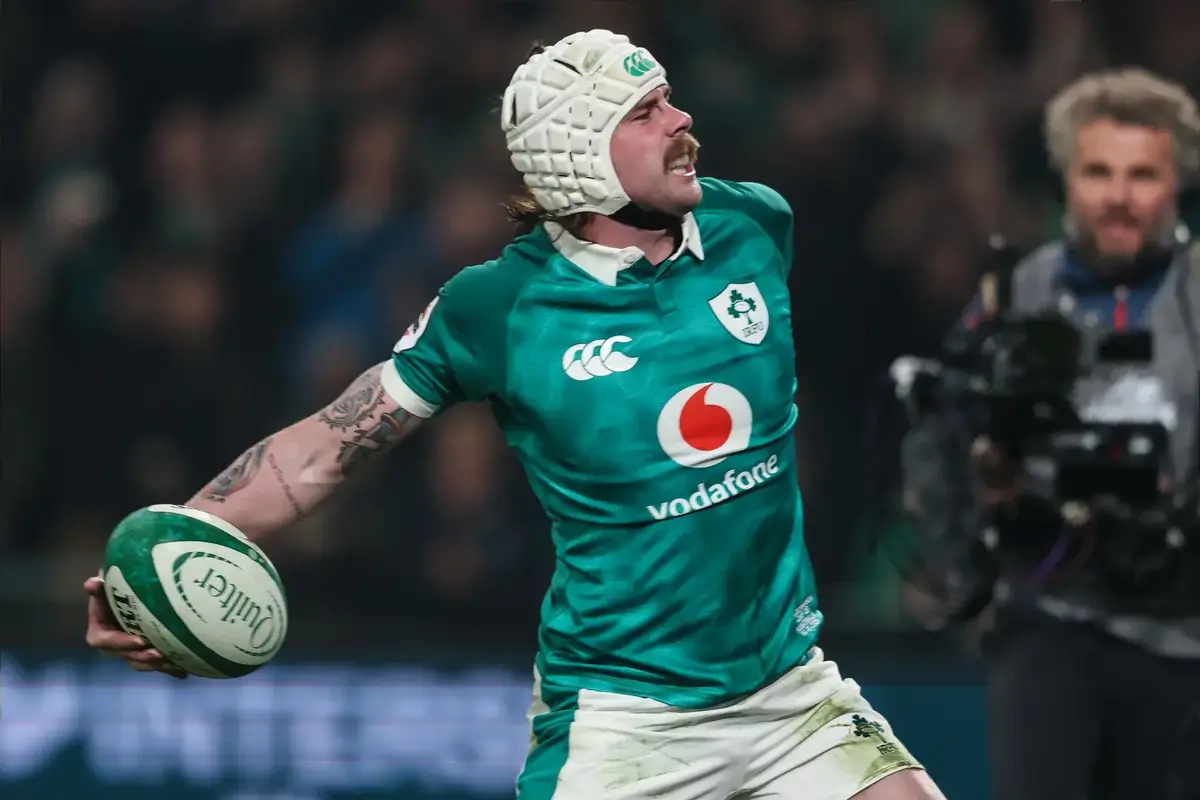
Ireland delivered the emphatic response Andy Farrell demanded, dismantling Australia 46-19 at a sold-out Aviva Stadium to record their biggest ever victory over the Wallabies. Mack Hansen announced his arrival at fullback with a first-half hat-trick on an emotional evening that saw Joe Schmidt return to his former home only to watch his Australian side suffer a comprehensive and at times humiliating defeat.
Key moments
6′ – TRY IRELAND: Mack Hansen strolls over untouched after quick tap penalty, Sam Prendergast converts (Ireland 7-0 Australia)
11′ – TRY IRELAND: Mack Hansen scores second try from Sam Prendergast loop play, Prendergast converts (Ireland 14-0 Australia)
18′ – TRY AUSTRALIA: Len Ikitau powers through Sam Prendergast after sustained pressure, James O’Connor converts (Ireland 14-7 Australia)
28′ – TRY IRELAND: Mack Hansen completes first-half hat-trick after cross-kick from Prendergast, conversion missed (Ireland 19-7 Australia)
28′ – INJURY SUBSTITUTION: Stuart McCloskey forced off injured, replaced by Bundee Aki
40′ – TRY AUSTRALIA: Fraser McReight scores from pick-and-go on half-time, James O’Connor converts (Ireland 19-14 Australia)
Half-time: Ireland 19-14 Australia
56′ – DROP GOAL IRELAND: Sam Prendergast slots drop goal from 35 metres (Ireland 22-14 Australia)
62′ – PENALTY IRELAND: Jack Crowley kicks penalty after scrum dominance (Ireland 25-14 Australia)
70′ – TRY IRELAND: Caelan Doris crashes over after sustained forward pressure, Jack Crowley converts (Ireland 32-14 Australia)
70′ – YELLOW CARD AUSTRALIA: Nick Frost sent to sin bin for high tackle on Thomas Clarkson
74′ – TRY AUSTRALIA: Billy Pollard forces way over from close range, Tane Edmed misses conversion (Ireland 32-19 Australia)
78′ – TRY IRELAND: Ryan Baird powers over after Bundee Aki carry, Jack Crowley converts (Ireland 39-19 Australia)
80′ – TRY IRELAND: Robbie Henshaw finishes cross-field move in corner, Jack Crowley converts from touchline (Ireland 46-19 Australia)
Full-time: Ireland 46-19 Australia
The 27-point winning margin eclipsed Ireland’s previous best of 15 points against Australia, achieved in 1979 and 2006, whilst the 46 points scored surpassed their previous record of 27 set in 1979 and equalled in 2016. After unconvincing performances against New Zealand and Japan had raised questions about this team’s direction, Ireland rediscovered their clinical edge with a display built on a dominant kicking game, set-piece superiority and ruthless finishing.
A big W under Saturday night lights! 😍 pic.twitter.com/E2x77gHqbi
— Irish Rugby (@IrishRugby) November 15, 2025
Sam Prendergast orchestrated proceedings brilliantly at out-half before Jack Crowley added further polish from the bench, whilst Ryan Baird’s lineout mastery – three steals in total – left Australia’s already fragile set-piece in tatters. The Wallabies lost six lineouts on their own throw, a statistic that laid bare their struggles on a wet Dublin evening.
The opening exchanges suggested Ireland meant business. Hansen demonstrated his aerial prowess with an early catch under pressure, whilst Tadhg Beirne made a half-break towards the 22. When Jeremy Williams strayed offside just six minutes in, Jamison Gibson-Park sensed vulnerability in the Australian defensive line and took matters into his own hands.
The scrumhalf’s quick tap caught the visitors napping. He released Lowe on the left edge, and though the wing was stopped metres short by Daugunu, Ireland’s support was exemplary. Through swift recycling and slick hands from McCloskey, the ball found Hansen who had an open boulevard to the tryline. The fullback didn’t have to break stride as he ghosted in beside the posts, touching down untouched to the delight of the 50,000 crowd. Prendergast’s conversion gave Ireland the perfect start.
Five minutes later came a try that showcased Prendergast’s game management and Ireland’s clinical execution. Following excellent kick-chase work from Hansen that forced an Australian knock-on, Ireland were awarded a free-kick at the scrum after an early shove. Prendergast launched a towering spiral bomb that travelled some 80 metres downfield. Jorgensen, under no pressure whatsoever, made an absolute hash of the gathering attempt, spilling the ball as he tried to prevent a 50-22. Ireland had a scrum five metres from the Australian line.
What followed was a masterclass in attacking rugby. Off the stable scrum platform, McCloskey took the initial carry over the gain line before Henshaw acted as the pivot. His flat pass out the back to Prendergast was perfectly weighted, taking out multiple defenders and creating a two-on-one overlap. Prendergast, demonstrating vision and composure, chose Hansen on the inside shoulder, and the fullback cantered through the gaping defensive hole to score his second try in the same spot as his first. Prendergast’s conversion from in front made it 14-0 after just 11 minutes, and the Wallabies looked shell-shocked.
Australia, staring down the barrel of a rout, finally found some traction through the only method that had troubled Ireland’s defence – direct, uncompromising forward play. The immediate impact of John Eales Medallist Len Ikitau was evident as the centre sparked the Australian attack with his powerful running. After Prendergast was penalised for not rolling away, the Wallabies went to the corner and established a strong attacking platform inside the 22.
Through two penalty advantages, they kept the ball narrow with punishing one-out carries from Faessler and Valetini. Jake Gordon’s quick service kept the momentum going as Australia stayed patient, probing for weaknesses. Harry Potter broke through a gap in midfield, sucking in more defenders. The Irish defence scrambled frantically but couldn’t stem the green and gold tide. When Ikitau received the ball 10 metres out, he identified Prendergast as the weak link and simply ran straight through the young out-half’s attempted tackle, diving over beside the posts. O’Connor’s conversion cut the deficit to seven points, offering Schmidt’s men genuine hope.
Ireland’s response was immediate and devastating. After Tommy O’Brien executed a delightful dink kick in behind that forced Jorgensen back towards his own line, Lowe produced a moment of pure physicality, picking up the Australian fullback and carrying him back over the tryline. The resulting five-metre scrum gave Ireland prime attacking position.
The third try, whilst credited to Hansen’s hat-trick, owed as much to good fortune as good management. Off the scrum, McCloskey’s hard carry drew in defenders before Aki – on as a replacement for the injured McCloskey who had limped off after 26 minutes – popped the ball back to Prendergast. With Suaalii bearing down on him, the out-half attempted an ambitious cross-kick towards O’Brien on the right wing. The execution was far from perfect as Prendergast was being tackled, but O’Brien managed to gather before being immediately tackled. As he went to ground, the ball spilled from his grasp, but crucially it rolled backwards. Hansen, following up with typical opportunism, scooped the wet ball off the turf and dived over from five metres. Prendergast’s conversion attempt drifted wide in the deteriorating conditions, but at 19-7 Ireland appeared in complete control.
The final act of a frantic first half, however, belonged to Australia. Having been outplayed in virtually every department, they showed admirable resilience to strike back just before the interval. From a lineout platform, the Wallabies eschewed any attempt at width, instead grinding forward through the guts of the Irish defence. Wilson and Hooper made valuable yardage with powerful carries before McReight spotted a gap on the blindside. The flanker executed a classic pick-and-go, powering through from close range and touching down beside the posts. O’Connor’s simple conversion made it 19-14 at the break – a scoreline that flattered the visitors given Ireland’s territorial and possession dominance, but one that kept them within touching distance.
The second half began as a tactical arm-wrestle, with both sides probing for weaknesses through the aerial battle. The conditions had worsened considerably, with rain sheeting down and making handling treacherous. Ireland’s kicking game, orchestrated by Gibson-Park and Prendergast, proved far more effective. Hansen was imperious under the high ball, claiming catch after catch despite the greasy conditions, whilst Australia’s back three looked increasingly uncertain.
When Daugunu was penalised for taking Prendergast off the ball on 56 minutes, the young out-half showed composure beyond his years. Rather than go for territory with penalty advantage, he dropped back into the pocket and stroked over a drop goal from 35 metres out. The three points extended Ireland’s lead to eight and, crucially, forced Australia to score twice.
The introduction of Andrew Porter at loosehead on 47 minutes proved transformative for Ireland’s scrum. The Leinster prop won a penalty at the first set-piece, allowing Prendergast to find touch just outside the 22. Minutes later, another Porter-won scrum penalty gave replacement out-half Crowley – on for Prendergast on 60 minutes after an outstanding shift – a straightforward kick from in front. His successful penalty made it 25-14, and Australia’s challenge was fading fast.
Ireland thought they had scored on the hour mark when O’Brien crossed in the corner after another Prendergast cross-kick found its target following yet another Jorgensen fumble under the high ball. The Aviva Stadium erupted, but the TMO spotted that Lowe had knocked on in the build-up after the initial Australian spill. No matter – the scrum gave Ireland attacking possession deep in Australian territory.
The decisive score arrived on 70 minutes and began, predictably, with Hansen claiming another Crowley bomb inside the 22. Ireland’s forwards took over, battering away at the Australian line with a series of close-range carries. Porter and Rónan Kelleher, fresh from the bench, made valuable ground before Gibson-Park worked the ball wide to Doris on the left edge. The captain, wearing the number seven shirt, had too much power for the covering defence and crashed over for Ireland’s fourth try. Crowley’s conversion from a wide angle made it 32-14, and the contest was effectively over.
Australia’s misery was compounded when the TMO identified foul play in the build-up to Doris’s try. Nick Frost had attempted a tackle on Thomas Clarkson but made contact with his shoulder to the prop’s head. Referee Karl Dickson brandished a yellow card, reducing the Wallabies to 14 men for the closing stages. The bunker review would later examine whether the card should be upgraded, though at this late stage the punishment length was immaterial.
Billy Pollard offered brief Australian resistance, forcing his way over from close range on 74 minutes after a series of penalties gave the visitors field position. The replacement hooker showed good determination, picking and going from the base of a ruck to dive over in the corner. Tane Edmed’s missed conversion left the score at 32-19, but any hopes of an unlikely comeback were extinguished almost immediately.
Ireland’s fifth try was a deserved reward for Baird’s outstanding performance. Spellbinding play from Craig Casey, on as a replacement for Gibson-Park, helped create the opportunity. After Aki punched a hole in the defence with a powerful carry that took him to within five metres of the line, Baird looped back on the short side and barged through sluggish Australian defenders to touch down on 78 minutes. Crowley’s conversion extended the advantage to 39-19 with two minutes remaining.
The finale was pure poetry. As the clock ticked into the red, Gibson-Park – who had replaced Hansen at fullback in the closing stages whilst Casey took over at scrumhalf – orchestrated a move of breathtaking ambition and execution. Crowley’s initial cross-kick found Kelleher on the right, the replacement hooker showing delicate footwork and dangerous pace as he burst through to advance the Irish attack. After quick recycling, Gibson-Park spotted Henshaw lurking on the left wing and launched a pinpoint cross-field kick that dropped perfectly into the centre’s breadbasket. Henshaw gathered in stride and raced into the corner for Ireland’s sixth try. Crowley completed a perfect evening with a magnificent touchline conversion that bisected the uprights to make the final score 46-19.
The final whistle brought a standing ovation from the capacity crowd, with particular acclaim reserved for Hansen, whose performance in his first Test start at fullback could scarcely have been better. The roar when Peter O’Mahony was spotted in the crowd was one of the loudest of the evening, a reminder of the affection Irish supporters hold for their former captain.
“Happy with how we started. Fast start,” captain Doris said afterwards. “I think they showed their quality with bouncing back in that second quarter. But how we finished off there, very pleasing. I think you could see the joy in how we played, and the support here was unbelievable as well. We obviously watched the football on Thursday, and saw how they played with so much passion and got the crowd involved, and we wanted to bring a bit of that today. I think we got some of it there.”
On Hansen’s performance, Doris added: “Mack has been class all week. Obviously challenging coming in not having been in for the last couple of weeks. Straight into the 15 jersey which is an unfamiliar position for him as well. But top class as you saw. Three tries, took them all nicely, so delighted for him.”
Hansen himself was effusive in his praise for the team effort. “It feels unbelievable, any chance to play in front of this crowd is great,” the Australian-born fullback said. “It’s the pleasure of playing in this team. All I had to do was pick the ball up and run over the line after a load of work from the boys. I wasn’t born here, but this feels like home to me and I love playing for this team. People expect a lot from us, so it’s not good enough to win games, we have to win games well.”
The 27-point margin represents Ireland’s record victory over Australia, eclipsing their previous best winning margins. More importantly, it delivered the statement performance Farrell desperately needed ahead of next week’s daunting visit from world champions South Africa. The Irish lineout, a source of concern in recent weeks, functioned smoothly with Baird exceptional in both attack and defence, whilst Prendergast’s assured display at out-half suggested Ireland may have found their long-term successor to Johnny Sexton. This was Ireland’s best performance since their Six Nations victory in Scotland back in February.
For Schmidt, returning to the scene of so many triumphs during his decorated Ireland tenure from 2013 to 2019, it proved a chastening and emotional experience. His Wallabies side, now with eight defeats in their last 10 matches, were comprehensively outplayed in every facet. The lineout malfunction continued throughout – six lost throws on their own ball proved catastrophic – whilst their attack lacked cohesion and penetration beyond close-range forward rumbles. The visitors struggled to control the high ball as the wet conditions took their toll, and a long season appeared to catch up with them in Dublin. With Schmidt set to hand over to Les Kiss mid-way through 2026, questions will inevitably be asked about Australia’s direction and whether this transitional period has gone according to plan. A daunting trip to Paris next week offers little respite.
Ireland, by contrast, can take immense satisfaction from a performance that combined clinical finishing, tactical nous and physical dominance. The challenge now is to replicate this level against the Springboks, a team unlikely to be as generous in defence as the Wallabies proved on this Dublin night. If Ireland can maintain this intensity and execution, they will fancy their chances of claiming another significant scalp.
Ireland: Hansen (Gibson-Park 72); O’Brien, Henshaw, McCloskey (Aki 28), Lowe; Prendergast (Crowley 60), Gibson-Park (Casey 70); McCarthy (Porter 47), Sheehan (Kelleher 56), Furlong (Clarkson 56), Ryan (C Prendergast 56), Beirne, Baird, Doris (capt), Conan (Timoney 47)
Australia: Jorgensen; Daugunu (Kellaway 58), Suaalii, Ikitau, Potter; O’Connor (Edmed 70), Gordon (Lonergan 70); Bell (Robertson 53), Faessler (Pollard 53), Alaalatoa (Nonggorr 60), Williams (Frost 54), Hooper, Valetini (Tizzano 62), McReight, Wilson (capt)
Referee: Karl Dickson (RFU)
Attendance: 50,000 (capacity)
Share this:


Trending
-
Autumn Nations Series4 days ago
Springboks overpower indisciplined Ireland to end Dublin hoodoo
-

 Autumn Nations Series3 weeks ago
Fourteen-man Springboks stun France in Paris masterclass
-
Autumn Nations Series2 weeks ago
George Ford guides England past All Blacks to claim historic win
-

 Autumn Nations Series3 weeks ago
Damian McKenzie magic rescues All Blacks after Scotland fightback
-
Autumn Nations Series2 weeks ago
Springboks survive another red card to hold off Italy in Turin
-
Autumn Nations Series2 weeks ago
Hansen hat-trick inspires Ireland to record rout of Wallabies
-

 Autumn Nations Series2 weeks ago
Jarrod Evans’ last-gasp kick saves Wales from Japan humiliation
-

 Autumn Nations Series3 weeks ago
Carter Gordon named in Wallabies starting lineup for Italy Test
