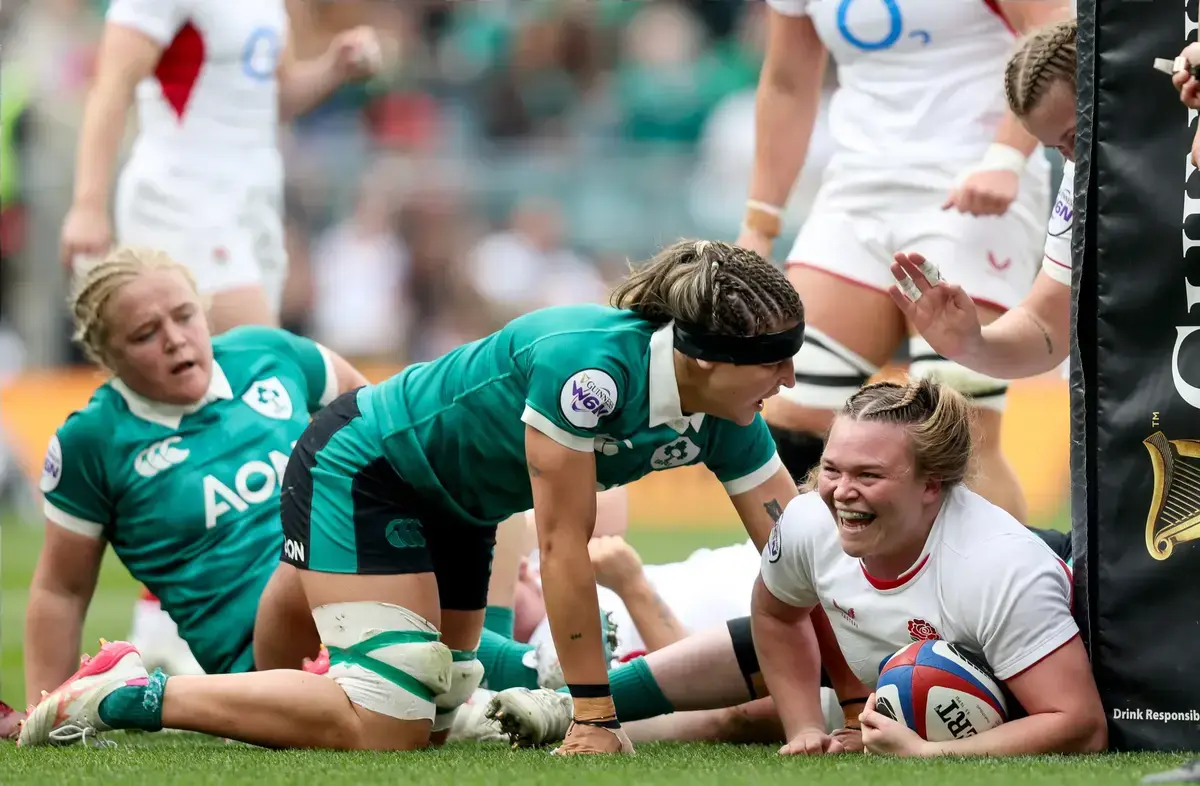
The 2026 Guinness Women’s Six Nations kicks off today with the sport riding an unprecedented wave of momentum following last year’s record-breaking Rugby World Cup. As more than 75,000 fans prepare to descend upon Allianz Stadium for England’s clash with Ireland — a tournament-record attendance — the question is no longer whether women’s rugby has arrived, but whether anyone can stop the dominant force that is John Mitchell’s Red Roses.
Key talking points at a glance
- England seeking an eighth consecutive Six Nations title and fifth Grand Slam in a row
- Record crowd of 75,000+ expected at Allianz Stadium for today’s opener
- Three nations with new captains: Meg Jones (England), Erin King (Ireland), Kate Williams (Wales)
- France undergo major rebuild with 16 uncapped players and new coach François Ratier
- Championship moves to dedicated standalone window in rugby calendar for first time
- U21 Women’s Six Nations Series debuts alongside senior tournament
Seven months after lifting the Webb Ellis Cup in front of 81,885 fans at the same venue, England return to Twickenham as the undisputed benchmark in women’s rugby. Yet this championship represents a subtle recalibration for the Red Roses — new captain, new tactical ambitions, and the challenge of maintaining dominance while evolving their game.
For the chasing pack, the calculus is different. France have torn up the playbook entirely under new head coach François Ratier. Ireland see opportunity with a young squad maturing under Scott Bemand. Scotland and Wales are in transition. Italy seek redemption after a disappointing World Cup. Every team arrives with their own narrative arc, but all roads lead through England.
Historic venues, unprecedented attention
This championship marks a watershed moment for the women’s game. For the first time, the tournament occupies its own dedicated window in the rugby calendar — a deliberate statement of intent from Six Nations Rugby about where the women’s game now sits in the sporting landscape.
The venue choices reflect that ambition. Beyond Allianz Stadium’s record crowd today, Scotland will host England at Scottish Gas Murrayfield next weekend, hoping to eclipse the 18,900 attendance record for a standalone women’s sporting event in Scotland. More than 25,000 tickets have already been sold. Ireland’s final-round match against Scotland at the Aviva Stadium will be the first standalone Women’s Six Nations fixture at the Dublin venue. France will host England at the 42,115-capacity Stade Atlantique in Bordeaux for what could be a Grand Slam decider.
The BBC’s exclusive UK television rights until 2029 ensure comprehensive coverage, with every fixture available on iPlayer and selected matches on BBC One and BBC Two. In Ireland, RTÉ and Virgin Media carry the action; France TV broadcasts in France; Sky covers Italy.
“There is probably a line of thinking that audiences will just keep growing, but they are actually hard to maintain,” RFU director of women’s rugby Alex Teasdale noted. “The role of the Red Roses as ambassadors has helped sustain some of that strong buy-in. You have to work hard to give fans a brilliant experience so they want to keep coming back.”
England: The hunt for history
England’s pursuit of an eighth consecutive title and fifth Grand Slam in succession would represent sustained excellence unmatched in the tournament’s history. Their 33-game winning streak — a world record — has redefined expectations. Yet this campaign begins with notable absences that test the squad’s vaunted depth.
Captain Zoe Stratford, hooker Lark Atkin-Davies and lock Abbie Ward are all unavailable due to pregnancy. Winger Abby Dow has retired following her six-try haul in last year’s championship. Centre Tatyana Heard is sidelined through injury. Emily Scarratt has transitioned to attack and backs coach.
Into this void steps Meg Jones, the powerhouse centre who inherits the armband. Jones has outlined a distinctive target for 2026: becoming the first men’s or women’s team to win the Six Nations immediately after a World Cup triumph.
“We could be the first men or women’s team to win a Six Nations after a World Cup win, so that is definitely a challenge we are very aware of,” Jones explained. “Our role is to be the entertainers and make sure that we provide a product that people want to come back and watch.”
The squad John Mitchell has assembled boasts 1,143 combined international caps and includes 25 World Cup winners. Seven uncapped players — Christiana Balogun, Millie David, Haineala Lutui, Annabel Meta, Sarah Parry, Demelza Short and Jodie Verghese — add fresh energy to the established core.
For the Ireland opener, Mitchell has selected Helena Rowland at inside centre alongside captain Jones, with Holly Aitchison at fly-half. The back three of Ellie Kildunne, Jess Breach and Claudia Moloney-MacDonald provides world-class finishing. Sadia Kabeya, Player of the Match in the World Cup final and the tournament’s leading tackler, anchors the back row alongside vice-captain Alex Matthews.
“The Six Nations is hugely important to us, and we know success in this competition has to be earned every time,” Mitchell said. “We’re excited by the energy the younger players will bring into the squad. What is important to me is to stay open-minded about player combinations.”
Lutui, the Loughborough Lightning No.8 who has led PWR’s carrying and metres-after-contact statistics for much of the season, is set to make her debut from the bench — offering a tantalising glimpse of England’s succession planning.
Key player: Sadia Kabeya. The 24-year-old flanker’s World Cup performance announced her as a genuine world-class talent. Her work rate at the breakdown, tackle accuracy and ability to produce on the biggest occasions make her central to England’s ambitions. Mitchell has a player with room still to grow — a frightening prospect for opponents.
Prediction: Grand Slam. England’s depth, experience and tactical sophistication remain unmatched.
France: Revolution under Ratier
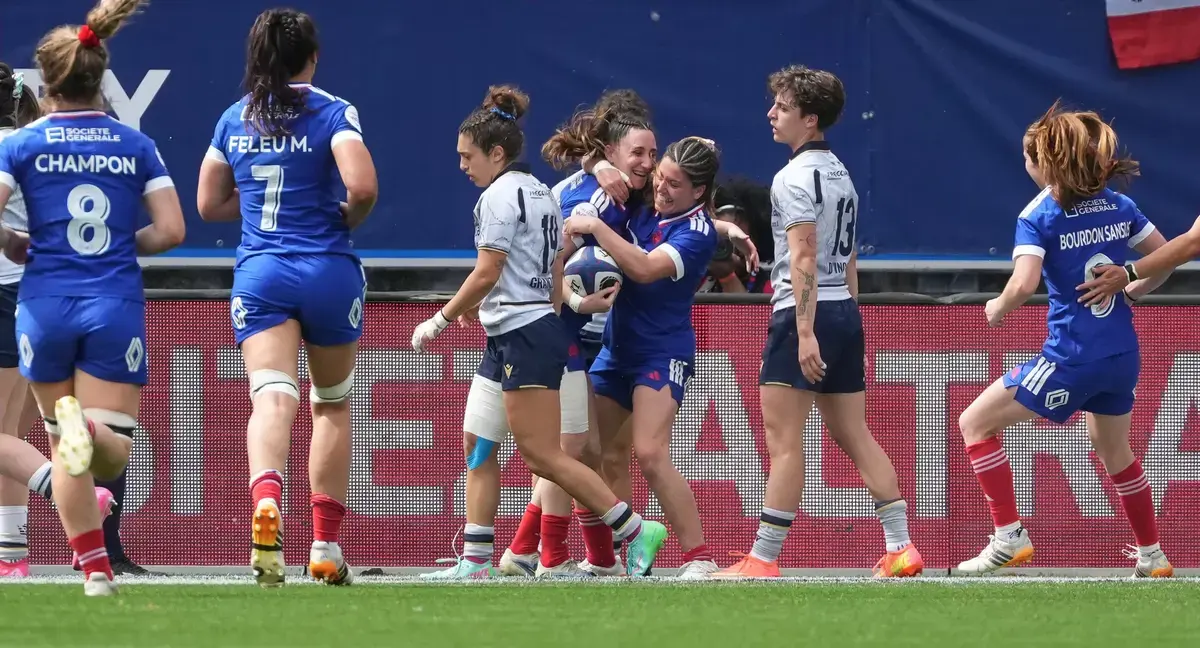
If England represent continuity perfected, France embody upheaval embraced. New head coach François Ratier — who guided Canada to the 2014 World Cup final — has overseen the most dramatic squad refresh in championship history, with 16 uncapped players in his training group and six debutantes in today’s starting XV against Italy.
The numbers tell part of the story. Only Pauline Bourdon Sansus (71 caps) and centre Gabrielle Vernier have more than 50 internationals. Just seven players from France’s World Cup bronze medal defeat to New Zealand retain starting positions. The average caps per player sits at 15 — a squad young in international terms but seasoned at club level.
Ratier has drawn heavily from his former club Stade Bordelais, back-to-back-to-back French champions, while also selecting 11 players from unbeaten AXA Elite 1 leaders Toulouse. Captain Manaé Feleu, from Grenoble, has been repositioned from lock to back row — a tactical shift emblematic of Ratier’s willingness to reimagine established structures.
“We have to be more clinical. The French team needs to be more clinical, more technical,” Ratier stated. “When it matters, under pressure, they know how to play rugby. We know how to counter-attack, to play in chaos, to create things from nothing, but it’s always in reaction. Now, we need to put our game forward and control what we’re doing.”
The emphasis on control marks a philosophical departure from France’s traditional flair-first approach. Ratier wants structure without sacrificing creativity — a demanding balance to strike with so many players learning international rugby in real time.
France’s challenge of facing England in Bordeaux on the final day has already been framed as a potential Grand Slam decider. Home advantage and a full Stade Atlantique could provide the platform Les Bleues have sought in their 16-game losing streak against England. But Ratier must first navigate Italy (home), Wales (away), Ireland (home) and Scotland (away) with a squad still finding its identity.
Key player: Pauline Bourdon Sansus. The 71-cap scrum-half brings game management, tempo control and crucial experience to a young squad. Her understanding of international rugby’s demands will be essential as France’s new generation finds its feet.
Prediction: Second place. The rebuild is genuine and necessary, but inexperience at this level exacts a price.
Ireland: The Green Wave builds
Scott Bemand’s tenure has been defined by steady, measurable progress. Third place in 2025. A narrow World Cup quarter-final defeat to France, having led 13-0 at half-time. The foundations are laid; now comes the harder work of converting potential into silverware.
The appointment of 22-year-old Erin King as captain signals Bemand’s commitment to a new Ireland identity. King missed the World Cup through a knee injury sustained during last year’s Six Nations, but has returned emphatically — finishing the Celtic Challenge as champion with the Wolfhounds and the tournament’s top try-scorer with nine touchdowns.
“We want to take and progress results,” Bemand said. “We’ve got three home games. We would want to be getting our best version out there, but we want to win games. We’ve got two really tough games away from home, but we believe we’ve advanced our game.”
The age profile is striking. King is 22. Ruth Campbell, Dannah O’Brien and Aoife Dalton are the same age. Reigning Player of the Championship Aoife Wafer is 23. This is a squad built for the next World Cup cycle, accumulating experience that will pay dividends in 2029.
Today’s opening assignment — England at Allianz Stadium in front of 75,000 — represents a brutal examination. Ireland competed for the first half-hour in Cork last year before eventually falling 5-49. Bemand will want to see extended periods of pressure, fewer unforced errors and improved set-piece execution against the world’s best.
Cliodhna Moloney-MacDonald earns her 50th cap at hooker, providing crucial experience alongside props Ellena Perry and Linda Djougang. Dorothy Wall and Fiona Tuite lock down the engine room. The back row of Brittany Hogan, King and Wafer offers pace, power and breakdown excellence.
In the backs, Emily Lane and Dannah O’Brien combine at half-back, with Eve Higgins and Aoife Dalton in midfield. Béibhinn Parsons — still only 21 but already a 31-cap veteran — brings her devastating finishing to the right wing. Two potential debutantes, prop Eilís Cahill and scrum-half Katie Whelan, wait on the bench.
Notable absences include wing Amee-Leigh Costigan, who is pregnant with twins, and injured co-captain Edel McMahon.
Key player: Erin King. The captaincy arrives at the perfect moment for the Old Belvedere back-rower. Her return from injury has been seamless, and she possesses the playing style — relentless carrying, tireless work rate, inspirational leadership — to drag teammates to their best performances.
Prediction: Third place. Progress continues, but France and England remain a level above.
Scotland: New era, new ambitions
Sione Fukofuka arrives as head coach with a mandate to transform Scottish women’s rugby. The former USA boss has inherited a squad with World Cup quarter-final experience but also significant personnel turnover. Jade Konkel, the indomitable No.8 and former captain, has retired. Lisa Cockburn, Caity Mattinson, Beth Blacklock and Christine Belisile have also stepped away.
Most damagingly, star back-rower Evie Gallagher — arguably Scotland’s most influential player at the World Cup — has been ruled out through injury. Her absence strips the team of its most dynamic ball-carrier and breakdown threat.
Fukofuka’s challenge is to implement his tactical vision — described as trading “grit for growth” — while integrating nine uncapped players. The returning trio of locks Hollie Cunningham, Louise McMillan and Emma Wassell, all unavailable for the World Cup, provides crucial experience.
“What we’re looking to do is implement our game style,” Fukofuka explained. “We want to put our game model in place. We want to test it against some really good opposition and review it to make sure we’re heading in the right direction.”
Captain Rachel Malcolm, now with 61 caps, has acknowledged the transition: “Jade is an incredible teammate to have on the pitch, but she is also one of the most caring off the pitch. To not have her and her quirkiness is something we all miss already.”
The fixture list offers Scotland opportunities. Today’s opener against Wales in Cardiff pits two teams in transition. Hosting England at Murrayfield next weekend — in front of a potential record crowd — provides motivation regardless of likely outcome. The challenge will be converting competitive performances into victories.
Key player: Helen Nelson. The 75-cap fly-half’s role as tactical orchestrator becomes even more vital under a new coaching regime. Her club form for Loughborough Lightning has been excellent, and Scotland will need her game management and goal-kicking.
Prediction: Fourth place. Gallagher’s absence is a significant blow, but the core talent remains.
Wales: Seeking consistency
Sean Lynn’s first full campaign in charge arrives freighted with expectation. The three-time PWR title winner with Gloucester-Hartpury has emphasised consistency as the defining objective — hardly surprising given Wales finished sixth in both 2024 and 2025, with a World Cup pool-stage exit sandwiched between.
The decision to prioritise Celtic Challenge game time over PWR bench appearances has increased match fitness across the squad. Twenty-five of Lynn’s 38-player group have represented Brython Thunder or Gwalia Lightning this season. Attack coach duties have been handed to Thunder boss Ashley Beck.
But the timing of injuries has been cruel. Co-captain Alex Callender and back-rower Nel Metcalfe have been ruled out, stripping experience from positions where Wales can least afford losses. Kate Williams now carries sole captaincy responsibility — a test of the calm naval officer’s leadership qualities.
The inclusion of Alisha Joyce, who gave birth to son Ralphie in November, offers an uplifting narrative. Nine uncapped players in the training squad signal Lynn’s willingness to blood new talent, even if results may suffer in the short term.
“If we’re looking at success here, we’ve got to be looking at our consistency,” Lynn said. “Consistency of performances, making sure that we’ve got consistency in that set piece and in defence. Then our attack — I want us being brave, I want us to be excited about the way we’re going to attack.”
Key player: Lleucu George. The Gloucester-Hartpury fly-half’s ability to control territory and tempo will be crucial. When Wales are under pressure, teammates will look to George for direction.
Prediction: Fifth place. The building blocks are being laid, but victories may prove elusive.
Italy: Redemption required
Italy’s 2026 campaign carries the weight of World Cup disappointment. Having beaten Scotland and Wales in last year’s Six Nations before pushing France close, Fabio Roselli’s team arrived in England with genuine ambitions of a breakthrough performance. Instead, pool-stage defeats to South Africa and France ended their tournament before the knockouts.
The six months since have been spent analysing what went wrong. Roselli has balanced his squad with experience and youth, naming nine uncapped players while retaining his established core. The emphasis has been on starting quickly and imposing Italy’s style before opponents find their rhythm.
Captain Elisa Giordano, at 35, provides the heartbeat. The back-rower has offered consistency since her 2011 debut, and her leadership will be tested as Italy attempt to translate domestic professional development into international results.
Centre Michela Sillari, on 94 caps, is tracking toward becoming only the fourth Italian woman to reach the century milestone. Her experience through midfield offers ballast for younger teammates still learning international rugby’s demands.
Key player: Michela Sillari. Her proximity to 100 caps reflects years of reliable service. Italy will need her composure and distribution to create for their outside backs.
Prediction: Sixth place. The World Cup hangover may prove difficult to shake.
Round 1 fixtures: Saturday 11 April
France v Italy — Stade des Alpes, Grenoble (12.25pm BST)
François Ratier begins his tenure with six debutantes against an Italy side seeking early-season momentum. France’s new-look side faces an immediate test of its cohesion.
England v Ireland — Allianz Stadium, London (2.25pm BST)
The tournament’s headline fixture. Record crowds, World Cup winners returning, Ireland’s young side seeking a statement. England are heavy favourites, but Ireland have shown they can compete for extended periods.
Wales v Scotland — Principality Stadium, Cardiff (4.40pm BST)
Two teams in transition meet on the national stadium stage. Wales seek consistency under Sean Lynn; Scotland begin the Fukofuka era without injured star Evie Gallagher. Potentially the most evenly-matched Round 1 contest.
The verdict
England’s pursuit of history appears likely to succeed. Their depth, tactical sophistication and championship experience set them apart. The interest lies in whether France’s revolution can peak for the Bordeaux finale, whether Ireland’s young squad can mature in real time, and whether Scotland or Wales can emerge from their transitional phases.
The record crowds and expanded television coverage reflect genuine progress for the women’s game. Now the entertainment on the pitch must match the clamour for tickets. If it does, the 2026 Guinness Women’s Six Nations will be comfortably the biggest yet — and potentially the most consequential for the sport’s continued growth.
Championship dates: 11 April – 17 May 2026
UK TV coverage: BBC (all fixtures on iPlayer; selected matches BBC One/BBC Two)
Ireland TV coverage: RTÉ, Virgin Media
France TV coverage: France TV




 New Zealand3 weeks ago
 Champions Cup1 day ago
 Super Rugby Pacific1 week ago
 Super Rugby Pacific2 weeks ago
 Super Rugby Pacific1 week ago
 United Rugby Championship3 weeks ago
 Super Rugby Pacific2 weeks ago
 Womens Six Nations2 days ago