
The Rugby Championship
Pumas ring the changes for Springboks rematch at Twickenham

Published
3 months agoon
Argentina have overhauled their side for Saturday’s Rugby Championship finale against South Africa at Twickenham, with coach Felipe Contepomi making seven changes to the starting XV in a bold attempt to erase the memories of last weekend’s humiliating 67-30 defeat in Durban.
- Felipe Contepomi makes seven changes following 67-30 Durban defeat
- Gerónimo Prisciantelli handed full debut at fly-half alongside Simón Benítez Cruz
- Santiago Carreras moves to fullback as backline undergoes major reshuffle
- Front row of Vivas, Montoya and Sclavi retained for scrum battle
- Julián Montoya to become Argentina’s most-capped captain with 52nd Test as leader
- Lock pairing reverts to Petti and Rubiolo combination
- Argentina can finish third with victory despite being out of title race
The most striking aspect of Contepomi’s selection is the decision to entrust the critical fly-half position to Gerónimo Prisciantelli, who will make his first Test start in what represents only his second cap for Los Pumas. The 26-year-old Racing 92 playmaker forms an inexperienced halfback axis with Newcastle Falcons scrum-half Simón Benítez Cruz, who earns just his second Test start, creating a partnership with a combined seven caps that will face the ultimate examination against the world champions.
¡Nuestros 23 para cerrar el VISA Macro Rugby Championship! ¡Vamos! 🇦🇷 pic.twitter.com/nMFxxvvFRw
— Los Pumas (@lospumas) October 2, 2025
Injuries have forced Contepomi’s hand to some extent. Gonzalo García was stretchered from the field with concussion during the Durban encounter, whilst Tomás Albornoz limped off with a hamstring complaint that left Argentina playing the final ten minutes a man short as their challenge disintegrated. The loss of both first-choice halfbacks represents a significant blow, yet Contepomi insists the replacements have earned their opportunity through consistent preparation.
“These guys have been training with us all the time,” the coach said on Thursday. “Some of them have played before in some of the other games, and now they will feel that they are ready. They’ve got good energy, they are up for the challenge, and mentally, physically and technically they are ready for it.”
Prisciantelli’s elevation to the starting side triggers a domino effect across the backline. Santiago Carreras, who wore the number 10 jersey in Durban, shifts to fullback, displacing Juan Cruz Mallía, who in turn moves to the left wing. The versatile Mallía, one of two vice-captains alongside Pablo Matera, takes over from Mateo Carreras in a reshuffle designed to accommodate the debutant fly-half whilst retaining experienced players in key positions.
The centres see Justo Piccardo recalled at outside centre, the Montpellier player replacing Lucio Cinti after making just seven previous Test appearances. On the right wing, Clermont’s Bautista Delguy returns to the starting side, with Rodrigo Isgró demoted to the replacements bench. The reconstructed backline will need to gel quickly against opponents who rarely grant second chances.
In contrast to the backline upheaval, the front row provides welcome continuity. Loosehead Mayco Vivas, hooker and captain Julián Montoya, and tighthead Joel Sclavi are all retained, offering stability in an area where Argentina held their own for periods last weekend despite the eventual margin of defeat. The trio will once again confront South Africa’s formidable scrummaging unit, knowing that parity at set-piece represents the foundation upon which any Pumas revival must be built.
Montoya’s selection carries historic significance beyond the immediate tactical considerations. The 113-cap hooker will captain Los Pumas for the 52nd time, moving ahead of Agustín Creevy’s previous record of 51 Tests as skipper. Since first leading Argentina against Romania in July 2021, Montoya has established himself as one of the nation’s finest captains, joining an illustrious list that includes Lisandro Arbizu, Hugo Porta and Agustín Pichot. His achievement underscores both his longevity and the respect he commands within the squad.
The second row sees Contepomi revert to the lock combination that served Argentina well during their victory over Australia in Sydney last month. Guido Petti, with 94 caps, returns alongside Pedro Rubiolo, the pair replacing Franco Molina and Lucas Paulos. Petti brings vast experience and lineout acumen, qualities that proved insufficient to stem South Africa’s dominance in Durban but remain essential components of Argentina’s game plan. The 28-cap Rubiolo provides athleticism and work rate, attributes the Pumas will need in abundance to compete with the world champions’ relentless forward power.
Santiago Grondona’s selection at number eight represents the sole change to the back row, with the 22-cap loose forward replacing Joaquín Oviedo at the base of the scrum. Grondona will pack down behind the retained flanker pairing of Marcos Kremer and Matera, two of Argentina’s most combative and experienced forwards. The 78-cap Kremer and 117-cap Matera form the spine of Los Pumas’ defensive effort, and their ability to slow South African ball and disrupt the Springboks’ phase play will prove crucial to Argentina’s chances.
The replacements bench again features a six-two split favouring forwards, with Contepomi anticipating another bruising encounter. Hooker Ignacio Ruiz, props Boris Wenger and Francisco Coria Marchetti, lock Franco Molina, and back-rowers Juan González and Joaquín Oviedo provide the forward cover, whilst scrum-half Agustín Moyano and wing Rodrigo Isgró constitute the backline options. The forward-heavy bench reflects lessons learned from Durban, where Argentina’s pack faded badly in the second half as South Africa’s renowned ‘Bomb Squad’ seized control.
Contepomi’s selection strategy represents a calculated risk. Fielding such an inexperienced halfback pairing against the world’s top-ranked side could backfire spectacularly, yet the coach evidently believes fresh legs and unburdened minds offer better prospects than battle-weary alternatives. The question remains whether Prisciantelli and Benítez Cruz possess the composure and game management to guide Argentina through 80 minutes against opponents who specialise in exploiting inexperience.
The match venue adds intrigue to proceedings. Twickenham, home of English rugby and one of the world’s great sporting amphitheatres, provides neutral territory, though Contepomi acknowledges the peculiarity of designating it a home fixture. “It’s weird to call it a home game in London,” he said. “Playing at Twickenham, it’s one of the best stadiums in the world playing against the world champions. There will be a lot of South Africans and there will be Argentines as well, it doesn’t matter the numbers, they will be very noisy.”
The UAR’s decision to stage the match in London reflects commercial considerations, capitalising on substantial South African and South American communities in the British capital. However, the sizeable South African expatriate presence suggests the Springboks may enjoy vocal superiority, effectively making Argentina’s notional home advantage largely theoretical.
Los Pumas’ motivation extends beyond mere redemption following last weekend’s embarrassment. Although mathematically eliminated from championship contention and anchored to the foot of the table with nine points, victory would secure third place and salvage a campaign that has featured impressive triumphs over New Zealand and Australia. The 29-23 defeat of the All Blacks in Buenos Aires and the 28-26 victory over the Wallabies in Sydney demonstrated Argentina’s capacity to compete with southern hemisphere rugby’s elite when execution matches ambition.
Yet the historical record provides sobering context. South Africa have dominated this fixture, winning 34 of 39 encounters including 11 of the last 13 since 2018. Argentina’s only recent victories came on home soil in Santiago del Estero last season and their famous 32-19 triumph in Mendoza in 2018. The teams’ sole previous meeting in London, the 2015 Rugby World Cup bronze final, resulted in a 24-13 South African victory.
Contepomi acknowledged his side must improve dramatically from last weekend’s showing. “Hopefully we are up to standard and we can give a good performance and be up there to be competitive against the best team in the world,” he said, before identifying specific areas requiring attention. The Pumas, he suggested, needed to be “better under the high ball, at set pieces and in direct play” – precisely the departments where South Africa’s superiority proved overwhelming in Durban.
The match kicks off at 14:00 local time (11:00 in Argentina, 15:00 in South Africa) following the earlier Australia-New Zealand fixture in Perth. South Africa will take the field knowing exactly what they require to retain their title, adding psychological weight to Argentina’s challenge. The Springboks need only a bonus-point victory to guarantee the championship regardless of events in Western Australia, providing clear motivation for an expansive approach that could expose Argentina’s reshuffled backline.
Los Pumas to play the Springboks in London:
1. VIVAS, Mayco (36 caps)
2. MONTOYA, Julián (113 caps) (Captain)
3. SCLAVI, Joel (32 caps)
4. PETTI, Guido (94 caps)
5. RUBIOLO, Pedro (28 caps)
6. MATERA, Pablo (117 caps) (Vice-captain)
7. KREMER, Marcos (78 caps)
8. GRONDONA, Santiago (22 caps)
9. BENÍTEZ CRUZ, Simón (6 caps)
10. PRISCIANTELLI, Gerónimo (1 cap)
11. MALLÍA, Juan Cruz (47 caps) (Vice-captain)
12. CHOCOBARES, Santiago (32 caps)
13. PICCARDO, Fair (7 caps)
14. DELGUY, Bautista (36 caps)
15. CARRERAS, Santiago (60 caps)
Replacements:
16. RUIZ, Ignacio (23 caps)
17. WENGER, Boris (3 caps)
18. CORIA MARCHETTI, Francisco (6 caps)
19. MOLINA, Franco (17 caps)
20. GONZÁLEZ, Juan (47 caps)
21. OVIEDO, Joaquín (18 caps)
22. MOYANO, Agustín (4 caps)
23. ISGRÓ, Rodrigo (12 caps)
Share this:

You may like
-


It’s Ireland v South Africa part 2 in top-of-the-table clash
-


Points machine Matthee dreaming of emulating Springbok stars
-


England edge Argentina in fiery contest to continue winning run
-


Springboks overpower indisciplined Ireland to end Dublin hoodoo
-


Springboks survive another red card to hold off Italy in Turin
-


Ruthless Pumas maul Wales in record win as Tandy era begins
The Rugby Championship
Springboks survive Pumas scare to retain Rugby Championship title
Published
3 months agoon
4th October 2025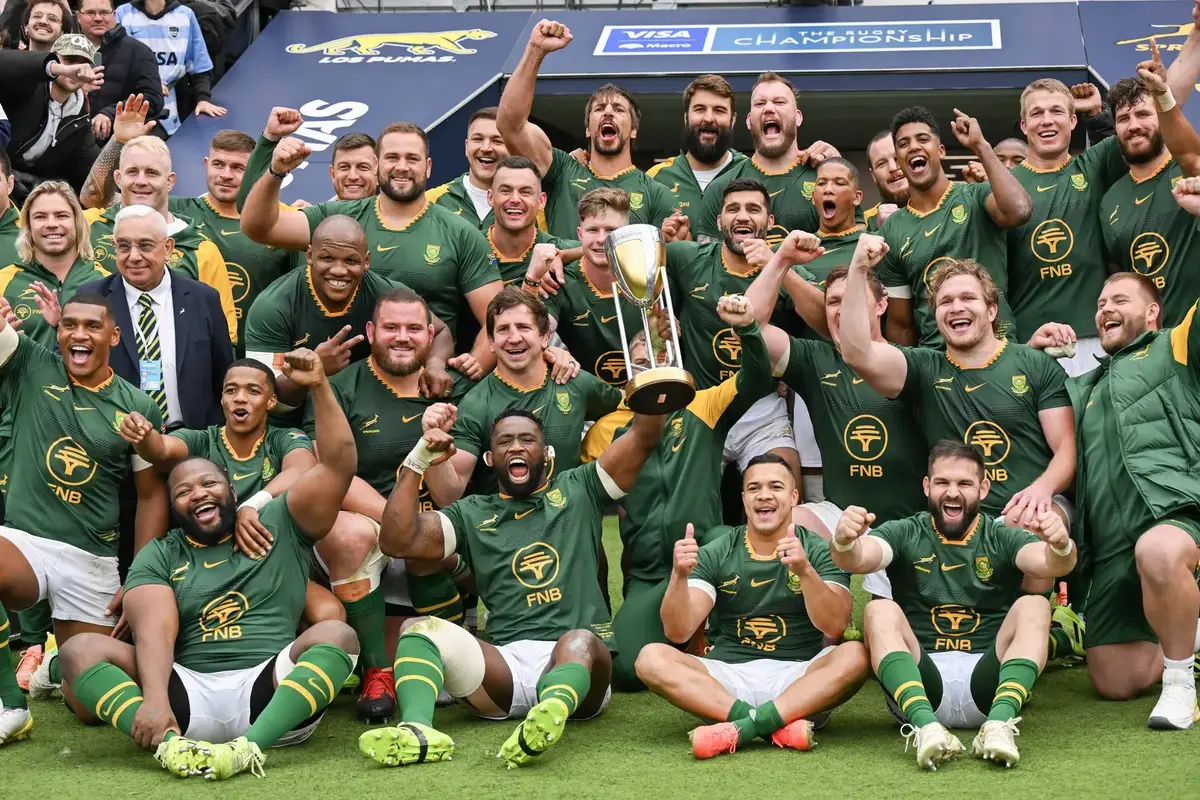
South Africa became the first side in history to retain the Rugby Championship title after surviving a titanic battle with Argentina at Twickenham, emerging victorious by the narrowest of margins in a pulsating encounter that produced their sixth championship crown in 30 editions of the southern hemisphere tournament.
Key moments:
2′ – Canan Moodie yellow card for high tackle on Juan Cruz Mallía
5′ – Bautista Delguy try after brilliant footwork beats Cobus Reinach and Ethan Hooker, Santiago Carreras converts (7-0)
10′ – Sacha Feinberg-Mngomezulu penalty goal from 35 metres (7-3)
18′ – Santiago Carreras penalty goal after South Africa high tackle (10-3)
27′ – Santiago Carreras penalty goal after Bautista Delguy break (13-3)
39′ – Cobus Reinach crashes over after dominant scrum on Argentina line, Sacha Feinberg-Mngomezulu converts (13-10)
Half-time: Argentina 13-10 South Africa
43′ – Mayco Vivas yellow card for high tackle on Eben Etzebeth
45′ – Malcolm Marx powers over from driving maul, Sacha Feinberg-Mngomezulu misses conversion (13-15)
52′ – Cobus Reinach scores second try after scrum penalty, Sacha Feinberg-Mngomezulu converts (13-22)
54′ – Francisco Coria Marchetti replaced by Tomás Rapetti (debut) after injury
59′ – Malcolm Marx crashes over from second driving maul, Sacha Feinberg-Mngomezulu converts (13-29)
66′ – Bautista Delguy intercepts Cheslin Kolbe error and runs in second try, Santiago Carreras converts (20-29)
78′ – Santiago Carreras penalty attempt from 40 metres hits right upright (20-29)
82′ – Rodrigo Isgró scores from Santiago Carreras crossfield kick, Santiago Carreras converts (27-29)
Full-time: Argentina 27-29 South Africa
The world champions weathered an early storm that saw them reduced to 14 men inside two minutes and trailing at half-time, before their trademark forward power and ruthless set-piece supremacy turned the contest decisively in their favour. Yet Argentina refused to surrender, mounting a stirring late rally that very nearly snatched an improbable victory and left a crowd in excess of 70,000 breathless.
It's all over in London. The #Springboks have retained the Castle Lager Rugby Championship 🇿🇦
Thanks for two tough games @lospumas and good luck for the rest of the year 🤝#ForeverGreenForeverGold #ARGvRSA pic.twitter.com/GcvF56nStY— Springboks (@Springboks) October 4, 2025
The equation had been straightforward for Rassie Erasmus’s side following New Zealand’s 28-14 victory over Australia in Perth earlier in the day. Any win would suffice to pip the All Blacks on points difference, both sides finishing level on 19 points but South Africa’s superior margin of +57 compared to New Zealand’s +8 proving decisive. What transpired, however, was anything but straightforward.
Disaster struck the Springboks almost immediately when centre Canan Moodie was dispatched to the sin bin after just 120 seconds for a high tackle on Juan Cruz Mallía. The upright challenge, with clear head-on-head contact, left Italian referee Andrea Piardi with little choice, and Argentina sensed opportunity against 14 men.
The Pumas required barely three more minutes to capitalise. Santiago Carreras’s superb long pass released right wing Bautista Delguy into space, and the Clermont flyer showcased exquisite footwork to bisect Reinach and Ethan Hooker before cantering under the posts. Carreras, the tournament’s leading points scorer, showed his class by converting from the touchline to hand his side a 7-0 lead, good reward for their 85 per cent ball possession in the opening exchanges.
Felipe Contepomi’s reshuffled side, boasting seven changes from the humiliating 67-30 defeat in Durban, played with intensity and precision that belied their inexperienced halfback pairing. Debutant fly-half Gerónimo Prisciantelli and scrum-half Simón Benítez Cruz directed traffic intelligently, whilst Argentina’s defensive line speed and physicality at the breakdown disrupted South Africa’s rhythm through the opening exchanges.
South Africa finally got their hands on the ball from the restart and attacked with purpose, earning a penalty that allowed Feinberg-Mngomezulu to open their account. Moodie returned from the sin bin without further damage to the defensive line, but the Pumas maintained their pressure with a number of industrious runs by their backs.
The Pumas extended their advantage through the boot of Carreras, who slotted penalties in the 18th and 27th minutes as Argentina’s discipline and composure contrasted sharply with South African errors. At 13-3, with the world champions appearing sloppy and overeager to do individual things whilst the Pumas kept it organised within their game plan, an upset seemed plausible.
Moodie’s difficult evening nearly worsened dramatically when he flew out of the defensive line and slapped down a Mallía pass. Many observers believed the knock-on deliberate and worthy of a second yellow card, which would have resulted in a red, but Piardi deemed it accidental and awarded only a scrum. Erasmus later conceded his centre had been fortunate. “Canan was lucky with the one that he tapped back – it was almost two yellow cards there,” the coach admitted. “If I was Felipe, I would have said one was maybe a red card and the one he was trying to reach might have been more than a yellow.”
Yet South Africa possess a weapon that few can match. Timely whispers from the Springboks’ water carriers not only slowed the game down but also calmed the frantic efforts on attack. Instead, the Boks returned to their scrumming prowess, opting for that set-piece three times from penalties conceded by Argentina. Francisco Coria Marchetti, thrust into the starting role after Joel Sclavi’s injury in the captain’s run, was being devoured by the returning Ox Nche.
It was third time lucky as Reinach pounced from the forward momentum created by his pack. On the stroke of half-time, with Argentina penalised yet again at the set-piece, South Africa elected for another scrum five metres from the line. The pack pulverised their opponents, and though Jasper Wiese couldn’t control at the base, Reinach was too close to be stopped. Feinberg-Mngomezulu converted, and the interval arrived with South Africa back within touching distance at 13-10. At the half-time hooter, the Springboks had their swagger back.
The Pumas started their second half poorly, spilling the restart, and their woes compounded when loosehead Mayco Vivas was shown a yellow card for a high tackle on the granite-like Eben Etzebeth. The Springboks lock had been shoved into Vivas by Guido Petti, providing mitigation that prevented an upgrade to red, but the sanction left Argentina a man short just as they needed bodies to resist the inevitable Springboks surge.
Malcolm Marx, the hooker whose power and dynamism embody South Africa’s forward dominance, required just three minutes to capitalise. The Boks kicked to the corner, got their lineout maul set, and Marx detached at the perfect moment to crash through Delguy’s attempted tackle and plant the ball in the corner. Feinberg-Mngomezulu’s conversion attempt drifted wide, but South Africa led for the first time at 15-13, their fans more at ease however slender the advantage.
The introduction of Jan-Hendrik Wessels and Wilco Louw bolstered the scrum further, earning another penalty. The Boks went to the corner again, and whilst the maul was stopped, the try was not. South Africa kept the ball at short range, attacking the fringes around the ruck until the Pumas faltered, leaving the smallest of gaps for Reinach to score his second. Feinberg-Mngomezulu converted, and at 22-13 after 53 minutes, the Springboks were in command.
More importantly, they smelled blood and their predatory instincts kicked in. Boosted by further bench interventions from RG Snyman and Jesse Kriel, the step-up in performance was complete when Marx scored the bonus-point try. The Boks, now in full flow, kicked to the corner following more Pumas indiscretions, and Marx crashed over from short range for his second on 59 minutes. The score equalled Richie McCaw’s record of 17 tries in Rugby Championship history for a forward. Feinberg-Mngomezulu’s conversion made it 29-13, and the championship appeared secure.
Sadly for the Pumas, old habits die hard and they started to falter under pressure, giving away penalty after penalty and handing all possession and dominance over to the reigning champions. They also lost all goodwill from referee Piardi, who started to call them out for every indiscretion.
Argentina’s challenge suffered another blow when Coria Marchetti departed with a leg injury, forcing 20-year-old Tomás Rapetti into a Test debut in the most demanding circumstances. Yet a poor option by the Boks gave the Argentinians a second lease on life when Cheslin Kolbe threw an unnecessary speculative pass inside his own half. Delguy intercepted and raced away for his second try, Carreras converting to make it 29-20 with 14 minutes remaining.
Credit to Argentina, who like the Boks earlier in the half took the half-chance presented by the South Africans and attacked well in the last quarter, sniffing a rare win. Again, it was the Bok bench who brought sanity and calm, with Kwagga Smith, Grant Williams and Manie Libbok providing guidance when needed.
On 78 minutes, a late tackle by Wessels earned a penalty 40 metres out, centrally positioned. Carreras, who had been faultless from the tee, stepped up to cut the lead to a converted try. The ball flew straight and true before striking the right-hand upright and rebounding into play. The groan from the Argentine supporters was audible even above the din, and South Africa scrambled possession to safety.
In the dying seconds, with South Africa running down the clock, Carreras launched one final crossfield kick towards the right corner. Rodrigo Isgró, the Harlequins wing playing across the road from The Stoop, soared to collect with supreme aerial skill and touch down. Carreras converted to make it 29-27, but time had expired. Piardi’s whistle sounded moments later, and South Africa’s celebrations could begin. They had their pride back, but the Castle Lager Rugby Championship trophy would return to South Africa, the country of the Springbok.
The contrast in emotions was stark. Kolisi, earning his 98th cap and moving ever closer to Springbok immortality, lifted the Rugby Championship trophy for the second consecutive year before a sea of green in the stands. “It was a tough day,” the captain said. “Credit to Argentina, who came hard. I am so proud of our boys. It was not the perfect game but the fight we show each and every time. The players we have coming off the bench are so special.”
Asked what the message had been at half-time, Kolisi revealed: “It was simple, and we all felt the same as the coaches. We needed to play with more unity, make fewer mistakes, and concede fewer penalties. But that said, all credit to Argentina. We knew they would come out fighting like that, and we know their mindset, so we knew we had to keep fighting until the end.”
On what made this team special, the captain reflected: “We know how to fight as a team and to dig deep, and that’s all thanks to coach Rassie in the way he made us change the way we think. This team have done a lot for the country, and I’m proud of the group and the coaches. They always come up with new ideas, and as players, we adapt and accept that. This Castle Lager Rugby Championship was tough, and anyone could have won it, so to be able to lift the trophy for the second time in a row is amazing for us and the country.”
Reinach, named player of the match after his two tries proved decisive, reflected on the historic achievement. “It is unreal to win it back-to-back,” the scrum-half said. “We have not won it ever back-to-back. Going back-to-back shows a lot of character. Argentina are unreal and have a lot of dog in them. Like us, they keep fighting. It is one of the best jobs in the world to be the scrum-half behind our pack.”
Erasmus, whilst satisfied with the result, offered a characteristically honest assessment of the performance. “I’m satisfied with the result and winning the Castle Lager Rugby Championship back-to-back,” he said. “This was a massive game for us, and although it was a far from perfect performance, I would prefer to see us learn while we are winning than losing. We are still in a good position for the Rugby World Cup draw, but there is no doubt we have five tough matches ahead, and there is a lot of work ahead for us.”
The coach acknowledged the quality of opposition. “The reality is that Argentina defeated Australia, New Zealand, and the British and Irish Lions, so we’ll celebrate tonight and take that positive from this match. We knew it would be tough and at halftime you could see the guys were tired, but at the same time Argentina played well. They played a loose game, and we got a yellow card in the first half, while there were also a few close calls that could have changed the game. But they definitely showed massive fight and that they can really take things to the gutters.”
For Argentina, the manner of defeat will sting. Contepomi’s gamble on inexperienced halfbacks nearly paid dividends, with Prisciantelli acquitting himself admirably on debut. “I feel enormous pride for the team,” the coach said. “Obviously it’s difficult and it hurts to lose, and there’s a lot to improve in the set-pieces, but at times we attacked them well and defensively the boys played a great match.”
Julián Montoya, who became Argentina’s most-capped captain with his 52nd Test as skipper, was similarly proud yet realistic. “Obviously the result hurts, but we showed another face compared to last match,” he said. “First I want to thank all the Argentine people who came to support us. We showed another face and we went looking for it until the last minute – in fact we closed it with a try. I’m proud of the character the team showed, and I also want to congratulate Tomi Rapetti, his family and his club for his debut against South Africa in a dream match, a very tough one.”
The captain was forthright about Argentina’s main weakness. “We have a lot of things to correct. Clearly the scrum was our biggest weakness today, so we have to keep improving.”
The scrum statistics told the brutal truth. South Africa earned seven penalties to Argentina’s none at the set-piece, that dominance providing the platform for victory. The Springboks’ bench, introducing world-class operators in Bongi Mbonambi, Wessels, Louw and Kwagga Smith, proved decisive in the final quarter as Argentina tired.
Etzebeth, bloodied but unbowed after being cut open in the second half, extended his record as South Africa’s most-capped player to 138 Tests with another warrior’s display. The lock epitomised the Springboks’ refusal to yield, his granite presence anchoring their forward effort throughout.
The decision to stage Argentina’s “home” fixture at Twickenham, driven by commercial considerations, created an unusual atmosphere. The Springboks enjoyed vocal superiority from a crowd dominated by their expatriate supporters, making this effectively a fifth straight victory at the venue and a third win in three years in matches not involving England.
South Africa’s achievement should not be understated. No previous Springbok side had retained the Rugby Championship, despite the nation’s dominance across decades. This team, under Erasmus’s innovative coaching, has now scaled that particular peak whilst developing remarkable squad depth. The championship campaign featured dramatic swings, from the opening-round defeat to Australia through comprehensive victories over New Zealand to last week’s 97-point spectacular, yet South Africa’s ability to grind out results when not at their best proved decisive.
As both sides departed Twickenham, the Springboks headed for celebrations as world number ones, whilst Argentina could reflect on notable victories over New Zealand and Australia if ultimately falling short against the world’s premier side. For South Africa, history had been made. For Argentina, the agonising near-miss would fuel motivation for future encounters. In what was certainly a thrilling edition of the Rugby Championship, the finale had delivered one last dramatic chapter.
Share this:
The Rugby Championship
Tupaea brace powers All Blacks past Wallabies in Perth rain
Published
3 months agoon
4th October 2025
Quinn Tupaea’s contentious first-half brace paved the way for New Zealand’s 28-14 bonus-point victory over Australia in torrential Perth rain, as the All Blacks overcame their own profligacy to keep alive slim hopes of claiming the Rugby Championship crown.
Key moments:
6′ – Tane Edmed penalty goal from 38 metres after Tamaiti Williams breakdown infringement (3-0)
8′ – Leroy Carter crashes over from close range after Nick Frost drops restart, Damian McKenzie converts (3-7)
11′ – Tane Edmed penalty goal after Tamaiti Williams penalised again at breakdown (6-7)
13′ – Allan Alaalatoa try disallowed, Tom Hooper yellow card for dangerous crocodile roll clearout on Jordie Barrett
17′ – Tane Edmed penalty goal after Scott Barrett fails to roll away (9-7)
22′ – Will Skelton fails HIA and does not return, Jeremy Williams replaces
33′ – Quinn Tupaea try after ball ricochets off Jordie Barrett’s head, Damian McKenzie misses conversion (9-12)
36′ – Quinn Tupaea scores second try after Will Jordan quick tap, Damian McKenzie misses conversion (9-17)
Half-time: Australia 9-17 New Zealand
44′ – James Slipper replaced by Tom Robertson in 151st and final Test appearance
46′ – Len Ikitau yellow card for head-on-head tackle on Quinn Tupaea
62′ – Damian McKenzie penalty goal from 35 metres after Rob Valetini high tackle (9-20)
67′ – Len Ikitau scores from close range, Tane Edmed conversion strikes post (14-20)
71′ – Damian McKenzie penalty goal after Will Jordan and Rieko Ioane force turnover (14-23)
81′ – George Bower crashes over after final hooter to secure bonus point, Damian McKenzie misses conversion (14-28)
Full-time: Australia 14-28 New Zealand
The Chiefs centre’s double—the first a freakish effort involving a ricochet off teammate Jordie Barrett’s head, the second a powerful individual score—established a platform the visitors never relinquished despite being comprehensively outplayed for vast periods of a chaotic encounter at Optus Stadium that deteriorated into an error-strewn arm-wrestle in the second half.
Job done in Perth 🖤 pic.twitter.com/9GPNWHLwy5
— All Blacks (@AllBlacks) October 4, 2025
George Bower’s try after the final hooter secured the crucial bonus point that elevates New Zealand four points clear of South Africa atop the championship standings, though the Springboks retain their destiny through superior points differential when they face Argentina at Twickenham later on Saturday evening.
For Australia, the defeat represented a deflating conclusion to a Rugby Championship campaign that had promised much but delivered insufficient silverware. Joe Schmidt’s side competed ferociously throughout and controlled possession for extended periods, yet two yellow cards, the premature loss of Will Skelton, and chronic errors at crucial moments conspired to extend their winless sequence against New Zealand to 11 matches.
The contest opened dramatically with Skelton demonstrating both his value and volatility within seconds. The towering lock dominated the opening collision to win a turnover penalty, only to immediately reverse the decision by shoving Tamaiti Williams to the ground after the whistle. Damian McKenzie’s subsequent penalty attempt from 46 metres drifted wide, setting the tone for a frustrating evening with the boot for the All Blacks playmaker.
Tane Edmed opened the scoring in the sixth minute with a nerveless strike from 38 metres after Williams was penalised at the breakdown. The 25-year-old’s composure under pressure provided early vindication for Schmidt’s decision to promote him ahead of the demoted James O’Connor, though his attacking game would subsequently underwhelm.
The All Blacks’ response proved immediate and devastating. Nick Frost’s botched restart catch gifted New Zealand possession deep in Australian territory, and when Allan Alaalatoa was penalised for playing the scrumhalf, the visitors kicked to the corner. The ensuing lineout produced a platform for Leroy Carter to burrow over from close range after Tupaea’s powerful carry had established momentum. McKenzie converted to put New Zealand 7-3 ahead after eight minutes.
Edmed reduced the deficit to a single point three minutes later with his second penalty after Williams was again caught infringing at the breakdown, but the match’s pivotal moment arrived in the 13th minute with ramifications that reverberated through the remainder of the half.
Australia constructed a magnificent try-scoring opportunity through sustained phase play that showcased everything positive about their performance. Max Jorgensen repeatedly appeared as first receiver to threaten the gainline, Filipo Daugunu made ground down the left wing, and Harry Potter weaved his way through traffic with electric footwork. When Alaalatoa finally crashed over near the posts, the sell-out crowd erupted in celebration of what appeared a deserved reward for scintillating attacking rugby.
Television match official Andrew Jackson had other ideas. Replays revealed Tom Hooper executing a dangerous crocodile roll clearout on Jordie Barrett during the build-up, twisting the All Black onto his neck in a manner that left referee Matthew Carley with no alternative but to disallow the try and dispatch the flanker to the sin bin for 10 minutes. The double blow—five points erased and a man lost—fundamentally altered the contest’s complexion.
Rather than wilt under pressure, the 14-man Wallabies continued to dominate possession and territory. Edmed restored their lead with his third penalty in the 17th minute after Scott Barrett was caught not rolling away, and Australia appeared well-positioned to extend their advantage despite the numerical disadvantage.
Those hopes suffered a severe blow when Skelton departed for his head injury assessment following a collision in the 22nd minute. The giant lock’s presence had added significant heft to Australia’s forward exchanges, and his absence created an imbalance that New Zealand’s scrum immediately exploited. Jeremy Williams proved a capable replacement, but Skelton’s failure to return at halftime—he would take no further part in the match—represented a major setback for the Wallabies’ forward strategy.
The All Blacks’ scrum dominance became increasingly pronounced as the half progressed, winning multiple penalties that provided crucial territorial relief. Yet their attacking ambition remained stifled by disciplined Australian defence until the 33rd minute, when fortune intervened in bizarre fashion.
New Zealand stole an Australian lineout near halfway and worked the ball wide to Jordie Barrett, who chipped ahead into space behind the defensive line. Harry Potter raced forward to gather but slipped on the wet surface, colliding with Barrett as both pursued the bouncing ball. What followed defied belief—the ball rebounded off Barrett’s head, propelling it forward for Tupaea to gather and toe ahead into the 22. The centre regathered his own kick to crash over near the posts for a try that owed everything to fortune and nothing to design.
McKenzie’s conversion attempt struck the upright, his second miss from three attempts highlighting a kicking malaise that kept Australia within touching distance. The 12-9 scoreline flattered the Wallabies given their territorial dominance, but worse was to follow.
Three minutes later, Tupaea crossed again in markedly more conventional fashion. The All Blacks won solid scrum ball on halfway, and when Australia were penalised for offside, Will Jordan eschewed the kick to touch in favour of a quick tap. The decision caught the Wallabies backpedalling, and Jordan’s offload found Tupaea steaming onto the ball with unstoppable momentum. The centre administered a textbook right-hand fend to dispatch Hooper before bulldozing over the line despite the attention of multiple defenders.
McKenzie’s third conversion miss from four attempts meant Australia trailed by only eight points despite conceding three tries, and Edmed’s perfect record from the tee—three from three penalties—kept the Wallabies mathematically competitive despite their try-scoring drought.
The halftime statistics painted a stark picture of Australian dominance everywhere except the scoreboard. The Wallabies enjoyed 60 percent possession and committed 77 tackles to New Zealand’s 35, suggesting sustained defensive pressure on the All Blacks. Yet three tries to nil told a different story, one of clinical finishing against profligate possession.
The second half commenced in scrappy fashion as both sides struggled to maintain possession in deteriorating conditions. Alaalatoa departed after five minutes, replaced by Taniela Tupou, whilst the heavens opened to transform the pristine Optus Stadium surface into a treacherous skating rink that punished ambition and rewarded pragmatism.
Australia’s discipline problems resurfaced in the 46th minute when Len Ikitau was dispatched to the sin bin for a head-on-head collision with Tupaea. The Brumbies centre executed an upright tackle that caught the All Black flush on the temple—a passive collision devoid of malice but dangerous nonetheless. Carley had no alternative but to brandish yellow, reducing the Wallabies to 14 men for the second time in the match.
James Slipper departed shortly afterwards to a standing ovation from the 60,000 spectators, bringing down the curtain on a 151-Test career that established him as Australia’s most-capped player. Even Carley paused to shake the veteran prop’s hand in acknowledgement of a remarkable international odyssey that spanned 15 years.
The numerical disadvantage failed to stifle Australian ambition. Jake Gordon orchestrated promising attacking raids, Jorgensen continued to threaten from fullback, and the forwards competed ferociously at the breakdown where Fraser McReight won multiple turnovers. Yet crucial errors repeatedly undermined momentum—overthrown lineouts gifted possession to New Zealand, whilst aimless kicks surrendered hard-won territory.
McKenzie finally rediscovered his radar in the 62nd minute, slotting a penalty from 35 metres after Rob Valetini was penalised for a high tackle on Jordie Barrett. The three points extended New Zealand’s buffer to 20-9 and provided breathing space the All Blacks desperately required as they struggled to generate attacking continuity in the sodden conditions.
Australia’s response proved immediate and dramatic. The Wallabies kicked to the corner and established sustained pressure on New Zealand’s line through sustained forward drives. Josh Nasser, who had replaced Billy Pollard minutes earlier, charged close before Ikitau—having returned from his sin bin stint—demonstrated quick thinking to smuggle the ball over the line from point-blank range in the 67th minute.
Edmed’s conversion attempt struck the upright, denying Australia the opportunity to reduce the deficit to a single score. The miss proved symptomatic of the Wallabies’ evening—promising positions squandered through minor technical failings that accumulated into decisive disadvantage.
McKenzie extended New Zealand’s advantage to nine points with another penalty four minutes later after excellent counter-rucking from Jordan and Rieko Ioane—a substitute for the try-scoring Tupaea—forced a turnover. The three points effectively extinguished Australian hopes with time evaporating and conditions deteriorating further.
The final quarter descended into attritional warfare as both sides struggled to maintain possession. New Zealand adopted a pragmatic approach built around Cam Roigard’s box-kicking and aggressive defensive line speed, whilst Australia continued attempting ambitious phase play that repeatedly broke down through handling errors or disciplinary infringements.
Jordie Barrett produced the defensive highlight of the half with a spectacular aerial take under pressure from Joseph-Aukuso Suaalii, claiming a contestable kick despite the Wallaby’s physical challenge. The moment exemplified New Zealand’s second-half approach—absorbing pressure through individual brilliance rather than collective dominance.
The match’s ugliest moment arrived in the 79th minute when Josh Flook was knocked unconscious in a sickening collision with Jordie Barrett. The substitute centre got his head positioning catastrophically wrong and absorbed the full force of Barrett’s hip to his face, leaving him motionless on the turf. Medical staff immediately attended and Flook eventually walked from the field, but the incident cast a sombre shadow over proceedings.
The final hooter sounded with New Zealand camped on Australia’s line pursuing the bonus point that would strengthen their championship aspirations. From a scrum 10 metres out, the All Blacks forwards battered away through a succession of pick-and-drive efforts before Bower crashed over in the 81st minute with Pasilio Tosi providing crucial momentum from behind.
McKenzie’s conversion attempt drifted wide—his fourth miss from six attempts in a performance that will concern Scott Robertson ahead of November’s northern hemisphere tour—but the damage was done. New Zealand had secured the five points required to maintain championship ambitions, whilst Australia were left to reflect on another frustrating near-miss against their trans-Tasman tormentors.
The statistics painted a familiar picture of Wallabies dominance undermined by crucial errors. Australia again enjoyed territorial advantage and created numerous promising positions, yet scored only one try to New Zealand’s four. Two yellow cards—both justified but both momentum-killing—disrupted rhythm at critical junctures, whilst Skelton’s premature departure removed their most influential forward.
For New Zealand, the victory represented mission accomplished if not mission perfected. They secured back-to-back wins for only the second time in the Rugby Championship and demonstrated the clinical finishing that has characterised their recent encounters with Australia. Yet significant concerns remain about attacking cohesion, set-piece consistency, and McKenzie’s goalkicking reliability.
Tupaea’s player-of-the-match performance vindicated Robertson’s selection gamble, though both tries carried asterisks regarding their legitimacy. The All Blacks scrum proved a decisive weapon, winning crucial penalties that provided territorial relief, whilst the defensive scramble—particularly in the second half—repeatedly snuffed out Australian attacking threats.
Australia’s campaign concludes with a 2-3 record that represents progress from previous years’ winless disasters but falls short of genuine contention. Schmidt has established solid foundations through improved set-piece work, enhanced squad depth, and competitive performances against higher-ranked opponents. Yet chronic discipline problems and an inability to identify a settled fly-half partnership continue hampering progress.
The result elevates New Zealand to 18 points atop the Rugby Championship standings, four clear of South Africa but vulnerable to the Springboks’ superior points differential. Argentina would need to upset South Africa in London to deliver the All Blacks an unlikely championship crown—a scenario that appears improbable given the world champions’ recent form.
For the Wallabies, attention shifts to a daunting five-match Spring Tour encompassing fixtures against Japan, England, Italy, Ireland and France. Schmidt must identify solutions to persistent problems—particularly at fly-half, where Edmed’s mixed performance raised more questions than answers—whilst maintaining the positive momentum generated through victories over Fiji, the British & Irish Lions, and South Africa.
“A lot of silly errors that we need to get out of our game,” Jorgensen lamented post-match. “That’s what Test footy is, it’s the best of the best, so you can’t be making those mistakes. If you want to be the best team in the world you’ve got to be at your best at every aspect of the game.”
Australia: 15 Max Jorgensen, 14 Harry Potter, 13 Joseph-Aukuso Suaalii, 12 Len Ikitau, 11 Filipo Daugunu, 10 Tane Edmed, 9 Jake Gordon, 8 Harry Wilson (captain), 7 Fraser McReight, 6 Tom Hooper, 5 Will Skelton, 4 Nick Frost, 3 Allan Alaalatoa, 2 Billy Pollard, 1 James Slipper. Replacements: 16 Josh Nasser, 17 Tom Robertson, 18 Taniela Tupou, 19 Jeremy Williams, 20 Rob Valetini, 21 Ryan Lonergan, 22 James O’Connor, 23 Josh Flook.
New Zealand: 15 Will Jordan, 14 Leroy Carter, 13 Quinn Tupaea, 12 Jordie Barrett, 11 Leicester Fainga’anuku, 10 Damian McKenzie, 9 Cam Roigard, 8 Peter Lakai, 7 Ardie Savea, 6 Simon Parker, 5 Fabian Holland, 4 Scott Barrett (captain), 3 Fletcher Newell, 2 Codie Taylor, 1 Tamaiti Williams. Replacements: 16 Samisoni Taukei’aho, 17 George Bower, 18 Pasilio Tosi, 19 Patrick Tuipulotu, 20 Wallace Sititi, 21 Cortez Ratima, 22 Rieko Ioane, 23 Ruben Love.
Referee: Matthew Carley (England)
Attendance: 60,000 (capacity)
Share this:
The Rugby Championship
All Blacks forced into seven changes for Bledisloe rematch
Published
3 months agoon
2nd October 2025
An injury crisis has forced Scott Robertson into seven changes for Saturday’s Rugby Championship finale in Perth, with the All Blacks coach admitting the brutal toll of last weekend’s Bledisloe Cup clash has left his squad severely depleted for the winner-takes-all showdown with Australia.
- Four injury-enforced changes decimate All Blacks’ continuity plans for Perth decider
- Beauden Barrett (shoulder), Ethan de Groot (concussion), Tyrel Lomax (thumb), Caleb Clarke (ankle) all ruled out
- Leicester Fainga’anuku makes shock return after two-year absence for first Test since 2023 World Cup
- Quinn Tupaea’s surprise promotion to starting centre sees Billy Proctor axed from 23
- Peter Lakai handed maiden Test start at No.8 as Robertson opts for fresh legs over Wallace Sititi
- Will Jordan to reach 50-Test milestone against nation where he made debut
Robertson’s plans for building continuity have been torn apart by injuries to four frontline players, compelling wholesale alterations to the side that secured the Bledisloe Cup with a 33-24 victory at Eden Park. The casualty list reads ominously: Beauden Barrett, Ethan de Groot, Tyrel Lomax and Caleb Clarke have all been ruled out, whilst several other players are carrying knocks that influenced selection decisions.
Your team for the final round of the Rugby Championship 😤
Will Jordan to bring up 50 Tests 🙌🏾 pic.twitter.com/yIOyBQRxK9
— All Blacks (@AllBlacks) October 2, 2025
“The games are so tough in the Rugby Championship,” Robertson acknowledged, surveying the wreckage of his forward pack. The All Blacks must now cobble together victory from the remnants, knowing only a bonus-point triumph combined with an Argentina upset over South Africa will deliver the championship crown.
Lomax suffered a broken thumb during the Eden Park encounter—the same digit he fractured earlier this season—and underwent scans on Wednesday that confirmed surgery would be required. The 29-year-old will return to New Zealand on Thursday evening and faces a six-to-eight week rehabilitation period that likely ends his season.
“With Tyrel, he broke the same thumb, but with a different break. That’s unlucky,” Robertson said, the understatement masking significant concern about front-row depth. Pasilio Tosi earns his opportunity as bench cover, whilst Crusaders pair Tamaiti Williams and Fletcher Newell form an all-Christchurch front row alongside hooker Codie Taylor.
De Groot’s head injury assessment failure at Eden Park removes the All Blacks’ premier loosehead prop, whilst Clarke’s ankle complaint—aggravated during the match—sidelines one of New Zealand’s most potent attacking weapons. Barrett’s shoulder issue keeps him in New Zealand entirely, creating a playmaking vacuum that thrust Damian McKenzie back into the starting role he struggled to own earlier this season.
Yet Robertson has gone beyond simply replacing injured bodies. His selection includes three changes driven by form and freshness rather than medical necessity, suggesting a coach prepared to gamble on squad depth rather than battle-hardened combinations.
Most striking is Leicester Fainga’anuku’s recall from international exile. The powerful utility back last wore black in the 2023 Rugby World Cup quarter-final victory over Ireland before departing for an 18-month stint with French club Toulon. His return to New Zealand and impressive provincial form for Tasman earned him a training berth as injury cover, but few expected immediate elevation to the starting XV.
“It gives a chance for Leicester on the left wing with his left foot,” Robertson explained. “He’s a big body and a point of difference.” That physical presence—Fainga’anuku tips the scales at 105 kilograms—offers New Zealand a battering ram on the edge, though his two years in France’s Top 14 midfield raise questions about positional sharpness. The Wallabies will surely test him aerially, probing for rust under the high ball.
Robertson’s most contentious call sees Quinn Tupaea promoted to outside centre for his first Test start in that position since 2020, displacing Billy Proctor not merely to the bench but from the matchday squad entirely. The Chiefs midfielder has delivered punchy cameos as a replacement recently, scoring against South Africa and consistently denting defensive lines with his direct carrying style.
“Billy is a bit banged up. He’s had five tests in a row and he’s been awesome,” Robertson said, offering both explanation and praise for the discarded player. “His body needs a chance to freshen up. It’s great for Quinn, who has had a couple of good cameos and he’s ready to go.”
The selection carries substantial risk. Tupaea has spent recent years predominantly at second five-eighth for the Chiefs, with his last extended run at outside centre occurring five years ago. Saturday he confronts Joseph-Aukuso Suaalii, the code-switching phenomenon whose physical gifts have illuminated Australia’s backline since his arrival from rugby league. The defensive assignment looms large.
Robertson expressed confidence in the combination with Jordie Barrett, citing their defensive preparation. “The last few tests he’s been at centre. Him and Jordie work really well together. They’ve done a lot of work defensively so they’re a good combo.” Whether that partnership can withstand Suaalii’s power and the Wallabies’ attacking intent remains Saturday’s great unknown.
McKenzie backed his provincial teammate whilst acknowledging the challenge ahead. “He’s slotted in very well, very similar to Leicester, just a guy who rips in and we’ve just got to find a way to get him the ball,” the fly-half said. “For us it’s about getting up and putting them under pressure early, not giving them time and space. We know what Suaalii can do when we give him time and space. Quinn’s ready for that challenge.”
The back-row shuffle represents Robertson’s third non-injury alteration. Peter Lakai earns his maiden Test start at No.8 after making a significant impact off the bench at Eden Park, his dynamic ball-carrying and relentless work rate earning promotion ahead of Wallace Sititi, who drops to the replacements.
“Peter has been good. He took his opportunity the other day,” Robertson said. “We feel like this sort of game, the way he hunts and his skill set, will suit the start. It’s a good chance for Wally to come on and make an impact. We’re pleased for Peter. He’s ready.”
The 22-year-old Hurricanes flanker brings raw energy and an aggressive mindset that Robertson believes suits this encounter. Lakai’s selection alongside Ardie Savea and Simon Parker creates New Zealand’s latest loose forward combination—a position group that has seen constant rotation under Robertson’s tenure as he searches for the optimal balance.
Captain Scott Barrett reclaims both his second-row berth and the leadership role after recovering from the shoulder complaint that sidelined him at Eden Park. His return sees rookie lock Fabian Holland dropped from the 23, with Patrick Tuipulotu maintaining his impact role off the bench. Barrett partners Tupou Vaa’i, who has overcome his own knee concern to retain his starting position.
The bench features six changes from Auckland, with George Bower, Pasilio Tosi, Rieko Ioane and Ruben Love all recalled. Ioane’s inclusion marks his first matchday selection since the South African victory at Eden Park, the versatile midfielder having endured a difficult season characterised by inconsistent form and loss of his starting position. Saturday represents a crucial opportunity to stake claims ahead of November’s northern hemisphere tour.
Robertson defended his rotation policy as necessary for both player welfare and squad development. “There are two ways to look at it,” he said. “You play someone and you get your combinations, and then there’s the time to give other guys opportunities, create competition in the squad and create depth. It’s the guys’ chance now who are fresh and hungry to have a crack. That’s the balance of it. Teams have done that really well this year. Every time someone has had an opportunity, they’ve taken it.”
The pragmatism acknowledges rugby’s modern reality—players cannot sustain Test match intensity week after week without breaking down. Yet the disruption to combinations poses significant challenges, particularly against a Wallabies outfit that competed ferociously at Eden Park and has recalled their own enforcer in Will Skelton.
“It changes the weight of the forward pack. There’s a few more kilos on it,” Robertson observed of Australia’s changes. “They’re big ball carriers and they’ll be running off nine. You’ve just got to watch the British & Irish Lions Tests to know how they’ll play. They’ll be hugely motivated for this occasion. It’s been a while since they’ve beaten us and there’s a bit of hype around them.”
The All Blacks have defeated Australia 10 consecutive times, a dominance that belies the recent competitiveness of encounters. Saturday’s match at Optus Stadium—where New Zealand suffered their heaviest defeat when losing 47-26 in 2019 before avenging that humiliation with a 38-21 triumph in 2021—will test whether Robertson’s reshuffled side can produce the consistency that has eluded them throughout this championship.
Will Jordan’s 50th Test appearance provides a celebratory subplot to proceedings. The Crusaders fullback made his debut against Australia in Brisbane in 2020 and has since accumulated 43 tries in 49 appearances, establishing himself amongst world rugby’s premier finishers. His milestone occurs against the nation where his international journey began, a symmetry not lost on the 26-year-old.
The championship mathematics inject urgency into proceedings, though Robertson resisted fixating on bonus-point permutations. “The first thing is you’ve got to get the result and that comes afterwards,” he said. “If you start playing from the start you can cook yourself, so you’ve got to keep your shape.”
“We saw how competitive and determined the Wallabies were in Auckland last weekend, staying in the fight right to the end,” Robertson said. “We expect another tough contest this Saturday. We have picked a 23 to go toe-to-toe with a quality Australian team. It’s all up for grabs in what has been the most even Rugby Championship we’ve ever seen, and we’re here to cap off this competition with a performance we can be proud of.”
All Blacks match-day 23 (Test caps in brackets)
1. Tamaiti Williams (22)
2. Codie Taylor (102)
3. Fletcher Newell (30)
4. Scott Barrett (85) (Captain)
5. Tupou Vaa’i (45)
6. Simon Parker (4)
7. Ardie Savea (102)
8. Peter Lakai (4)
9. Cam Roigard (13)
10. Damian McKenzie (69)
11. Leicester Fainga’anuku (7)
12. Jordie Barrett (76) (Vice-Captain)
13. Quinn Tupaea (20)
14. Leroy Carter (2)
15. Will Jordan (49)
16. Samisoni Taukei’aho (38)
17.George Bower (23)
18. Pasilio Tosi (11)
19. Patrick Tuipulotu (55)
20. Wallace Sititi (14)
21. Cortez Ratima (17)
22. Rieko Ioane (86)
23. Ruben Love (3)
Share this:


Trending
-

 Men's Rugby World Cup 20272 weeks ago
Pools confirmed for Men’s Rugby World Cup 2027 in Australia
-

 United Rugby Championship3 weeks ago
Stormers stage stunning comeback to end Munster’s unbeaten run
-

 Champions Cup1 week ago
Ioane to start as Leinster makes seven changes for Leicester trip
-

 United Rugby Championship3 weeks ago
Joshua Kenny brace helps unconvincing Leinster edge past Dragons
-

 United Rugby Championship3 weeks ago
BKT URC Round 6 Review – Stormers the only unbeaten team
-

 Champions Cup2 weeks ago
Leinster’s bench proves decisive as Quins’ effort falls short
-

 Champions Cup5 days ago
Munster leave it late to sweep aside Gloucester in Champions Cup
-

 Champions Cup6 days ago
Gibson-Park sparks Leinster’s second-half rally to beat Leicester
