Carter Gordon’s brief foray into rugby league has come to an end, with Rugby Australia and the Queensland Reds announcing the return of the 2023 Wallabies flyhalf on a three-year contract that runs through to the end of 2028.
The signing, which was finalised in a matter of days according to Reds coach Les Kiss, sees Gordon immediately added to Joe Schmidt’s 34-man Wallabies squad for the upcoming Spring Tour of Japan and Europe. It marks a remarkable turnaround for a player who made just one NRL appearance after his high-profile code switch in 2024.
Gordon, who earned eight Test caps and played at the 2023 Rugby World Cup, left rugby union following the financial collapse of the Melbourne Rebels, for whom he had made 46 Super Rugby appearances. His departure was seen as a significant blow to Australian rugby at the time, with the talented playmaker choosing to sign a two-year deal with the Gold Coast Titans.
However, Rugby Australia chief executive Phil Waugh moved quickly to secure Gordon’s return, negotiating a release from the second year of his NRL contract. It’s understood RA was forced to pay a transfer fee to the Titans, with reports suggesting the deal is worth more than $500,000.
“We are pleased Carter is returning to rugby after excelling as a junior with Sunshine Coast Grammar, Brisbane Boys’ College and Wests in Brisbane before taking the step up to Super Rugby and Test arena at a young age,” Waugh said. “Carter’s signing will ensure additional healthy competition at the Reds and the Wallabies and provides him with a two-year runway to make his case for the 2027 Rugby World Cup in Australia.”
For Gordon, the move represents a return to his roots. The Nambour-born playmaker first signed with the Reds as a 17-year-old schoolboy in 2018 but never managed to break into the senior side during three injury-affected seasons. His move to the Rebels in 2021 provided the platform he needed, and he quickly established himself as one of Super Rugby Pacific’s most promising talents.
“I’m stoked to return to the game I grew up playing and loving as a kid, especially with the opportunity to represent the team I grew up supporting, the Queensland Reds,” Gordon said. “I’ve watched both Queensland and the Wallabies from afar over the past year or so, and the journey they’re on motivates me to want to work hard and contribute positively on and off the field.”
Gordon’s rugby league stint was hampered by a serious spinal injury that delayed his debut until the Titans’ final-round clash with the Wests Tigers in September, where he played in the centres. With limited opportunities ahead and a home Rugby World Cup just two years away, the timing proved right for a return. “I’d also like to thank the Gold Coast Titans for the opportunity to grow as a player and person at their club and for all their support for me and my family over the past 16 months,” Gordon added. “I wish the players and the staff all the best for what’s ahead.”
Speaking to reporters in Brisbane, Kiss revealed the speed at which the deal came together, describing the process as “absolutely rapid” and taking just four or five days to complete. “I think there was always something in Carter’s mind that he’d like to come back one day, but from my perspective, this just accelerated in the last four or five days,” Kiss explained. “It was a combined thing in terms of RA and Queensland, just getting it to a point to make things work. I wasn’t involved in that whole process, but as you can imagine, we’re very happy to have Carter coming back to the Reds.”
The Reds coach, who will succeed Schmidt as Wallabies coach following next year’s British & Irish Lions series, was quick to highlight Gordon’s physical attributes whilst also managing expectations around his immediate role. “The one thing about Carter is he’s got a good size about him – he’s got a good height, he’s robust, he’s physical, and he meets all those things to be able to play what is now a very, very challenging position in the game,” Kiss said. “Tens are targeted a lot, and he gives us another quality option to be able to play in that position and balance out how we want to play our game.”
Gordon’s arrival adds depth to the playmaking stocks at both the Reds and Wallabies level. At Ballymore, he joins Tom Lynagh, rising star Harry McLaughlin-Phillips and Fijian international Ben Volavola in the flyhalf pecking order. Lynagh, 22, has been omitted from the Wallabies’ Spring Tour squad due to a lingering hamstring issue that has prevented him from training and playing consistently since the British & Irish Lions series.
“He hasn’t had a lot of volume in running, a lot of volume getting over a ball, hasn’t had a lot of volume in his kicking, so we’ve got an opportunity in the next two weeks to just work on that,” Kiss said of Lynagh’s rehabilitation. “We’ve got a plan that we’re putting together with RA to make sure that we get that right. He’ll have a leave period, and then he’ll have a full pre-season with us, and I think that’ll be good for him as well.”
Kiss was careful to emphasise that Gordon faces genuine competition for the No. 10 jersey, particularly praising McLaughlin-Phillips’s attitude and development. “One thing you know about Harry, he’s a competitor and he’s young and learning at a rate of knots as well, so he’ll take this on in a positive way, and we’ve already spoken, and he knows that the challenge is there,” Kiss said. “He didn’t feel entitled to anything beforehand, Harry, so he just wants to fight hard and earn his position as well.”
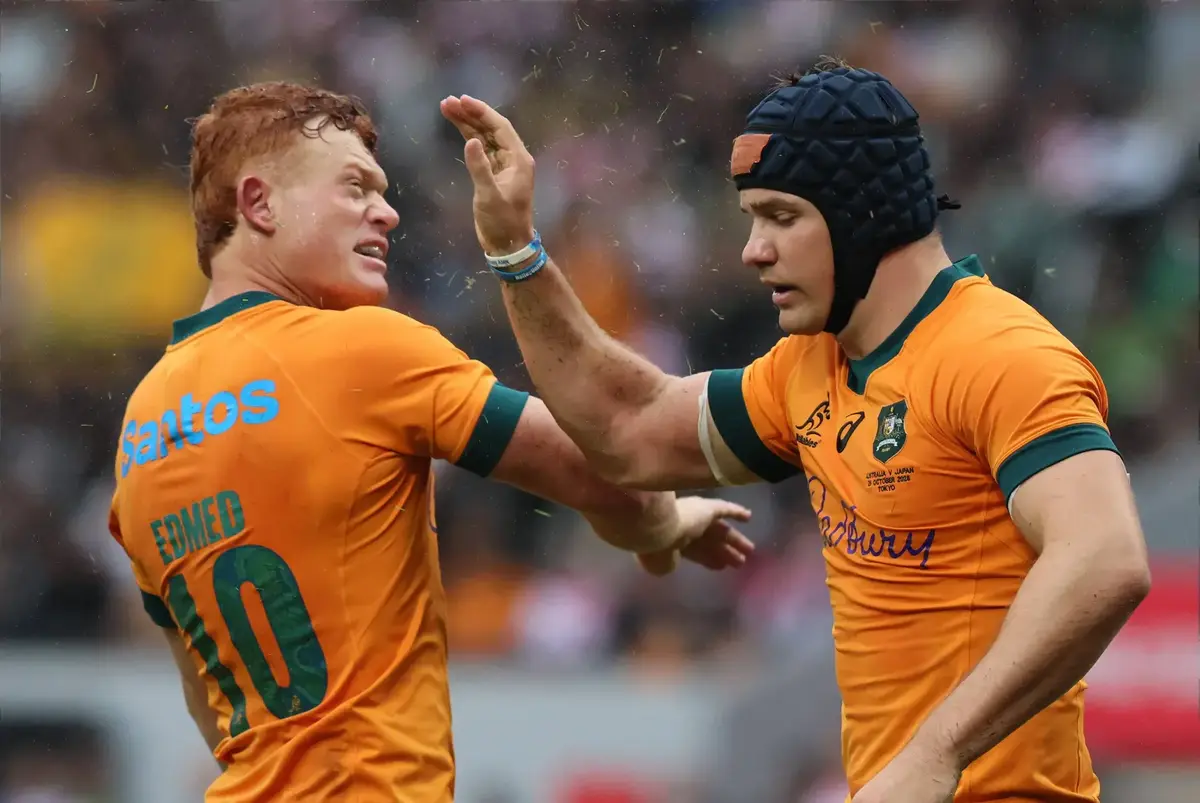
Gordon has been named alongside Tane Edmed as Schmidt’s playmaking options for the Spring Tour, which begins with a Test against Japan in Tokyo on 25 October. The tour also includes matches against England, Italy, Ireland and France. It presents Gordon with the opportunity to reunite with some familiar faces, including working under Schmidt for the first time since the Wallabies coach took over from Eddie Jones. It was Jones who controversially selected Gordon to start at flyhalf during the 2023 World Cup campaign.
Gordon became Wallaby No. 967 when he debuted off the bench against the Springboks at Loftus Versfeld in 2023, making an immediate impression by grubber-kicking ahead, receiving a pass and running more than 60 metres to score a remarkable try. He went on to make three appearances at the World Cup, starting against Georgia and Fiji before coming off the bench against Wales.
However, the tournament proved difficult for both Gordon and the Wallabies. After Australia’s shock defeat to Fiji in Saint-Étienne, where Gordon spilt a box kick that led to Fiji’s only try, he was dropped to the bench and later joined the injury list before the team’s elimination in the pool stages.
Kiss was adamant that Gordon’s versatility will prove valuable for the Reds, noting that the playmaker can operate at flyhalf, inside centre and fullback – positions where all of Queensland’s options can also play. “If you look at all our tens, they give something different, and that’s a real plus for us as well, and they can all play 12, and they can all play 15, which is fantastic,” Kiss said. “In every Super Rugby Pacific season, there are challenges with how byes are placed and travel periods. Increasing depth across our squad is definitely helpful.”
For Waugh and Rugby Australia, Gordon’s return represents a significant coup in their strategic approach to the 2027 World Cup cycle. With the tournament to be hosted on home soil, having Gordon back in the system provides crucial depth and competition in the crucial flyhalf position. “Rugby Australia has taken a strategic approach to player contracting this World Cup cycle and we are delighted to bring Carter back into the system,” Waugh said.





 United Rugby Championship2 weeks ago
 United Rugby Championship1 week ago
 United Rugby Championship2 weeks ago
 United Rugby Championship2 days ago
 United Rugby Championship2 weeks ago
 Champions Cup2 weeks ago
 United Rugby Championship5 days ago
 Champions Cup2 weeks ago